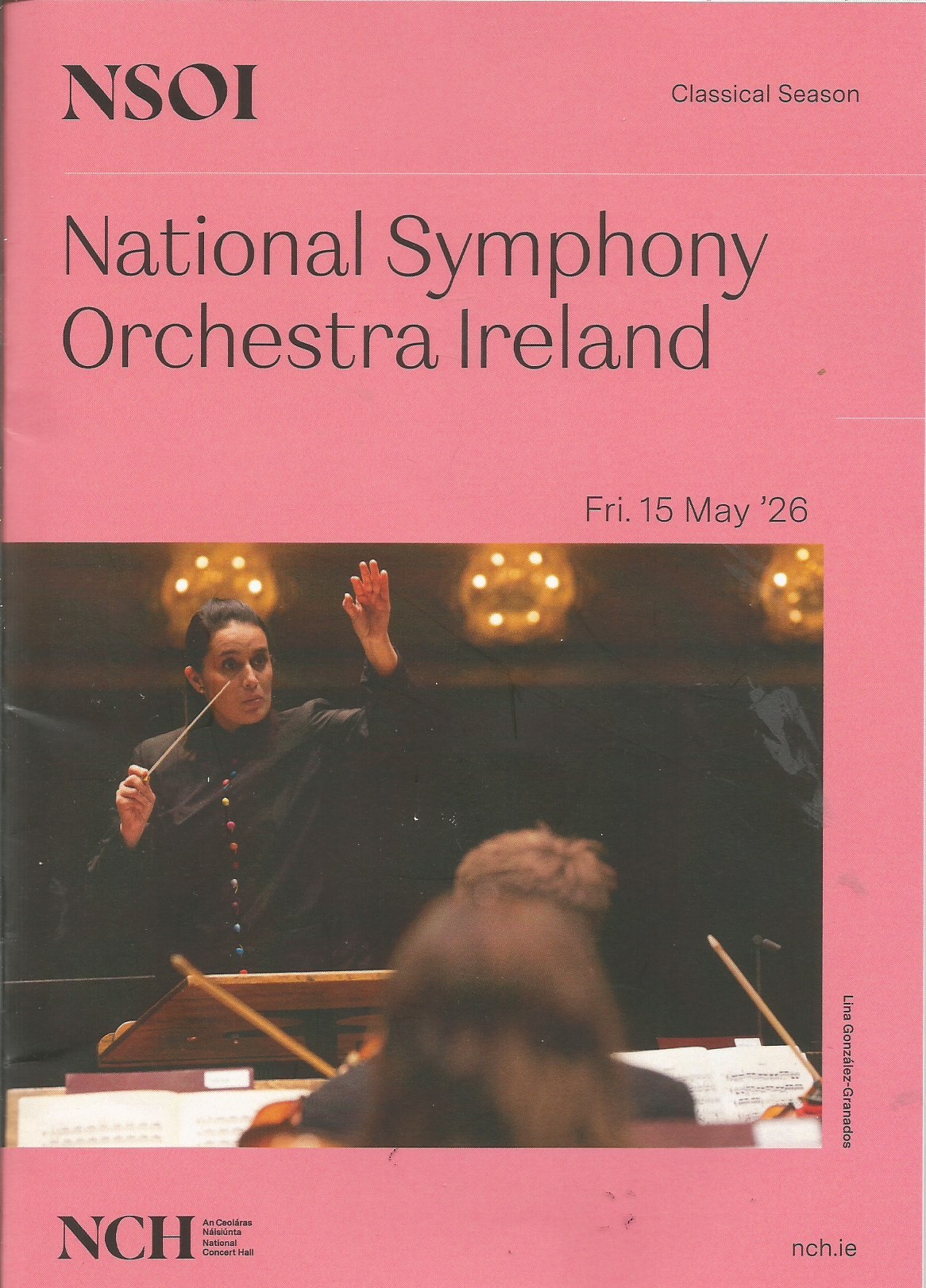
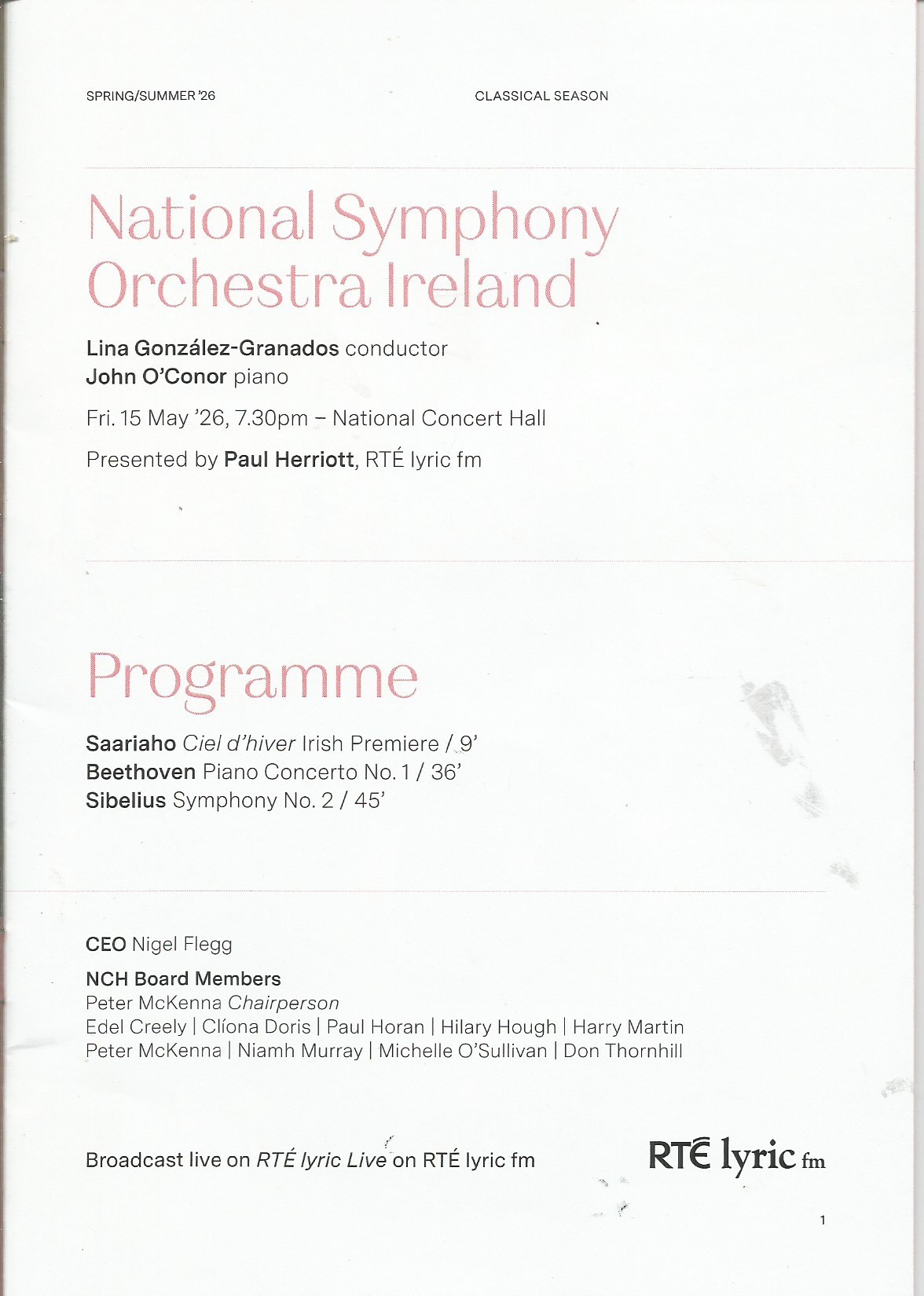
And so it came to pass that yesterday evening I took the train into Dublin and back to see what, for me, will be the penultimate concert by National Symphony Orchestra Ireland at the National Concert Hall. The conductor for this occasion was Colombian born Lina Gonzalez-Granados. There was a good crowd at the NCH, although it wasn’t quite full.
By way of a starter we heard Ciel d’hiver by Kaija Saariaho, a Finnish composer who spent her later life living in Paris; she passed away in 2023. This piece is an intriguing evocation of the winter sky, with dense blocks of harmonies suggesting the broad expanse of the heavens punctuated by drifting clusters of fragmented patterns until it reaches the zenith expressed by an intense climax before fading away again. This piece was new to me – it was in fact the Irish premier – and I enjoyed it greatly. I like it when there are unfamiliar items on the menu!
The rest of the first half of the concert consisted of Beethoven’s Piano Concerto No. 1 (in C) with soloist John O’Conor. This was first published in 1795 (but revised around 1800). It actually Beethoven’s third go at writing a piano concerto but was published first. His first attempt was written when he was a teenager and was never published. What we now know as the Piano Concerto No. 2 was written around 1788 but not published until 1801. I hope this clarifies the situation.
The Piano Concrto No. 1 consists of three movements, an expansive slow movement (marked Largo) sandwiched between two sprightly up-tempo movements, marked Allegro con brio and Rondo-Allegro Scherzando, respectively. It’s very obviously influenced by Mozart, but Beethoven’s own voice is very clear too. I think the first part of the last movement, full of energy and wit, is the best part of this work and O’Conor played it with genuine sparkle. His performance was very well received, and he rounded it off with a very familiar charming encore, also by Beethoven, his Für Elise, which O’Conor played for his two granddaughters who were both in the audience last night.
Ludwig van Beethoven washimself by all accounts an extraordinary pianist and I couldn’t help wondering during the interval what he would have sounded like playing his own piano concertos.
After the wine break we returned to hear the Symphony No. 2 in D Major by Jean Sibelius. This piece was written about a century later than the Beethoven Piano Concerto and its sound world is very different, although it does share an overall mood of hope and defiance that you will find in many works by Beethoven. It’s probably this aspect of the work that led to it being co-opted by the Finnish nationalist movement although I don’t think it was written for that purpose.
I had been looking forward to this for quite a while as I had never heard this work performed in a live concert before. Hearing it last night was a revelation, especially because the momentum of the piece was much better controlled than on some recordings I’ve heard. It’s a large piece, in four movements, lasting about 45 minutes altogether. The first movement starts with hesitant figures repeated a number of times by different sections of the orchstra. The second movement is slow and rather mournful in tone but full of great melodic ideas. It is marked Tempo andante, ma rubato and I think how to handle the rubato (deviating from strict tempo) is what some conductors might struggle with: I think it’s supposed to flow naturally, but not wallow or become too turbulent. The third movement starts in a hurry and moves directly into the thrilling Finale. The last movement is full of blazing statements of triumph, as would accompany a hero reaching the end of a perilous journey.
The balance and contrast between the different sections of the orchestra was very well done. I especially enjoyed the playing of the brass instruments which was vigorous but superbly controlled. Hats off to NSOI and to Lina Gonzalez-Granados for the performance. I found myself humming pieces of the Sibelius to myself as I walked back to Pearse station for the train back to Maynooth.
P.S. I must get a better recording of the Symphony No. 2 by Jean Sibelius for my collection – does anyone out there have any suggestions?