Euclid on Sky
I haven’t posted much recently about the European Space Agency’s Euclid Mission but I’ve got an excuse to remedy that today as I’ve just seen that the Special Issue of Astronomy & Astrophysics called Euclid on Sky has at last been published (with a date of 30th April 2025). This contains the main mission and instrument overview papers as well as scientific papers relating to the Early Release Observations. All the individual papers have been on arXiv for some time already.
You can access the Special Issue here.
The main mission overview paper has 1139 authors (including yours truly); that’s definitely the longest author list I’ve ever been on! The arXiv version has been available for almost a year and has already got 254 citations. Here is the abstract:
The current standard model of cosmology successfully describes a variety of measurements, but the nature of its main ingredients, dark matter and dark energy, remains unknown. Euclid is a medium-class mission in the Cosmic Vision 2015-2025 programme of the European Space Agency (ESA) that will provide high-resolution optical imaging, as well as near-infrared imaging and spectroscopy, over about 14,000 deg^2 of extragalactic sky. In addition to accurate weak lensing and clustering measurements that probe structure formation over half of the age of the Universe, its primary probes for cosmology, these exquisite data will enable a wide range of science. This paper provides a high-level overview of the mission, summarising the survey characteristics, the various data-processing steps, and data products. We also highlight the main science objectives and expected performance.
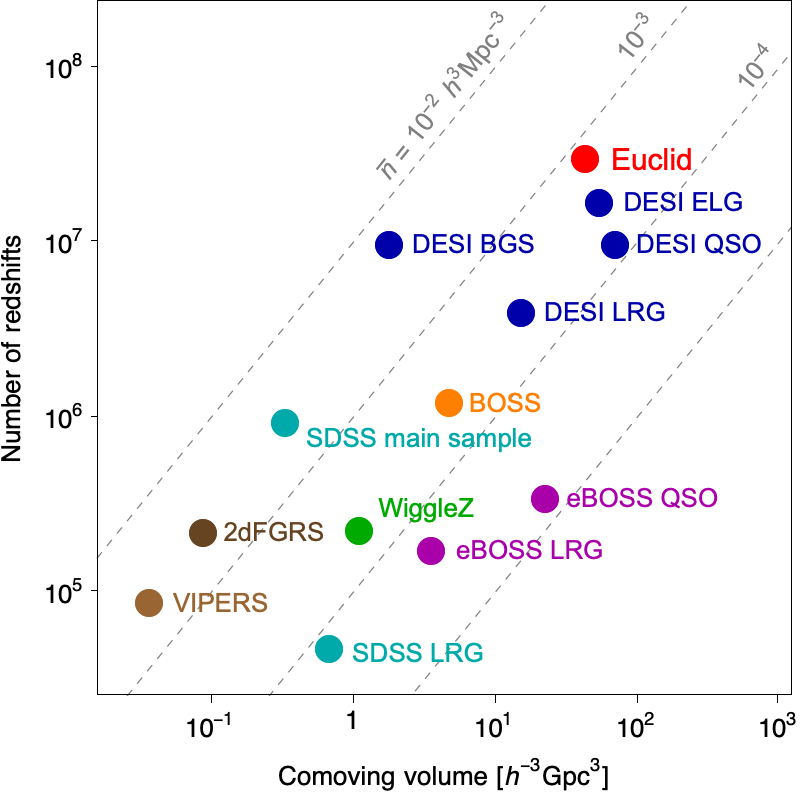
Here’s Figure 1.
 In the Dark
May 2, 2025 at 8:43 pm
I signed that paper too. But unfortunately it seems we both missed an error, as the DESI numbers on this plot don’t look right. It has about 4M LRGs, 10M BGS, 10M QSO, 15M ELG. In DESI DR1, which is 1/5 of the full survey, the actual numbers are 2.8M, 6.3M, 1.3M, 3.9M. So the LRG numbers in particular are too low, by about a factor 3. The full DESI will have about 50M redshifts in total – substantially more than Euclid, which is not the impression given by this plot.
May 2, 2025 at 8:47 pm
I missed that. But then I was never any good with figures.