Archive for Euclid Early Release Observations

Euclid, Gravitational Lensing, and Dark Matter

Posted in Euclid, The Universe and Stuff with tags , , on June 11, 2026 by telescoper

I’ve been slow onto a result which was announced last week concerning the detection weak gravitational lensing in the cluster Abell 2390 by the Euclid spacecraft and its use to determine the distribution of dark matter in the cluster. You can find a full discussion of the result here and the scientific paper is here.

The analysis was based on Early Release Observations of the cluster, a pretty picture of which are shown here:
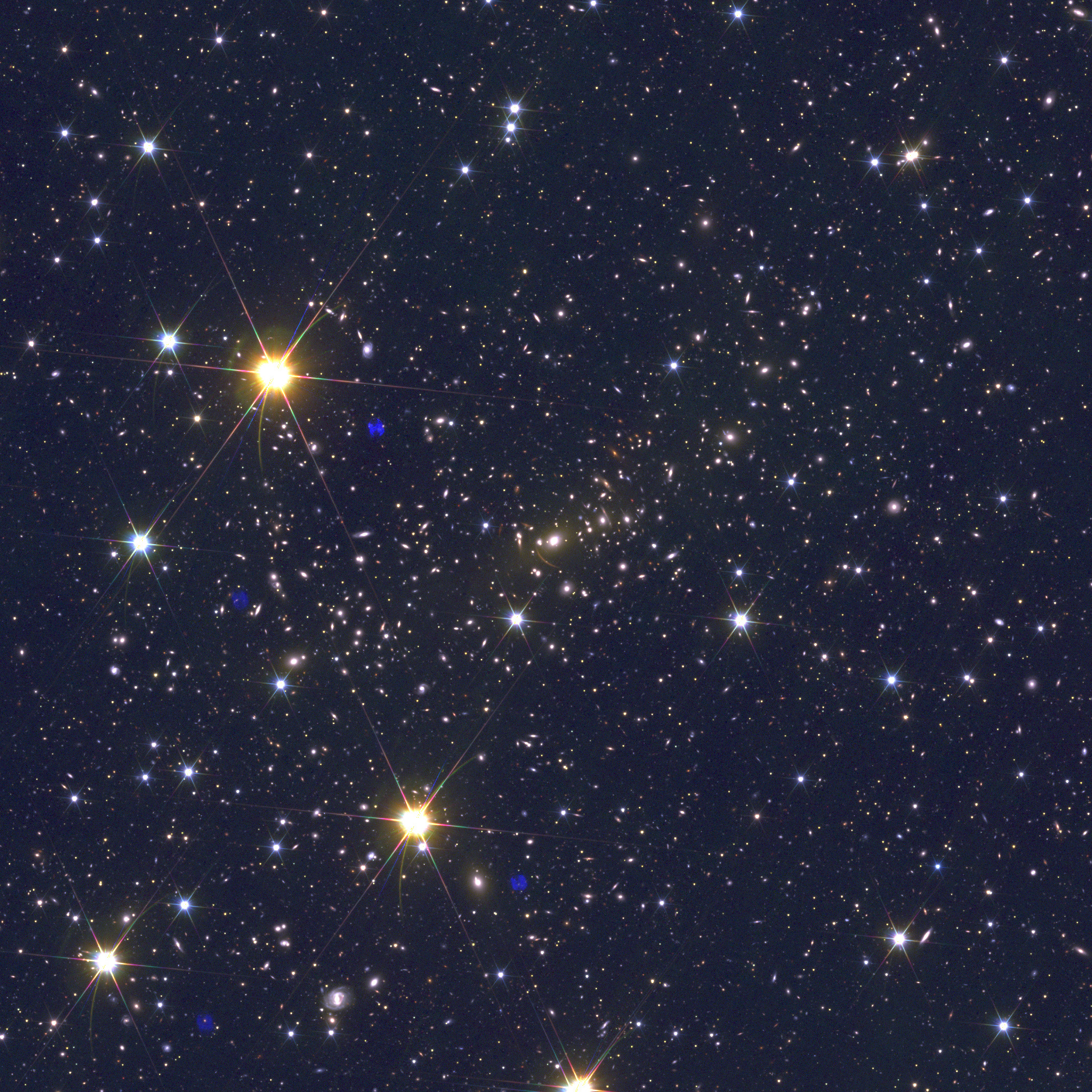
Credit: ESA/Euclid/Euclid Consortium/NASA, image processing by J.-C. Cuillandre (CEA Paris-Saclay), G. Anselmi.

(The little blue patches are artefacts caused by internal reflections in the VIS instrument and can be dealt with in software.)

According to general relativity, the presence of any mass bends the path of light passing near it, producing gravitational lensing. The most famous examples of this are the giant arcs and multiple images associated with strong gravitational lensing, but these are very rare as they require good alignment between observer, lens and source.. Most lines of sight in the universe do not satisfy this condition so are in the weak lensing regime. Even in such cases, however, the presence of the foreground mass can be detected, by way of a systematic alignment in the orientation of background sources around the lensing mass. A circular background image would be distorted into an ellipse by this process. Unfortunately galaxies aren’t circular but are approximately elliptical, so the shape of each source is changed from an ellipse to differently shaped ellipse. The distortion is therefore impossible to detect in a single background source because we don’t know the intrinsic orientation of the galaxy, but the distortion of different sources is correlated in a particular way. Weak gravitational lensing is thus an intrinsically statistical measurement, but it provides a way to measure the masses of astronomical objects without requiring assumptions about their composition or dynamical state. Weak gravitational lensing observations are, however technically difficult to carry out and analyse, as one has to be very careful that no correlations are introduced by systematic errors in the optics.

Anyway, they say that a picture paints a thousand words so here are two pictures. On the left we see the shear axes as extracted from the above image and on the right the inferred dark matter distribution. You can slide the bar backwards and forwards to see how the two images relate.
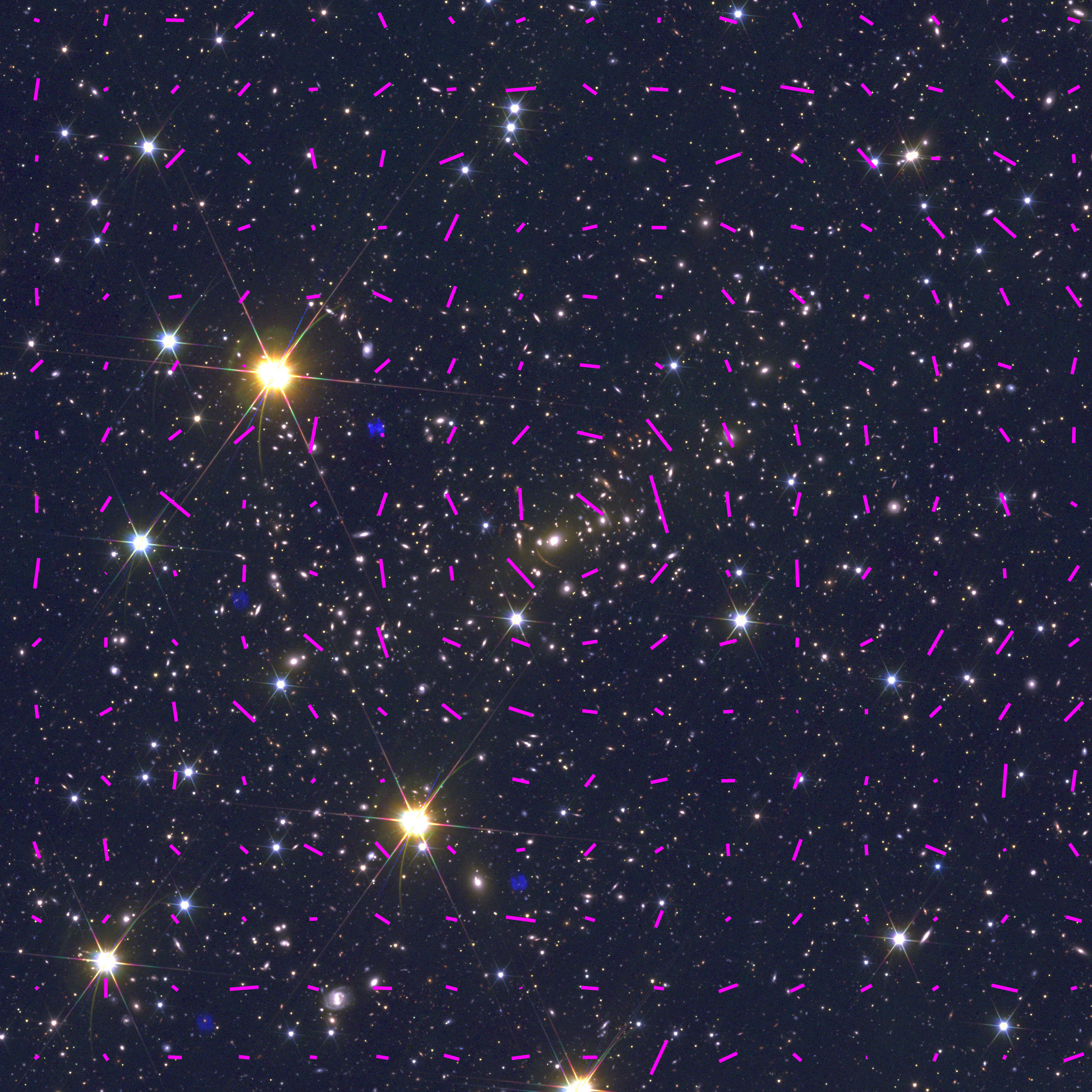
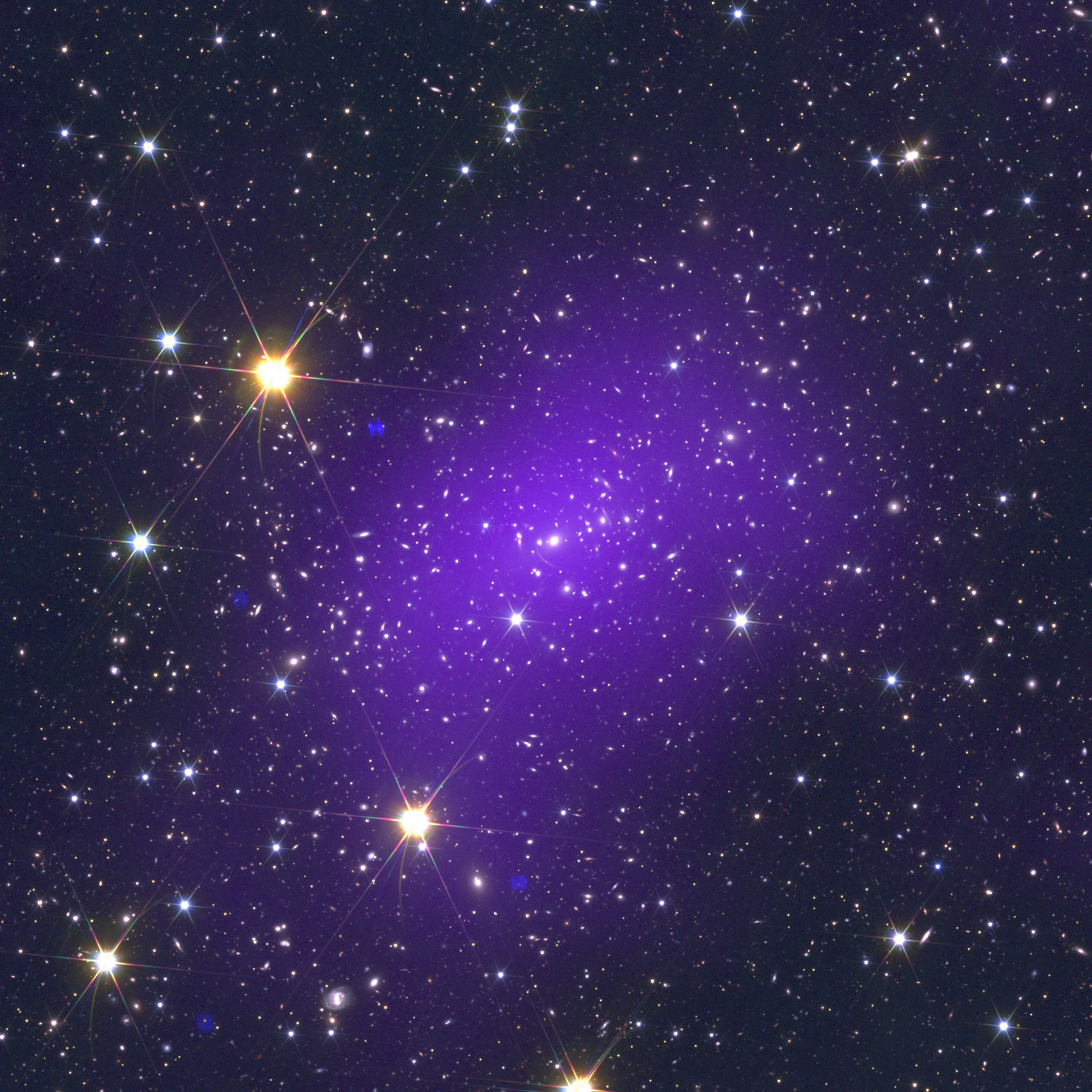
Shear map (left) and inferred dark matter distribution (right)

You can see that the shear tends to be aligned tangentially to a line connecting the image to the cluster centre (in the plane of the sky), which is what theory would predict.

There’ll be much more of this sort of analysis in the full Euclid Survey. I hope to be able to give an update about this reasonably soon.
Euclid on Sky

Posted in Euclid, The Universe and Stuff with tags , , , on May 2, 2025 by telescoper

I haven’t posted much recently about the European Space Agency’s Euclid Mission but I’ve got an excuse to remedy that today as I’ve just seen that the Special Issue of Astronomy & Astrophysics called Euclid on Sky has at last been published (with a date of 30th April 2025). This contains the main mission and instrument overview papers as well as scientific papers relating to the Early Release Observations. All the individual papers have been on arXiv for some time already.

You can access the Special Issue here.

The main mission overview paper has 1139 authors (including yours truly); that’s definitely the longest author list I’ve ever been on! The arXiv version has been available for almost a year and has already got 254 citations. Here is the abstract:

The current standard model of cosmology successfully describes a variety of measurements, but the nature of its main ingredients, dark matter and dark energy, remains unknown. Euclid is a medium-class mission in the Cosmic Vision 2015-2025 programme of the European Space Agency (ESA) that will provide high-resolution optical imaging, as well as near-infrared imaging and spectroscopy, over about 14,000 deg^2 of extragalactic sky. In addition to accurate weak lensing and clustering measurements that probe structure formation over half of the age of the Universe, its primary probes for cosmology, these exquisite data will enable a wide range of science. This paper provides a high-level overview of the mission, summarising the survey characteristics, the various data-processing steps, and data products. We also highlight the main science objectives and expected performance.

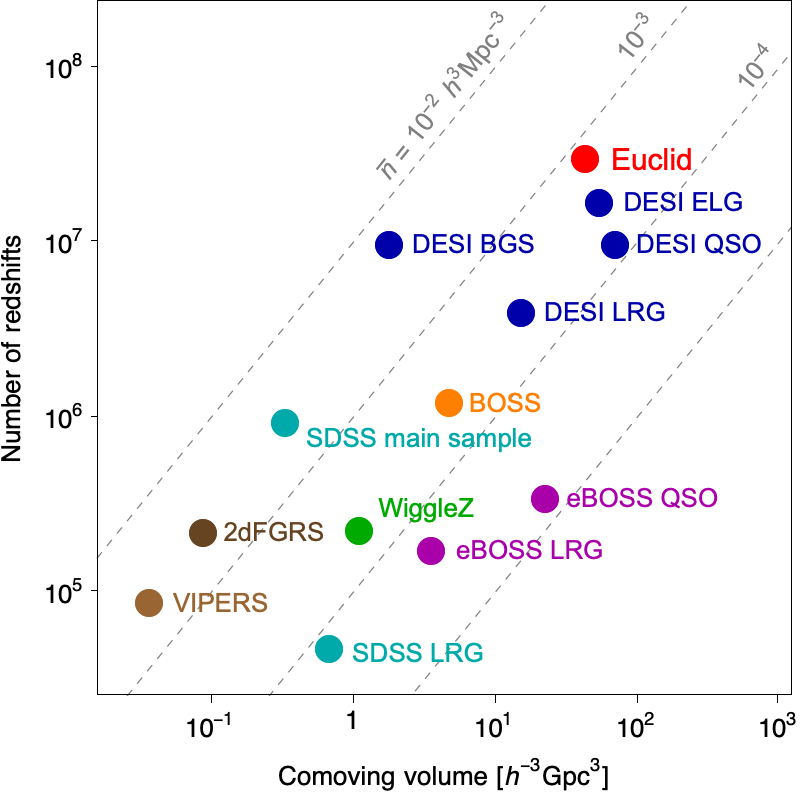
Here’s Figure 1.

Two More Euclid ERO videos

Posted in Euclid, Football with tags , , , , on July 1, 2024 by telescoper

I’ve been a bit busy catching up on things since my departure from Barcelona with the result that I almost forgot to post anything today. Fortunately there are two more Euclid Early Release Observations I can share to fill the gap. They’re about 4 minutes apiece, so there’ll be plenty time to watch them while waiting for the VAR operators to make an offside decision during the next European Championship match…

The first is entitled Measuring Luminosity Function for the Perseus Cluster of Galaxies using Euclid ERO data:

The article describing this work can be found on arXiv here; it perhaps makes up for the missing article in the title of the video.

The second one is this, about gravitational lensing and the search for high-redshift galaxies:

The paper for this one can be found on arXiv here.