Lá Saoire i mí Mheitheamh
It’s a Bank Holiday Monday here in Ireland, which makes for a nice end-of-term break for some of us. Not all staff had exams early enough to finish in time like I did, however, and no doubt some had to spend the weekend marking exam scripts. I am fortunate to have been able to accomplish everything I intended over the weekend – nothing at all – and today I’ll be able to recover from that exertion.
The June Bank Holiday (Lá Saoire i mí Mheitheamh) in Ireland is the equivalent of last week’s late May Bank Holiday in the UK, in that both have their origin in the old festival of Whitsuntide (or Pentecost) which falls on the 7th Sunday after Easter. Because the date of Easter moves around in the calendar so does Whit Sunday, but it is always in late May or early June; this year it falls on Sunday 8th June.
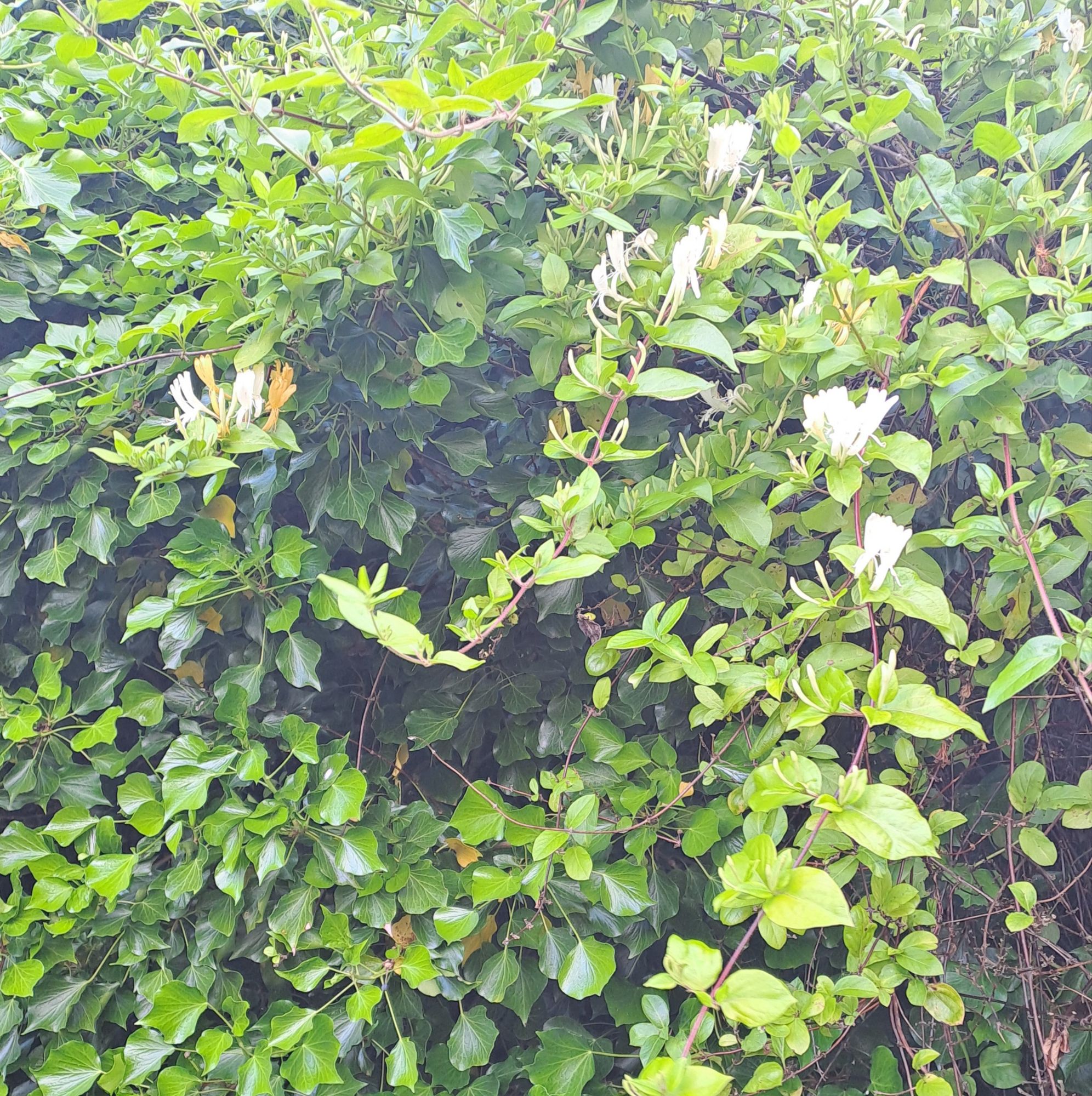
As if in celebration, the honeysuckle in my garden has started to flower:
The day after Pentecost was traditionally a holiday known as Pentecost Monday or Whit Monday. This enabled people to attend extra church services and organize local fairs and cultural events. Pentecost Monday became a public holiday in Ireland following the Bank Holidays Act 1871 which applied before Ireland became independent. Following the Holidays (Employees) Act 1973, this holiday was moved to the First Monday of June. This new date was first observed in 1974. This is why
we have the first Monday in June off work instead of the last Monday in May.
Although I’m only at beginners’ level in Irish, the phrase Lá Saoire i mí Mheitheamh gives me a chance to bore you about it. It’s actually quite a straightforward phrase until you reach the last word. “Lá” means “day” and “Saoire” means “leave” or “vacation” so “Lá Saoire” means “holiday”; “i” is a prepositional pronoun meaning “in” and “mí” means “month”. So far so good.
The word for June, however, is Meitheamh (at least when it is in the nominative singular case). Irish is an inflected language, which means that words change form according to their grammatical function. As an Indo-European language, Irish is distantly related to Latin which has six grammatical cases for nouns (actually seven if you count the rarely used locative case). Irish has only four cases – there’s no ablative and, curiously, no distinction between nominative and accusative. That leaves nominative, dative, genitive, and vocative. The dative – used after simple prepositions – is only rarely distinct from the nominative so basically the ones you have to learn are the genitive and the vocative.
In Latin cases are indicated by changes to the end of a word, but in Irish they involve initial mutations. In the example of “mí Mheitheamh” meaning “month of June”, requiring the genitive form of “June”, the initial consonant “M” undergoes lenition (softening) to sound more like a “v”. In old Irish texts this would be indicated by a dot over the M but in modern orthography it is indicated by writing an “h” after the consonant. This is called a séimhiú (pronounced “shay-voo” ). Note the softened m in the middle of that word too but it’s not a mutation – it’s just part of the regular spelling of the word, as is the -mh at the end of Meitheamh. There’s also a softened “t” in the middle of Meitheamh which makes it vrtually disappear in pronunciation. Meitheamh is thus pronounced something like “Meh-hiv” whereas “Mheitheamh” is something like “Veh-hiv”.
Gheobhaidh mé mo chóta…
 In the Dark
Leave a comment