Star of the Sea, by Joseph O’Connor
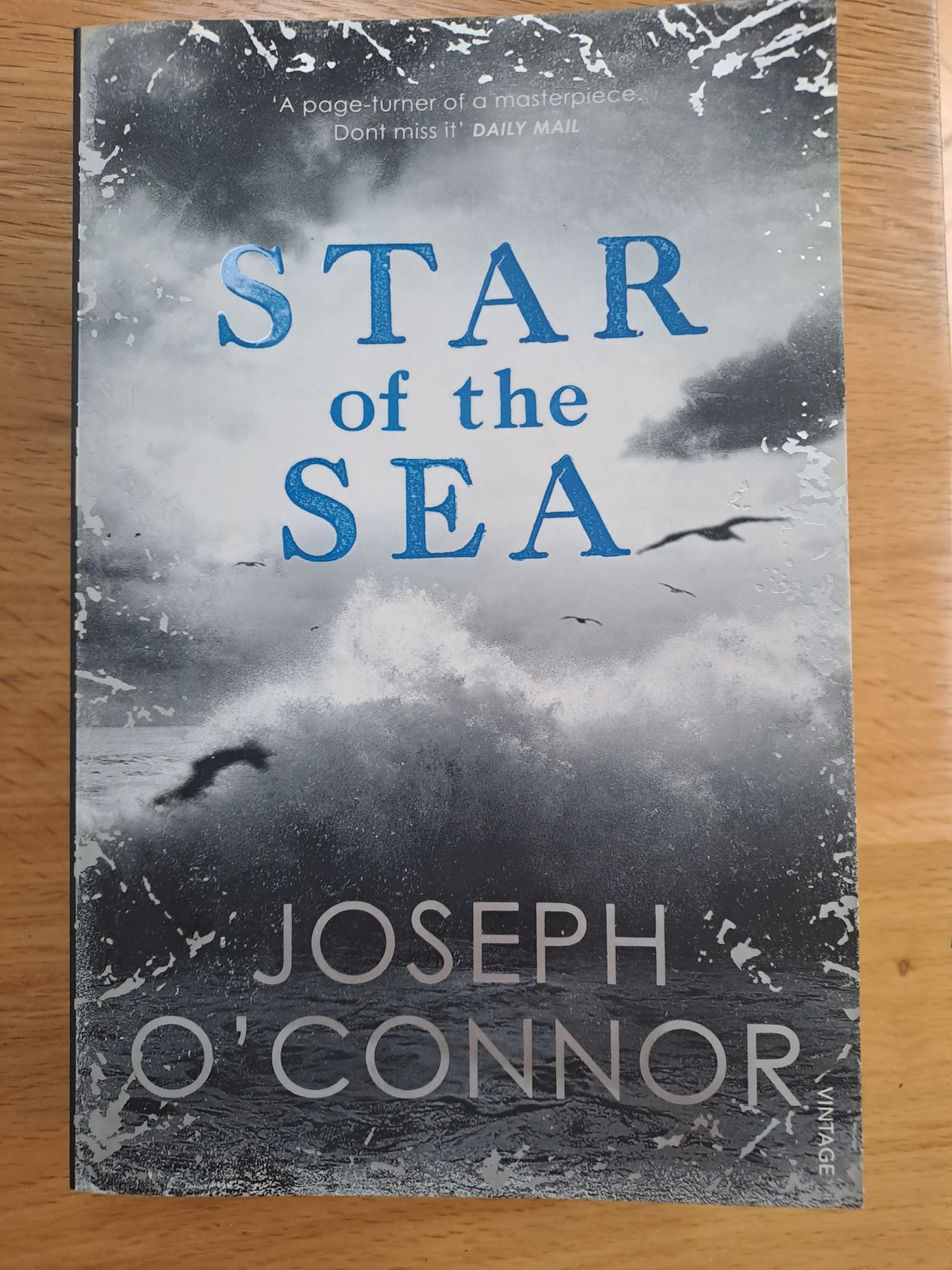
After the excitement of today’s Hurling Final, I finished the second of the six novels I bought earlier this year. Star of the Sea by Joseph O’Connor is set in 1847 and onboard the ship that gives the novel its name, bound for New York from Ireland, carrying desperate passengers fleeing the Great Famine, which provides the overall context for the story.
It’s worth quoting a couple of paragraphs from the author’s introduction to the novel:
We tourists take pleasure in the emptiness of Connemara. There are reasons why such a silence exists. You would not think, as you amble the sleepy lanes, as you are stilled by the twilight descending on the mountain, that you are walking through a space that was once a disaster zone: the Ground Zero, perhaps, of Victorian Europe. These meadows, those pebbled fields, saw astonishing suffering. There was heroism too; there was extraordinary courage and love. But these wine-dark boglands and rutted boreens witnessed tragedy so immense that those that witnessed it, like Grantley Dixon in my novel, would never forget the sight.
All this happened in the 1840s , that decade in which a million of the Irish underclass died as a consequence of famine. residents of the richest kingdom on earth, they lived only a few hundred miles from the empire’s capital, London. But that did not save them; nothing saved them. Abandoned by the dominant of Ireland and Britain, perhaps two million of the desperate became refugees. We might call them `asylum seekers’ or `economic migrants’. They fled their homeland by any means possible, often on ships like the Star of the Sea. Their language, Gaelic, already in decline virtually disappeared overnight. `Mharbh an gorta achanrud‘, one Gaelic speaker remembered. ‘The famine killed everything’.
O’Connor writes unflinchingly about the effects of famine, the poverty, deprivation and starvation, as well as the squalid rqat-infested conditions the `economic migrants’ were forced to endure on their month-long voyage to America. This in itself is interesting, as it has always seemed to me quite surprising that so few Irish authors have written books about An Gorta Mór. But while the Great Hunger is always present, and is what precipitates most of the action, this book is about many other things besides.
The story begins on Star of the Sea with a mysterious character who is taken to walking the decks at night. We learn very early on that his name is Pius Mulvey and his intention is to commit murder. But who is he to kill, and how, and why? The answer to the last of these questions is revealed through a series of flashbacks that reveal connections between him and several passengers in First Class, including a bankrupt Lord Merridith attempting to escape his creditors, Merridith’s wife and family, an aspiring novelist (the Grantley Dixon mentioned above), and a maidservant (Mary Duane) whose connection to them and to Mulvey is deeply tragic. The narrative is interspersed with excerpts from the log of the ship’s Captain, sundry clippings from contemporary newspapers and magazines, including examples of vile anti-Irish racism from the satirical magazine, Punch, and folk songs of the time. It’s all very carefully and cleverly plotted.
It’s partly a mystery novel, partly a suspense thriller, and partly a social commentary worthy of Dickens (who actually appears in the book, in chapters describing Pius Mulvey’s past life in London). It takes a master story-teller to bring all these elements together convincingly, and that is what Joseph O’Connor clearly is. It is not exactly a whodunnit, but I will nevertheless refrain from posting any spoilers as the ending is very clever (as indeed is the whole book). I’ll just say that I found the whole book immensely satisfying and I recommend it highly, as a novel that has real depth as well as being a true page-turner.
Star of the Sea was published in 2002, and was a best-seller then. It’s taken me too long to discover it. I must read more by Joseph O’Connor, but I have four others on my list to finish first!
 In the Dark
July 20, 2025 at 9:42 pm
Rather different from the Star of the Seas which will enter service next month as the world’s largest passenger ship yet!
July 20, 2025 at 9:47 pm
I certainly hope so. We don’t want daily burials at sea of those dead from hunger and disease.
July 23, 2025 at 7:12 pm
[…] last novel I wrote about was a work of historical fiction, and so is this. Although it is set in the 1980s, that was a time in which social attitudes in […]