Primordial Black Holes in Cosmological Simulations – Update
Just time for a quick update about a paper that I posted about at the start of the summer, when it appeared on arXiv. At that time it had already gained a bit of traction in the media, e.g. here. Well, the paper is now published in the Open Journal of Astrophysics. Obviously, as an author I was conflicted so not involved in the editorial process.
Here is the overlay:
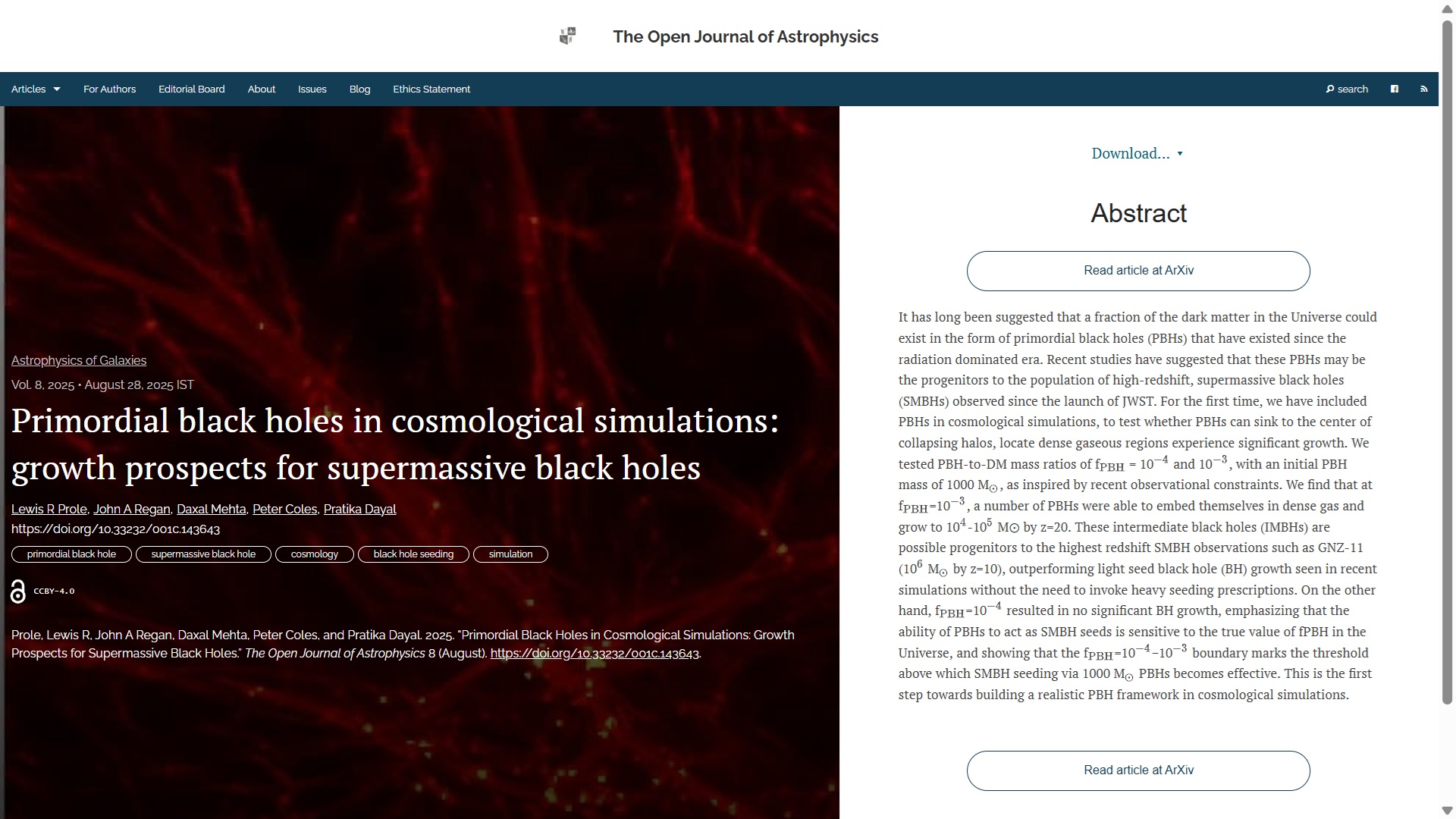
For those of you not in the field, there is currently a big mystery about how galaxies we have found at high redshift with JWST managed to acquire massive black holes so early in the Universe’s evolution. Black holes can grow quickly in a dense environment by accreting mass onto an initial seed, but what are the seeds? In this paper we investigate the possibility that they were primordial black holes. These form directly from fluctuations in the early Universe, as opposed to astrophysical black holes which form from stellar collapse. We don’t know exactly what mass primordial black holes would have nor how numerous they would be, but this paper uses high-resolution numerical experiments to investigate their effects if they do exist.
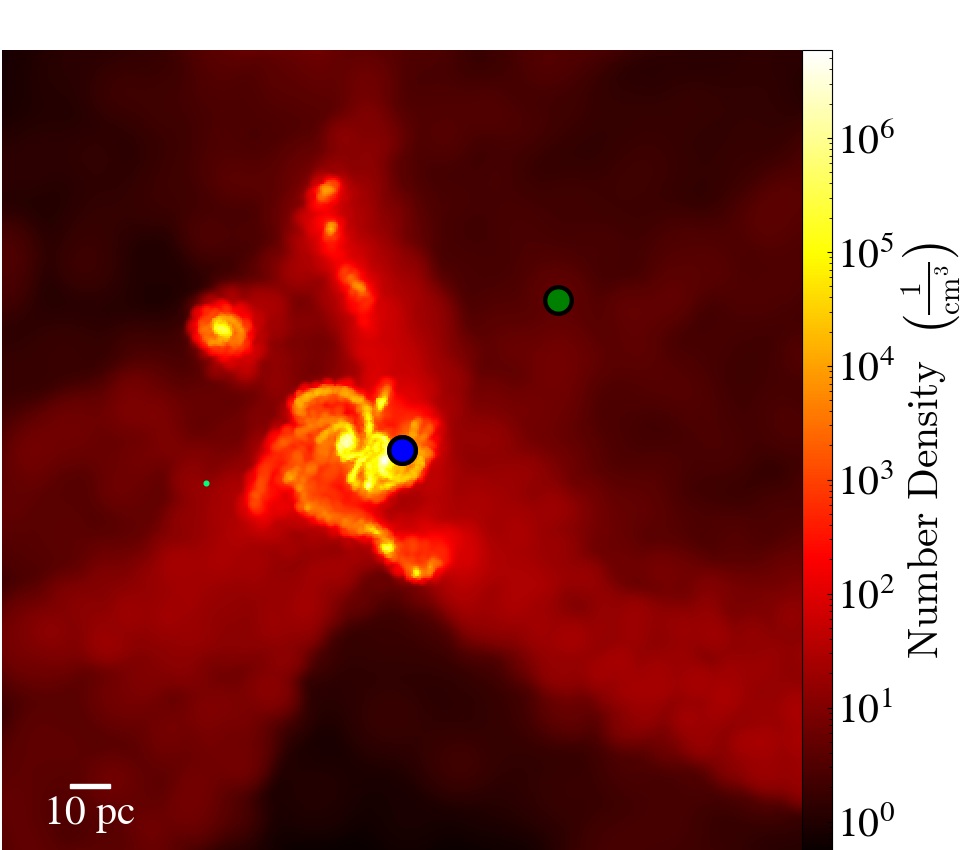
Here’s a pretty picture which is a zoom into 200 pc of the full simulation. I think 10pc counts as high resolution for a cosmological simulation! The blue circle shows the most massive PBH in the simulation, the green circle shows its nearest neighbour. The colour scale represents the number-density of dark matter particles.
For more details, read the paper!
 In the Dark
August 30, 2025 at 2:26 pm
[…] in Astrophysics of Galaxies folder on Thursday 28th August 2025. You can read more about this paper here: basically it studies the growth of primordial black holes in the early Universe using numerical […]