The Nebra Sky Disc
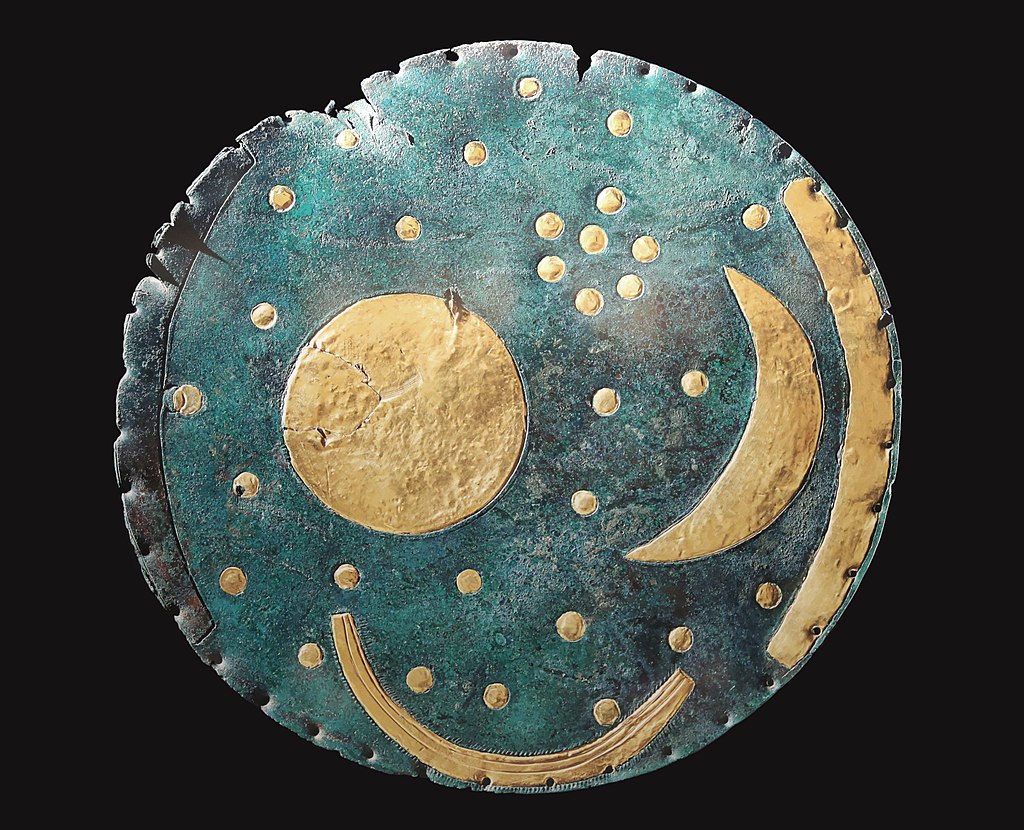
This remarkable object is made of bronze, is around 30 cm diameter and weighs about 2.2 kg. It has a blue-green patina and is inlaid with gold symbols, usually interpreted as the full moon, a lunar crescent, and stars, including a cluster of seven stars, thought to represent the Pleiades. The gold arc on the right probably represents the Sun’s path between the solstices; the angle subtended by the arc (82°) is the correct angle sunrise at the summer and winter solstices and at the latitude of the discovery site (Mittelberg, near Nebra, in Germany); there was probably another such arc on the other side of the disk (now lost). Remarkably, the tin used in making the bronze from which it is formed has been traced by metallurgical analysis to Cornwall.
The Nebra disc has been dated to c. 1800–1600 BCE (Bronze Age) which makes it the oldest (certain) depiction of celestial phenomena known from anywhere in the world. In November 2021, a replica of the Nebra Sky Disc was taken by German astronaut Matthias Maurer to the International Space Station.
 In the Dark
September 24, 2025 at 8:20 pm
[…] vital. It was reading about archaeology in this book that prompted me to write a post about the Nebra Sky Disc. There are some fascinating snippets from palaeogenetics, too. Full DNA sequences are now known for […]
February 23, 2026 at 7:57 am
I suggest reading:
The World of Nebra Sky Disc and Stonehenge: Two Great Exhibitions Inspired by Ancient Sky Lore?
Emília Pásztor
JSA 9.2 (2023) 132–150
February 23, 2026 at 10:40 am
What is the full name of JSA please?
February 23, 2026 at 1:33 pm
Journal of Skyscape Archaeology. I can send you the manuscript if you write me an email address.