Can you make a neutral pion from two photons?
A neutral pion can decay into two photons. It is therefore not unreasonable to ask the question whether the reverse process – the creation of a neutral pion by colliding two photons – is physically possible and, if not, why not? It is perhaps less reasonable to ask an AI bot these questions. One of my colleagues did just that and found it said “no”, giving the following three answers to the “why not?” question:
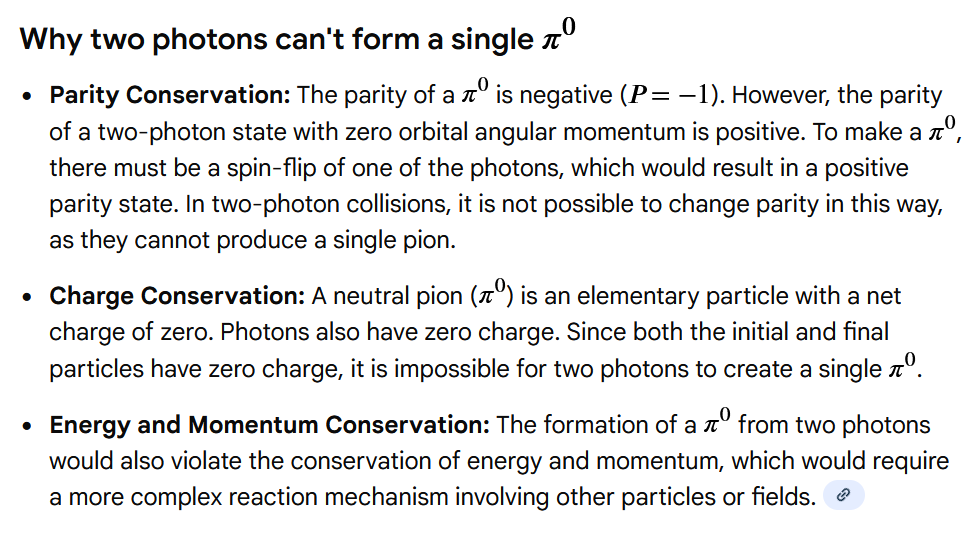
I particularly like the second one.
Would anyone like to offer a correct answer through the comments box?
 In the Dark
November 10, 2025 at 9:32 pm
I can’t imagine why it wouldn’t be possible. In fact, since both photons and neutral pions are their own antiparticles, if I’m not mistaken, CPT invariance says it must be possible.
November 10, 2025 at 9:53 pm
A pion has something that two photons don’t…
November 10, 2025 at 10:17 pm
I’m sure I’m just being stupid (for neither the first nor the last time), but I don’t know what you mean.
Are you referring to mass? Yes, a pion has mass, but who cares? Mass isn’t conserved. As long as total energy of the two photons, in their center-of-momentum frame, matches the pion rest energy, there’s no problem with energy-momentum conservation.
November 11, 2025 at 12:07 pm
No, I didn’t mean (rest) mass.
November 11, 2025 at 1:14 am
I agree with the CPT argument. Take a video of the pion decay and run it backwards so you see a pion being formed. If you spatially invert the picture and replace particles by antiparticles (no change in this case), you are guaranteed to be seeing a valid physical process.
November 11, 2025 at 12:14 pm
I think it’s possible, but hard because the two colliding photons (gamma-rays) would have to have the same polarization state (parallel) as the two emitted photons in the reverse process.
I’m also a bit confused about the fact that the mechanism for the two-photon decay involves the chiral anomaly and I’m not sure that is time-reversible. I plead ignorance on that one.
November 11, 2025 at 3:38 pm
Yes, it’s definitely not easy, perhaps impossible in practice. In addition to what you (Peter) say about polarization, you’ve also got to get the energy / momentum just right: the total energy-momentum vector has to be on the pi0 mass shell (or in other words, in the center-of-momentum frame the total energy has to be exactly* the pion mass.
(*”exactly” means “within the natural line width associated with the pion lifetime”, I guess.)
I confess I’ve forgotten (if indeed I ever knew) what the chiral anomaly is.
November 11, 2025 at 8:32 pm
I tried asking the search engine (DuckDuckGo in this case) the same question, and it said “No” … and cited “telescoper.blog” as its reference.
This is how AI slop propagates.
November 11, 2025 at 8:34 pm
I’m an influencer, you see…
November 26, 2025 at 3:04 pm
FYI the measurement of this process https://arxiv.org/abs/1205.3249
Also when I asked Gemini 3 it correctly pointed to me that despite the question the process is possible and does happen.