Imbolg, St Brigid, and the Quickening of the Year
It is 1st February 2026, which means that today is Imbolc (or Imbolg in modern Irish), an ancient Gaelic festival marking the point halfway between the winter solstice and vernal equinox. In the old pagan calendar, this day is regarded as the first day of spring, as it is roughly the time when the first spring lambs are born, daffodils etc start to appear, and the days get noticeably longer. The name Imbolg may be derived from “i mbolg” meaning “in the belly”, referring to the pregnancy of ewes. This time corresponds to the Welsh Gŵyl Fair y Canhwyllau and is also sometimes called, rather beautifully, The Quickening of the Year. It’s a time for rebirth and renewal after the darkness of winter.
Incidentally, in spoken Irish it is common to place an unstressed vowel sound – often schwa – between certain pairs of consonants, e.g. the name “Colm” is pronounced “Collum”. This extends to Hiberno-English: e.g. many Irish people say “fillum” for “film”. Imbolg is therefore pronounced something like “Imbollig”. In phonology this is called anaptyxis.
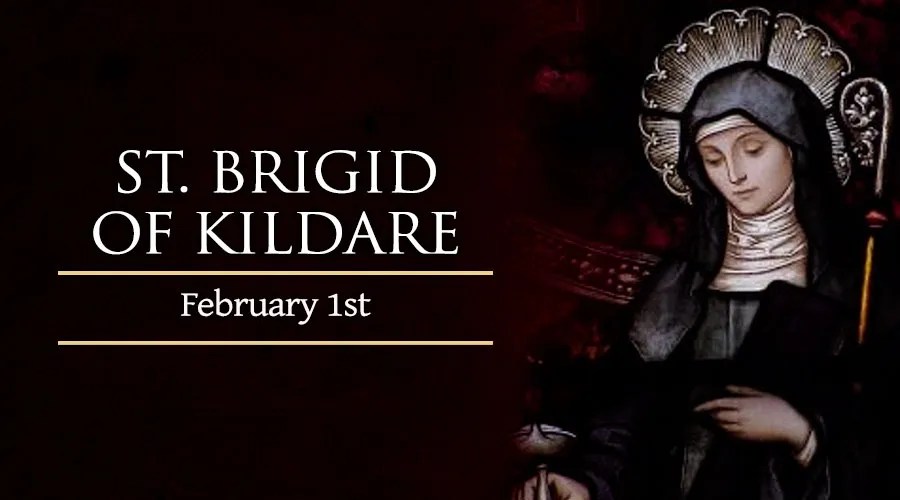
In Ireland Imbolc is usually often referred to a Lá Fhéile Bríde, St Brigid’s Day, after St Brigid of Kildare, whose feast day is today 1st February. There are events going on in Maynooth, which is in Couny Kildare, but I am not in Maynooth today so I don’t know what is going on. Incidentally, the Celts counted each day starting from sunset, so the Imbolc/St Brigid’s Day celebrations in County Kildare started last night, 31st January, but I didn’t see any of them either.
In the Northern hemisphere, in astronomical terms, the solar year is defined by the two solstices (summer, around June 21st, and winter, around December 21st) and the equinoxes (spring, around March 21st, and Autumn, around September 21st). These four events divide the year into four roughly equal parts of about 13 weeks each.
If you divide each of these intervals in two you divide the year into eight pieces of six and a bit weeks each. The dates midway between the astronomical events mentioned above are the cross-quarter days, of which Imbolc is one. They are:
- 1st February: Imbolc (Candlemas)
- 1st May: Beltane (Mayday)
- 1st August: Lughnasadh (Lammas)
- 1st November: Samhain (All Saints Day)
The names I’ve added in italics are taken from the Celtic/neo-Pagan and, in parenthesis the Christian terms, for the cross-quarter days. These timings are rough because the dates of the equinoxes and solstices vary from year to year. Imbolc is often taken to be the 2nd of February (Groundhog Day) and Samhain is sometimes taken to be October 31st, Halloween but hopefully you get the point that although the Pagan festivals have been appropriated by the Christian church, they have much older origins. The status of St Brigid herself is particular obscure; it is not known for sure whether she was a real person or Christian appropriation of a Celtic deity, or some amalgamation of those.
Until recently there was an anomaly in that the first of these was the only one not associated with a Bank Holiday. That was changed in 2022 and tomorrow, Monday 2nd February, will be the St Brigid’s Day holiday. It would have been the first of teaching in Semester 2 had it not been a holiday; we return to teaching on Tuesday. As you may have surmised, I’ve taken the opportunity of the long weekend for a bit of a break and a trip elsewhere.
P.S. As it also happens, today is also the 8th anniversary of the very first lecture I gave in Maynooth, on Computational Physics, on 1st February 2018. I”ll be giving pretty much the same lecture again on Thursday 5th February.
 In the Dark
February 1, 2026 at 12:30 pm
Very interesting.
February 2, 2026 at 11:25 am
Not always. Colm can be pronounced Collum but I also have know people for which its pronounced without the extra vowel.
February 3, 2026 at 10:47 pm
[…] because, of course, 1st February was the first day of […]
March 20, 2026 at 10:01 am
[…] Equinox as the first day of Spring, atlhough round these parts that is taken to be 1st February (Imbolc). Of course in the Southern hemisphere, this is the Autumnal […]