The STFC Funding Crisis – Guest Post by George Efstathiou
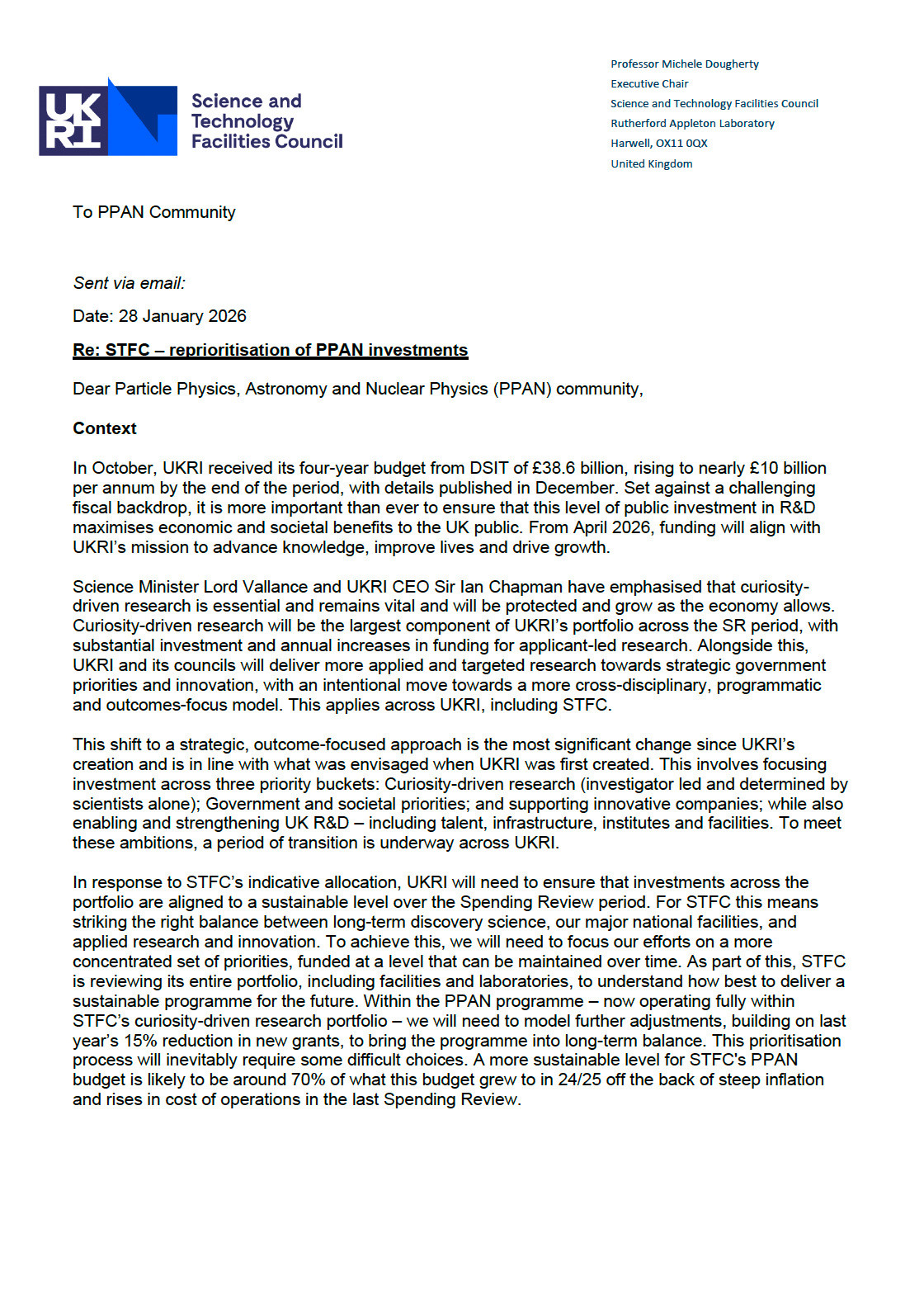
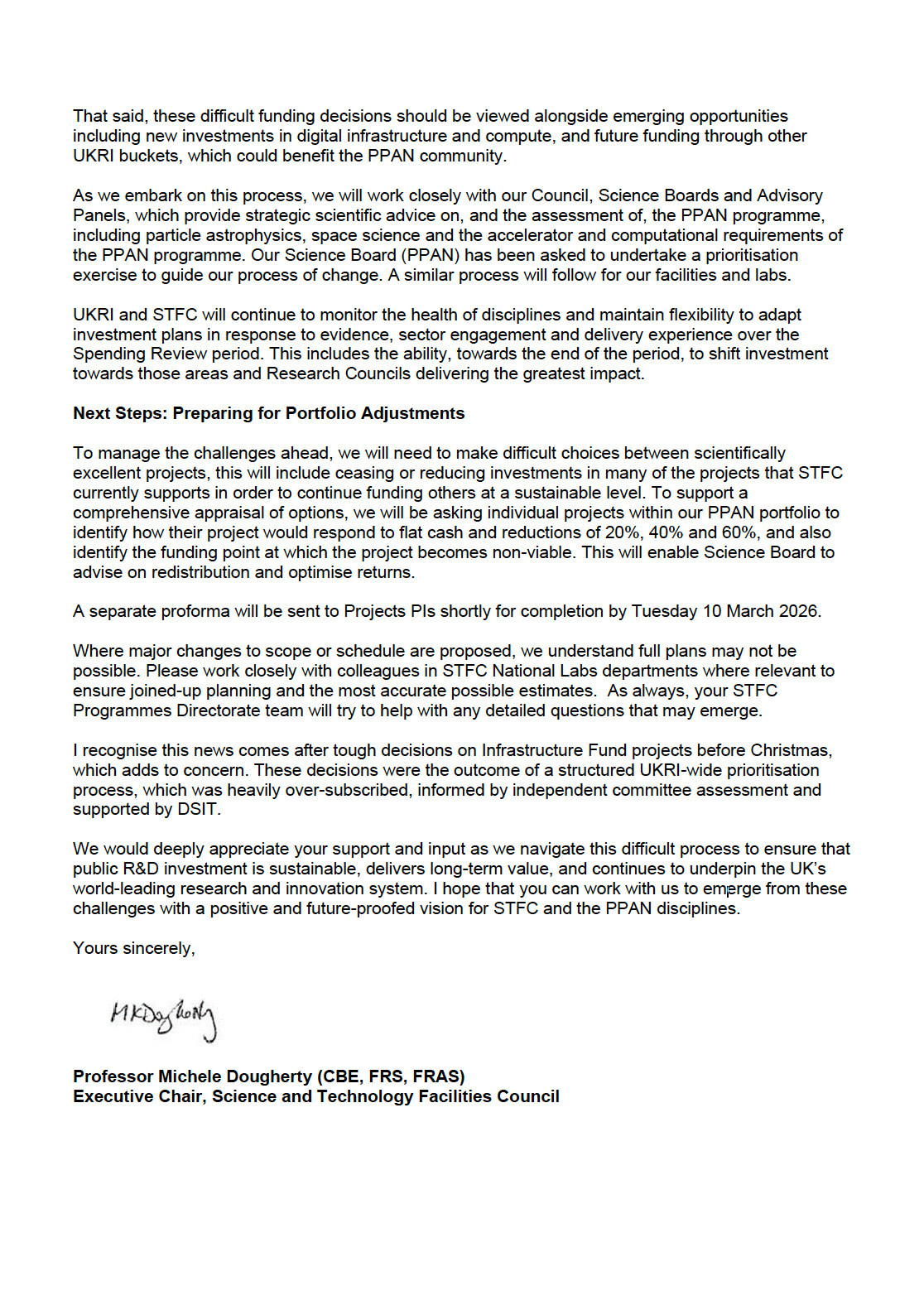
The following guest post by George Efstathiou is a response to the current STFC funding crisis I blogged about here, and specifically to a letter by the Executive Chair of STFC, Professor Michele Dougherty. I include the letter here for completeness:
George’s post follows:
–o–
I am glad that Michele Dougherty has finally communicated the position of STFC to the community. There is a glaring inconsistency between paragraphs 2 and 4 of her letter.
I have just finished a 5 year term on the STFC Science Board and now that the problems are in the public domain I am able to speak freely. In brief, the financial problems at STFC have arisen because of high inflation and high costs of energy against the backdrop of long term flat cash settlements. The national labs/facilities are particularly vulnerable to both. In addition, the labs invested heavily in ambitious upgrades that are now acknowldeged to be unsustainable. However, it is difficult to downsize programmes at the facilities quickly because it takes time to cut staff levels. In fact, money needs to be spent up front to achieve long term reductions in staff levels. From my time on Science Board, I can see no solution given the SR settlement other than for PPAN to take a big cut. Asking for more money from UKRI will likely fall on deaf ears, since the STFC problems are (to a large extent) of their own making.
The problem, as I see it, is whether it is possible for STFC to construct a recovery programme for PPAN science. The impression given in the Dougherty letter is that the ‘bucket’ allocation formula constrains STFC and so they are forced to reduce PPAN expenditure (Bucket 1) at the expense of ‘outcome driven’ growth related expenditure (Bucket 2) which goes mostly to the government labs/facilities. Science board was told that the new allocation formula was to blame for the huge cuts in the PPAN programme. Furthermore, the STFC plan to shift towards ‘growth related’ priorities is envisaged by STFC to lead to a long term cut in PPAN science. This situation was described to Science Board as the ‘new normal’. This is clearly inconsistent with paragraph 2 in Dougherty’s letter, which states that ‘curiosity-driven research will be the largest component of UKRI’s portfolio across the SR period, with substantial investment and annual increases in funding for applicant-led research’.
I discussed this contradiction with Paul Nurse, who told me that Patric Vallance had assured him that funding for basic research would not be cut under the new funding model. This prompted me to write to Michele Dougherty and Grahame Blair asking for clarification on the interpretation of the new funding model by STFC. I did not receive a reply.
This is what I think is going on. I believe that it is the STFC Executive Board that has decided to prioritise the facilities ahead of the PPAN programme. This is their decision and is not forced on them by the new allocation formula. I also believe that the their priorities are a reflection of conflicts of interest in the governance structure of STFC. Decisions at STFC are made by the Executive Board (EB) which is composed mostly of lab/facility directors and senior programme managers. The Council and Science Boards are advisory. The EB is therefore heavily biased in favour of the facilities component of the STFC portfolio. This bias has afflicted STFC since it was first created. I wrote to Michele Dougherty last July concerning the governance structure at STFC. I did not get a reply.
The situation for PPAN science is very serious and I objected to Science Board being used to conduct a ‘prioritisation’ exercise. At these high levels of cuts, decisions depend on many programmatic factors that Science Board cannot judge. Large cuts to key PPAN projects will surely raise questions of whether the UK should continue to pay international subscriptions. In addition, the UK Space Agency is being absorbed into DSIT and there is uncertainty concerning the relationship between UKSA and STFC. We also have the absurd spectacle of deep cuts to PPAN projects running alongside a call for white papers on future space missions.
I would urge the community to ask questions of STFC. It is important, in particular, to extract an answer from Michele Dougherty to the question of ‘how much freedom does STFC have to distribute funds between the three buckets?’. This is pertinent to the issue of whether STFC can construct a recovery plan for PPAN science. I also think that it is worth pursuing questions on the governance of STFC, which are at the heart of the problems.
George Efstathiou FRS
Emeritus Professor of Astrophysics (1909)
Kavli Institute for Cosmology
Madingley Road
Cambridge
 In the Dark
February 6, 2026 at 11:33 am
Nicely explained George. I am glad that someone finally saying out loud that the core problem is one of STFC governance. I will be even blunter. Over many decades, the naming/structures of UK science have continuously evolved, but the Rutherford/Harwell complex has consistently grown and absorbed other organisations. Some years back, we allowed our community to be swallowed by the beast. This has sometimes been useful, being part of a powerful organisation, but now the danger is coming home. We are the sponge to soak up the problems of the national labs. Not sure if that is quite the right metaphor, but you see what I mean. This will be a hard battle to win, because the problems for the labs/facilities are real. So if we successfully argue to protect fundamental research, even decouple it, something somewhere has to crack in the world of Diamond, ISIS etc.
February 6, 2026 at 2:08 pm
If Diamond/ISIS are causing the problem I absolutely should be on the table to shut them down rather than raid PP/Astro grants.
February 6, 2026 at 3:27 pm
Well, that would be unwise and unfair, because it is also about subscription costs rising too. Perhaps reduced service, or trimmed development plans, rather than actual closure. But maybe that has already been considered – I am out of the loop these days.
February 6, 2026 at 3:10 pm
We are the shock absorbers of the system.
We don’t mind paying for cost overruns in our facilities, but it’s patently unfair to make us pay for overruns in facilities we don’t even use.
Surely the councils that actually use the facilities should contribute to overspends?
February 6, 2026 at 3:51 pm
This lines up with thinking elsewhere. The statements from UKRI and from STFC all imply that subscription costs are part of the problem, which needs scrutiny because post Drayson review these are hedged against currency fluctuations. The CERN subscription which is likely to be the largest of these has stayed constant over the previous spending review in 2025 pounds, so inflation is also hard to blame. It sounds like the financial issues are with UK facilities and this is being obfuscated by pointing to ‘external factors’ in order to cover.
February 15, 2026 at 1:38 pm
[…] have been two posts about the STFC funding crisis, first mine at the end of January and then a Guest Post by George Efstathiou which has been shared very […]
February 24, 2026 at 5:43 pm
The nuclear option is a community petition of no confidence in the UKRI chief exec -a trigger to pull only when everything else is exhausted, & it may be ineffective, & it is not without risk, so let’s let our excellent science advisory panels/boards do their work first and take our steer from them.
February 25, 2026 at 11:51 am
Do you think anyone at UKRI will pay attention to such a letter?
They’ve already collectively decided to throw the commnunity under a bus.
February 25, 2026 at 2:39 pm
I don’t agree with ‘collectively’. My impression of the select committee hearing is that the policy choices, and the ‘bucket’ structure, are decisions at the UKRI chief exec level.
The panel/board members I’ve spoken to privately are facing a very difficult job in desperately bad circumstances. These panels exist to be the science community voices. If the news we get from them is that the science communities are having no impact on UKRI’s decision making, and if the situation remains this dire, then that’s the moment for us all to pull the trigger on a no-confidence petition in the UKRI chief exec. In the meantime let’s let them do what they can.
It’s easy to be skeptical that petitions like these can simply be ignored, but they can have consequences as the OU showed in 2018 when it lost confidence in its then VC. But it’s not without risk. Allons enfants de la patrie