Astrophysics Wrapped 2025
An interesting paper has appeared on the arXiv by Lewis, Shah & Alfred with the title Astrophysics Wrapped 2025: Year-in-Review of Every Astrophysics arXiv Paper from 2025 and abstract as follows:
Over the past few years, Astrophysics has experienced an unprecedented increase in research output, as is evident from the year-over-year increase in the number of research papers put onto the arXiv. As a result, keeping up with progress happening outside our respective sub-fields can be exhausting. While it is impossible to be informed on every single aspect of every sub-field, this paper aims to be the next best thing. We present a summary of statistics for every paper uploaded onto the Astrophysics arXiv over the past year – 2025. We analyse a host of metadata ranging from simple metrics like the number of pages and the most used keywords, as well as deeper, more interesting statistics like the distribution of journals to which papers are submitted, the most used telescopes, the most studied astrophysical objects including GW, GRB, FRB events, exoplanets and much more. We also indexed the authors’ affiliations to put into context the global distribution of research and collaboration. Combining this data with the citation information of each paper allows us to understand how influential different papers have been on the progress of the field this year. Overall, these statistics highlight the general current state of the field, the hot topics people are working on and the different research communities across the globe and how they function. We also delve into the costs involved in publications and what it means for the community. We hope that this is helpful for both students and professionals alike to adapt their current trajectories to better benefit the field.
The paper does what is says in the abstract and is well worth reading because it gives some fascinating insights into what’s hot in astrophysics, at least in terms of arXiv submissions which is probably a very good measure of activity because it is a truth universally acknowledged that every paper of interest in astrophysics is on ar|Xiv. I don’t intend to duplicate the whole paper here, as I think you should go and read it yourselves, but will pick out a couple of points.
One, near the start of the paper, is the following:
We begin with some general, overarching statistics from the year. As mentioned before, there were 18660 research papers published this year on the arXiv under the Astrophysics category in comparison to 16333 articles published in 2024. On average, there were 1555 papers per month, or about 72 papers per day, excluding weekends and accounting for the fact that arXiv uploads 5 days a week.
This is a huge level of activity by any standard, especially as it does not include replacements or cross-submissions. As Editor of the Open Journal of Astrophysics it comes as no surprise to learn that the section `Astrophysics of Galaxies’ is the highest submitted primary subject category with 4761 papers submitted over the year and an average of 397 papers per month under this category. Interestingly, ‘Cosmology and Nongalactic Astrophysics’ papers have the highest number of citations across all indices, by some margin, despite having a lower number of papers submitted under this category. This tells us that while there might be fewer papers under this category, these papers are cited more on average, than the papers from any of the other categories. These are the two most popular categories for submissions at OJAp too.
For more interesting data on geographical distribution, citation rates, etc, read the text!
I also want to pick up on an issue mentioned near the end of the abstract, namely the absurd system of funding “Gold” Open Access by Article Processing Charges. Here is a quote:
We estimate the total amount of money spent in publishing to paid journals, assuming every paper is published under Gold Open Access. Our calculation takes into account the publishing fees for different journals, the cost per page where applicable, as well as discounted rates for authors from certain ‘member’ countries for specific journals. In total, we estimate the community spent 17 million USD on publishing fees this year. Counting only the papers that were published and ignoring the zero cost of open source journals, this rounds out to an absolutely ridiculous 2,400 USD per publication. If every astrophysics paper published on the arXiv in 2025 were to be published under the same standards (average cost from the previous calculation applied to every paper), that would mean a total cost of 45 million USD on publishing. These numbers are similar to those obtained in Coles (2025). Astrophysics is, according to our calculations, a multi-million dollar business, but for whom? Certainly not for the people who make it possible. Definitely not for the scientists and not for the general public.
(I added the link to my own post at the OJAp blog which is referred to in the article).
I agree wholeheartedly with the conclusion. The figure of 45 million dollars for the money wasted on APCs is nothing short of a scandal. Why does the astrophysics community put up with being fleeced in this way?
Here is another excerpt:
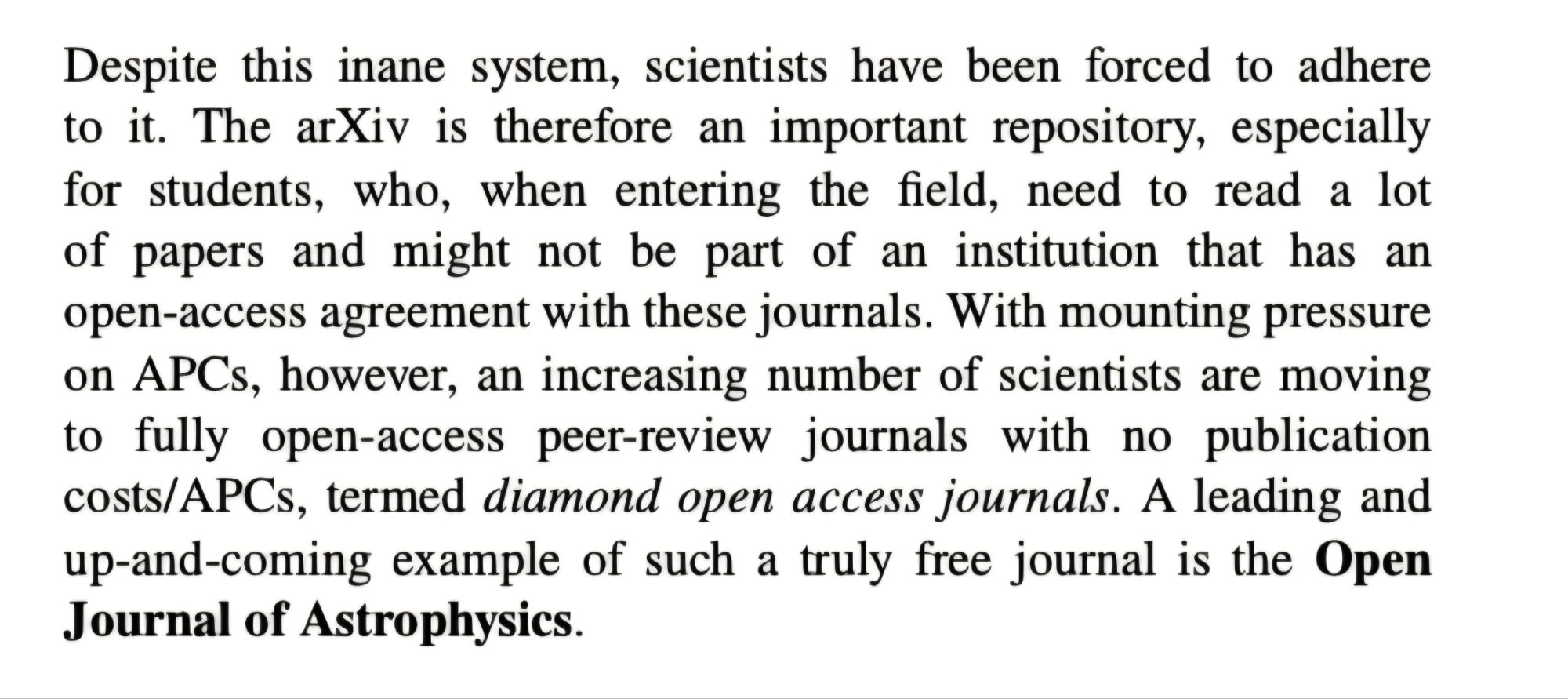
While it is nice to have the Open Journal of Astrophysics singled out for praise, the earlier statistics do put the situation in perspective. In 2025 OJAp published 213 papers using our arXiv overlay model. That’s only just over 1% of the overall arXiv submissions on astro-ph! As a community we need to be publishing via a Diamond Open Acess model by default. Given the scale of the problem The Open Journal of Astrophysics can’t achieve that goal on its own, but at least we’re showing that there is a way forward.
 In the Dark
February 19, 2026 at 9:46 am
Certainly in the UK, with cuts envisaged to astrophysics in STFC, money could be better spent on actual research than providing profits for publishers. However even in the age of DORA we are still ‘trapped’ by the impact factors and reputations of ‘leading journals’.
February 22, 2026 at 2:23 pm
[…] have people who can cover a range of subjects (as some of our existing editors do). As I mentioned here, our most popular area is 1 (Astrophysics of Galaxies) but 2 (Cosmology and NonGalactic […]