A Gulf in the Airspace
So Operation Epstein Furore is in full swing, and already US and Israeli forces have scored some notable successes in the indiscriminate slaughter of civilians – the attack on a school in southern Iran that killed over 150 people, many of them children, stands out so far although it is certain that many more Iranian citizens will be similarly “liberated” (i.e. blown to bits). Trump’s plan is obviously to set the Middle East on fire in order to distract attention from his problems at home.
Anyway, I suddenly realized that it is just about two years to the day since I flew back to Dublin from Sydney where I spent a month during my sabbatical. It was actually 3rd March, not 2nd March, that I boarded the plan bound for Abu Dhabi, but one day is neither here not there (especially when you’re jetlagged). It seems that Iran has been firing drones and missiles at airports around the Gulf so there are no flights in the airspace right now:
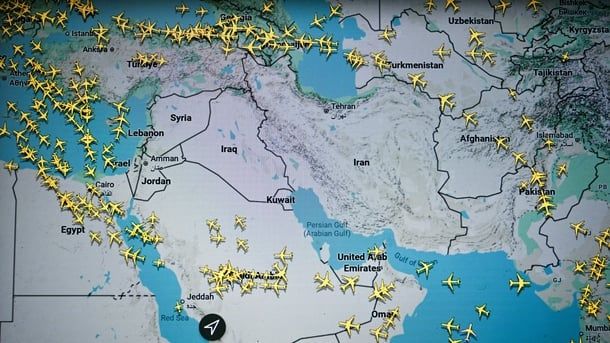
I flew via Etihad, which has suspended commercial flights entirely. Abu Dhabi airport was struck by drones over the weekend, but I don’t think anyone was hurt. I suppose anyone wanting to fly from Sydney to Dublin these days will have to go via Singapore or just stay put. I’ve heard there are around 20,000 Irish people in the Gulf States right now. I hope they stay safe, and the same goes for all civilians caught up in the conflict.
 In the Dark
March 3, 2026 at 7:37 am
For me as an Iranian “expat”, the hardest part to swallow is the fact that my people are dancing and thanking Trump and Israel for the attack (Mostly on streets of LA and Frankfurt and whatnot). Don’t know how long it will take for Iranians to accept they are just as human as the Arabs they hate so much, just as vulnerable to bombs and let themselves go and allow themselves to mourn the pains of war, instead of being in this constant state of denial.
March 3, 2026 at 10:01 am
The question is whether Iranians there can organise themselves to get a decent government in place to replace the present one. I hope so; this is a great people with a remarkable history. Just as Greece gave the conquering Romans a higher culture, so Persia gave one to the Arab conquerors who replaced Zoroastrianism with Islam, and the Abbasid era was one of high cultural achievement. I would love to visit Iran and I wish it well.
The Arab Spring was based largely on an Arabic translation of a remarkable book, ‘From dictatorship to democracy’ by Gene Sharp. The author wrote a doctoral thesis a generation ago about non-violent resistance movements that achieved their ends, and then distilled this how-to manual from it. It worked, but the problem was that there was no tradition of wider government in Arab lands to draw on after the regimes had been overthrown. Sharp says that violence is the State’s strong suit, so don’t resort to violence. This requires discipline and courage, but it can be done. I hope that Farsi translations are circulating widely. It is easy to find online.
March 3, 2026 at 10:35 am
Unfortunately, I think the very problem with the Iranian mindset right now is summarized in your first paragraph. Living in a dream of a “great past” forever and ever, to the point, the biggest opposition movement has become a literal race-supremacist crowd that wants to bring back a monarch to Iran to restore the great and true Aryan culture (funny, right? 21st century and peasants protesting to bring back the King) and begs Americans to please bomb their country in front of the US embassies all over the world.
From what I see (and unfortunately, I see a lot of well-educated and smart people) the majority of, at least, Iranian diaspora is far from picking up a book about political movements, contemplating about ideas and consequences, and having an actual plan about personal and collective change that results in a meaningful change of the system right now. My hope is that the diaspora does not represent the majority of Iranians inside the country, or that I am a complete fool! Either of the two will do!
March 3, 2026 at 1:14 pm
The key to a successful regime is neither democracy (impossible in any case where all parties won’t abide peaceably by acceptance of an electoral result) nor an enlightened absolute monarch (who might at any time be replaced by an unenlightened one). The key is rather a regime that is inclusive, meaning that virtuous circles are set up of innovation, economic expansion and more widely-held wealth – meaning in practice a broad middle class. This involves in particular stable property rights and enforceable contract law. The alternative is an extractive regime that is run by its aristocracy to gouge as much as it can out of everybody else. I take this terminology from the excellent book “Why nations fail” by Daron Acemoglu and James Robinson, which sets out the historical, economic and political analyses for which they won the 2024 Nobel Prize in economics (one of its better years). A monarchy is one such way provided that it is a constitutional one. I hope Iran can become an inclusive regime.
March 3, 2026 at 4:36 pm
Thanks for the book suggestion! I might have read it, I am not sure!
I understand your argument about monarchies being one such example. I am not sure how closely you follow the specific guy and movement I am talking about, but I don’t think he has the capacity to fall under that category you have in mind, regardless of whether or not I agree with this form of a “successful system”.
Anyway, discussing these and clearing things up and having follow up arguments would probably require hours of back-and-forth and is out of the scope of a comment section on a blog 😛
All I hope for now is that not so many people suffer.
March 3, 2026 at 4:55 pm
I think you are referring to the late Shah’s son. I know nothing about him and in referring to Sharp’s remarkable book I was speaking generally.