On Pedantry, by Arnoud S.Q. Visser
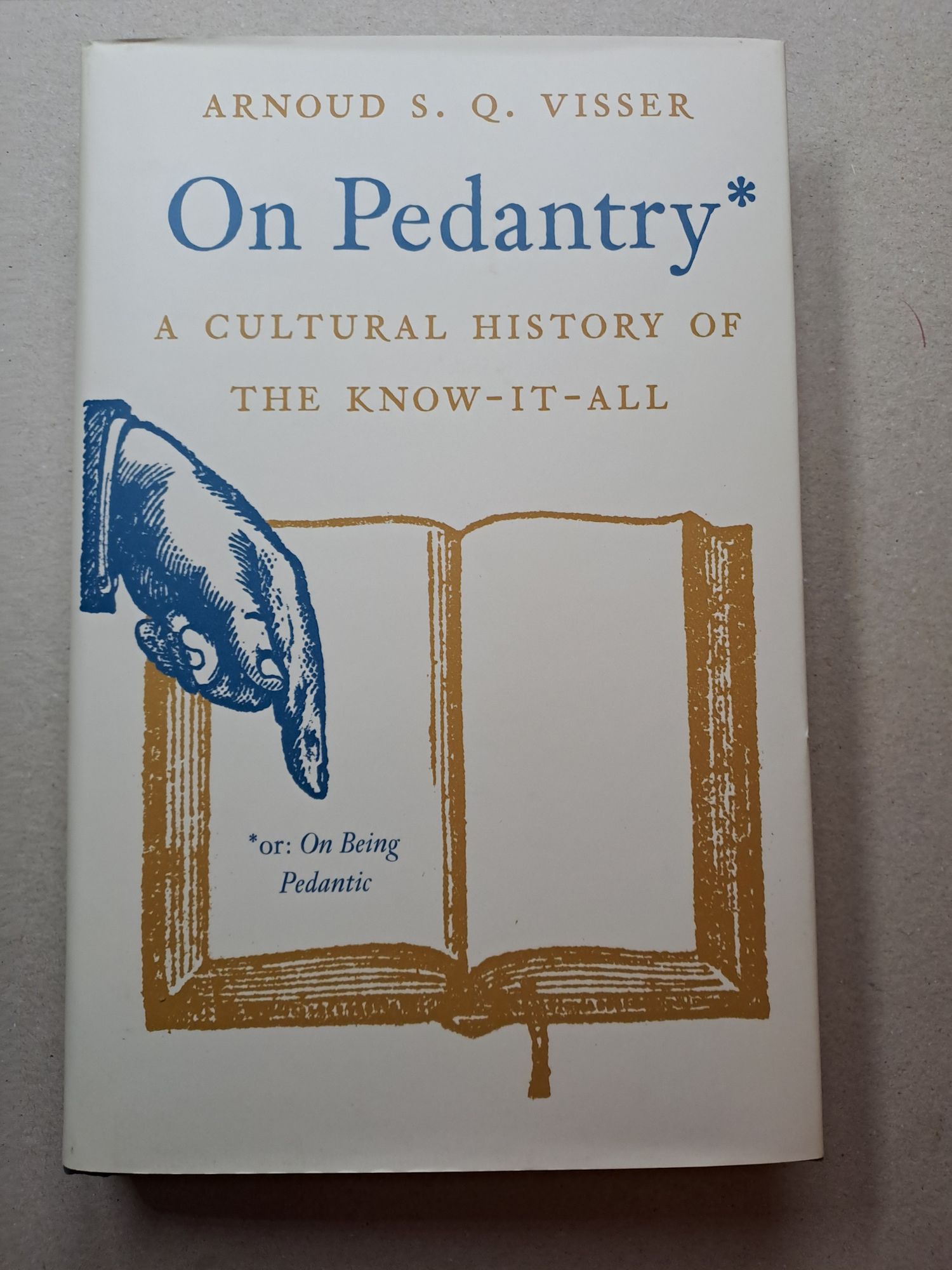
Regular readers of this blog will be surprised to learn that I have, from time to time, been accused of being somewhat pedantic, though not as often as I am accused of being a tad sarastic. Anyway, a certain person recently bought me a copy of On Pedantry (subtitled A Cultural History of the Know-it-all) by Arnoud S.Q. Visser, who is Professor of Textual Culture in the Renaissance at Utrecht University in the Netherlands. Whatever the reason for the gift, I found it a very enjoyable read and learnt a huge amount from it.
Working in a University it is hard to escape the stereotype of the Boffin or the Know-all. I suppose it is because it is part of the scholarly life that we tend to criticize the work of other academics – mostly with the intention of advancing knowledge – that we run the risk of being thought to be excessively assiduous in correction things we perceive to be incorrect or unclear – in other words, of being pedants – and irritating all kinds of people in the process. This book studies the long history of this sort of behaviour , in as part of the broader history of anti-intellectualism, a story of suspicion and deprecation of expertise that is highly relevant today. We have recently seen a widespread assault on universities, the removal of swathes of information (such as environmental data) from the websites of federal agencies, and the discrediting of the use of vaccines and of scientists engaged in vaccine research. The reader of On Pedantry will discover that this sort of hostility is by no means new.
The word “pedant” as such first appears as such in Renaissance Italy, with pedante being a name for private tutors who were hired by the wealthy to teach their children. Such teachers were of a lower social status than their students, so the word gained a negative connotation, especially when combined with the ostentatious display of knowledge with which these teachers were often associated – the new pedants soon found themselves satirised in sonnets and plays.
But although the word dates from much later, Visser identifies the original pedants in ancient Greece, among the Sophists, who emerged as a group of experts in the Athens of the fifth century BCE, with figures such as Protagoras and Prodicus becoming celebrities thanks to their novel approach to learning: they emphasised argumentation and speech, practices that became closely linked to the emergence of democracy. The Sophists gained a reputation, however, for competitive debate that was more about winning an argument than discovering the truth. The name “Sophist” comes from sophia, the greek word for knowledge, from which we get “Philosophy” but also “sophistry” (the use of clever but false arguments).
The philosopher Plato deplored the pedantic nature of Sophists in several of his dialogues and in his Republic, where they would rather “have a quarrel than a conversation”. The playwright Aristophanes went further, lampooning them in his play The Clouds, perhaps the first satire on intellectuals. In ancient Rome, this mistrust of the intellectual took on another aspect – a disdain the lack of practical use of much of Greek philosophy.
Incidentally, I learnt reading this book that the Emperor Hadrian, keen to demonstrate his own intellectual capacity and his admiration for Greek philosophy, forged the link between learning and social elite status by growing a beard, unusually for high status Romans of his time. Hadrian’s beard became much imitated – as a marker of intellectual capacity – but also lampooned as a sign of pretentiousness.
The next developments mapped out by Visser concern the rise of the scholar – in the middle ages and the Renaissance – whose world centred specifically on the Latin language, its literature and grammar. The learning of teachers and scholars was both celebrated and denigrated. John of Salisbury in the 12th century loathed “academics … poring over every syllable … expressing doubts about everything”. The French philosopher Michel de Montaigne wrote a famous essay On Pedantry, which is well worth reading; this is one of the few references in this book that I’ve actually read! Negative depictions of the intellectual subsequently appeared widely in literature, from Molière to Shakespeare. During the Enlightenment, pedantry was dismissed as a “vice of the mind”, with writers such asDiderot, in the prospectus to his famous Encyclopédie, writing that “he who claims to know everything only shows himself ignorant of the limits of his human mind”.
Closer to modern times, Visser switches his attention to America and the mistrust of scholars there, beginning with Thomas Paine, whose bestselling Common Sense provided a major influence on the American revolution. Paine identified refined language and classical erudition with a colonialist aristocratic mentality. Visser comments that “in a political culture of democratic machismo, politicians denounced colleagues who made an inordinate display of their education as elitist, overly sensitive, and effeminate”, I which is just as true of the 21st Century as the 19th. This American distrust of the expert even created a political party, the “Know Nothings”, in the early 19th century.
The final chapter of the book discusses attitudes towards intellectuals in popular culture, focussing on stereotypical portrayals of professors in Hollywood movies. I think more could have been made about the gendered nature of the pedant – until recently a stricly male stereotype. More recent versions are hardly more enlightened: just as male intellectuals are usually depicted as being “unmanly”, the focus on female academics in the movies is largely on their “mannish” looks.
I also think much more could be made of more recent phenomena, such as the annoying nitpicking of the anonymous internet troll and the rise of “mansplaining”. There’s also the emergence of generative AI. ChatGPT and other chatbots could have emerged as very irritating pedants, but instead they come across as servile and sycophantic, which some of us find even more irritating. And most most modern-day real-life pedants do not hallucinate or generate obvious untruths. Some of us who have been accused of being pedantic are at least trying to get things right, rather than pass off slop as truth.
As you might expect, this book involves many enjoyable digressions and asides. I especially appreciated the discussions of scholarly life and attitudes to education in mediaeval and early modern Europe. What you might not have expected for what is a scholarly work – with footnotes and whatnot – is that it is written in a very light and readable style and is frequently very funny.
Highly recommended.
 In the Dark
March 6, 2026 at 11:29 am
Any book with a footnote to the title has got to be worth looking into. I should probably read it anyway.
March 6, 2026 at 12:03 pm
The focus on all academics on films and TV is that they are either (a) nerds, (b) difficult with zero social skills (usually male), (c) evil, (d) absolutely brilliant, able to solve problems in a fraction of the time that real academics need. Rarely do they appear to be just like everyone else but good at academic matters. I