Adams, Rachmaninov & Stravinsky at the National Concert Hall
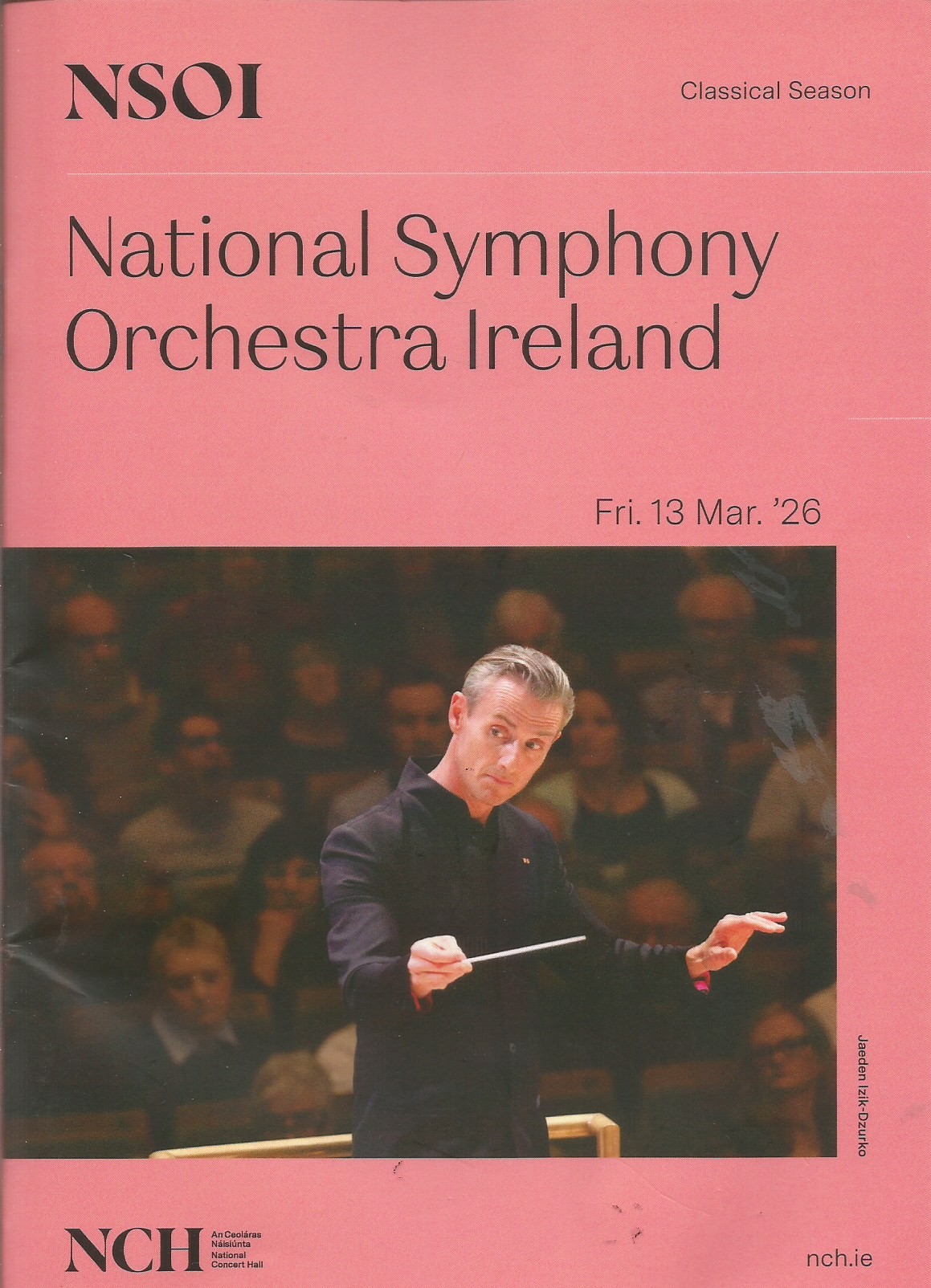
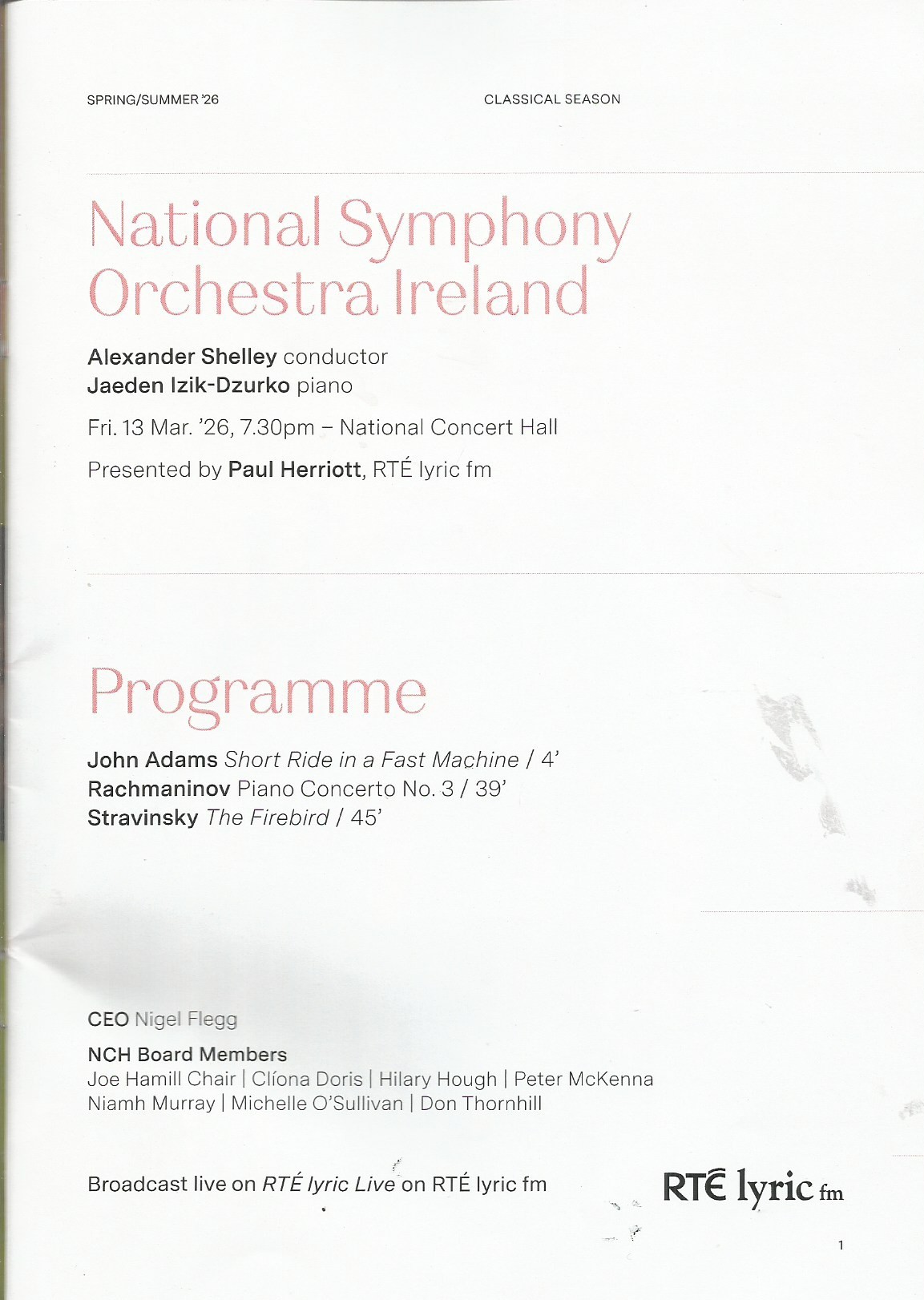
Yesterday evening found me once again at the National Concert Hall in Dublin for a programme of music played by National Symphony Orchestra Ireland, this time conducted by Principal Conductor Designate, Alexander Shelley, who takes over fully for the 2026/7 season. He took the opportunity afforded by the break between the first two numbers needed to bring the piano onstage, to introduce himself to the audience which made a pleasant change from having to watch in silence as all the chairs and desks were moved around.
The programme began with the exuvberant Short Ride in a Fast Machine by American composer John Adams which – believe it or not – was written forty years ago, in 1986. It is an exuberant piece based on interrelated rhythmic figures which is great fun to listen to and an ideal warm-up exercise for the orchestra.
The piano having been hauled into position, it was time to welcome Canadian pianist Jaeden Izik-Dzurko (who has Hungarian and Ukrainian ancestry) for the Piano Concerto No. 3 by Sergei Rachmaninov. When the soloist walked on stage I was struck by how young he looked. He is, in fact, 27 but looks younger. Still, I’ve reached an age when most people look very young. Rachmaninov’s Piano Concerto No. 3 is a monster of a piece – very long for a piano concerto – and also very difficult, with some fierce cadenzas. For all its reputation as a finger-breaker, it does have some lovely melodies in it. Rachmaninov himself realized he had created bit of a beast and cut some of the toughest bits for early performances, but nowadays we tend to hear the whole original score, as we did last night. I thought Jaeden Izik-Dzurko not only coped admirably with its technical demands but also conveyed its lyrical aspects very tenderly. It was a very impressive performance. The audience at the NCH obviously agreed. A standing ovation greeted him at the end, though he looked almost embarrassed by such an effusive reaction.
After the interval wine break we had a concert performance the complete score for Igor Stravinsky’s ballet The Firebird. This is a thrilling piece, involving a huge orchestra, numbering about a hundred musicians, and stunning orchestration. The Firebird is a tour de force: intricate but vividly coloured, full of excitement and colour and NSOI played it with great passion and aplomb. A really brilliant performance.
There was an electronic sign above the orchestra for The Firebird explaining what would be going on in the ballet as the various sections of the music were played. I found that an unwelcome and slightly annoying distraction, but it didn’t detract significantly from the performance. There was thunderous applause at the end of the concert but, it being quite a long concert, I couldn’t stay for all the ovations as I had to leave to catch the train home.
 In the Dark
March 14, 2026 at 10:48 pm
Dear Professor Cole,
Yes, Rachmaninov’s Third is a great challenge to play. Virtuosity aside, he had a great advantage: having very large hand and long fingers. However, Fats Waller had hands that could stretch a 13th! Even Rachmaninov could only stretch a 12th. Most folks can cover only an octave or slightly more. I always struggle to play his pieces.
Rachmaninov’s two piano sonatas are also masterpieces. I hope that he had composed more. Indeed, Martha Argerich’s rendition of one of the sonatas is exceptional, as is her performance of Rachmaninov’s Third Piano Concerto.
Speaking of piano sonatas, I have composed three, the first and third being the most demanding on the pianist. The first two had been performed by David Pitman (whose large hands can stretch an 11th) in the recital hall of a Conservatorium of Music. It seems that the most often performed of my sonata movements by my colleagues from the music department is “The Last Rag“, which is the second movement of my Second Piano Sonata entitled “The Time Beyond”. You are very welcome to listen to the music and examine (and even print out) the musical scores of “The Last Rag” presented in a special post published at my main website. The post is entitled “🎼🎹—THE—🎹—LAST—🎹—RAG—🎹🎵🎶“, which is available to you at
There are two versions of the said movement to choose from. You can listen to them as well as watch the videos, and also download the scores if you want to learn to play it yourself.
Yours sincerely,
SoundEagle🦅