Nobel Prize for Physics Speculation
Just to mention the announcement of this year’s Nobel Prize for Physics will take place tomorrow (Tuesday, October 6th,2026). I must remember to make sure my mobile phone is fully charged so I can be easily reached, although I am likely to be lecturing when the announcement is made.
I do, of course, already have a Nobel Prize Medal of my own already, dating from 2006, when I was lucky enough to attend the prize-giving ceremony and banquet.

I was, however, a guest of the Nobel Foundation rather than a prizewinner, so my medal is made of chocolate rather than gold. I think after 20 years the chocolate is now inedible, but it serves as a souvenir of a very nice weekend in Stockholm! Sadly one of the Laureates whose award we were celebrating passed away recently.
Regular readers of this blog may recall that I called it correctly in 2022 when Alain Aspect, John F. Clauser and Anton Zeilinger won the Nobel Prize for Physics that year. I had, however, predicted them every year for many years until they won, and they won’t win it again, so I’ve probably shot my bolt.
I drew a blank in 2023 when “attosecond light pulses” were the topic and was completely wrongfooted when the 2024 Nobel Prize for Physics was awarded to John J. Hopfield and Geoffrey E. Hinton “for foundational discoveries and inventions that enable machine learning with artificial neural networks”. I didn’t see that one coming at all. Last year’s went to John Clarke, Michel H. Devoret and John M. Martinis “for the discovery of macroscopic quantum mechanical tunnelling and energy quantisation in an electric circuit”.
I really have no idea who will win it this year, but I’ll suggest that there’s still an outside chance for Michael Berry and Yakir Aharonov for their work on the geometric phase, although if they were going to win they would probably have done so by now.
Feel free to make your own predictions through the comments box below! To find out who the lucky winners you’ll have to wait for the announcement, around about 10.45 (UK/Irish time) on Tuesday morning. I’ll update this post when the wavefunction has collapsed.
Update: I’m not often right but I was wrong again.
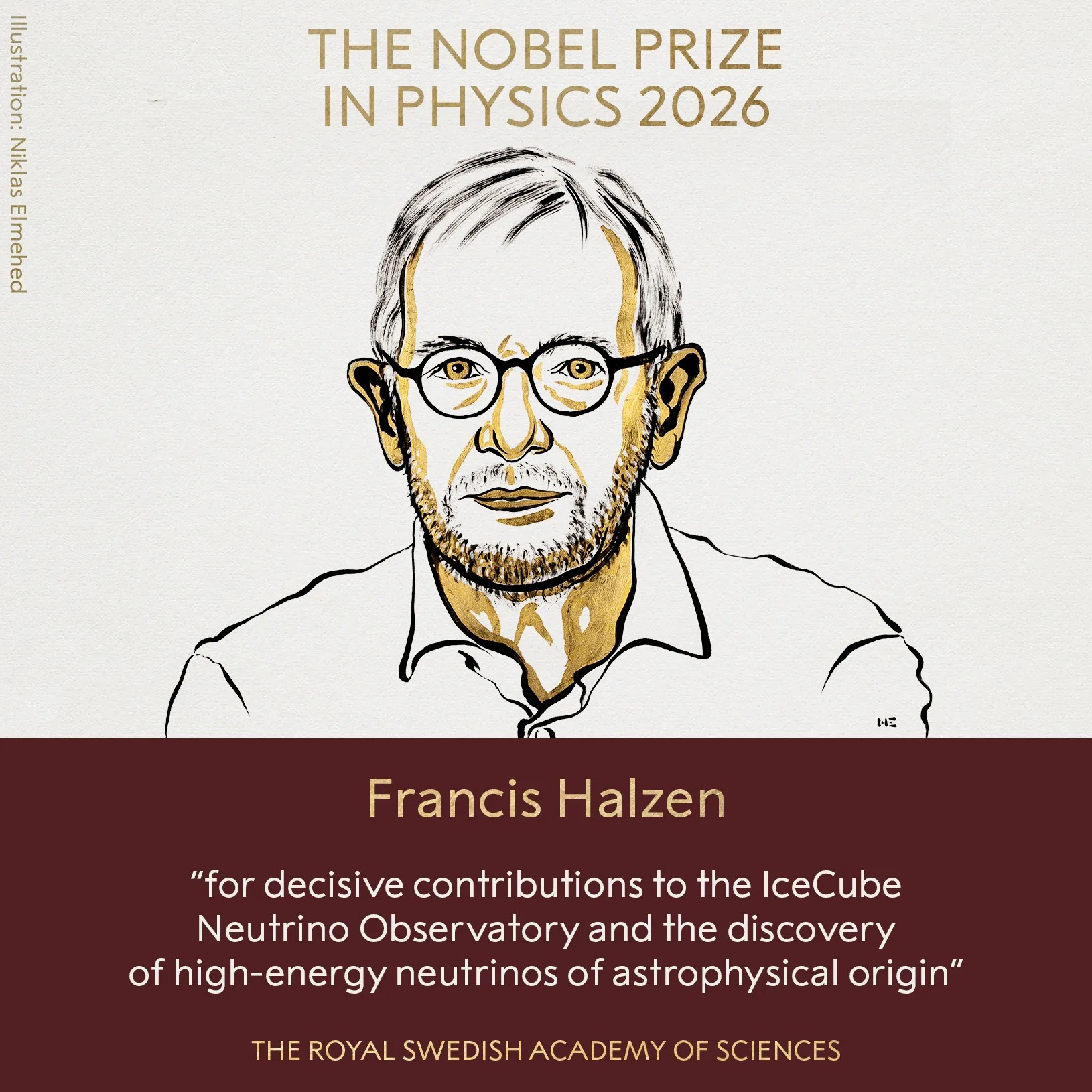
I’m a little surprised to see this going to just one person, but there you are.


October 5, 2026 at 10:13 pm
If Roy Kerr wins it, would it be the only time for a physics paper less than 2 pages long?
October 5, 2026 at 10:44 pm
That’s an unusual choice of metric…
October 6, 2026 at 7:42 am
I hope Irwin shapiro wins it for Shapiro delay. It has been so fundamental in both astrophysics and fundamental Physics. Maybe also Francis Halzen for neutrino astrophysics?
October 6, 2026 at 10:51 am
One of my guesses are right.
October 6, 2026 at 3:40 pm
It’s been many years since they have run out of things to give a Physics Nobel prize for. The prize should be discontinued before it becomes completely meaningless. I am sorry but to give a single-person prize for this is farcical.
October 7, 2026 at 2:19 pm
There is little doubt that the winner deserved the prize. IceCube and its predecessor form a visionary experiment. Other people may also deserve it: there are many excellent research projects in physics. The fact that one person gets it does not denigrate others. To argue that no one should get it seems blinkered.
October 7, 2026 at 3:09 pm
I am not commenting on your last sentence, but the detection of the Higgs boson and of gravitational waves in the last 15 years shows that Nobel-calibre work did not remotely end with the Standard Model and now lies dormant until the model is exceeded. We can reasonably await the mechanism of high-temperature superconductivity too.
October 10, 2026 at 11:23 am
[…] folder Astrophysics of Galaxies. It is very topical, in the light of the award of this year’s Nobel Prize for Physics to Francis Halzen for his work on IceCube. The paper explains how data from VLASS and IceCube […]