Summer Solstice 2026
The Summer Solstice in the Northern hemisphere takes took place this morning, Sunday 21st June 2026, at 9.24am local Irish Time (08.24 UTC). Among other things, this means that tomorrow is the longest day of the year around these parts. According to this website, the interval between sunrise and sunset in Dublin today will be 17 hours 4 minutes and 52 seconds. which is 2 seconds longer than yesterday, while tomorrow will be two whole seconds shorter.
The Earth orbits the Sun once a year in a nearly circular orbit. The Earth’s axis of rotation (the straight line through the center of the Earth between the north and south poles) is not perpendicular to the plane of the Earth’s orbit. The Earth’s axis is tilted by about 23.4° from the the direction perpendiular to the orbital plane:
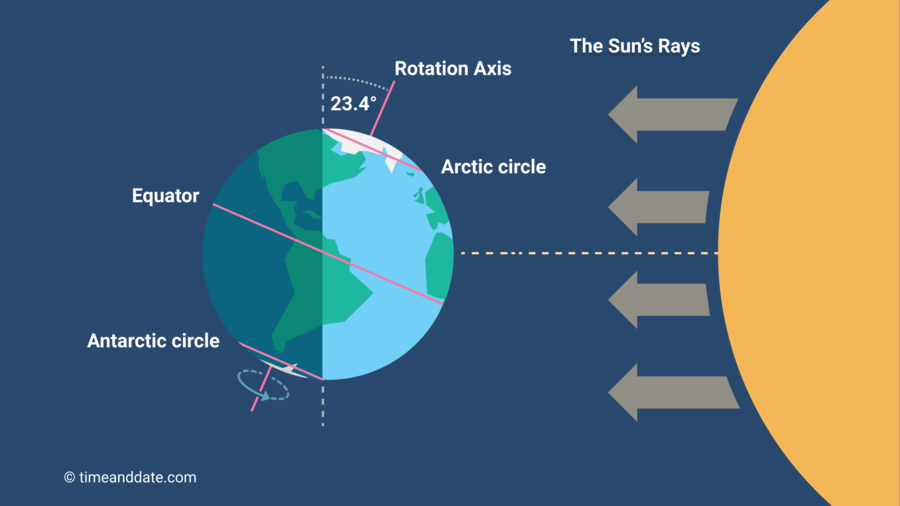
The orientation of the Earth’s axis in space remains nearly constant even as the Earth revolves around the Sun. It always points in the general direction of the star Polaris. The result is that when the Earth is on one side of its orbit, the South Pole is tilted toward the Sun (by as much as 23.4°) and the Southern Hemisphere experiences summer. Six months later, when the Earth is on the opposite side of its orbit, the North pole is tilted toward the Sun (by as much as 23.4°) and the Northern Hemisphere experiences summer.
On the Summer Solstice, Earth’s maximum axial tilt toward the Sun is 23.4°. Likewise, the Sun’s declination from the celestial equator is 23.4°. In areas outside the tropics, the Sun reaches its highest elevation angle at solar noon on the summer solstice. At the North Pole the Sun doesn’t set at all on the Summer Solstice.
So in a sense it’s all downhill from today until the Winter Solstice in December, but the nights won’t start drawing in just yet. Days will indeed get shorter from tomorrow, although this does not mean that sunset will happen earlier tomorrow than it does today. In fact it is a little later; the latest sunset will be on 25th June. Nor does it mean that today sees the earliest sunrise. Sunrise this morning was a little later than yesterday; the earliest sunrise was actually on 17th June.
This arises because there is a difference between mean solar time (measured by clocks) and apparent solar time (defined by the position of the Sun in the sky), so that a solar day does not always last exactly 24 hours. A description of apparent and mean time was given by Nevil Maskelyne in the Nautical Almanac for 1767:
Apparent Time is that deduced immediately from the Sun, whether from the Observation of his passing the Meridian, or from his observed Rising or Setting. This Time is different from that shewn by Clocks and Watches well regulated at Land, which is called equated or mean Time.
The discrepancy between mean time and apparent time arises because of the Earth’s axial tilt and the fact that it travels around the Sun in an elliptical orbit in which its orbital speed varies with time of year (being faster at perihelion than at aphelion).
You can read a piece about the cultural importance of the solstice over the years here.
 In the Dark
June 21, 2026 at 10:26 am
Did you study celestial mechanics as part of your UG astrophysics courses? We had lectures on it – declination, RA, solar time, equation of time etc. Plus spherical geometry (which was not much fun). Then exam questions on working out your position on the Earth when given limited information. Don’t know if this stuff is still taught nowadays.
June 21, 2026 at 11:54 am
I didn’t do much undergraduate astrophysics: one course on Observational Cosmology and one on High-Energy Astrophysics. I did Theoretical Physics for Part II.
When I started my DPhil however I had to do a course on all that which was taught for the MSc but all DPhil students had to take it. We didn’t take the written exam, but had to do an oral exam. I failed it first time round, actually, but we were allowed to keep taking it until we passed, which I did at the second attempt.
June 25, 2026 at 1:06 pm
[…] worth also repeating the fact I mentioned a few days ago on the Solstice, that this evening we will have the latest sunset of 2026, at 9:59:38 […]
June 26, 2026 at 12:20 pm
[…] telescoper.blog, sunrisesunsettime.org, future.fandom.com, daylight-savings.com, connectbrazil.com, […]