Hawking Points in the CMB Sky?
As I wait in Cardiff Airport for a flight back to civilization, I thought I’d briefly mention a paper that appeared on the arXiv this summer. The abstract of this paper (by Daniel An, Krzysztof A. Meissner and Roger Penrose) reads as follows:
This paper presents powerful observational evidence of anomalous individual points in the very early universe that appear to be sources of vast amounts of energy, revealed as specific signals found in the CMB sky. Though seemingly problematic for cosmic inflation, the existence of such anomalous points is an implication of conformal cyclic cosmology (CCC), as what could be the Hawking points of the theory, these being the effects of the final Hawking evaporation of supermassive black holes in the aeon prior to ours. Although of extremely low temperature at emission, in CCC this radiation is enormously concentrated by the conformal compression of the entire future of the black hole, resulting in a single point at the crossover into our current aeon, with the emission of vast numbers of particles, whose effects we appear to be seeing as the observed anomalous points. Remarkably, the B-mode location found by BICEP 2 is at one of these anomalous points.
The presence of Roger Penrose in the author list of this paper is no doubt a factor that contributed to the substantial amount of hype surrounding it, but although he is the originator of the Conformal Cyclic Cosmology I suspect he didn’t have anything to do with the data analysis presented in the paper as, great mathematician though he is, data analysis is not his forte.
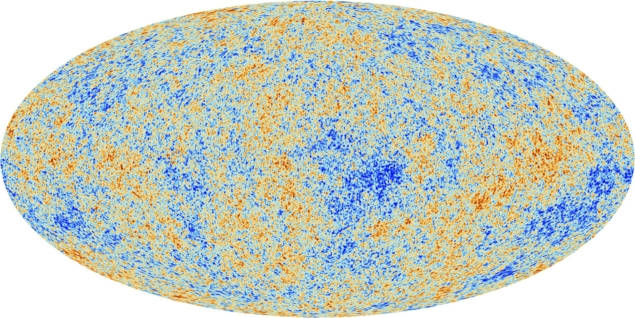
I have to admit that I am very skeptical of the claims made in this paper – as I was in the previous case of claims of a evidence in favour of the Penrose model. In that case the analysis was flawed because it did not properly calculate the probability of the claimed anomalies in the standard model of cosmology. Moreover, the addition of a reference to BICEP2 at the end of the abstract doesn’t strengthen the case. The detection claimed by BICEP2 was (a) in polarization not in temperature and (b) is now known to be consistent with galactic foregrounds.
I will, however, hold my tongue on these claims, at least for the time being. I have an MSc student at Maynooth who is going to try to reproduce the analysis (which is not trivial, as the description in the paper is extremely vague). Watch this space.
Follow @telescoper In the Dark
October 30, 2018 at 3:31 pm
What could be meant by “the B-mode location” “at a point”? Either they are not very good at writing intelligible sentences, or they have fundamentally misunderstood what the B-mode signal (whether due to dust or gravitational waves) actually is.
October 30, 2018 at 3:40 pm
These possibilities are not mutually exclusive.
October 30, 2018 at 4:51 pm
I once took part in a literature review in which a paper came up that mentioned the “damped Budden branch” of a plasma dispersion relation. Ken Budden said he had no idea what that was!
October 30, 2018 at 3:34 pm
What did you your MSc student do to deserve that fate, Peter?
October 30, 2018 at 3:40 pm
Well, he chose to do it!
October 31, 2018 at 11:08 am
“Statistics” is an ambiguous word. Data are of course not mathematics. What does he consider probability theory to be?
October 31, 2018 at 1:39 pm
“Beauty is truth, truth beauty” – Keats (from Ode on a Grecian Urn).
February 28, 2019 at 10:08 pm
Hi Peter, did you manage to reproduce any of this? (Just saw a video of Penrose talking about this paper.)
February 28, 2019 at 10:09 pm
Can’t comment yet…. 😉
March 5, 2020 at 4:31 pm
Hi Peter, do you have any results yet in reproducing Penrose’s Hawking Points data?
March 5, 2020 at 4:56 pm
The Masters student who was doing this was off for about a year because of an injury sustained while playing rugby but he resumed his course last month and I’m expecting some results fairly promptly.
February 14, 2022 at 9:28 am
Hi Peter, I was wondering if your student has been able to confirm these results yet. I haven’t seen any report on your site so I got curious.
February 14, 2022 at 10:13 am
This is a long story. I had a Masters student working on this but he had to suspend for some time because of an injury. When he got back on it the pandemic arrived so progress was slow. He had to finish last year with the project not quite complete.
We didn’t run enough simulations to get decisive results but the partial results he obtained do suggest a marginally significant excess of annular features in the Planck data compared with standard LCDM maps. I need somehow to find enough time to finish it off now that the student has finished and is now doing other things.
July 14, 2019 at 10:29 pm
“The detection claimed by BICEP2 was (a) in polarization not in temperature and (b) is now known to be consistent with galactic foregrounds.”
Please elaborate as if, as it were, “you were trying to explain it to a small child, or a golden retriever” (Jeremy Irons in ‘Margin Call’).
Thanks.
July 15, 2019 at 8:59 am
That’s exactly what I did.
August 16, 2019 at 4:58 pm
@telescoper
Let me do it for you then, since perhaps you don’t understand the theory well enough to explain it.
“”The detection claimed by BICEP2 was (a) in polarization not in temperature and (b) is now known to be consistent with galactic foregrounds.””
It means the detection was of something like a variation caused by the Zeeman Effect which is ALWAYS directly integrated with magnetic density (electromagnetic field), of which temperature is just a relative epiphenomenon.
Also, this is wrong: “”In that case the analysis was flawed because it did not properly calculate the probability of the claimed anomalies in the standard model of cosmology.””
All calculations in the ‘standard model of cosmology’ are flawed. Just very rough guesstimates, open to adjustment and change. You don’t have the monopoly on ‘the model’.
This is wrong: “”with the emission of vast numbers of particles””
There are no particles in this universe.
This is just ego-driven: “”as, great mathematician though he is, data analysis is not his forte.””
Yes, as did the autistic Einstein. At least Penrose admitted he was autistic. But that does not negate his overall theories on CCC.
This is wrong: “”resulting in a single point at the crossover into our current aeon””
It is infinite and point at the same time. Something a scientist’s brain is too overspecialised into a form of cloistered autism, to comprehend.
““I have to admit that I am very skeptical of the claims made in this paper””
Yea, for irrational reasons.
I bet you delete this message due to scientist’s hobbit-like brain, but you won’t escape these truths.
Tommy
August 16, 2019 at 5:12 pm
I’m leaving this here to show that you (a) know nothing of physics and (b) are an abusive twit.
No further comments will be accepted from you.