Irish Bingo Lingo
This week I had my third lunchtime Irish language class during which, among a few other things, we learned about numbers (just 1-10 so far). After some practice in pronunciation, we then had some practice in comprehension by playing Bingo in Irish. Out of interest I’ve put up the Irish numbers along with their counterparts in Welsh for reasons which will become clear:
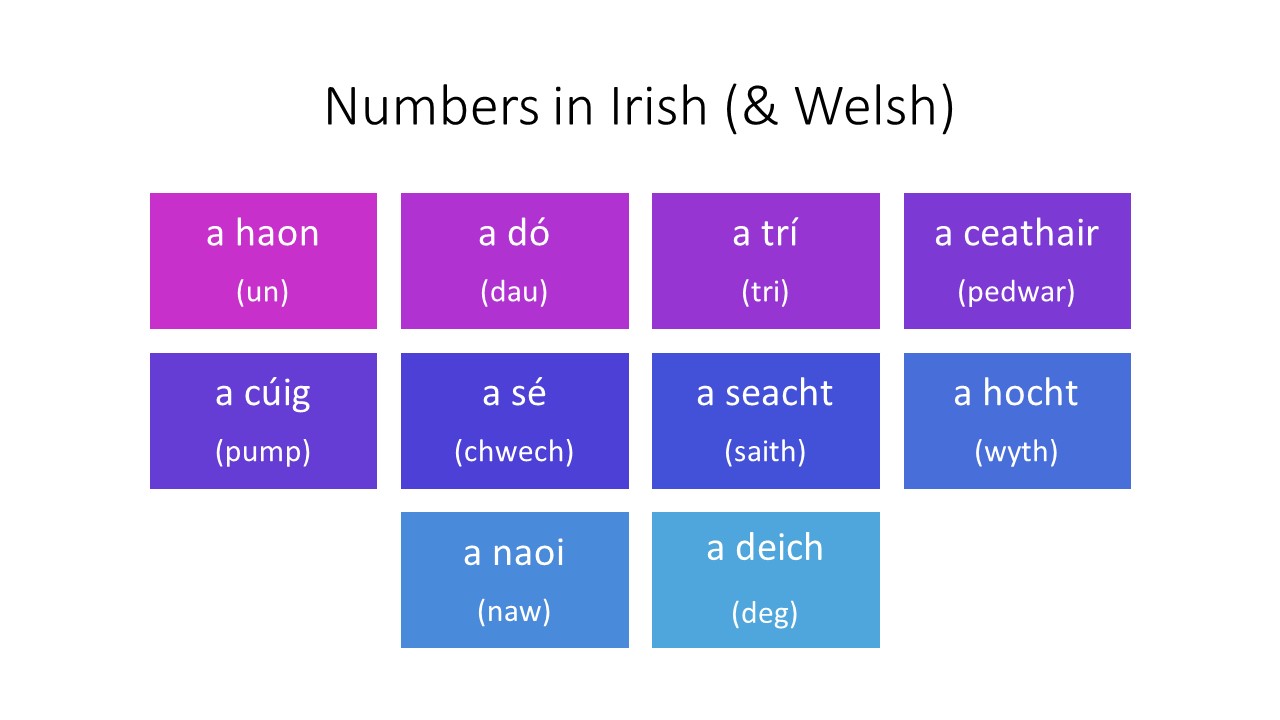
The first thing to note is the presence of the particle “a” in front of the number in Irish. This is a consequence of something I didn’t know about before taking this course. In Irish there are different ways of using numbers depending on whether you’re using them just as numbers (in which case you put the “a” in front) or if you’re using them to denote a quantity of things or people (in which cases you don’t put the “a” in front but have to use a particular grammatical construction involving the thing being counted). Numbers in Irish are not used simply as adjectives, as in for example English. That’s not how it works in any other language I know. So far we haven’t been taught about these other counting systems so I can’t say any more.
The second thing concerns the similarity of these numbers to those in many other European languages, which is not surprising since they share an Indo-European origin. Integers are such basic things that they are embedded at a very deep level in languages. The Irish numbers resemble those in French particularly strongly. This may be a consequence of modern Irish being influenced by Norman French or may just be evidence of the common root.
Notice the comparison with Welsh, however, which gives very clear evidence of the ancient mutation that led to the distinct language branches of p-Celtic and q-Celtic. Look at the number 4. In Irish, this is a ceathair (which is pronounced “a ka-hir”; the t is weakened by the following h) which resembles the French quatre. There is no q in the standard Irish alphabet but the sound is similar. In Welsh we have pedwar which, apart from the initial letter being a “p”, is structurally similar to the Irish version. A similar change in initial consonant happens with the number five.
Anyway I’m enjoying learning Irish. It’s a very interesting challenge. In the rest of the class we learned how to answer questions like What is your name (Cad is ainm duit?) followed by an exercise in giving names to celebrities shown in photographs. I firmly established my status as the Old Fogey of the class in this part, by being unable to identify a person called Shakira who, I’m told, is a popular vocal artiste of some sort.
Follow @telescoper In the Dark
February 20, 2021 at 5:44 pm
In Hindi or Bengali they are:
Ek, Do, Tin, Char, Panch, Chai, Saat, Aast, Nau, Das.
In all North Indian languages (as well as in other branches of Indo-Europian language family) they are very similar.
February 20, 2021 at 5:57 pm
My point is that’s not what happens in Irish. If you want to specificy the number three you say “a trí” if you want to say, e.g., three boats you don’t just stick a “trí” in front of the plural word for boats. In fact you say “trí bhád” which involves using the singular word for boat “bád” but mutating the initial consonant to indicate its grammatical position. It’s a bit like “three of boat”. The number is not simply used as an adjective in such a case.
February 20, 2021 at 6:40 pm
The particle “a” is not an article: “a haon” does not mean “the one”. A particle is basically a word that doesn’t fit into the most common categories of words. The same particle is used in Irish to introduce the vocative case where it is identical to the archaic English form “O” found in old verses.
February 20, 2021 at 6:38 pm
It seems to me that the English “four” and German “vier” and equivalents in other Germanic languages are a bit anomalous in this context.
February 20, 2021 at 10:09 pm
Not at all, the f in four and five is just a softened p is it not?
The anomaly must be the slavonic languages, with variations on “chetyr” for four?
February 21, 2021 at 3:47 pm
Perhaps you can take over some of the Raidió na Gaeltachta interviews for me soon, a Pheadair a chroí!
February 21, 2021 at 4:06 pm
I am hoping at one point to be able to the level at which I can understand the sports commentary on TG4.
February 21, 2021 at 4:55 pm
The number system (in full detail) is probably one of the more complex areas of the language, as all the dialects diverged in various ways retaining different elements of the Classical grammar.
If you find it interesting the “a” is the same as the feminine possessive. So “a trí” originally meant “her three”. That’s not how it would be intuitively understand by a native speaker today, but it’s the idiom it grew out of in the early Medieval period.