In Defence of Blackboards
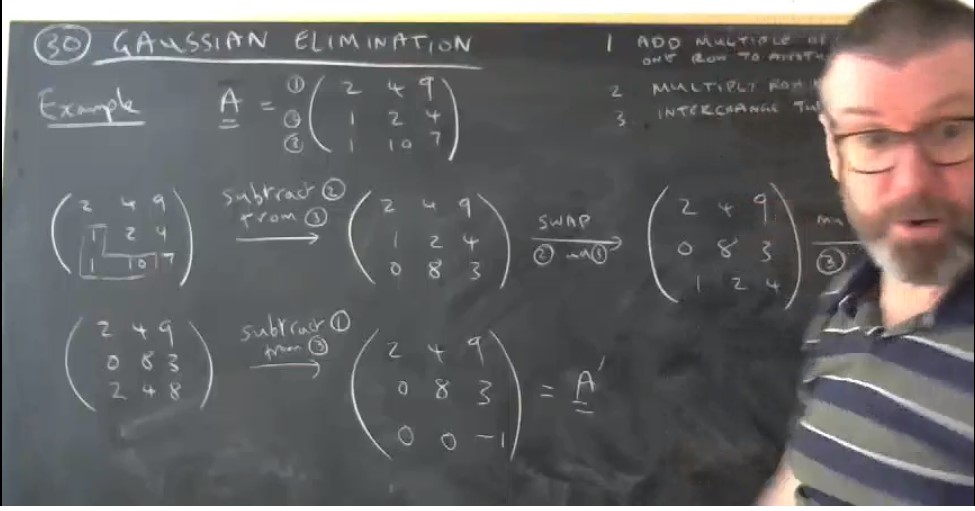
I wasn’t very surprised to find that the large lecture theatres in the swanky new building at Maynooth University are not equipped with chalkboards, as I had been told that the powers-that-be were finding it difficult to “source” boards of the appropriate size. I was more surprised and disappointed to find that none of the smaller teaching rooms have blackboards either; the best they have is very small whiteboards which are useless for teaching mathematical subjects.
I know people think I am very old fashioned in persistently using a chalkboard (a better word than “blackboard” as many chalkboards are actually dark green). They also find it quite amusing that I bought one especially so I could do lectures during the pandemic from home using it. One reason for that is that it’s far easier to get a decent contrast on camera than using a whiteboard. I also find that standing up and walking around allows me to communicate more effectively, at a decent pace and with a reasonable amount of energy which made the lectures from home a little less unbearable to give and, hopefully, to watch. Here’s the green blackboard in my office that I used to give some lectures during lockdown:

It was never the intention of course that the board in my office would be used for lecturing. We have such things to facilitate the communication of ideas during a discussion by scribbling mathematical expressions or diagrams.
I found some time ago an article about why Mathematics professors at Stanford University still use chalkboards. I agree with everything in it. The renowned Perimeter Institute in Canada and the Isaac Newton Institute in Cambridge also have blackboards, not only in teaching rooms but also in corridors and offices to encourage scientific discussions.
For teaching I think the most important thing for the students in a lecture on a subject like theoretical physics to see a calculation as a process unfolding step-by-step as you explain the reasoning, rather than being presented in complete form which suggests that it should be memorized rather than understood. Far too many students come to university with the impression that their brain is just a memory device. I fill it’s our job as lecturers to encourage students develop genuine problem-solving skills. The example in the first picture above – Gaussian Elimination – is a good illustration of this. Most of my colleagues in Theoretical Physics and in the Department of Mathematics and Statistics seem to prefer chalkboards too, no doubt for similar reasons.
I know that many in Senior Management think of us as dinosaurs for clinging to “old technology” but the fact is that new technology isn’t always better technology. Whiteboards are just awful. As well as being impossible to read in a large room or to record from, the marker pens are expensive, filled with nasty solvent, and impossible to recycle when empty. Unfortunately the purveyors of these items seem to have cornered the market I hate whiteboards so much I call them shiteboards.
Anyway, with the new academic year due to start in a month, and there being no likely resolution of the accommodation crisis, it looks like many students will be unable to attend lectures in person. It doesn’t matter whether rooms have blackboards or whiteboards or enhanced multimedia digital display screens if the students can’t get to the campus…
 In the Dark
August 21, 2022 at 5:23 pm
For some time I lectured with Wacom graphics tablet + projection. With the right colour settings it can look just like a chalkboard! When making videos for the pandemic era, it really came into its own. I tried an IPad for live lecturing, but it was too laggy. Of course neither of these works for the corridor spontaneous discussion thing. Re chalkboards, what about the ghastly dust? Worse then the ghastly solvent!
August 21, 2022 at 6:57 pm
Me too. I bought one of those drawing tablets in the hope that it would help with teaching during lockdown but I couldn’t be doing with it. The chalkboard I bought was far more useful. I like standing up when I’m teaching. The dust isn’t all that bad – it depends on the chalk.
August 21, 2022 at 6:48 pm
I understand your rationale, however I dislike chalkboards and chalk for the feel, the dust, and the effort at cleaning. For those reasons I prefer whiteboards, but grease pencils on thin glass or neon grease pencils on glass over black paper are a good alternative.
August 22, 2022 at 3:10 am
Here is a technical solution that is used in class rooms in Japan that you might get behind:
https://i.imgur.com/EKNemYO.png
Cleans and scans the blackboard at the same time. 😉
August 22, 2022 at 10:11 am
I also preferred using a blackboard. However I can understand the move to stop using them, and indeed supported this when it happened in my school. Even ‘dust-free’ chalk produces a lot of dust, and it cannot be good for you to constantly breathe it in. Also I believe its bad for computer equipment, which most lecture theatres will now have.
August 22, 2022 at 5:19 pm
My Chemistry, Biochemistry and Maths u/grad lecturers in the early 80s all used blackboards (typically on those pulley system things where the lecture theatre had six boards in two banks of three), but by the time I was lecturing a few years later it was all overhead projectors and acetates…. and whiteboards.
In medicine & biosciences, use of Powerpoint for lectures has become near universal since the mid-late 90s, but for tutorials we are mostly on whiteboards – which I use the way Peter describes for a blackboard, sketching diagrams and even the odd (very simple) equation. Can’t say I share the same objections to whiteboards Peter has, although the choice of pens does make a difference… and the absence of a “board duster” in the room is a frequent source of aggravation.
August 22, 2022 at 9:38 pm
I’ve been told that chalk dust is bad for electronics, as Francis says, and I certainly have colleagues who say the dust bothers them. So I’ve made my peace with whiteboards, although I’d stick with chalkboards if I could.
To me, the great advantage of the chalkboard is this: if you have a chalkboard, a piece of chalk, and an eraser, you can be certain that you will be able to write and to erase. That is not true if you have a whiteboard, a marker, and an eraser. At least as annoying as the marker that doesn’t write is the eraser that doesn’t erase properly.
August 22, 2022 at 9:54 pm
I’m more concerned by the solvent and ink in the markers than I am about dust from the chalk. As for the effect on computers it may clog the fan in the long run which may cause overheating but that’s all. Decent maintenance of PCs in lecture theatres could stop this.