Yellowface, by Rebecca F. Kuang
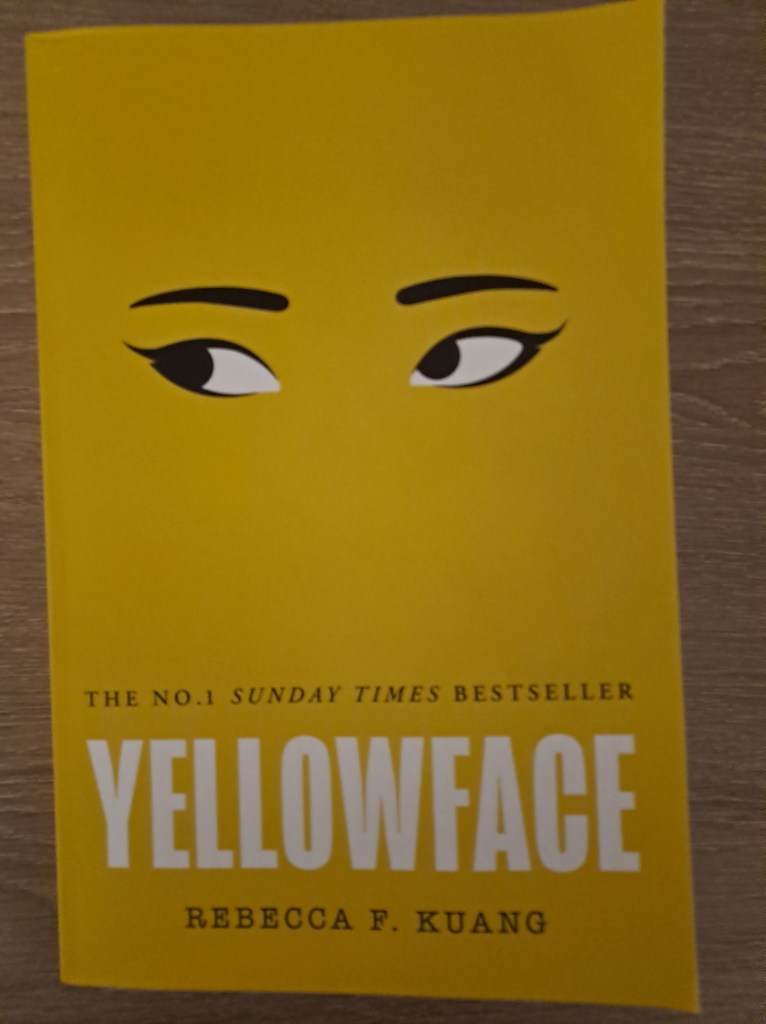
Continuing with my aim of reading more books while on sabbatical, I’ve just finished Yellowface by Rebecca F. Kuang. The story, told in the first person, revolves around June Hayward, an unsuccessful young white author, who is present at the accidental death of Athena Liu, a Chinese-American author, a hit in literary circles, who chokes on a pancake. Athena has just finished a complete draft of a novel about Chinese laborers in World War I and while waiting for emergency services to arrive, June purloins the manuscript and passes it off as her own. She is immediately welcomed by publishers and offered a large advance, but that’s only the start as she has to then contend with accusations of plagiarism and racism as well as being haunted by what appears to be Athena’s ghost. I won’t spoil the read by telling you how it ends, but it did remind me a little bit of Dostoevsky’s Crime and Punishment.
The author describes this as a “horror story about loneliness” in the highly competitive world of publishing, I found much of it resonates with academia too, but it’s really more of a satire about plagiarism and marketing hype than a horror story per se. I found it very readable, and interesting for someone who has recently quit Twitter to see how social media play such an important – and negative – role in the story. I was gripped by the story and read it in just two evenings, which is quick for me. Recommended.
 In the Dark
October 17, 2023 at 8:57 pm
I must say that I am astonished at the number of novels whose main characters are novelists. I’d never read one.
October 18, 2023 at 8:32 am
There are indeed many novels whose protagonist is a novelist … as compared to a scientist, for example. 🙂
My recommendation for Peter’s sabbatical reading is “The Affair” by CP Snow.
It is a novel on subject that is hardly ever written about.
Scientific fraud.
I think it may be the only novel on this subject.
October 18, 2023 at 8:44 am
I have an outline of a murder mystery based around scientific fraud in the form of fabricated cosmological data.
October 18, 2023 at 8:59 am
Excellent! The motivation for scientific fraud has always puzzled & interested me.
If you fabricate data or results, it is either about something unimportant or something important.
In the first case, why bother? In the second case, it will be quickly checked and you will be found out.
October 18, 2023 at 9:20 am
In this plot the idea is that the data come from an experiment that is so complex and expensive that it will never be replicated, at least not in the perpetrator’s lifetime…
October 18, 2023 at 9:59 am
Who is the hero/protagonist?
I did notice that in all Fred Hoyle’s many novels, the hero was usually a blunt-speaking Yorkshireman.
October 18, 2023 at 11:12 am
Mine is totally different – he’s a young gay theoretical astrophysicist…
(The novel is set in the 1990s..)
October 18, 2023 at 9:45 am
The Delta Star by Joseph Wambaugh involves a group of chemists and the Nobel Prize.
October 18, 2023 at 1:26 pm
It’s grump time. I call novels about novelists self-indulgence; the sole CP Snow novel I read about college politics was dull; I agreed with the reviewer of Hoyle’s The Black Cloud which said that the characters might as well be given numbers for all the personality Hoyle was able to imbue them with (albeit fine plot); and Joseph Wambaugh’s The Choirboys I gave up reading, as being trash.
I agree with Wyn’s point about scientific fraud, in physics at least. Jan Hendrik Schön’s motivation was always a mystery given that his claims were sufficiently important and potentially lucrative that attempts would soon be made at replication. I’m more concerned about candidates for the Journal of Irreproducible Results in biochemistry, where the number of noise variables cannot be reduced and where lucrative drug therapies are tested in university laboratories in receipt of large grants from pharmaceutical companies.
October 18, 2023 at 4:27 pm
Fred’s novels are mainly about Fred, though the sadism of the Machine in ‘A is for Andromeda’ is still shocking, many years later.
CP Snow’s novels are variable, but ‘The Affair’ does convey the claustrophobia of College life. I recollect reading somewhere that it was based on a real incident and was responsible for Snow turning away from scientific research to novel-writing.
Another novel about academic fraud (though the fabrication of historical documents rather than scientific data) is ‘Gaudy Night’. The denunciation of the Oxford Fellows by the inarticulate scout Annie — the perpetrator of the outrages — is just stompingly magnificent.
October 18, 2023 at 4:43 pm
I’ve read it at half-attention. I don’t think she ever wrote another novel as fine as The Nine Tailors. What a polymath – her “Introductory Papers on Dante” are an excellent accompaniment to her own verse translation of the Divine Comedy, and her radio adaptation of the gospel story is very fine. Then there is Sayers’ book on trinitarian literary criticism! Interesting life she had, too.
October 18, 2023 at 4:46 pm
Gaudy Night is very good, actually, though I agree that The Nine Tailors is her best.
October 18, 2023 at 4:45 pm
I’ve read the version set in Barcelona: Gaudi Night.
October 19, 2023 at 10:47 pm
I thought it meant an evening of Motown hits.