Euclid, the Perseus Cluster, and Beyond!
I see that the Euclid Early Release Observation of the Perseus Cluster is today’s Astronomy Picture of the Day:
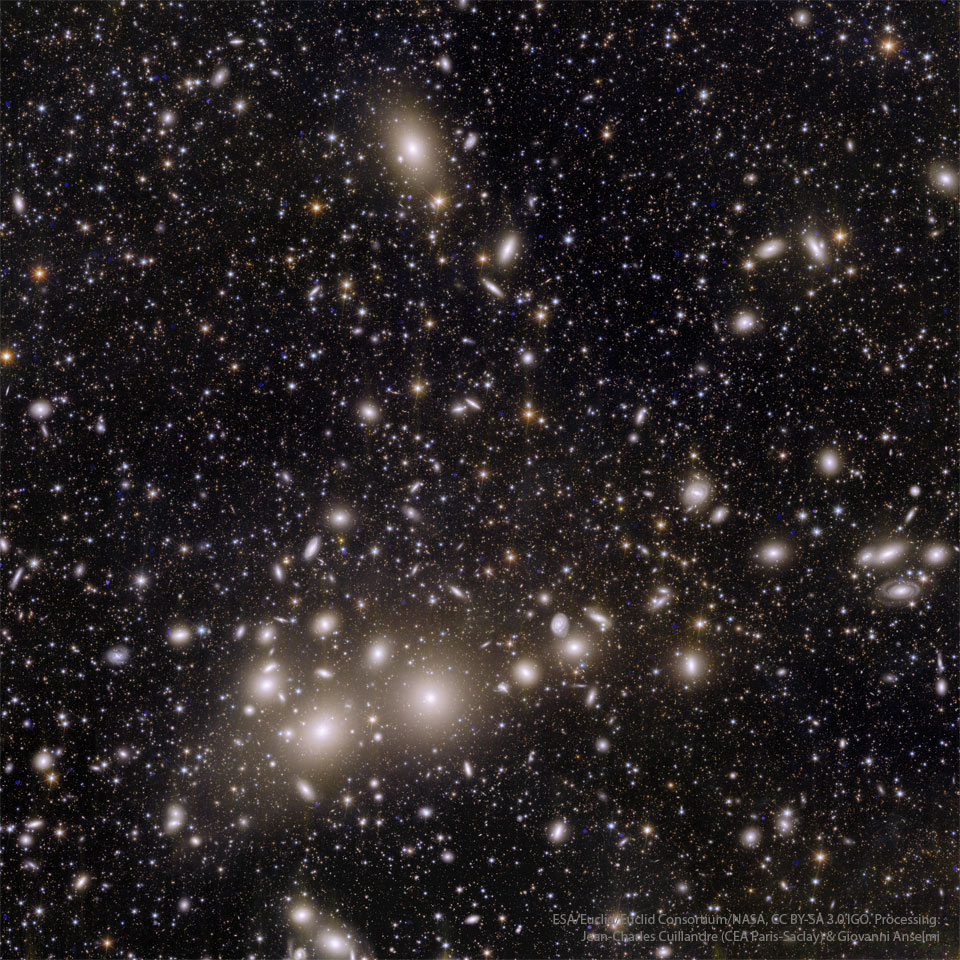
The Perseus Cluster (Abell 426) – a dense concentration of over a thousand galaxies with a total mass of about 1.2 × 10¹⁵ M⊙ – is impressive in its own right, especially because the picture was taken in a single exposure, but the staggering thing about this image is that it contains hundreds of thousands of galaxies. In other words there are as many galaxies in this picture as there are words in a book. Most of these galaxies are in the background, not associated with the cluster, and many of them extremely distant. With so many objects in one field, you can perhaps see how much data we will get from the entire survey, which will last more than 6 years. It is these distant sources – billions of them – that Euclid will survey to glean information about the expansion history of the Universe.
P.S. Yesterday’s press conference resulted in a lot of media attention worldwide, even some in Ireland. There is a piece on the RTÉ website, for example, and another on Silicon Republic (which includes a quote from yours truly).
 In the Dark
November 8, 2023 at 6:34 pm
It looks very nice, indeed! However, when one zooms in on the high-resolution version (https://upload.wikimedia.org/wikipedia/commons/a/ae/Euclid%E2%80%99s_view_of_the_Perseus_cluster_of_galaxies_ESA25170535.jpg), there’s quite a lot of obvious visible systematic errors, for instance blue dots to left of each bright star and strong striping in the upper right corner. Are these effects going to be removed with further tuning, or will they be there throughout the mission?
November 8, 2023 at 8:30 pm
None of the images released yesterday is part of the Euclid Survey (which won’t start until January); consequently none of them has been through the full pipeline. The features you describe (ghosts, etc) are consequences of stray light in the VIS instrument and are understood well enough that (a) the survey can be designed to minimise their occurrence and (b) any remaining ones can be removed by software. So the answer to your question is that there will be fewer in the raw survey data, but those left will be removed in the data processing.