Is it a truth universally acknowledged?
For reasons that may or may not be revealed shortly, I am currently re-reading the novel Pride and Prejudice by Jane Austen:
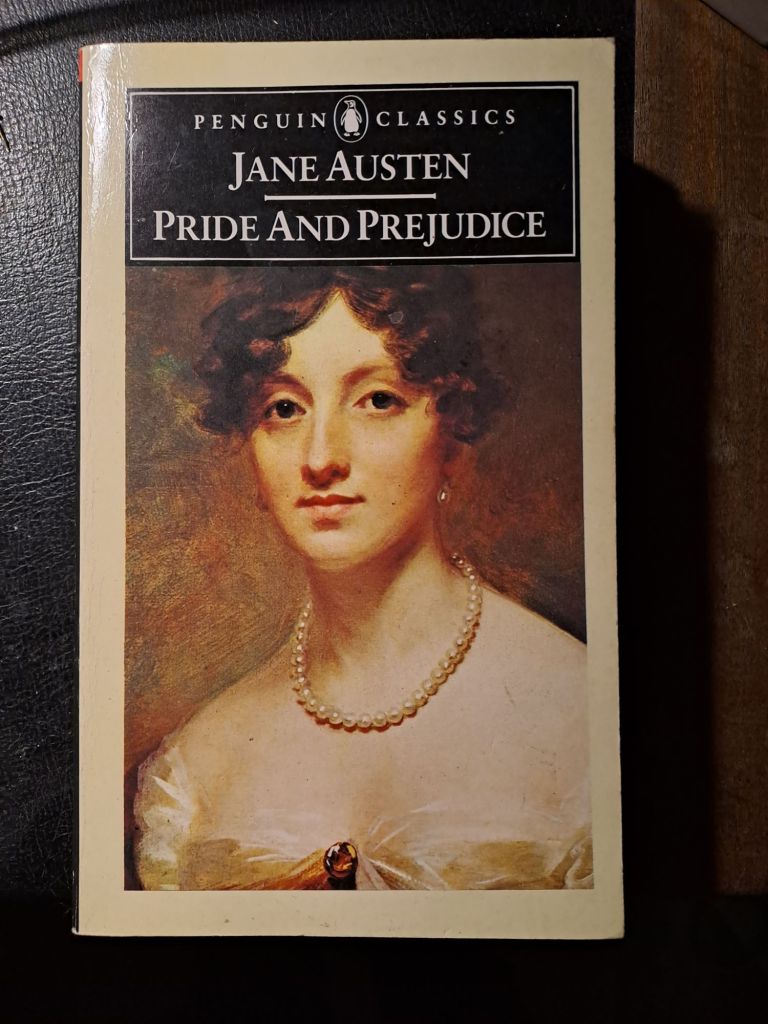
Among many other things, this has one of the most famously ironic opening lines in all English literature:
It is a truth universally acknowledged that, that a single man in possession of a good fortune must be in want of a wife.
I recently came across this discussion of this sentence by the philosopher Ludwig Wittgenstein, which I thought it would be amusing to share:
Let us ask what it is when we say “It is a truth universally acknowledged” that something is the case. Isn’t this a queer thing to say? How can we possibly understand it? At first sight it may appear that “it” is simply the something that is the case (ie that a man possessed of a certain degree of wealth will always feel the lack, or perhaps, without feeling it, be in need, of a wife). This “it”, however, can be no more than a pronominal anterior reference to the “truth” that is being claimed, without as yet there being any evidence for it, even though it is later stated to be acknowledged as a truth by everyone. In such a case it seems to us that the truth has been claimed a priori, since nothing can be acknowledged until it is proposed, although once proposed, such a supposed truth may be further tested through opinion and behaviour. Consider the much simpler proposition: “A man in possession of a good fortune must be in want of a wife”. We might reply “How do you know?”, a response that immediately raises the idea of possible exceptions to such a generalisation, such as (among other more complex forms of exception) that he may have a wife already, or may be a secret lover of men. To claim universal acknowledgement of a truth is to claim that a probable “truth” is undeniably true, which can be no more than a specious tautology. Moreover, as we have seen, the “it” with which we began has already laid claim to the existence of something (a kind of truth, as it soon turns out) that can only be assumed through this insistent and superfluous pronoun, which is a form of private acknowledgement by the speaker alone, and is by no means obviously universal. That this “it” is true, and that truth is also true, is what is being claimed here, and the double tautology becomes a distinct puzzle. To be induced to assent to an “it”, when there may be ample reason to doubt its very relation to the proposition which follows, is to be invited not to understand it.
I hope this clarifies the situation.
 In the Dark
January 16, 2024 at 2:50 pm
You’ve certainly piqued my curiosity as to the reason! (Although I don’t think all that strong a reason is required to reread this book.)
I don’t know about your fortune, but I suspect that you are not in want of a wife.
January 16, 2024 at 3:33 pm
It’s not mysterious but does pertain to a mystery. A while ago I bought a novel by PD James called ‘Death Comes to Pemberley’ which is set in the place and time of Pride and Prejudice. I thought I would read Jane Austen’s novel before the PD James one, as a refresher.
January 16, 2024 at 3:59 pm
I read that and enjoyed it.
January 16, 2024 at 4:49 pm
A German theoretical physicist once told me that his colleagues in the Philosophy Department often preferred to read Kant in English translation rather than the original, which I take to be a great compliment to the English language.
January 16, 2024 at 6:07 pm
I once told a German friend of mine that I tried to read Kant’s Critique of Pure Reason in English but found it impenetrable so concluded it must have been badly translated. He replied that it was also impenetrable in German.
January 17, 2024 at 10:37 am
When i was studying philosophy one of my fellow students, from Germany, indeed told me the same. It says much less about the english language than about the german, and in particular Kants use of its sentence structures. There are sentences that go over two or three pages, always with the verb at the end.
That said, i have read Kritik der Urteilskraft in the original.
February 27, 2024 at 10:48 pm
[…] pastiche of the style of Jane Austen set in the world of Pride and Prejudice; this is why I re-read that book before departing for Sydney. It has however taken longer than I thought to get around to reading the P.D. James book as I have […]