An Exercise in Bayesian Probability
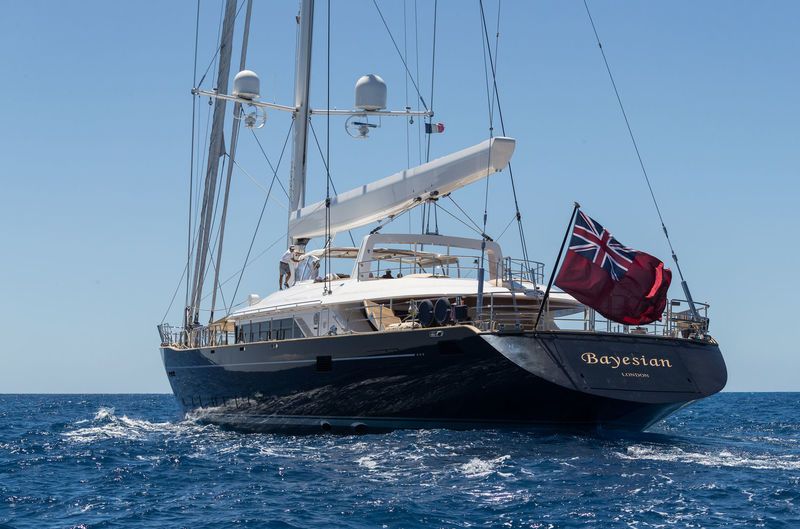
A businessman is on a luxury yacht, celebrating his recent acquittal in a high-profile fraud trial, when the yacht sinks in mysterious circumstances off the coast of Sicily. The businessman is one of six people on board who are missing, presumed dead. Just last week, the businessman’s co-defendant in the aforementioned fraud trial died in a mysterious road accident while out running in Cambridgeshire.
Using Bayesian methods, calculate the probability of these two events being a coincidence. Show your working. To the police.
Update: An investigation into possible manslaughter has been opened by the authorities in Italy.
 In the Dark
August 20, 2024 at 10:51 am
You’ll have to do better than that – the Lucy Letby case is making prosecutors nervous of basing their argument purely on statistics and probability.
August 20, 2024 at 12:40 pm
There’s also the Roy Meadows case from a few years back. I’ve been following the Lucy Letby case at a superficial level through the coverage in Private Eye and it does seem to me a possibility that a miscarriage of justice has occurred. In my opinion it is perfectly reasonable to use probability in the course of an investigation, to see what leads are worth prioritizing, but using such arguments in trial is fraught with difficulties.
August 21, 2024 at 12:21 am
Sally Clark was the cause celebre in this department.
It takes a higher power than a hitman to whistle up a waterspout and get it to make a direct hit on a yacht, even a yacht called Bayesian. (Yes, it was named after Rev Thomas Bayes.)
August 21, 2024 at 10:25 am
The eye-witness accounts are a bit confused and not all of them say a waterspout hit the boat. There was some sort of storm, but reports that the mast snapped contradict the divers’ saying that it was intact. Others say all the boat sank because all the hatches were open…
August 21, 2024 at 10:42 am
You leave hatches open for air when you aren’t expecting a storm, and it was 4.30am. I don’t see how the breaking of a mast can DEstabilise a yacht; certainly the mast was very tall. More info needed!
August 21, 2024 at 10:50 am
I suspect that the witness who claims to have seen the mast fall may have been confused and just saw it roll with the yacht when it capsized.
August 21, 2024 at 10:54 am
Did anyone on board work for Boeing?
August 21, 2024 at 5:02 pm
Mast failure could topple the boat. The mast is held straight by a complex set of tension cables “standing rigging” and lateral bars “spreaders”. If something fails, a metal mast will usually buckle sideways near the fail point but not snap in two, so that may topple the boat.
August 21, 2024 at 8:03 pm
I’m surprised because I thought the mast would be rather light.
August 25, 2024 at 11:00 am
The yacht had a keel to counterbalance the (very high, aluminium) mast, as is standard, but this keel was retractable for navigation in shallow water and was apparently raised into the boat at the time, even though the boat was at anchor in (as we now know) 50m of water. So it seems likely that the squall consequently tipped the boat onto its side, and water poured in through apertures that were not closed because they would not normally be below water level. So: why was the keel up? It also seems that nobody was on watch, raising the question of what was standard procedure on a vessel of this size and whether it was being followed. (Was alcohol a factor?)
https://www.bbc.co.uk/news/articles/c0l8kj1p0ylo
The driver whose car fatally hit Chamberlain (Lynch’s co-defendant) remained at the scene; it was not a hit-and-run.
January 13, 2025 at 8:41 am
Thanks You