The Quickening of the Year Again
Today would be the first day of teaching in Semester 2 at Maynooth University, were it not for the fact that it is a Bank Holiday in Ireland. The holiday marks Imbolc, an old Celtic festival occurring halfway between the winter solstice and vernal equinox in the Northern hemisphere. In the modern calendar the date is 1st February. In Ireland Imbolc is often referred to as a Lá Fhéile Bríde, St Brigid’s Day, after St Brigid of Kildare, whose feast day is 1st February. In the old pagan calendar, this day is regarded as the first day of spring, as it is roughly the time when the first spring lambs are born, daffodils, etc, start to appear, and the days get noticeably longer. It corresponds to the Welsh Gŵyl Fair y Canhwyllau and is also sometimes called, rather beautifully, The Quickening of the Year. It’s a time for rebirth and renewal after the darkness of winter.

I noticed some scepticism on social media about 1st February being the first day of spring, but it makes sense to me. I feel the same way about May being the start of summer too. From living 7 years in Ireland, I’ve always found May/June the most summery months – as far as that means anything in Ireland!
In the Northern hemisphere, in astronomical terms, the solar year is defined by the two solstices (summer, around June 21st, and winter, around December 21st) and the equinoxes (spring, around March 21st, and Autumn, around September 21st). These four events divide the year into four roughly equal parts of about 13 weeks each. If you divide each of these intervals in two you divide the year into eight pieces of six and a bit weeks each. The dates midway between the astronomical events mentioned above are the cross-quarter days, of which Imbolc is one. Here they are represented on a diagram:
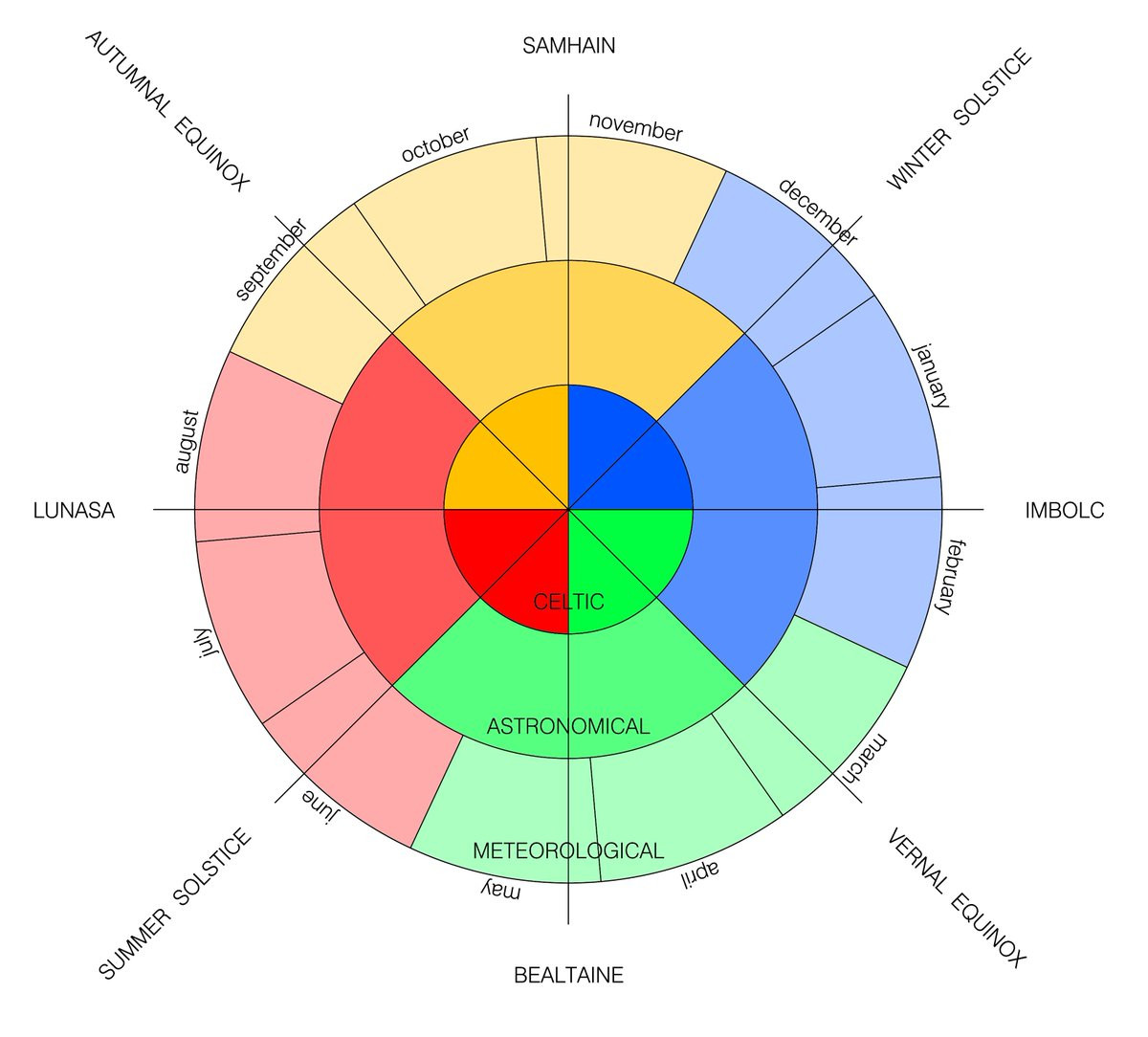
The timings are rough because the dates of the equinoxes and solstices vary from year to year. Imbolc is often taken to be the 2nd of February (Groundhog Day) and Samhain is sometimes taken to be October 31st, Halloween but hopefully you get the point that although the Pagan festivals have been appropriated by the Christian church, they have much older origins.
Until 2023 only three of the four cross-quarter days were associated with public holidays in Ireland; there wasn’t a holiday for Imbolc. In 2022 however, the Government decided to create a new Bank Holiday that corrected this anomaly by introducing a new St Brigid’s Day holiday on the first Monday on or after 1st February (or on Friday if 1st February falls on that day), which also happens to be the first national holiday in Ireland to be named after a woman. The first such holiday was Monday, 6th February 2023 and the second was on Monday 5th February 2024. This is the third.
But I digress.
I am glad to have today’s holiday just before teaching starts. Having completed my examination marking duties promptly I was planning to use last week to get my teaching materials ready. Unfortunately I wasn’t at all well for most of the week – though I recovered by Friday – and am way behind schedule. Fortunately, I’ve taught one of the modules (Computational Physics) many times before so not much preparation is required although it is a bigger class than I’ve had on previous occasions which means extra work in due course grading the CA components. The other module, Particle Physics is new for me at Maynooth, though I have taught it elsewhere. This also has a bigger class than I was expecting for a final-year module and my first lecture on it is tomorrow. I’m going to have to spend most of today quickening the writing of the lecture notes and preparing assignments.
P.S. Not particularly relevantly, Particle Physics is an anagram of Happier Cyclists.
 In the Dark
February 3, 2025 at 9:43 pm
I find it puzzling that people commonly refer to the definition of the seasons based on the solstices and equinoxes as being “astronomical”. A properly astronomical definition would be based on the declination of the Sun, not on the weather, and would therefore run between the cross-quarter days.
Incidentally, there is a modern cross dedicated to St Brigid on a beach not far from where I am, reputed to be the location where she landed in Britain.
February 3, 2025 at 11:02 pm
St Brigid seems to be a conflation of a number of legends, some of them pre-Christian. It is claimed thar she died in 525 A.D. which makes this the 1500th anniversary.
One of her miracles is that she somehow squeezed enough beer out of a single barrel to quench the thirsts of the parishioners of 18 different churches.
February 3, 2025 at 11:27 pm
Her skill with barrels would have made her popular.
February 17, 2025 at 6:51 pm
[…] Semester 1 because of a number of interruptions for holidays, etc. The first Monday of this term was actually a holiday, but I don’t actually have lectures on Mondays this term so that didn’t matter, nor […]