Masters from Cambridge
A few weeks ago, after I posted an item about it being 40 years since I graduated from the University of Cambridge, I was talking to some students. The main subject was that the primary route for becoming a research student is to do an undergraduate degree (Bachelors) followed by a taught postgraduate programme (Masters) before starting a PhD or equivalent. In the course of that discussion I mentioned that I skipped the middle step and went straight from my (three-year) BA at Cambridge to my DPhil at Sussex. Nevertheless, I have got a Masters degree: MA (Cantab), to be precise.
I had to explain that if you graduate from the University of Cambridge then all you have to do is wait a few years and then your B.A. automatically becomes an M.A. In my memory I received news of this just a year or two after graduation but this evening I found the correspondence and it was later than that:

By December 1988 I’d already finished my DPhil thesis, though I wasn’t formally awarded the degree until the following July. I didn’t turn up to the graduation ceremony, of course. I had done at least some work for my B.A. but did nothing at all for my M.A. except survive for three and a half years. Neverthless, I still have the stiff ticket (right) which I show here alongside my B.A. certificate (left) to demonstrate that it looks just like a proper degree certificate even though it is, frankly, a bit of a fraud.

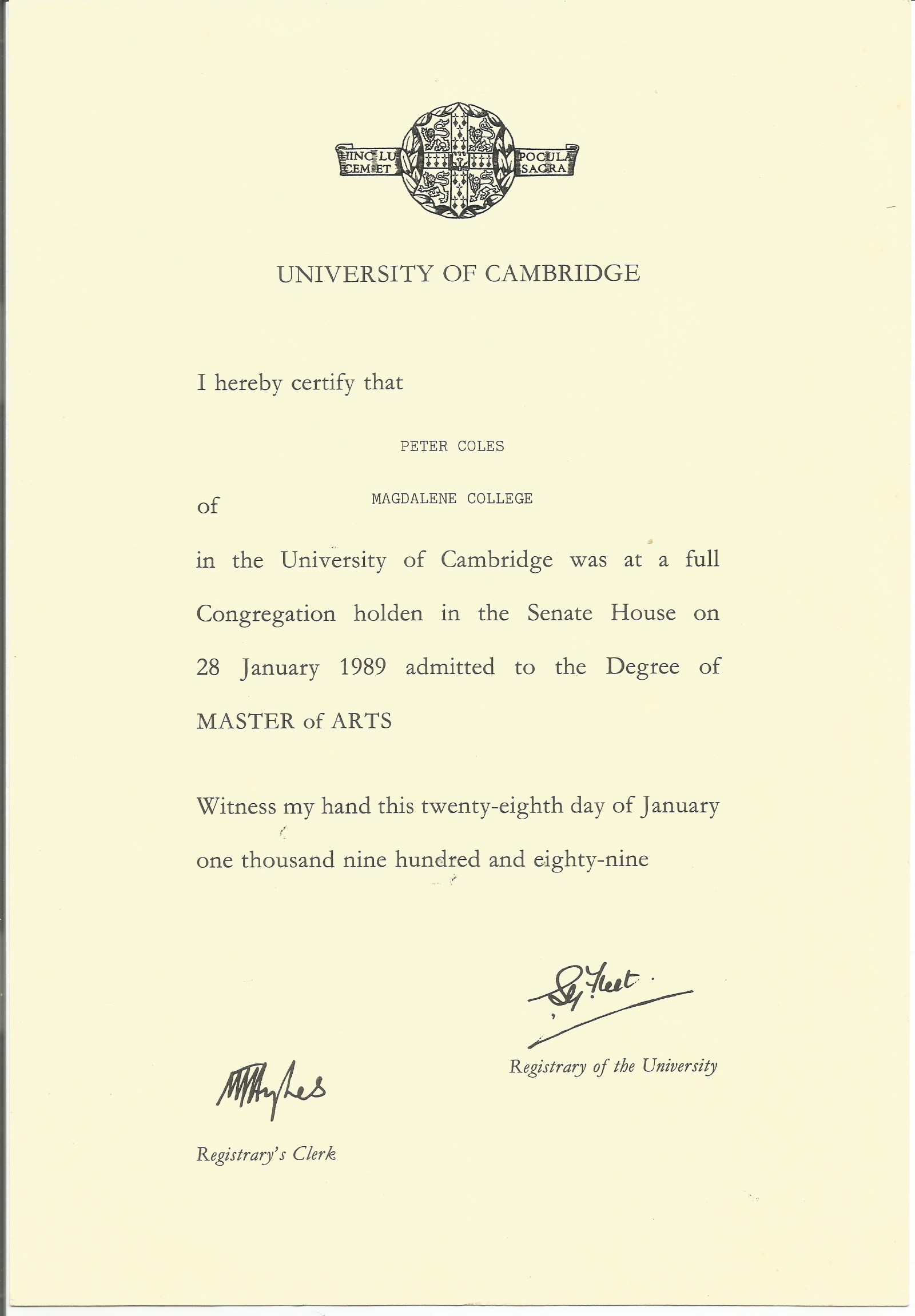
I bet our MSc students currently hard at work on their dissertations wish that theirs were so easy!
By the way, having an MA also gives you (limited) dining rights in College. I’ve never once availed myself of this privilege.
 In the Dark
July 23, 2025 at 9:19 pm
Everyone tends to think their experience is the normal, so for a long time I thought it was normal in the UK to go from a BSc directly to starting a PhD. In fact, this is the case for an Astronomy PhD from the Astronomy Unit at Queen Mary College, London. To be precise you need an upper second or first in a Physics or maths BSc. It is still the case today, as far as I know.
July 23, 2025 at 10:23 pm
Yes, but there are now also integrated masters, ie 4-year undergraduate programmes supposed to be equivalent to BSc + MSc. Most UK PhD students in science now do one of those first.
July 24, 2025 at 2:45 pm
We have the 4-year MSci degree where the students do a research-led project in their final year, when they are located within the research centre. They can then proceed from this to PhD.
July 23, 2025 at 11:28 pm
In Oxford in my time (graduated 1971 with a BA in Natural Philosophy) the norm was to go straight to a DPhil. There was no taught Masters course, although there was a strange option which anywhere else would be a taught MSc but Oxford called it a BSc (to distinguish it from the BA that physicists received). Naturally, nobody took it, so whether it could be called alive or dead is up to Schrodinger.
I achieved the 21 terms from matriculation, being the work required to receive the MA, so I collected my MA and DPhil at the same degree ceremony, which required several quick changes of gowns and robes to leave the building with one status, re-gown and rush round to re-enter with another.
I do recall the Cambridge degree ceremony (my son) being less elaborate than the Oxford one.
… but I think MAs from either place gives us entitlements of some sort at the other, plus Durham, St Andrews and Trinity College Dublin?
July 23, 2025 at 11:30 pm
I don’t know the details but I think Trinity College Dublin operates a similar system and has reciprocal arrangements for dining rights at Oxford and Cambridge.
July 24, 2025 at 9:12 am
I got my MA and PhD at the same ceremony, in 1981. They did the PhDs first, and candidates were called up one by one, by name: “John Peacock”. Then I went to the back of the MA queue and was eventually called up: “Dr John Peacock”. I suppose the establishment emphasis on status and pigeonholing can seem slightly distasteful, but I couldn’t help being impressed that they had gone to the trouble of attending to that tiny detail.
July 24, 2025 at 9:56 am
As I recall, this is a historical anomaly running back to when Oxford and Cambridge were the only universities in England.
Cambridge at least has changed to match majority practice at younger universities in regard to swapping the LLM and LLB degrees round (postgraduate law degrees), and has permitted colourful higher-degree gowns from yonger universities to be worn in its academic parades (it used not to). But the practice you discuss is yet to be changed.
I have a dim memory of being told on starting my PhD that if, at the end of my first year of research for my PhD, my research supervisor reckoned that I was not up to it, I might be awarded something lesser if I could provide a write-up to that point. Does this still go on and what is it called?
July 24, 2025 at 10:00 am
That option existed when I was a research student. It was called an MPhil. It is rare for anyone to register for an MPhil at the outset, but students would occasionally be transferred onto it as an exit award. You still have to write a thesis but there’s no requirement that it contain publishable material.
July 24, 2025 at 5:46 pm
Peter, your posting is quite funny. I do not think the eager “Oxbridge” respondents caught on your irony regarding the “emphasis on status” (paraphrasing JAP). I recommend they (re)watch [or read the novel, although the graphics of the TV series are more powerful] Poterhouse Blue, recalling that it is not satire but actually a documentary about Oxbridge ;-)
Of course, in the past Italians didn’t even award a PhD, so it is not Dr. Matarrese, but Sabino.
I recall a bit back a case of an ultra famous mathematician being offered one of the pompous “chairs” at Cambridge maths. He considered it for a bit and had to fill in some forms regarding his degrees. In surprise he calls up the Cambridge math administrative assistant because only two options were available for PhD degree: Oxford/Cambridge, when he explained his was from Princeton math, he was told: then put none! …
…still an empire of corsairs ;-)
July 25, 2025 at 12:14 pm
I preferred Ian Richardson in another documentary, called House of Cards.