On Cosmography (and going Mainstream)
On Friday I attended a colloquium in the Physics Department at Maynooth University by Asta Heinesen of the Niels Bohr Institute in Copenhagen. The talk had the title of Cosmography of the local Universe, as shown on the first slide:
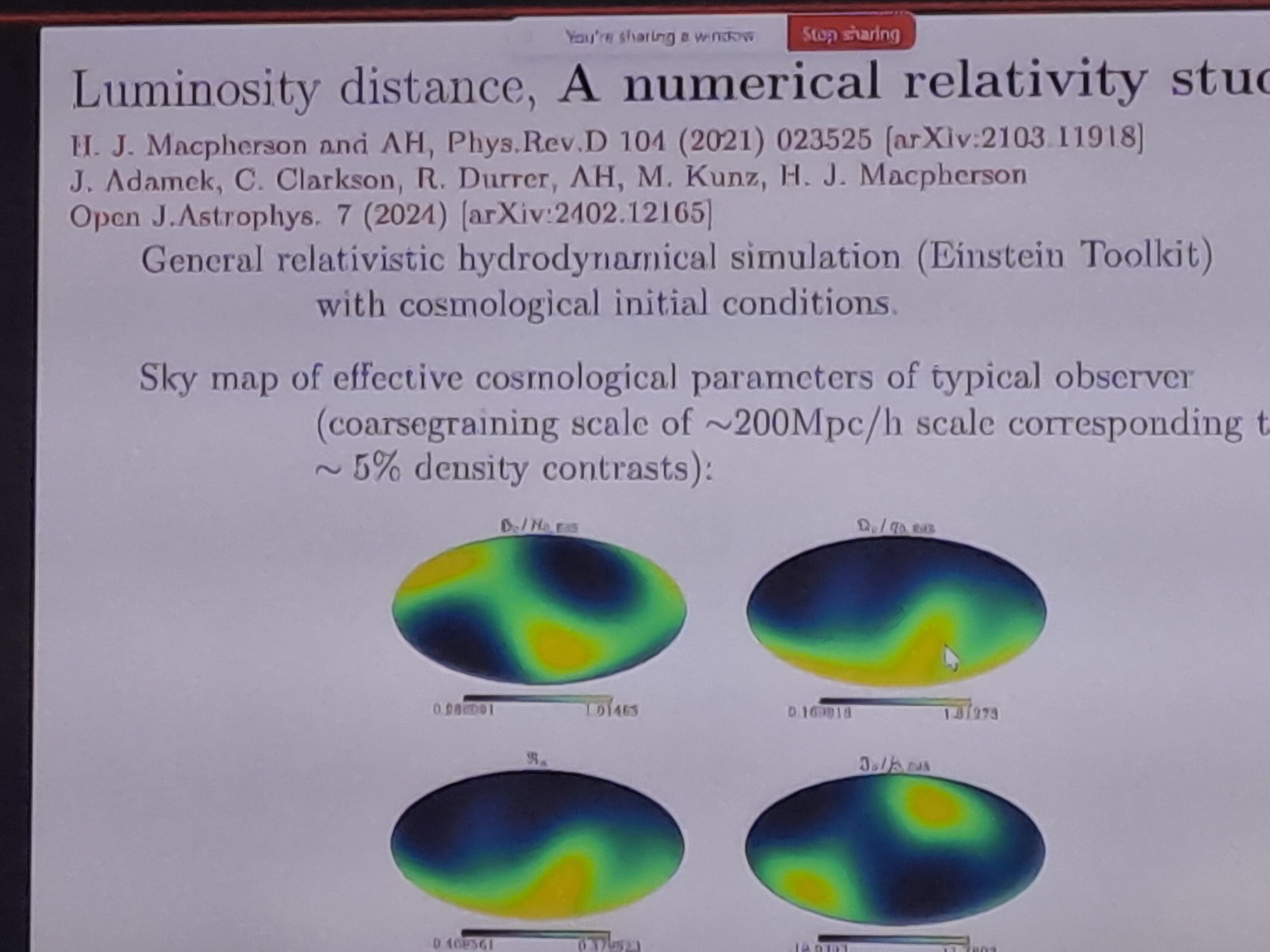
Asta talked about a very interesting programme of work that takes a different approach from most of modern cosmology in that it avoids making the prior assumption of global homogeneity and isotropy embodied by the Friedmann–Lemaître–Robertson–Walker metric. In particular, instead of assuming the isotropic expansion of the Universe, it tries to determine its properties directly using only such measurements as luminosity distances and redshifts. This method is not entirely model-independent because it does assume Lorentz invariance and the conditions required for the Etherington Reciprocity Theorem to hold, but it does not assume any particular form of the metric, so can be applied on scales where the distribution of matter is inhomogeneous and isotropic, e.g. in our local neighbourhood.
To apply this “metric-free” idea one has to construct as general as possible description of the kinematic properties of the underlying matter flow, allowing the global expansion to be anisotropic, and for there to be both rotation and shear. Obviously one would need a large number of measurements to extract anything like a full description of the matter flow, so generally one is restricted to deriving the low-order multipoles (monopole. dipole and quadrupole) as well as the observer’s velocity with respect to the large-scale matter flow.
I found Asta Heinesen’s seminar very stimulating in itself, but it was also nice to see that one of the papers on which it was based is published in the Open Journal of Astrophysics:
When I checked it, I found it was published on my birthday! Here is the overlay:

I announced it on this blog here.
I freely admit that I feel quite proud to have played a small part in helping to get such interesting work published. I’m seeing more and more papers referenced like this, actually. I was reminded of the recent announcement of this year’s list of MacArthur Fellows. among them Kareem El-Badry who has published quite a few papers with the Open Journal of Astrophysics. His biography on the MacArthur Foundation page includes this:
He has published articles in Monthly Notices of the Royal Astronomical Society, The Astrophysical Journal, and The Open Journal of Astrophysics, among other leading scientific journals.
I’m pleased to see us listed with the established names. I mention this just in case there are still people out there who think it might damage their career if they publish with a non-mainstream journal. We are mainstream now…
 In the Dark
October 20, 2025 at 11:45 am
Are there cosmologists who *don’t* assume Lorentz invariance? I can understand questioning the GR Lagrangian, but what grounds are there to question SR, and what do you replace it with?
October 20, 2025 at 1:11 pm
There are people who work on constraints on departures from Lorentz invariance using astrophysical observations. There are extensions of the standard model of particle physics that violate Lorentz invariance. One obvious possibility is to allow the photon to have a non-zero rest mass. The constraints on this are that m<10^-20 ev/c^2…
November 29, 2025 at 10:26 am
[…] The first paper this week is “A theoretical prediction for the dipole in nearby distances using cosmography” by Hayley J. Macpherson (U. Chicago, USA) and Asta Heinesen (Niels Bohr Institute, Denmark). This was published on Monday 24th November 2025 in the folder Cosmology and Nongalactic Astrophysics. It presents a method to predict the dipole in luminosity distances that arises due to nearby inhomogeneities to leading-order correction to the standard isotropic distance-redshift law. Incidentally, I wrote about a talk by one of the authors here. […]