The growth of light seed black holes in the early Universe
Meanwhile, back in the world of research, I see that Maynooth University has issued a news item about a new paper by colleagues in the Department of Physics, Daxal H. Mehta, John A. Regan and Lewis Prole. The story has also been picked up by the Irish media, e.g. here.
You may find the paper behind a paywall, as it is published in Nature Astronomy, in which case you will just have to make do with the abstract:

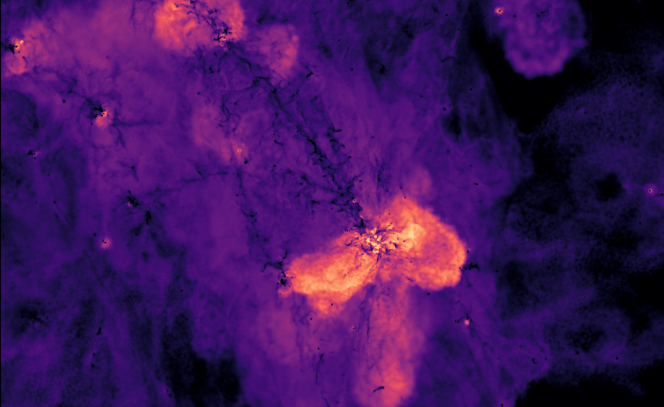
And here’s a pretty picture from one of the simulations used in the paper:
 In the Dark
January 27, 2026 at 4:50 am
[…] Black Holes“, „Growth of Light Seed Black Holes in the Early Universe“ mit einem Artikel und „JWST Spectroscopic Census of ALMA Faint Submillimeter Galaxies in the Hubble Ultra Deep […]
January 28, 2026 at 11:17 am
Fascinating work, Daxal. It is incredibly refreshing to see robust evidence that ‘Heavy Seeds’ are not a prerequisite for early supermassive giants.
Your simulation of rapid accretion in dense environments aligns perfectly with the discrete-time geometric stability I’m currently modeling. It suggests that what looks like ‘chaotic feeding’ might actually be a topological mechanism that allows matter to bypass standard radiative limits (the Eddington barrier).
Congratulations to you and the Maynooth team on the Nature publication!