Dark Energy Survey Year Y6 Results Day!
This morning’s arXiv announcement contained a number of papers related to the Dark Energy Survey Y6 analysis. There is also a Zoom webinar later today at 10.30 Central Time (16.30 GMT; 13.30 in Greenland). Details can be found here.
You can find links to and abstracts of all the papers here, but I thought it would be useful to provide arXiv links to the latest batch here.
- arXiv:2601.14559 Dark Energy Survey Year 6 Results: Cosmological Constraints from Galaxy Clustering and Weak Lensing – this is the key summary paper.
- arXiv:2601.14484 Dark Energy Survey Year 6 Results: MagLim++ Lens Sample Selection and Measurements of Galaxy Clustering
- arXiv:2601.14864 Dark Energy Survey: DESI-Independent Angular BAO Measurement
- arXiv:2601.15175 Dark Energy Survey Year 6 Results: Galaxy-galaxy lensing
- arXiv:2601.14833 Dark Energy Survey Year 6 Results: Magnification modeling and its impact on galaxy clustering and galaxy-galaxy lensing cosmology
- arXiv:2601.14859 Dark Energy Survey Year 6 Results: Weak Lensing and Galaxy Clustering Cosmological Analysis Framework
A number of DES Y6 papers already published – including several in the Open Journal of Astrophysics – are listed here.
I’ll just highlight a couple of points from the first paper listed above, which uses the now standard “3x2pt” analysis, which combines three complementary two-point correlation functions: cosmic shear; galaxy-galaxy lensing and galaxy clustering. The abstract of this paper is as follows:
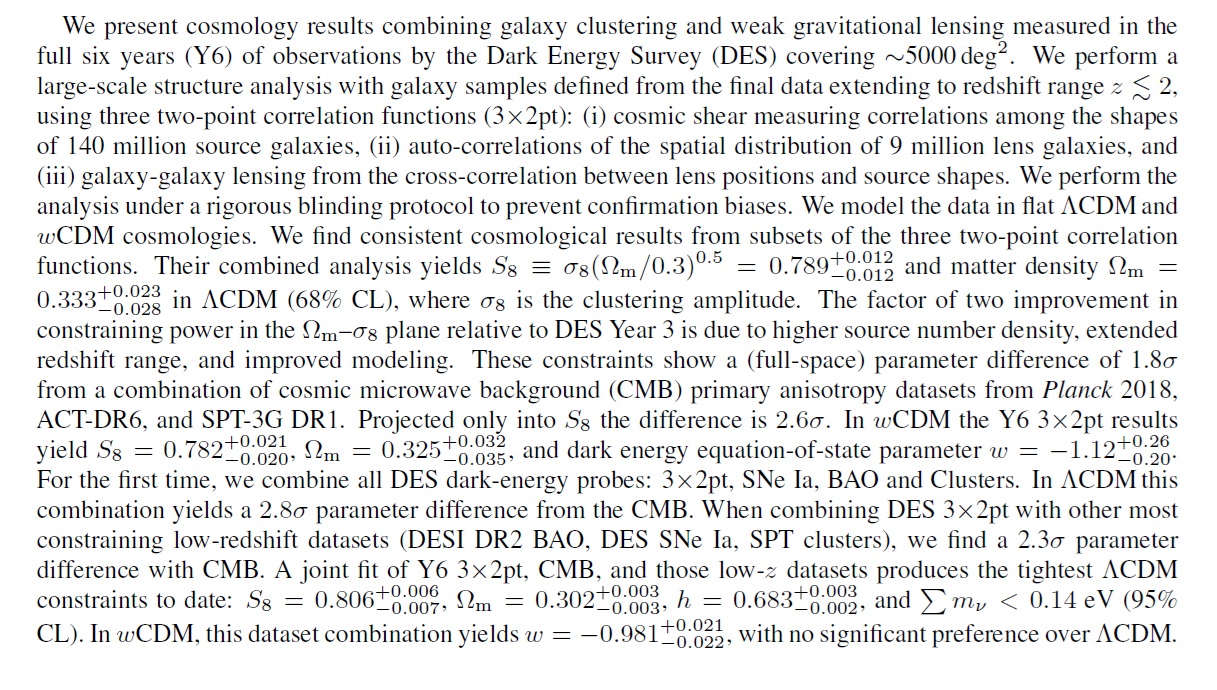
A notable result is contained in the last sentence. The simplest interpretation of dark energy is that it is a cosmological constant (usually called Λ) which – as explained here – corresponds to a perfect fluid with an equation-of-state p=wρc2 with w=-1. In this case the effective mass density ρ of the dark energy remains constant as the universe expands. To parametrise departures from this constant behaviour, cosmologists have replaced this form with the form w(a)=w0+wa(1-a) where a(t) is the cosmic scale factor. A cosmological constant Λ would correspond to a point (w0=-1, wa=0) in the plane defined by these parameters, but the only requirement for dark energy to result in cosmic acceleration is that w<-1/3, not that w=-1. Results last year from DESI suggested values of w0 ≠-1 and wa≠0 , but the current DES results are consistent with w=-1; they do not constrain w0 and wa jointly.
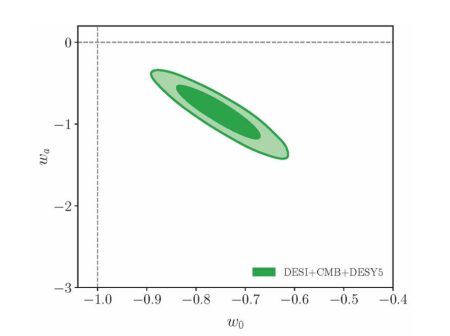
For reference on the left you can find the (w0, wa) plane from DESI.
I thought I’d add one of the other cosmological contraint plots:
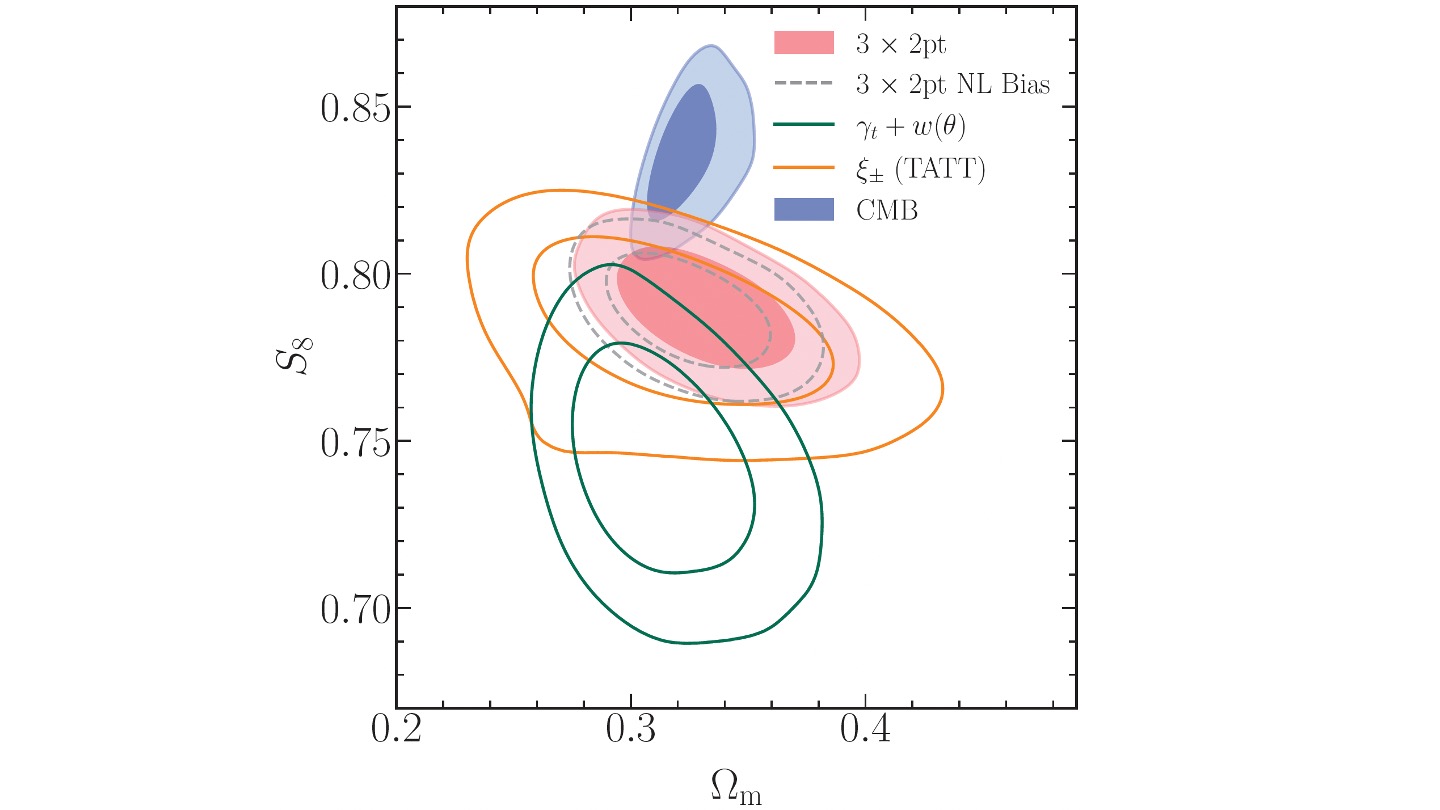
The results look qualitatively similar to previous plots but the contours have shifted a bit.
 In the Dark
January 22, 2026 at 1:33 pm
Do the DESI results say w != -1? With wCDM there was nothing strange. It was only with w0-wa that things got interesting… Note the 3x2pt DES paper doesn’t test w0-wa!
January 22, 2026 at 1:48 pm
My recollection is that only the lowest redshift bin for DESI favours w=-1 (although the error bars increase with redshift).
I should have made it clearer that the new DES results do not constrain w_a and have amended the text.