Structures on Gigaparsec Scales?
The latest in a sequence of claims of very large scale structures in the distribution that violate the cosmological principle emerged a week or so ago with a paper in Nature. The paper is behind a paywall but here is the abstract:
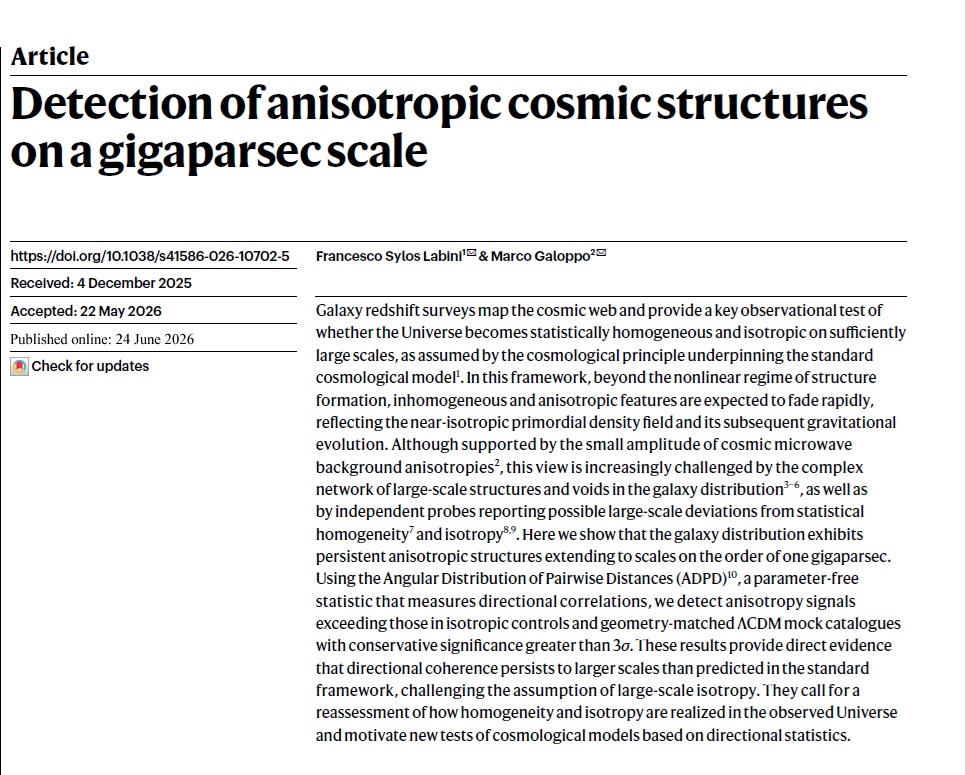
I’ve been nudged a few times by various people to comment on that but I’ve been busy recently and didn’t have time to look at the paper in detail. I had a quick look today and the thing that immediately struck me was that I didn’t understand the mock catalogues they used to compare the ΛCDM model with the observations. I still don’t understand that but I’ve stopped worrying about it because today I received a preprint (not behind a paywall, but on arXiv) from Till Sawala with the title The local galaxy distribution does not violate the cosmological principle and the (rather devastating) abstract:
The cosmological principle, which states that the Universe is statistically homogeneous and isotropic on sufficiently large scales, is a foundational assumption of the standard cosmological model. A recent analysis of DESI DR1 galaxy samples reported coherent anisotropic features in the local galaxy distribution extending to gigaparsec scales. If correct, this result would directly contradict the cosmological principle and motivate inhomogeneous cosmologies. Here I analyse the same data and compare them with galaxy distributions predicted by the FLAMINGO cosmological hydrodynamic simulation, performed in the standard ΛCDM paradigm. I show that the apparent anomaly disappears when the correct comoving distance scale is used. I also show that, rather than violating the cosmological principle, the observed structures are consistent with those expected in a ΛCDM Universe.
Here’s Figure 9 of the Sawala paper.
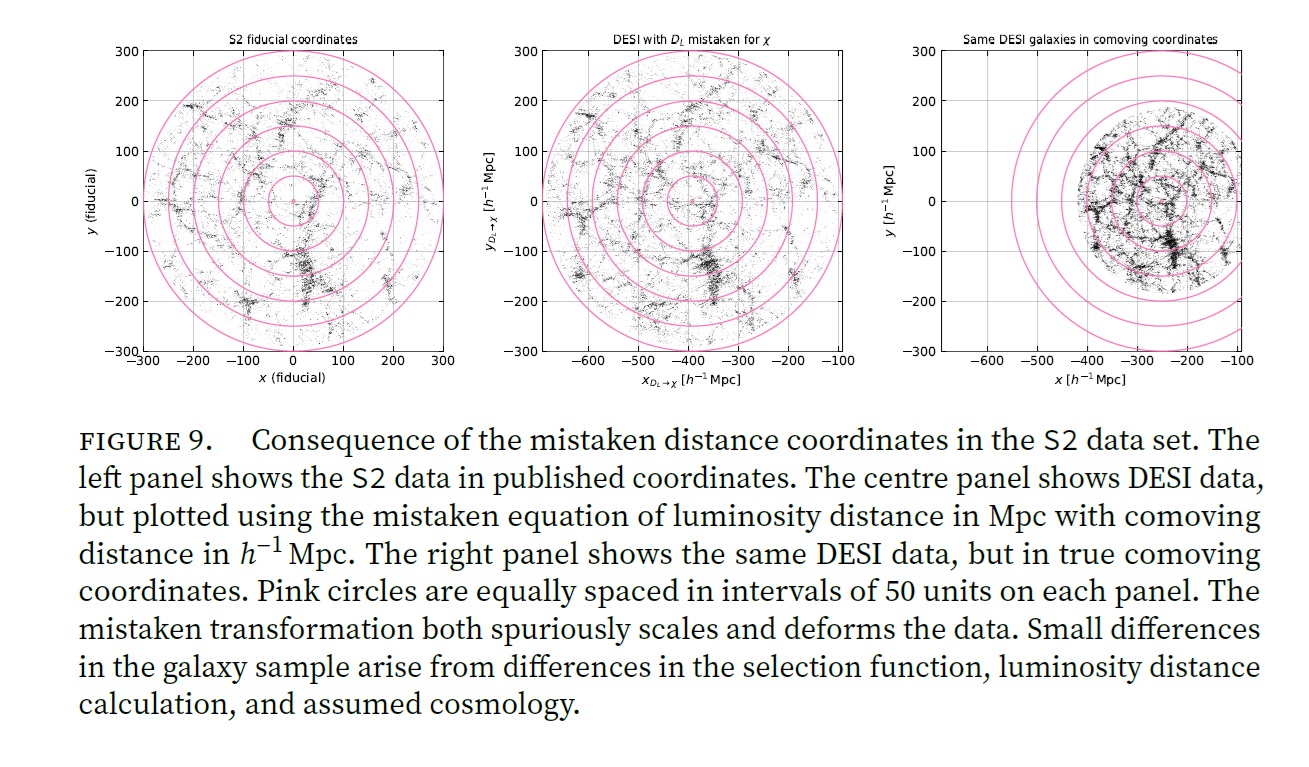
It seems that the authors of the Nature paper, Francesco Sylos Labini and Marco Galoppo, misinterpreted the distances of galaxies in the DESI DR1 sample in a way which boils down to an error of a factor (1+z)/h, where z is the redshift and h represents the Hubble constant. This hugely increases the scale and distorts the pattern of galaxy clustering. Using the correct comoving distance the measured structures are completely consistent with ΛCDM.
Oops!
P.S. I’ve stopped worrying about the mock surveys…


July 3, 2026 at 8:35 pm
Apart from the embarrassing error that Sawala points out, you were right to worry about the mock catalogues too. As far as I can tell, they are actually catalogues of dark matter particle positions from a simulation, not catalogues of mock galaxies. Galaxy catalogues would have a higher bias, so higher clustering amplitude, so structures out to larger scales …
July 3, 2026 at 8:54 pm
Yes, few details are given in the paper but it looked like they just used DM simulations despite galaxy mocks being available.
July 4, 2026 at 8:46 pm
[…] pictures in galleries, especially when I’ve got company as I had today, but in the light of yesterday’s post I couldn’t resist […]