Cosmology, Escher and the Field of Screams
Up early this morning for yet another busy day I thought I’d post a quick follow-up to my recent item about analogies for teaching physics (especially cosmology).
Another concept related to the cosmic microwave background that people sometimes have problems understanding is that of last scattering surface.
Various analogies are useful for this. For example, when you find yourself in thick fog you may have the impression that you are surrounded by an impenetrable wall at some specific distance around you. It’s not a physical barrier, of course, it’s just the distance at which there sufficient water droplets in the air to prevent light from penetrating further. In more technical terms the optical depth of the fog exceeds unity at the distance at which this wall is seen.
Another more direct analogy is provided by the Sun. Here’s a picture of said object, taken through an H-α filter..
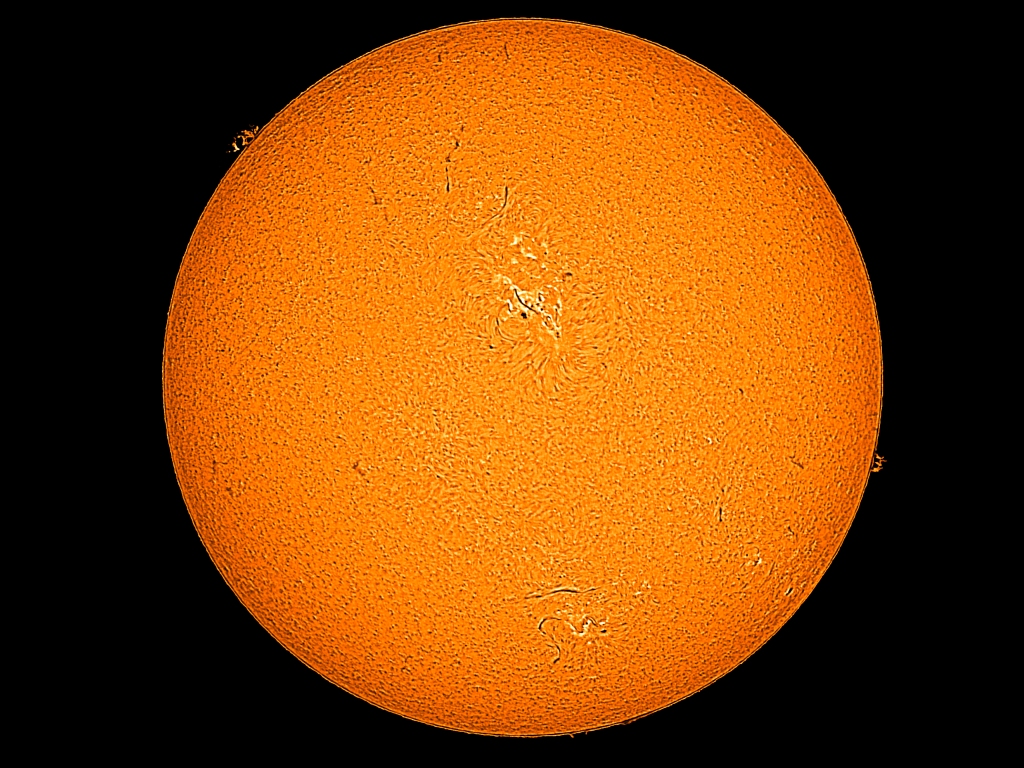
What’s surprising to the uninitiated about an image such as this is that the Sun appears to have a distinct edge, like a solid object. The Sun, however, is far from solid. It’s just a ball of hot gas whose density and temperature fall off with distance from its centre. In the inner parts the Sun is basically opaque, and photons of light diffuse outwards extremely slowly because they are efficiently scattered by the plasma. At a certain radius, however, the material becomes transparent and photons travel without hindrance. What you see is the photosphere which is a sharp edge defined by this transition from opaque to transparent.
The physics defining the Sun’s photosphere is much the same as in the Big Bang, except that in the case of the Sun we are outside looking in whereas we are inside the Universe trying to look out. Take a look at this image from M.C. Escher:

The universe isn’t actually made of Angels and Demons – at least not in the standard model – but if you imagine you are in the centre of the picture it nicely represents what it is like looking out through an expanding cosmology. Since light travels with finite speed, the further you look out the further you look back into the past when things were denser (and hotter). Eventually you reach a point where the whole Universe was as hot as the surface of a star, this is the cosmic photosphere or the last scattering surface, which is a spherical surface centred on the observer. We can’t see any further than this because what’s beyond is hidden from us by an impenetrable curtain, but if we could just a little bit further we’d see the Big Bang itself where the density is infinite, not as a point in space but all around us.
Although it looks like we’re in a special place (in the middle) of the image, in the Big Bang theory everywhere is equivalent; any observer would see a cosmic photosphere forming a sphere around them.
And while I’m on about last scattering, here’s another analogy which might be useful if the others aren’t. I call this one the Field of Screams.
Imagine you’re in the middle of a very large, perhaps infinite, field crammed full of people, furnished with synchronised watches, each of whom is screaming at the top of their voice. At a certain instant, say time T, everyone everywhere stops screaming.
What do you hear?
Well , you’ll obviously notice that it gets quieter straight away as the people closest to you have stopped screaming. But you will still hear a sound because some of the sound entering your ear set out at a time before t=T. The speed of sound is 300 m/s or so, so after 1 second you will still hear the sound arriving from people further than 300 metres away. It might be faint, but it would be there. After two seconds you’d still be hearing from people further than 600 metres away,. and so on. At any time there’ll be circle around you, defined by the distance sound can have travelled since the screaming stopped – the Circle of Last Screaming. It would appear that you are in the centre of this circle, but anyone anywhere in the field would form the same impression about what’s happening around them.
Change sound to light, and move from two dimensions to three, and you can see how last scattering produces a spherical surface around you. Simples.
Follow @telescoper
 In the Dark
March 20, 2012 at 8:05 am
The Escher thing (a Poincare disc) also has a deeper subtlety: it’s a representation of an infinite hyperbolic plane. But I LOVE the field of screams.
March 20, 2012 at 9:31 am
This is very good. Sounds travels mostly horizontally so this becomes a two-dimensional universe. If the field is infinitely large, the noise level become infinite (a sound version of Olbers) – unless the screamers have an ‘optical’ depth to the background sound radiation, the field of screams has a finite age, or the field is expanding and the long-distance screams are doppler-shifted. There are possibilities here. Could you make it an Escher-like hyperbolic field?
March 20, 2012 at 11:09 am
Do you want the Angels to scream, or just the Demons?
March 20, 2012 at 11:54 am
Screams and antiscreams?
March 20, 2012 at 8:41 pm
iscreams?
M
March 21, 2012 at 9:23 pm
smaercs
March 20, 2012 at 11:11 pm
I once gave a cosmology talk to a farmers’ club, and was stuck with trying to explain this view of the Universe as a series of shells of greater look back time. I’m afraid I found myself talking about a field of wheat, where the speed of light was really slow, so you were surrounded by tall wheat, but further out it got shorter until far out you saw only the green shoots. As you can imagine it was a bit of a struggle and not terribly successful.
March 21, 2012 at 8:08 pm
If I could switch to Coxian mode, the sharp visible edge to the Sun is amaaazing.
The Sun is 1.39 million km in diameter. The optical depth for light of 500nm wavelength changes from 0.2 (mostly transparent) to 2 (opaque) over just 120 km when looking at the centre of the solar disc, caused by a sharp change in the proportion of atoms that are ionised. That distance is 0.009% of the Sun’s diameter. That gives the sharp edge we observe for the solar disc. The temperature changes quite abruptly from 5410K to 7120K over this short distance. [I’m using the figures from the old Allen Astrophysical Quantities here to save having to type data and interpolate to get the figures I want from more definitive data.]
My research upbringing was in stellar chemical abundances, so I was very familiar with the physics of the solar atmosphere. It came as a pleasant surprise when I first realised that the same physics applied in a very similar way in cosmology to the formation of the cosmic background radiation.
Amaaazing.
March 23, 2012 at 2:15 am
” It might be faint, but it would be there.”
Begging your pardon, sir, but wouldn’t there be an aural equivalent of Olbers’ Paradox? You know, more screamers at the larger distances. I’m not quite sure of the 2-D properties of sound propagation, especially when the screamers are not Angels and Demons but old outfielders magically sifting in from cornfields. In baseball, you scream “I got it!” to warn off Shoeless Joe as you settle in under a fly.
March 23, 2012 at 7:51 am
But if you go back far enough, the sound would have to have been emitted long before baseball was even invented…
In any case Olbers’ paradox is that every line of sight ends on a photosphere, which it actually does (the cosmic photosphere)