End of Term Report: David Willetts
News broke yesterday that the Minister responsible for Universities and Science within the Department of Business, Innovation and Skills, David Willetts, had stepped down from his role and would be leaving Parliament at the next election.
Willetts’ departure isn’t particularly surprising in itself, but its announcement came along with a host of other sackings and resignations in a pre-Election cabinet reshuffle that was much wider in its scope than most expected. It seems to me that Prime Minster David Cameron has decided to play to the gallery again. After almost four years in which his Cabinet has been dominated by white males, most of them nondescript timeserving political hacks without beards, he has culled some of them at random to try to pretend that he does after all care about equality and diversity. Actually, I don’t think David Cameron cares for very much at all apart from his own political future and this is just a cynical attempt to win back some votes before the next Polling Day, presumably in May 2015. Rumour has it that one of the new Cabinet ministers may even have facial hair. Such progress.
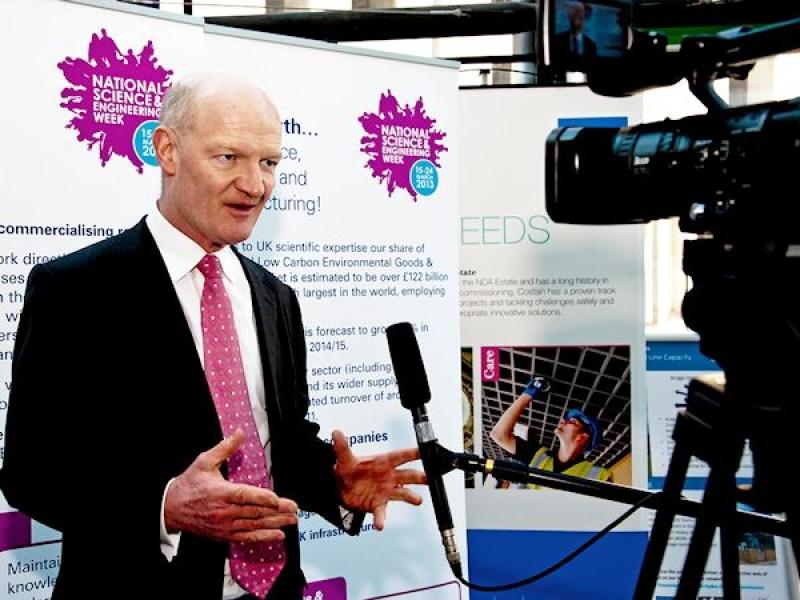
David Willetts was planning to step down at the next General Election anyway so his departure now was pretty much inevitable. I never agreed with his politics, but have to admit that he was a Minister who at least understood some things about Higher Education. In particular he knew the value of science and secured a flat cash settlement for the science budget at a time when other Whitehall budgets were suffering drastic cuts. He was by no means all bad. He even had the good taste – so I’m told – to read this blog from time to time….
The campaigning organization Science is Vital has expressed its sadness at his departure:
We’re sorry to see David Willetts moved from the Science Minister role. He listened, in person, to our arguments for increasing public funding for science, and we appreciated the support he showed for science within the government.
We look forward to renewed dialogue with his successor, in order to continue to press the case that science is vital for the UK.
Now that he has gone, my main worry is that the commitments he gave to ring-fence the science budget will go with him. I don’t know anything about his replacement, Greg Clark, though I hope he follows his predecessor at least in this regard.
Other aspects of Willetts’ tenure of the Higher Education office are much less positive. He has provided over an ideologically-driven rush to force the University sector into an era of chaos and instability, driven by a rigged quasi-market propelled by an unsustainable system of tuition fees funded by student loans, a large fraction of which will never be repaid.
Another of Willetts’ notable failures relates to Open Access. Although apparently grasping the argument and make all the right noises about breaking the stranglehold exerted on academia by outmoded forms of publication, he sadly allowed the agenda to be hijacked by vested interests in the academic publishing lobby. Fortunately, there’s still a very strong chance that academics can take this particular issue into their own hands instead of relying on the politicians who time and time again prove themselves to be in the pockets of big business.
My biggest fear for Higher Education at the moment is that the new Minister will turn out to be far worse and that if the Conservatives win the next election (which is far from unlikely), Science is Vital will have to return to Whitehall to protest against the inevitable cuts. If that happens, it may well be that David Willetts is remembered not as the man who saved British science, but the man who gave it a stay of execution.
Follow @telescoper In the Dark
July 15, 2014 at 12:00 pm
Re: beards, you’re in luck – apparently Stephen Crabb is the new Secretary of State for Wales: http://en.wikipedia.org/wiki/Stephen_Crabb
July 16, 2014 at 10:05 am
All politics ends in failure. But Willetts can probably call his ministership a success. We have been protected against the worst of the cuts, and as important, we have not had the specific targeting of pure or inconvenient science that has hit Australia and Canada. All major UK parties (leaving UKIP aside) now support science: I think four years ago that was far less obvious. Willetts may not be the sole person responsible but he has made persuasive arguments and set the agenda. And for us personally, the strong support for Jodrell Bank and the SKA has been a real help.
On the minus side, the UK cuts have been real, and offset only by the EU science money. If that were to dry up we would be in some trouble, The tuition fee system seems a financial black hole in waiting, and the open access policy is taking money from science for no obvious benefit (or the opposite: our university is now being difficult about paying page charges for ApJ – ‘non compliant journal’). I think both are cases where private companies are being given access to public money. Perhaps not wrong in principle where private companies provide a good service, but where are the checks? How is it possible we now can pay for the ‘open journal of the irrelevant’ and not for the highest cited astronomy journal in existence? Perhaps Willetts could have sorted this out with a bit more time.
The next incumbent won’t have much time to gain the trust of the community, or to proof he can set policy rather than just follow orders.
July 16, 2014 at 12:36 pm
I keep a list of about 15 astronomy journals (out of about 55) which I am happy to pay for out of our group resources. There is another group where people may want to publish in if they wish but I won’t pay. They are not widely read. There are also bona fide journals which I do not recommend. And finally there are bogus journals. Those make a big deal out of being ‘open access’ (names may even start with ‘open’) and meet all the relevant criteria but lack standards (and in some case, don’t actually exist). With the new system, some of the top journals are blocked for us and the quality control and protection against the open access predators aiming to separate scientists from their money has mostly gone.
Whether ApJ is necessary is not the issue (but remember (1) co-authors have no choice, (2) different journals target different communities. But I want a way to stop rubbish being published under our name.
Bur wasn’t this about the Willetts legacy?
July 17, 2014 at 8:20 am
Arxiv has leveled the field a lot. Still, there is so much being published that people have their coping strategies, deciding what to read, what to accept, and what to deem important. The judgement uses perceived quality of the journal, its refereeing standards, reputation of the authors and for unknown authors, their affiliation. There may be others. A well-known author can publish in a minor journal and still be noted. A junior person can not.
And the reputation of the journal does still differ per field. Not as much as in the pre-arxiv days, but it has not gone. If you want to compete with the best, publish where they publish. And wait. in 20 years, your competitors will publish where you publish.
July 17, 2014 at 10:09 am
The effect can be measured. Of course interpretation of the measurement is, as always, more subjective. On ADS, select a year, rank on citation count, and compare the journals. Cosmology still is bigger in the US. Exoplanets are stronger in ApJ. For Milky way studies, A&A. Star formation histories, MNRAS.
ADS may have been an even more important leveler than arxiv.