What works with Online Teaching?
Since the cancellation of in-person lectures and tutorials at Maynooth University a few weeks ago, we’ve all been trying – mostly without much a priori knowledge – how to teach students using exclusively online methods.
In the Department of Theoretical Physics we’re all trying different things and trying our best to learn from student feedback how to improve.
Maynooth University recently launched a survey of students that was completed by about 3000 in 24 hours, which is a very good response.
The results are very interesting. When asked what works best for them the responses were:
- 39% prefer PowerPoint with sound;
- 27.2% prefer recorded video or screencast;
- 18.6% prefer text materials (Word/Pwpt); and
- 12.2% prefer live video or screen cast.
I’m sure that there is no single “best” way of doing this. What works will depend a lot on the discipline (and the kind of material to be presented) and on the lecturer (and how comfortable they are with different approaches), as well as on the student.
I’ve always felt that students being different individuals all learn in different ways so the best approach is to offer as broad a mixture of approaches as possible in order to try to offer something for everyone.
For my part what I’m doing is making a PDF of the lectures available for the students to study in their own time, but also record short (15-minute) recorded video explainers of the key concepts using a piece of software called Screencast-o-matic.
Here’s a still from one of my Computational Physics videos:
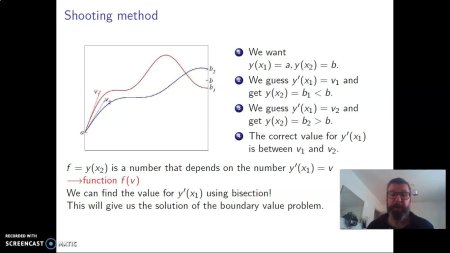
You see they get the notes with a pointer moving about on it as I talk, but also have to endure an encapsulated video of me waving my hands and blabbering on, for that authentic lecture experience.
The video and audio is not ideal because of lighting and background sound issues in my flat which is why I felt keeping the recordings short would be useful.
I recorded the one shown above (and several others) before I figured that it works better to use the natural light coming in through the window than electric lighting. That means that I now do my recordings in the morning, when I can face the sunlight in my sitting room.
I should add that we also have a laboratory for this course. The students are given a script to work through then some (Python) coding exercises to complete. They have to do these at home but myself and a demonstrator are online via Microsoft Teams to assist the students who can share screens and output files to help us diagnose any bugs.
Anyway, what works for you?
Follow @telescoper In the Dark
April 8, 2020 at 3:13 pm
This is v interesting. There was I feeling guilty about just bolting on sound to ppt!
The results also make sense to me. When looking at conferences, I very rarely download video of entire talks, much prefer scroll through the slides.
April 8, 2020 at 3:18 pm
I’m going to prepare an Open Day talk like that today!