They think it’s all over…
This afternoon it was announced that the Government of Ireland would be accepting the latest advice from the National Public Health Emergency Team (NPHET) to wind down most of the remaining Covid-19 restrictions from 28th February 2002. The first officially recognized Covid-19 case in Ireland was reported on March 1st 2020, so that will be two years after the arrival of the pandemic here.
The decision means that face masks will no longer be required on public transport or in shops or in schools, though they will be mandatory in hospitals and other health-care settings. I assume this extends to universities too. Likewise limits on social distancing. The Chief Medical Officer has also announced that PCR testing will no longer be performed for anyone under the age of 55. It seems that even NPHET itself is to be phased out.
I know many people will be celebrating the end of these restrictions, but in case you need reminding here are the latest figures for Covid-19 in Ireland:
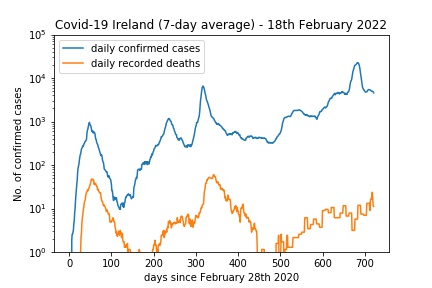
PCR-confirmed new cases are still running at 4500+ per day (almost double that if you include self-reported antigen tests). That means medically vulnerable people would be at risk of infection if those around them are not wearing masks. Masks protect others more than they protect the wearer so allowing the wearing of face masks to be discretionary puts such people in danger. For this reason I for one will be continuing to wear a face covering in shops, on buses, etc for the foreseeable future.
I don’t mind this – it was widespread practice in Asia long before the Coronavirus pandemic – and just can’t understand the extreme anti-maskers who liken the wearing of a face covering to being put in a concentration camp. I just hope we don’t get situations in which those who choose to wear a mask on, say, a bus get picked on by those who don’t.
At the moment in the Department of Theoretical Physics at Maynooth the situation is that a significant fraction of our students are staying away from lectures because of illness or self-isolation and one lecturer is having to do his teaching remotely. That’s not too bad; I feared much worse. I think other Departments have worse problems, missing demonstrators and tutors who are unable to come on campus.
The logic behind scrapping these restrictions is that despite the high case numbers the vaccination programme (helped, perhaps by the ‘milder’ omicron variant) does seem to have succeeded in keeping hospitalizations and deaths at a much lower level than in previous waves. Implicitly the strategy is to let Covid-19 wash over the population without worrying that the Health Service will be overwhelmed. My main worry now is what if another variant emerges after we have let our guard down?
 In the Dark
February 19, 2022 at 10:08 am
The other worry is long covid, which very few politicians are talking about, but which could affect over 10% of those who catch the disease. This can lead to long term disability which is expensive in economic and social terms. I don’t even know if countries are keep stats for long covid cases. In the UK clinics dedicated to helping people with it are overwhelmed.
February 19, 2022 at 8:52 pm
I’m not sure why you hedge the ‘milder’ character of omicron with quotation marks; it surely is milder, and it (not vaccination) is clearly why many countries are lifting restrictions at the moment; the countries lifting restrictions are at diverse percentages of vaccinated but in all of them omicron is sweeping through, so that is the unique correlative factor.
What matters is not the number of infections but the number of hospitalisations, just as with flu. If that is down to the level of a regular winter flu, life must return to normal as an imperative for the sake of the economy (which in practice means so that the poor can pay their bills) and for the mental health of the young and the old.
February 21, 2022 at 8:52 am
You are missing two things here.
Firstly it is not just hospitalisations that matter. You can be long-term disabled by Covid – omicron or otherwise – without being hospitalised. Figures for long term impacts if covid infection vary but seem to be in the range of 10 to 40% for impacts that linger for 12 weeks or more. That can have a huge impact if the infection is allowed to spread. So number of infections does in fact matter. More infections also makes new variants more likely, which an be worse as well as better.
Secondly, while omicron seems to be about half as likely as delta to send you to hospital, it is 2 to 4 times as infective. Its impact is thus likely to be similar or greater in terms of hospitalisations. That many countries are seeing fewer hospitalisations with omicron is likely due to vaccinations and other demographic factors, not to any inherent reduction in overall hazard. But vaccination effectiveness wanes, and those with weak immune systems or who are immunocompromised don’t have that benefit. So they are being put into far greater hazard by the demands to get back to normal without any additional anti covid measures.
I for one am not willing to sacrifice the immunocompromised and risk long term disability for the perceived benefit of those who can’t be bothered to wear face coverings, or for governments and organisations who don’t want to spend a little money on improved ventilation.
Pretending covid has gone away or is just a new flu is actually going to make matters worse.
February 21, 2022 at 6:59 pm
Did I mention face coverings?
Perhaps the optimal strategy is for everybody to catch omicron – which confers longer immunity than vaccines – while still fairly well protected by immunity conferred by a previous dose of covid, or the vaccines. The immunocompromised lived under permanent risk before covid. Don’t forget the economy, ie the poor, and the mentally ill. I still have some long cvid symptoms myself, by the way.