Not a Weekly Update from the Open Journal of Astrophysics – 03/01/2026
Not entirely surprisingly, we have not published any papers at the Open Journal of Astrophysics since the last update on 27th December 2025. Of course many authors have been on holiday and there were no arXiv announcements on either Tuesday 30th December or Thursday 1st January anyway. Although we had a few papers accepted before the break, none of them appeared this past week. I dare say some of them will appear next week. We will be starting Volume 9 in 2026, as soon as there is a paper to publish in it.
There being no papers to report, instead of doing one of the regular Saturday updates, I’d like to take the opportunity afforded by this pause to thank everyone who has supported the Open Journal of Astrophysics this year – Editors, Reviewers, Authors and the excellent Library staff at Maynooth University Library – and who have made it such a bumper year. I’d also like to repeat a call for volunteers to join the Editorial Board. In 2023 we published just 50 papers, and in 2025 the figure was 213, so we have more than quadrupled in two years. How many will we publish in 2026?
Here is a graphic showing the number of new papers submitted to the Open Journal of Astrophysics since January 2020:
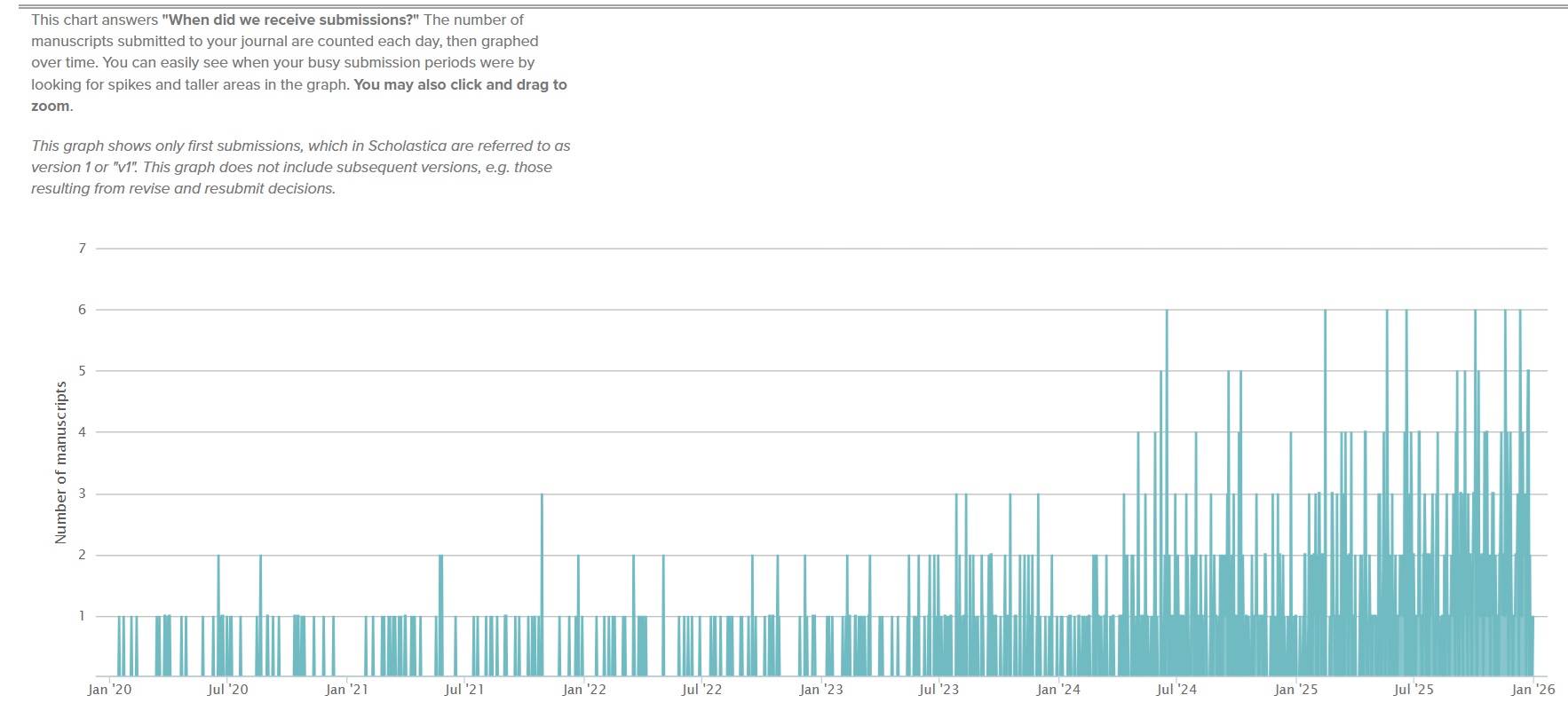
As the legend explains, this is only the first submission of a paper – resubmissions of revised papers are not included. You can see the thicket is getting denser all the time!
The increasing number of articles is of course very welcome indeed, but it is increasing the load on our Editorial Board many of whom are also very busy with other things. We have expanded the Board recently, but we’re always for volunteers to join the team, in any area of astrophysics. As a reminder, here are the areas we cover, corresponding to the sections of astro-ph on the arXiv:
- astro-ph.GA – Astrophysics of Galaxies. Phenomena pertaining to galaxies or the Milky Way. Star clusters, HII regions and planetary nebulae, the interstellar medium, atomic and molecular clouds, dust. Stellar populations. Galactic structure, formation, dynamics. Galactic nuclei, bulges, disks, halo. Active Galactic Nuclei, supermassive black holes, quasars. Gravitational lens systems. The Milky Way and its contents
- astro-ph.CO – Cosmology and Nongalactic Astrophysics. Phenomenology of early universe, cosmic microwave background, cosmological parameters, primordial element abundances, extragalactic distance scale, large-scale structure of the universe. Groups, superclusters, voids, intergalactic medium. Particle astrophysics: dark energy, dark matter, baryogenesis, leptogenesis, inflationary models, reheating, monopoles, WIMPs, cosmic strings, primordial black holes, cosmological gravitational radiation
- astro-ph.EP – Earth and Planetary Astrophysics. Interplanetary medium, planetary physics, planetary astrobiology, extrasolar planets, comets, asteroids, meteorites. Structure and formation of the solar system
- astro-ph.HE – High Energy Astrophysical Phenomena. Cosmic ray production, acceleration, propagation, detection. Gamma ray astronomy and bursts, X-rays, charged particles, supernovae and other explosive phenomena, stellar remnants and accretion systems, jets, microquasars, neutron stars, pulsars, black holes
- astro-ph.IM – Instrumentation and Methods for Astrophysics. Detector and telescope design, experiment proposals. Laboratory Astrophysics. Methods for data analysis, statistical methods. Software, database design
- astro-ph.SR – Solar and Stellar Astrophysics. White dwarfs, brown dwarfs, cataclysmic variables. Star formation and protostellar systems, stellar astrobiology, binary and multiple systems of stars, stellar evolution and structure, coronas. Central stars of planetary nebulae. Helioseismology, solar neutrinos, production and detection of gravitational radiation from stellar systems.
We are looking for experienced scientists in any of these areas, and it would indeed be useful to have people who can cover a range of subjects (as some of our existing editors do). Since we don’t charge authors or readers we can not offer payment to Editors but it is nevertheless a way of providing a service to the community. If you’re interested, please get in touch either through the Open Journal website here, through a message on Mastodon here or BlueSky here.
 In the Dark
January 3, 2026 at 9:19 pm
I’d like to volunteer, but I can’t find a way to submit information at the OJA website you provide above. Could you please clarify how one should apply, please?
January 5, 2026 at 8:48 am
An email link is provided at the page I linked to.
February 8, 2026 at 11:54 am
[…] As I mentioned last month, we are always on the lookout for new Editors. Please contact me if you’re […]