M.C. Escher and CP Violation
I’ve had these pictures for quite a while and can’t remember where I got them from, but I used to show them in my lectures on Theoretical Particle Physics when I was in Nottingham to illustrate CP-violation and used them in this morning’s lecture at Maynooth.
The following picture by M.C. Escher is called Day and Night:
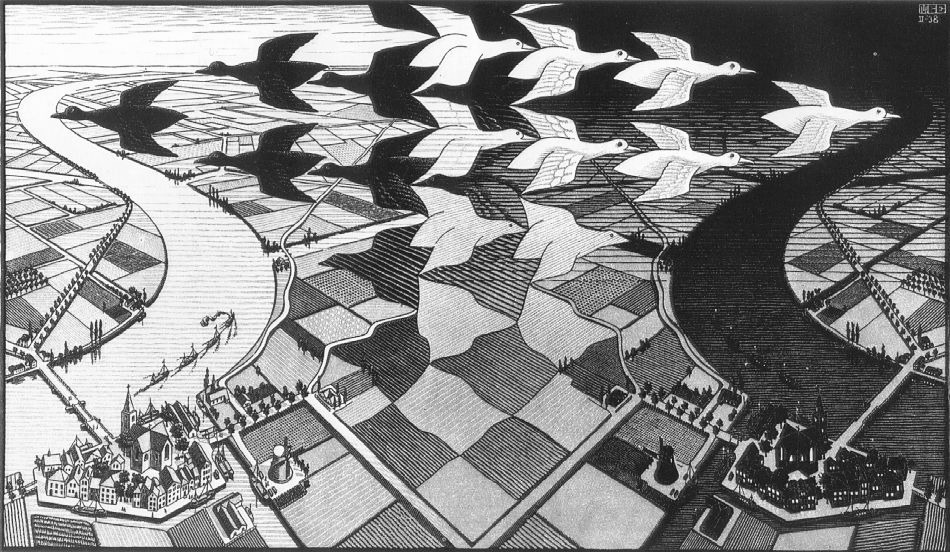
If you look at it you can see two kinds of symmetry emerging. One is a kind of reflection symmetry about a vertical axis drawn through the centre of the picture that applies to shapes but not to colour. The other is between black and white. But it is obvious that the picture doesn’t display these symmetries separately: to get a picture unchanged from the original you would have to do the mirror reflection and change black to white (and vice-versa).
The mirror reflection in the image can be taken to represent parity (P). Strictly speaking parity refers to a reflection through the origin in 3D rather than a mirror reflection, but it’s just for illustration. We know that a parity symmetry is violated in weak interactions just as it is in the picture.
The other possible symmetry, between black and white can be taken to represent charge-conjugation (C), the operation that converts particles into anti-particles and vice-versa.
While P is not an exact symmetry of weak interactions, it was long thought that the combination of C and P (CP) would be. Actually it isn’t. The story of the discovery of CP-violation is fascinating but I don’t have time to go into it here. It suffices to say that the Escher print also displays CP violation.
First lets do `C’, i.e. convert black to white and vice-versa. The result is:

Now reflect about the vertical mid-line to illustrate `P’:
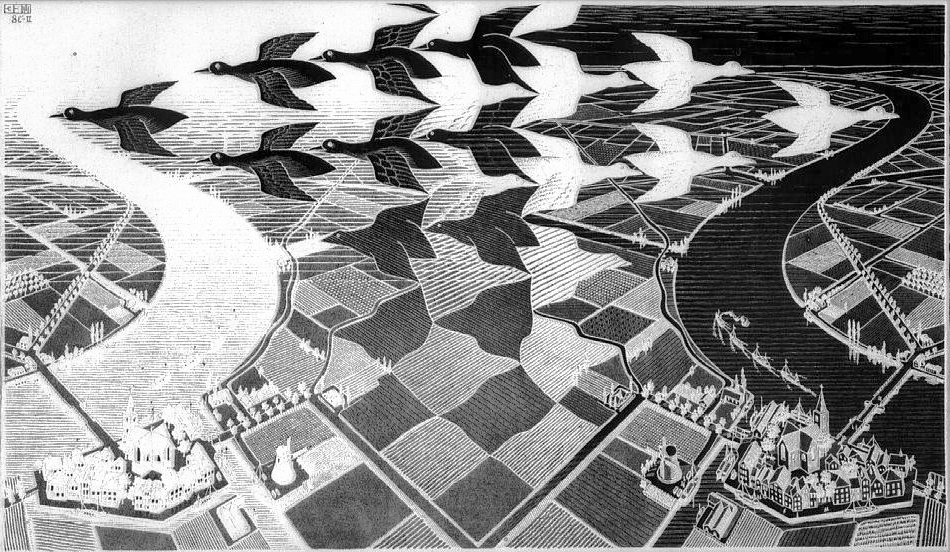
If `CP’ were an exact symmetry then that image would be identical to the original, which I reproduce here:
You can see, however, that while some elements of the picture do look the same after this combined operation (e.g. the birds), others (e.g. the buildings at the bottom) do not. Although CP is not an exact symmetry of this picture, it is almost (just like it is in particle physics).


April 28, 2026 at 10:29 am
Honour to bicultural Chen-Ning Yang, who died aged 103 last October and proposed parity violation with TD Lee, winning a Nobel Prize. He perhaps deserved another for Yang-Mills theory.
April 28, 2026 at 10:33 am
Yes, I did the oration for TD Lee when he received an honorary degree from Nottingham University years ago. He passed away in 2024 aged 97.
T.D. Lee was the second-youngest ever winner of the Physics Nobel Prize…
April 28, 2026 at 12:14 pm
Did he Bragg about it?
April 28, 2026 at 12:19 pm
Yes, after some reflection.
April 28, 2026 at 12:22 pm
That’s crystal clear.
April 28, 2026 at 2:11 pm
Bragg’s word is the law around here.
April 28, 2026 at 12:09 pm
In the late 1940s, while based at the Yerkes Observatory, Chandrasekhar drove 80 miles each way to the University of Chicago to teach a special course, which often had only two dedicated students: T.D. Lee and C.N. Yang.