The Fallen, by Louise Brangan
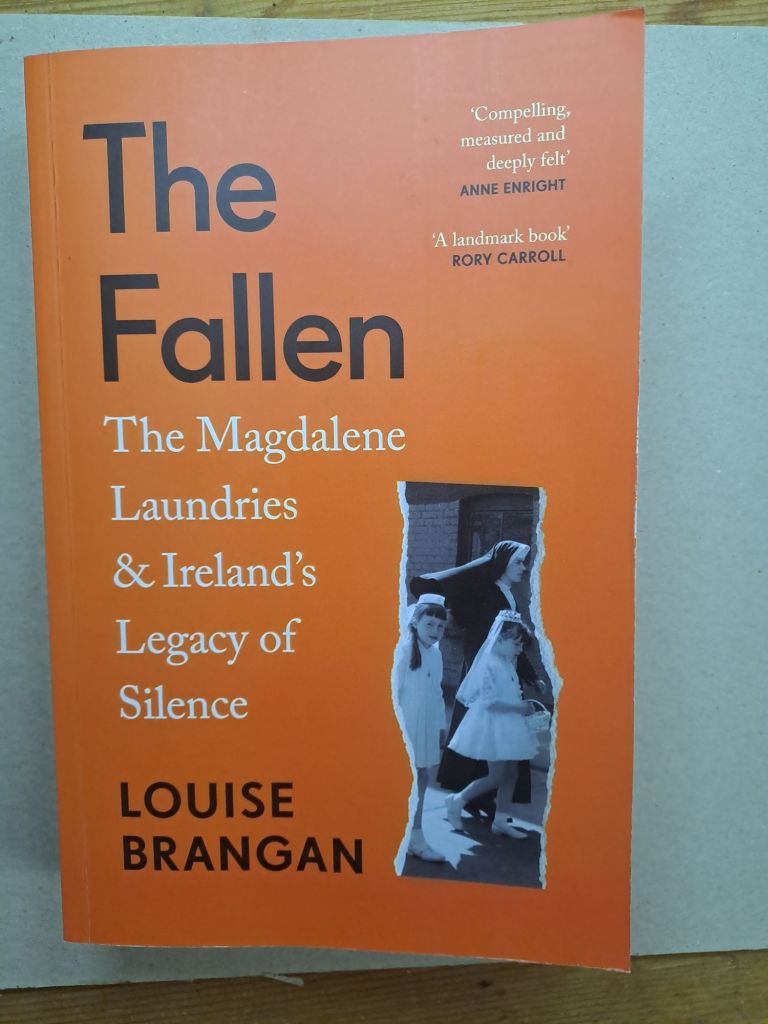
I’ve just finished reading The Fallen: The Magdalene Laundries & Ireland’s Legacy of Shame by Louise Brangan, which I bought a couple of months ago. This tells the shocking story of Ireland’s Magdalene Laundries, institutions run by a variety of religious orders designed to accommodate “fallen” women and girls. Also known as “Penitents”, the inmates of these institutions were a mixture of the poor and unwanted, orphans, disabled, those who had suffered familial abuse, and those who simply didn’t conform to Ireland’s self-image of a virtuous Roman Catholic state.
After Independence in 1922 these institutions, which had already been in existence for over a century, became a sort of dumping ground for inconvenient woman of all kinds. Once inside, the Penitents – most of whom hadn’t really done anything wrong – were stripped of what meagre possessions they had, had their hair shorn, their names were erased, and they were put to hard menial labour washing and drying clothes. They were fed and housed – after a fashion – but conditions were damp and unsanitary and they were forbidden to make friendships with their companions, or even talk to them. They were locked inside and forbidden to leave unless and until the nuns decided they could, which was often never. The Magdalene Laundries were prisons in which every inmate was serving an indefinite sentence of hard labour.
Not surprisingly, the result of this soul-destroying regime was that many of the Penitents became completely institutionalised, some living our their days in a man-made purgatory. Perhaps the most shocking thing of all is the last of these terrible places – which was on what is now Sean McDermott Street in North Dublin – didn’t close until 1996. This book was published to mark the 30th anniversary of this event.
The book is a scholarly work, woven around the oral testimonies of several women, measured in tone but with an unmistakeable undertone of righteous indignitation. It also sets the story of the Magdalene Laundries in the context of 20th Century Irish history, especially the rise of the Catholic theocracy under de Valera and it subsequent fall in the wake of major scandals, of which the Magdalene Laundries were one. As a relative newcomer to Ireland, I was unaware of the true nature of these places and found this book educational as well as deeply moving.
Some comments cut very much to the bone. Here is a paragraph concerning a woman known in the book as Carmel who had been taken to Sunday’s Well for reasons she was never told to find that many of the other women there were quite elderly and infirm:
Going to bed that first night, Carmel had thought that she had been sent to Sunday’s Well to care for the old women. Gradually, she had come to realise, like many others before her, that she had been sent to the Laundry not to look after these women but to become one of them.
Another passage that hit me hard was about the disinterment, in 1993, of 133 bodies from a mass grave when the Sisters of Our Lady of Charity decided to sell the land to a property developer. The graves of the women, who had died while incarcerated at a Magdalene Laundry, were unmarked; another 22 were found later. Shamefully, only 75 death certificates had ever been registered. It is against the law in Ireland to bury someone without registering their death so 80 crimes had been committed over the years. No action was ever taken.
In recent years there has been a redress scheme for the survivors of these institutions, but what financial compensation can possibly be adequate for a lifetime of penal servitude? The most important message of this book is that stories like this have to be told. Ireland must confront the dark side of its recent past. Silence can be the worst form of dishonesty.


August 1, 2026 at 12:16 pm
You’ve read the book and I would be glad to be corrected, but I think you underplay some of the things wrong with the Magdalene system and overplay some others.
Is is not the case that most of these women ended up in the Magdalene system because they got pregnant and the man who got them pregnant deserted them?
I deplore that desertion by the men, but I also think there is an element of personal responsibility regarding women who get pregnant without first entering a committed relationship. In that sense the Magdalenes – run by the Catholic church – were doing a job that would otherwise have fallen to the taxpayer.
Don’t think I am a friend of the Catholic church, by the way. There seem to have been roughly twice the proportion of child abusers among its priests in Ireland as among the general population, which is autodiscrediting in an organisation that is meant to set an example of morality. And although that proportion is still small, every bishop covered it up by shuffling such priests round their diocese from parish to parish, there to repeat their foul acts. Given that ‘episkopos’ means ‘overseer’, episcopal oversight was not useless but far worse.
Peter, you don’t mention what I think is the worst aspects of the Magdalenes: the women couldn’t leave the premises. The doors were locked. These were prisons. That is appalling.
August 1, 2026 at 12:38 pm
Your first statement is a common misconception, and one that I shared until I read the book. The Magdalene Laundries were quite different from the “Mother and Baby Homes” with which they are often conflated. Some of the women in the Magdalene Laundries had been born out of wedlock and brought up in Mother and Baby Homes, and had ended up in the Laundries simply because they had nowhere else to go. There were no babies or young children in the “care” of the Laundries. Official figures don’t exist but the indication is that only a small fraction of the women there had ever given birth. Most were confined because they were outcasts for other reasons: destitute, oprhaned, suffering from mental illness, or even just being “a bit flighty”. Some parents offloaded offspring who had Downs Syndrome, for example.
Early on in the book the author criticises the book and film Small Things Like These for making the same error. There are huge issues about Mother and Baby homes too, e.g. in terms of high rates of infant mortality, but I think it’s important to understand the distinction between the two types of institution.
The Mother and Baby homes were also run by Catholic institutions but were funded by the taxpayer. The Laundries were not – their income came from the washing and ironing services they provided to the general public. For this reason they were not covered by the original redress schemes, which were for state-funded institutions only. The scheme for the Magdalene Laundries came much later.
You are right that these were effectively prisons. Women could only leave when the nuns felt they were ready, which was often never. One of the testimonies, from a woman who was allowed to leave and went to work in domestic service, explains that she was confused when she got her first pay packet from her employer. She had spent her life in institutions and had no idea what money was, or how shops worked. That explains, partly, why some women who were allowed to leave actually went back. They had no idea how to survive in the outside world. There was no attempt whatsoever to provide education in the Laundries.
August 1, 2026 at 1:05 pm
Thanks Peter.
August 1, 2026 at 6:17 pm
There was a similar system in Franco’s Spain called the Patronato ‘reformatories’. And in Renaissance Italy a large proportion of aristocratic widows (and spinsters) were forced to become nuns, saving their families from paying large dowries. Convents were effectively prisons, as enclosure was rigorous. Some of the antics of these nuns (taken from Vatican archives) are in Craig Monson’s book, Nuns Behaving Badly: Tales of Music, Magic, Art and Arson in the Convents of Italy. The book is both entertaining and harrowing.
August 1, 2026 at 12:42 pm
P.S. I did use the word “incarcerated” but have edited the text to make it more explicit that these institutions were prisons by another name.
August 10, 2026 at 1:13 am
Did anybody read what was just written above, by an human being?
I so wish there were a simple method in blog comments to block ever seeing anything ever written by this sociopathic sophist reply-guy monster ever again.
“… but I also think …” Anytime you see that, just stop reading. Because what’s coming is both-sides-ism! And oh dear we are going to be accused of ignoring the nuance involved. Oh, and personal responsibility. Utter sociopathy.