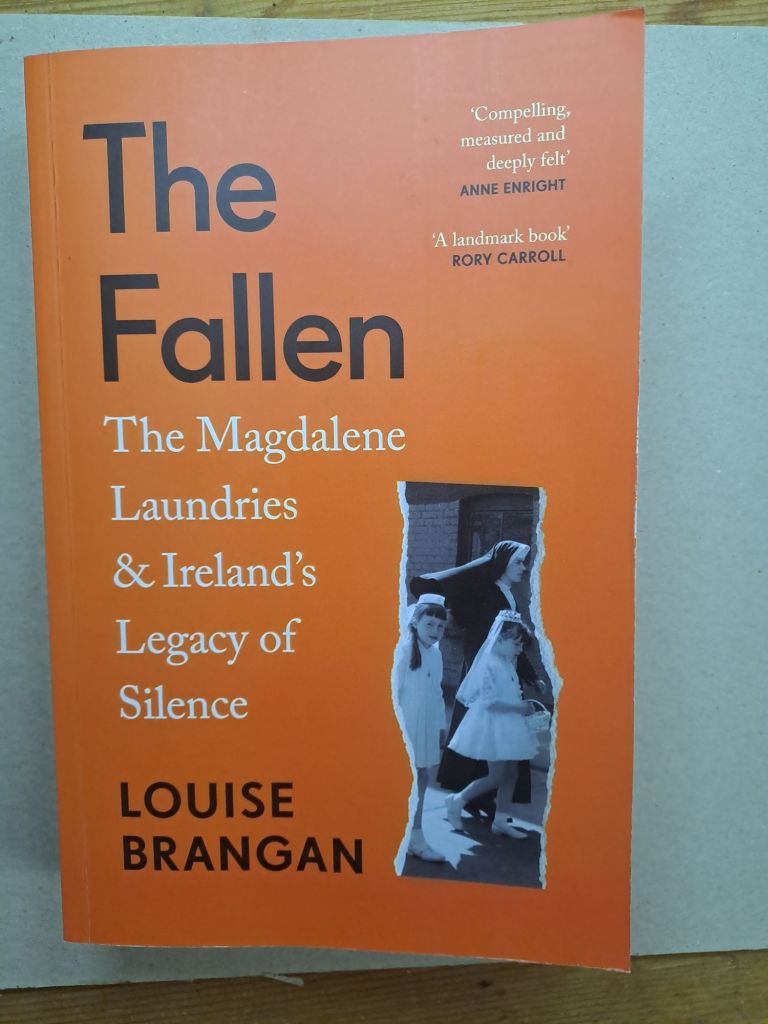
I’ve just finished reading The Fallen: The Magdalene Laundries & Ireland’s Legacy of Shame by Louise Brangan, which I bought a couple of months ago. This tells the shocking story of Ireland’s Magdalene Laundries, institutions run by a variety of religious orders designed to accommodate “fallen” women and girls. Also known as “Penitents”, the inmates of these institutions were a mixture of the poor and unwanted, orphans, disabled, those who had suffered familial abuse, and those who simply didn’t conform to Ireland’s self-image of a virtuous Roman Catholic state.
After Independence in 1922 these institutions, which had already been in existence for over a century, became a sort of dumping ground for inconvenient woman of all kinds. Once inside, the Penitents – most of whom hadn’t really done anything wrong – were stripped of what meagre possessions they had, had their hair shorn, their names were erased, and they were put to hard menial labour washing and drying clothes. They were fed and housed – after a fashion – but conditions were damp and unsanitary and they were forbidden to make friendships with their companions, or even talk to them. They were locked inside and forbidden to leave unless and until the nuns decided they could, which was often never. The Magdalene Laundries were prisons in which every inmate was serving an indefinite sentence of hard labour.
Not surprisingly, the result of this soul-destroying regime was that many of the Penitents became completely institutionalised, some living our their days in a man-made purgatory. Perhaps the most shocking thing of all is the last of these terrible places – which was on what is now Sean McDermott Street in North Dublin – didn’t close until 1996. This book was published to mark the 30th anniversary of this event.
The book is a scholarly work, woven around the oral testimonies of several women, measured in tone but with an unmistakeable undertone of righteous indignitation. It also sets the story of the Magdalene Laundries in the context of 20th Century Irish history, especially the rise of the Catholic theocracy under de Valera and it subsequent fall in the wake of major scandals, of which the Magdalene Laundries were one. As a relative newcomer to Ireland, I was unaware of the true nature of these places and found this book educational as well as deeply moving.
Some comments cut very much to the bone. Here is a paragraph concerning a woman known in the book as Carmel who had been taken to Sunday’s Well for reasons she was never told to find that many of the other women there were quite elderly and infirm:
Going to bed that first night, Carmel had thought that she had been sent to Sunday’s Well to care for the old women. Gradually, she had come to realise, like many others before her, that she had been sent to the Laundry not to look after these women but to become one of them.
Another passage that hit me hard was about the disinterment, in 1993, of 133 bodies from a mass grave when the Sisters of Our Lady of Charity decided to sell the land to a property developer. The graves of the women, who had died while incarcerated at a Magdalene Laundry, were unmarked; another 22 were found later. Shamefully, only 75 death certificates had ever been registered. It is against the law in Ireland to bury someone without registering their death so 80 crimes had been committed over the years. No action was ever taken.
In recent years there has been a redress scheme for the survivors of these institutions, but what financial compensation can possibly be adequate for a lifetime of penal servitude? The most important message of this book is that stories like this have to be told. Ireland must confront the dark side of its recent past. Silence can be the worst form of dishonesty.


