A “Full House” at the Open Journal of Astrophysics!
In my recent weekly updates of activity at the Open Journal of Astrophysics, the latest of which is here, I’ve remarked that we had built up quite a backlog of papers accepted but yet to be published. This is no doubt due to August being a holiday for many researchers. Well, we seem to be catching up rather rapidly. So far this week we have published eight new papers, and it’s only Wednesday!
The recent burst of activity has led to us establishing a first, a week in which we have published a full house of at least one paper in each of the six sections of astro-ph on the arXiv. As a reminder, these are they:
- astro-ph.GA – Astrophysics of Galaxies. Phenomena pertaining to galaxies or the Milky Way. Star clusters, HII regions and planetary nebulae, the interstellar medium, atomic and molecular clouds, dust. Stellar populations. Galactic structure, formation, dynamics. Galactic nuclei, bulges, disks, halo. Active Galactic Nuclei, supermassive black holes, quasars. Gravitational lens systems. The Milky Way and its contents
- astro-ph.CO – Cosmology and Nongalactic Astrophysics. Phenomenology of early universe, cosmic microwave background, cosmological parameters, primordial element abundances, extragalactic distance scale, large-scale structure of the universe. Groups, superclusters, voids, intergalactic medium. Particle astrophysics: dark energy, dark matter, baryogenesis, leptogenesis, inflationary models, reheating, monopoles, WIMPs, cosmic strings, primordial black holes, cosmological gravitational radiation
- astro-ph.EP – Earth and Planetary Astrophysics. Interplanetary medium, planetary physics, planetary astrobiology, extrasolar planets, comets, asteroids, meteorites. Structure and formation of the solar system
- astro-ph.HE – High Energy Astrophysical Phenomena. Cosmic ray production, acceleration, propagation, detection. Gamma ray astronomy and bursts, X-rays, charged particles, supernovae and other explosive phenomena, stellar remnants and accretion systems, jets, microquasars, neutron stars, pulsars, black holes
- astro-ph.IM – Instrumentation and Methods for Astrophysics. Detector and telescope design, experiment proposals. Laboratory Astrophysics. Methods for data analysis, statistical methods. Software, database design
- astro-ph.SR – Solar and Stellar Astrophysics. White dwarfs, brown dwarfs, cataclysmic variables. Star formation and protostellar systems, stellar astrobiology, binary and multiple systems of stars, stellar evolution and structure, coronas. Central stars of planetary nebulae. Helioseismology, solar neutrinos, production and detection of gravitational radiation from stellar systems.
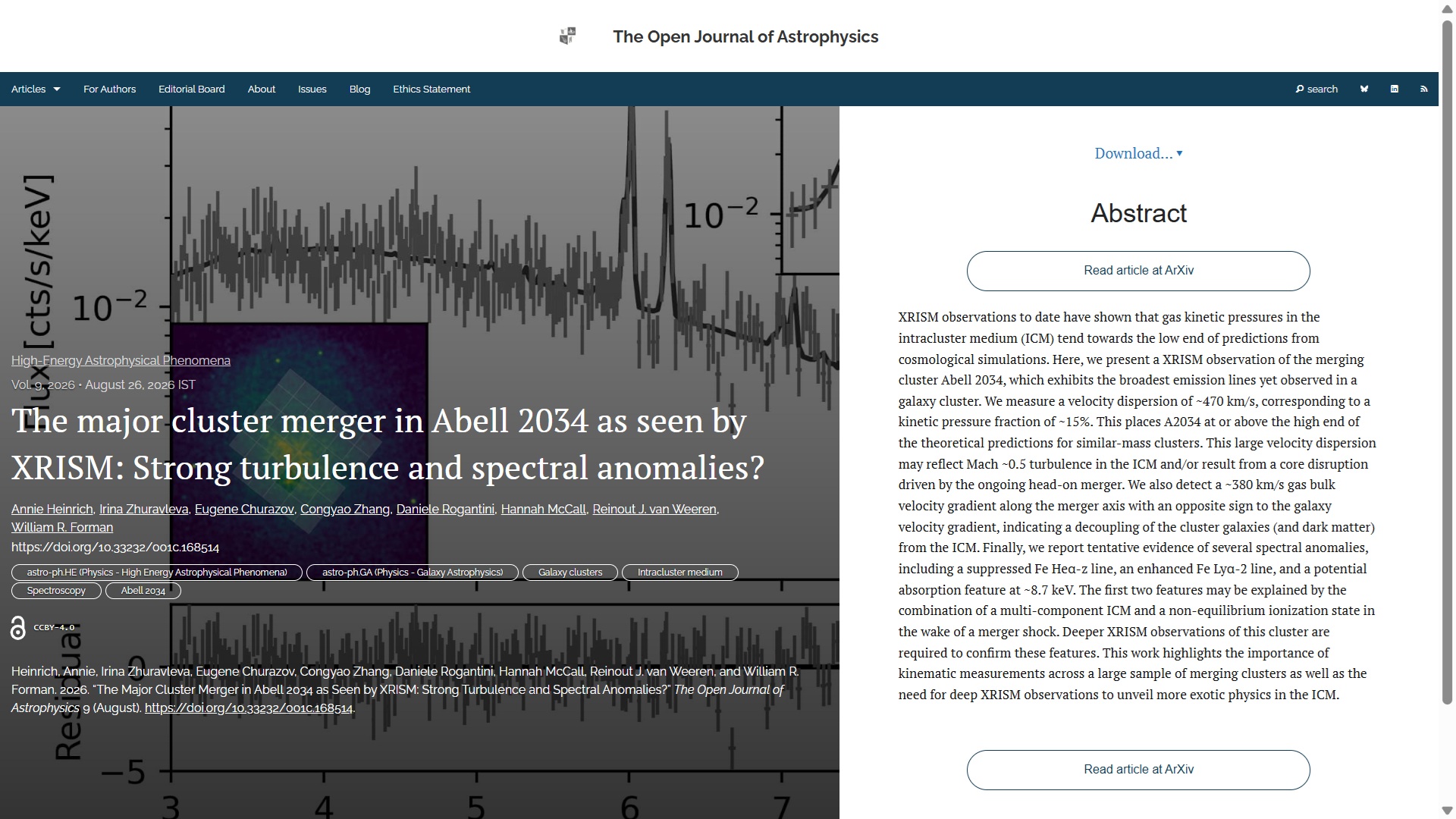
As of yesterday we had published in five of the six categories and were only missing a paper (in Number 4 – High-Energy Astrophysical Phenomena). Today, right on cue, from the queue, came this paper to complete the set:
There’s still a couple of days to go and we have more papers in the pipeline so it looks like I’ll have a busy time on Saturday morning when I do the next update!


August 29, 2026 at 1:31 pm
[…] the number in Volume 9 (2026) to 189 and the total so far published by OJAp up to 637. As I pointed out on Wednesday this week is the first during which we have published at least one paper in each of the six […]