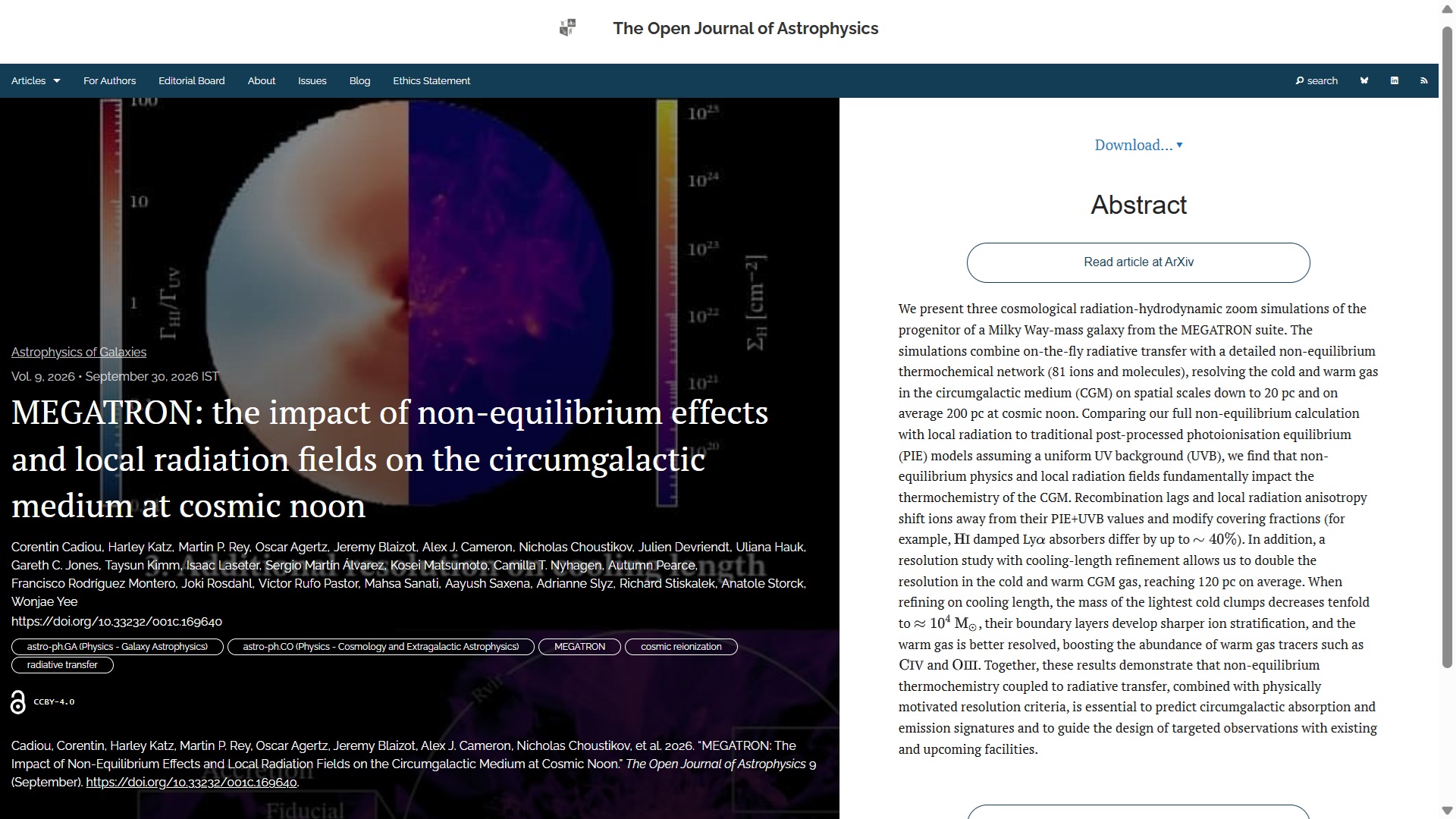
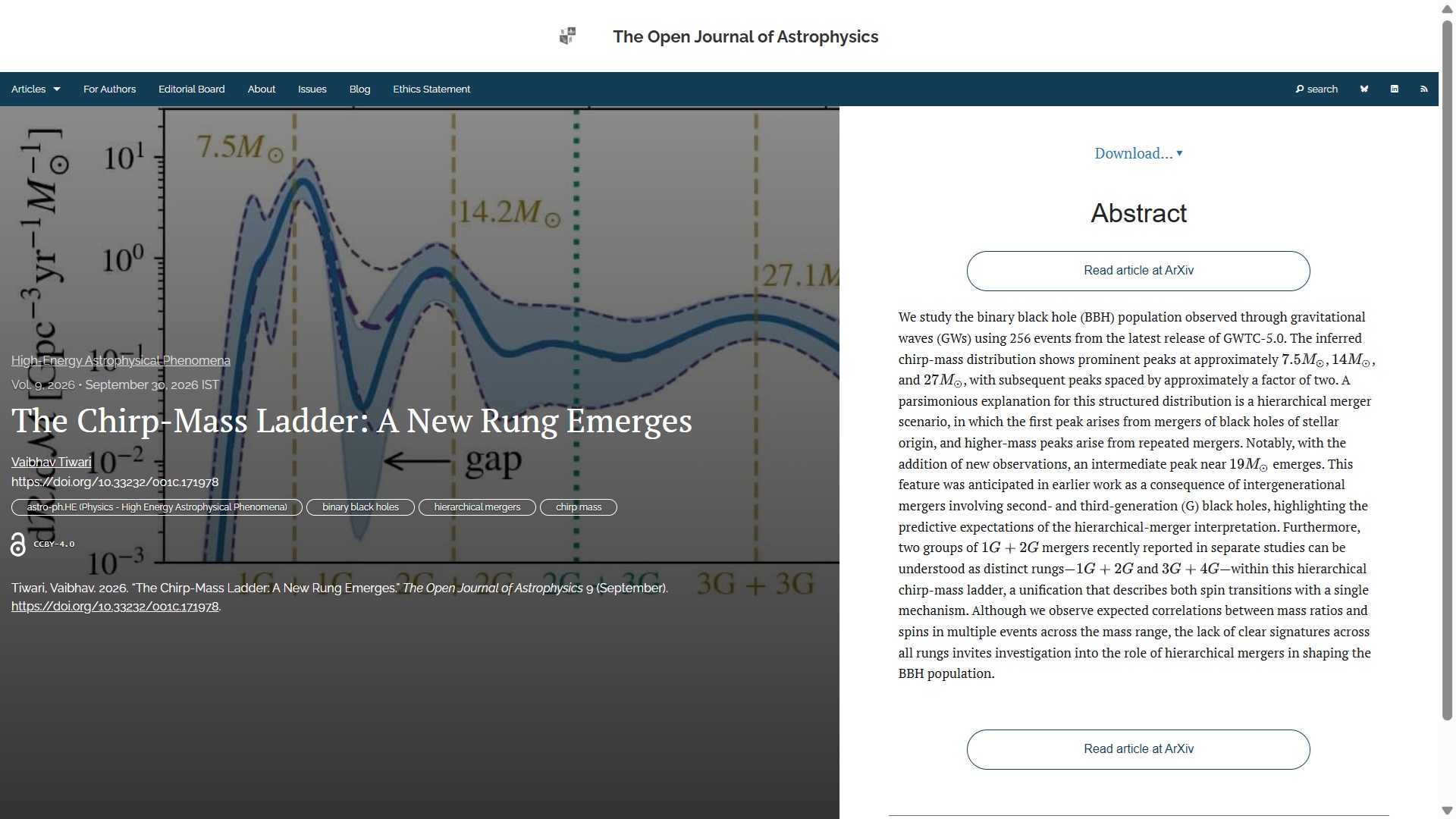
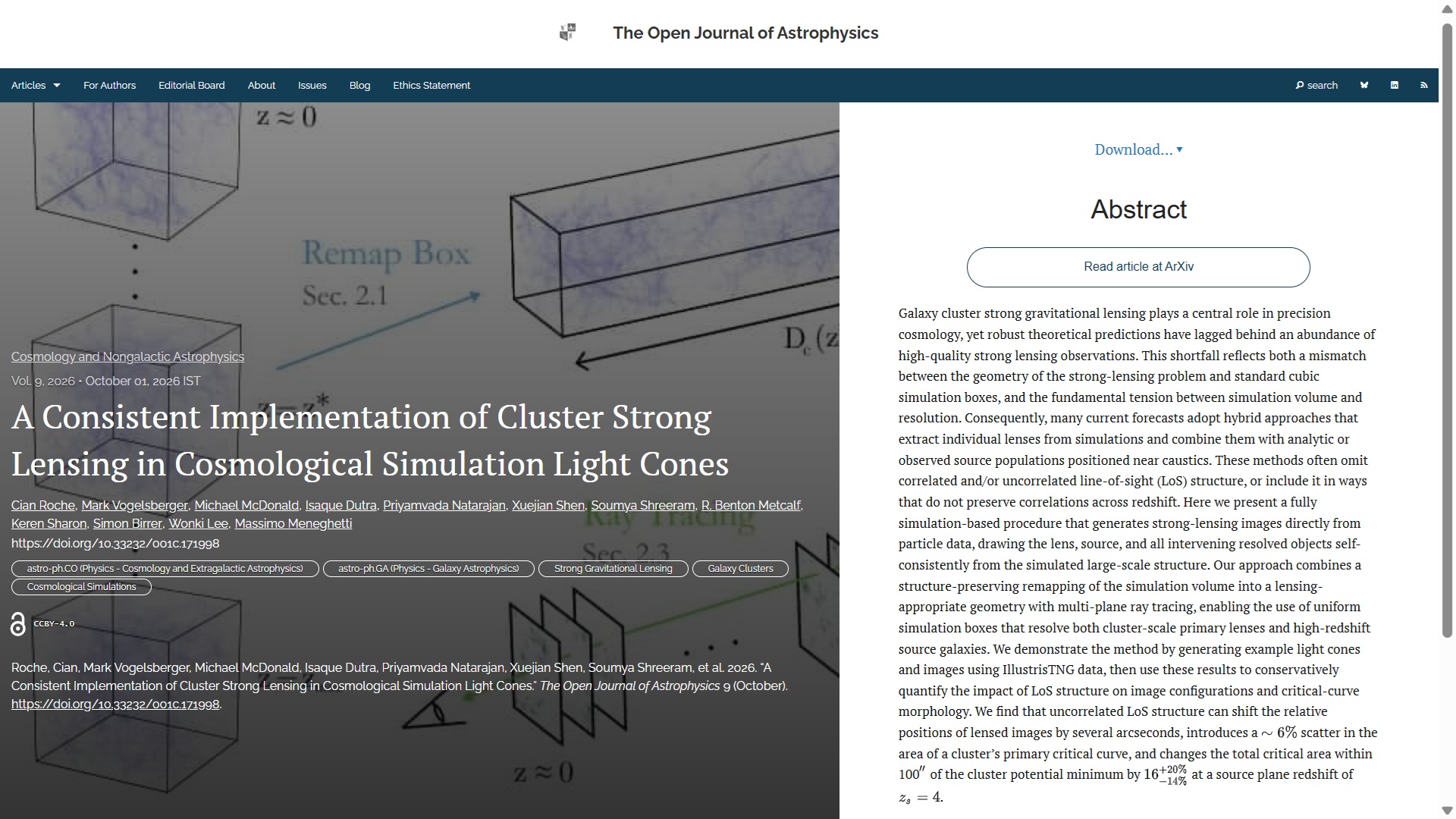
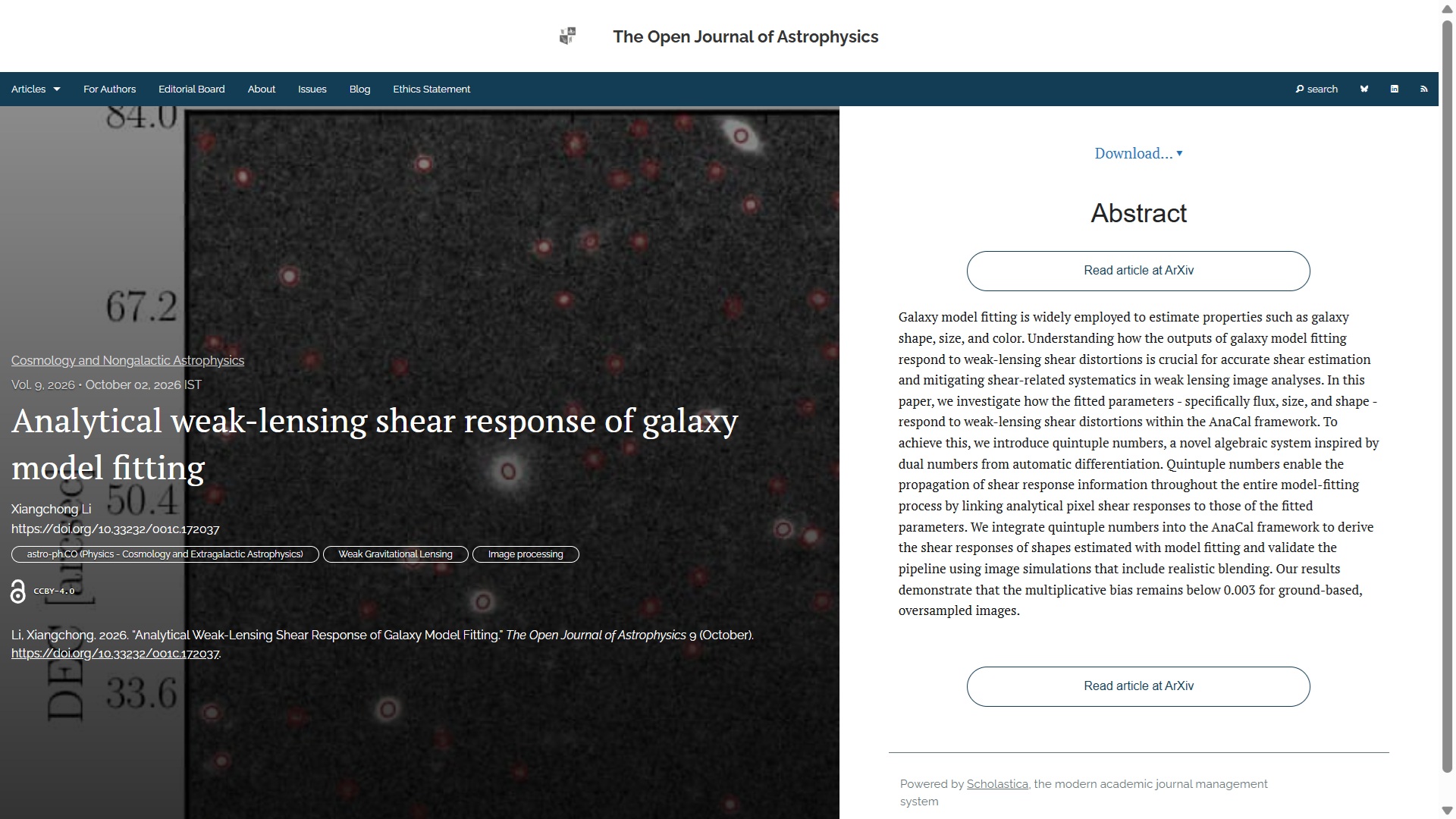
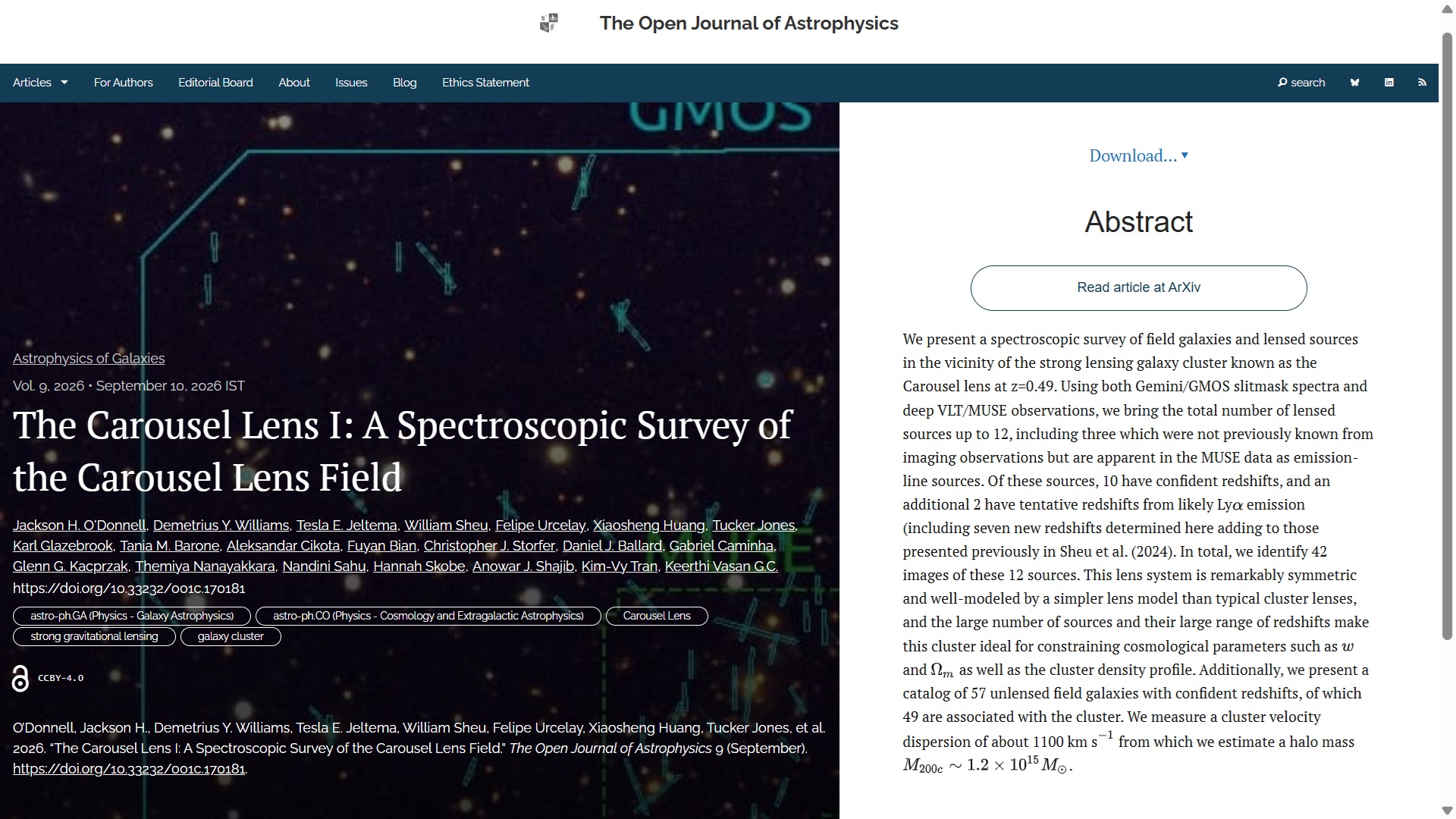
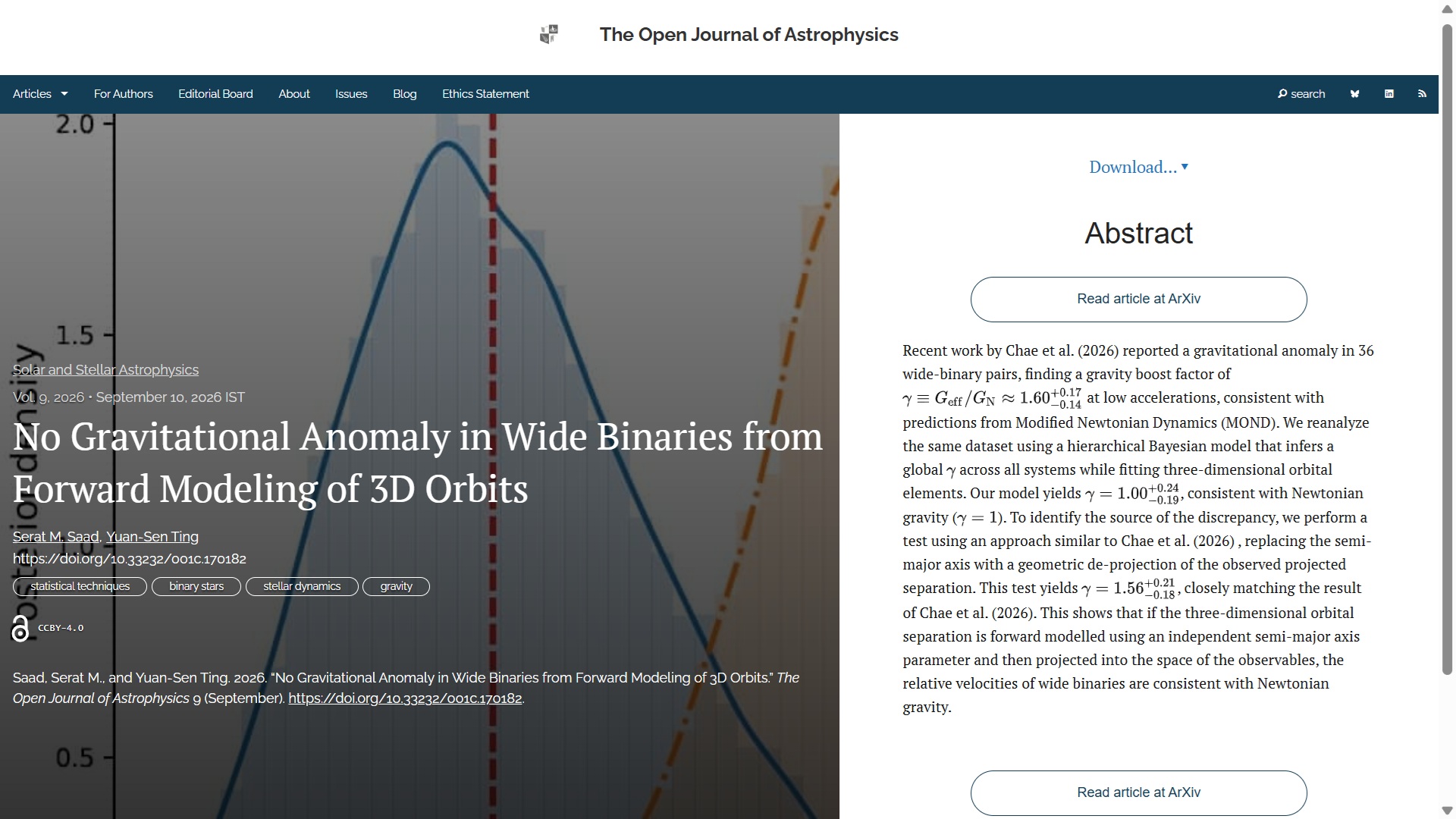
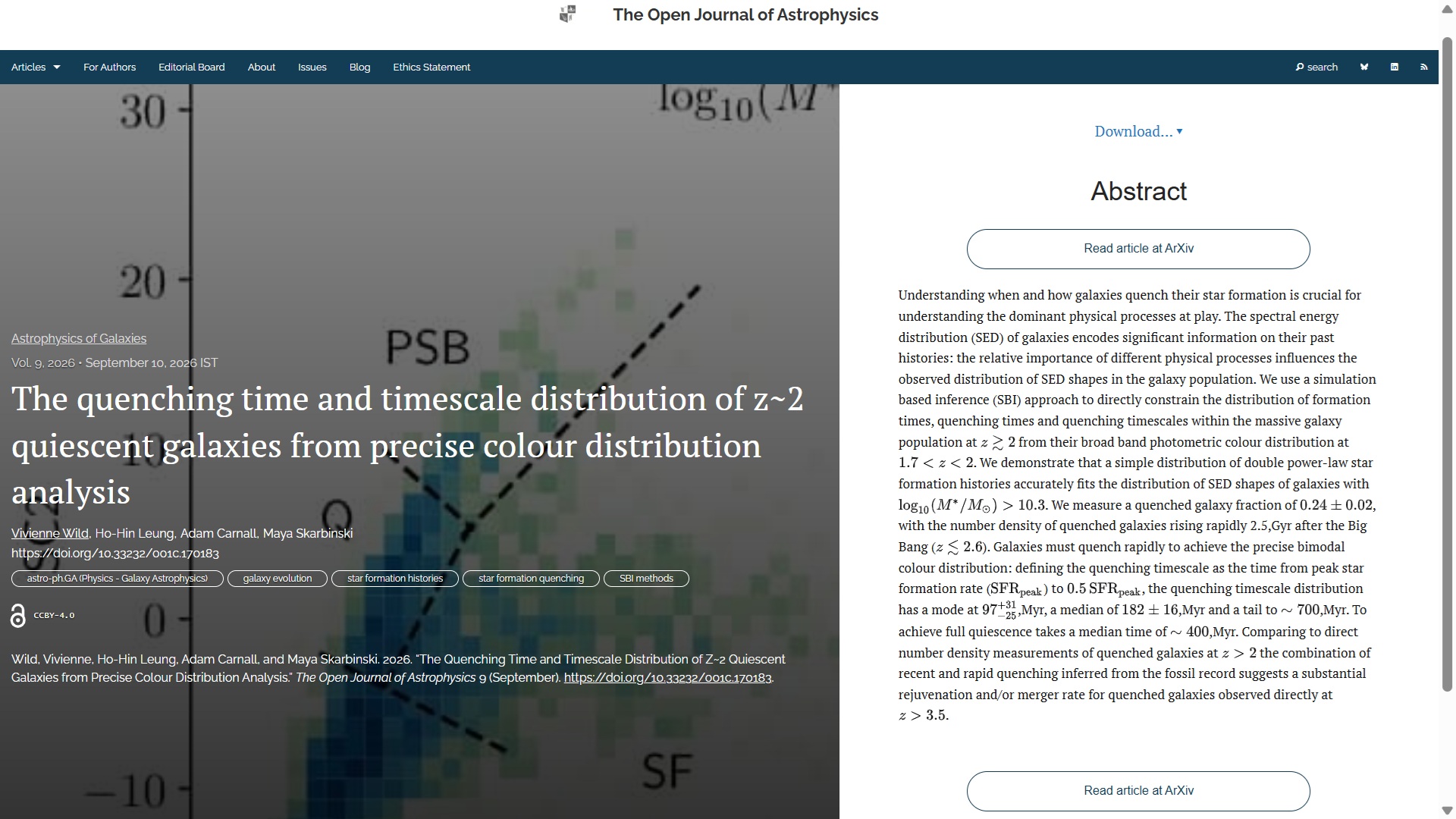
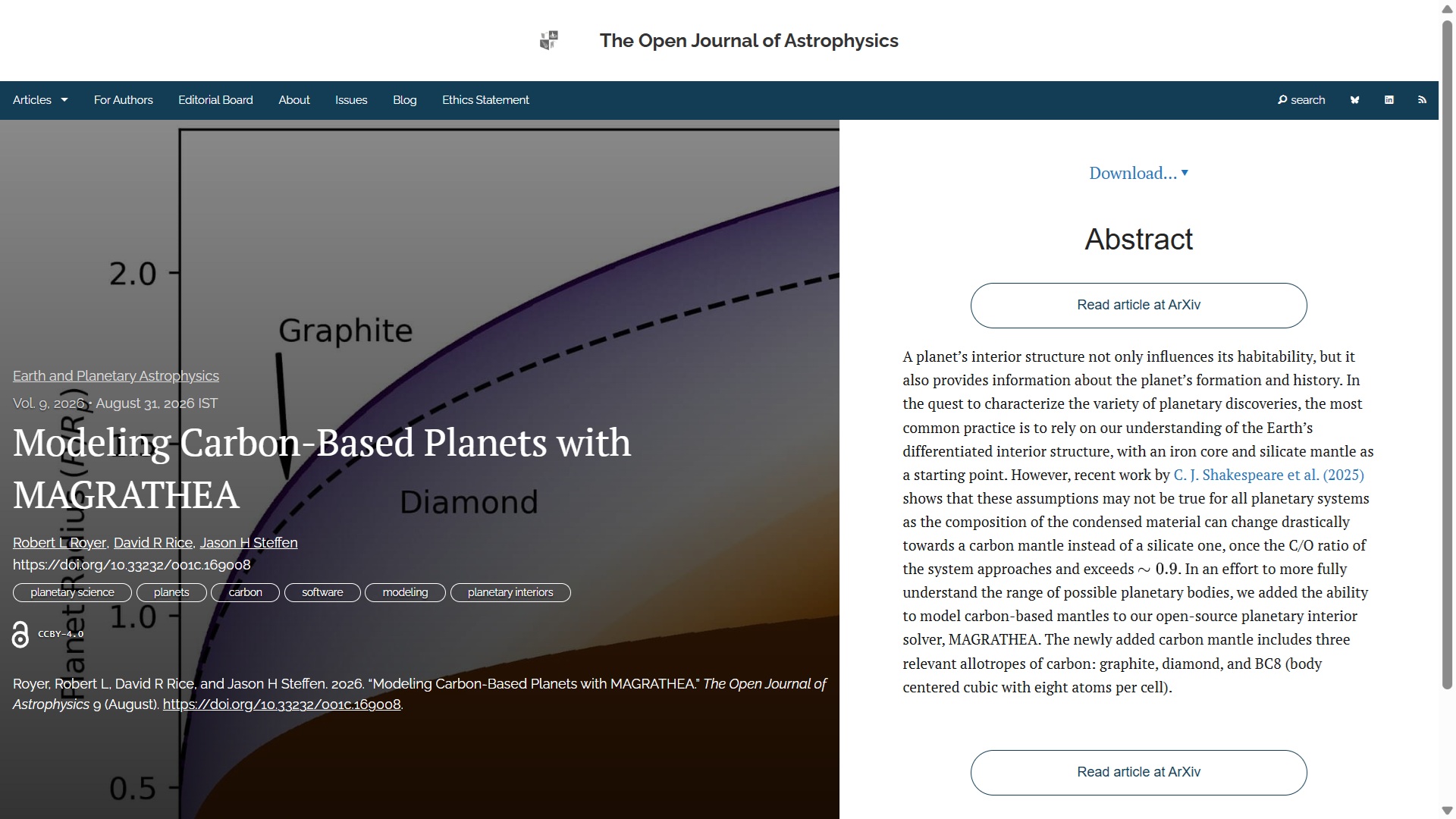
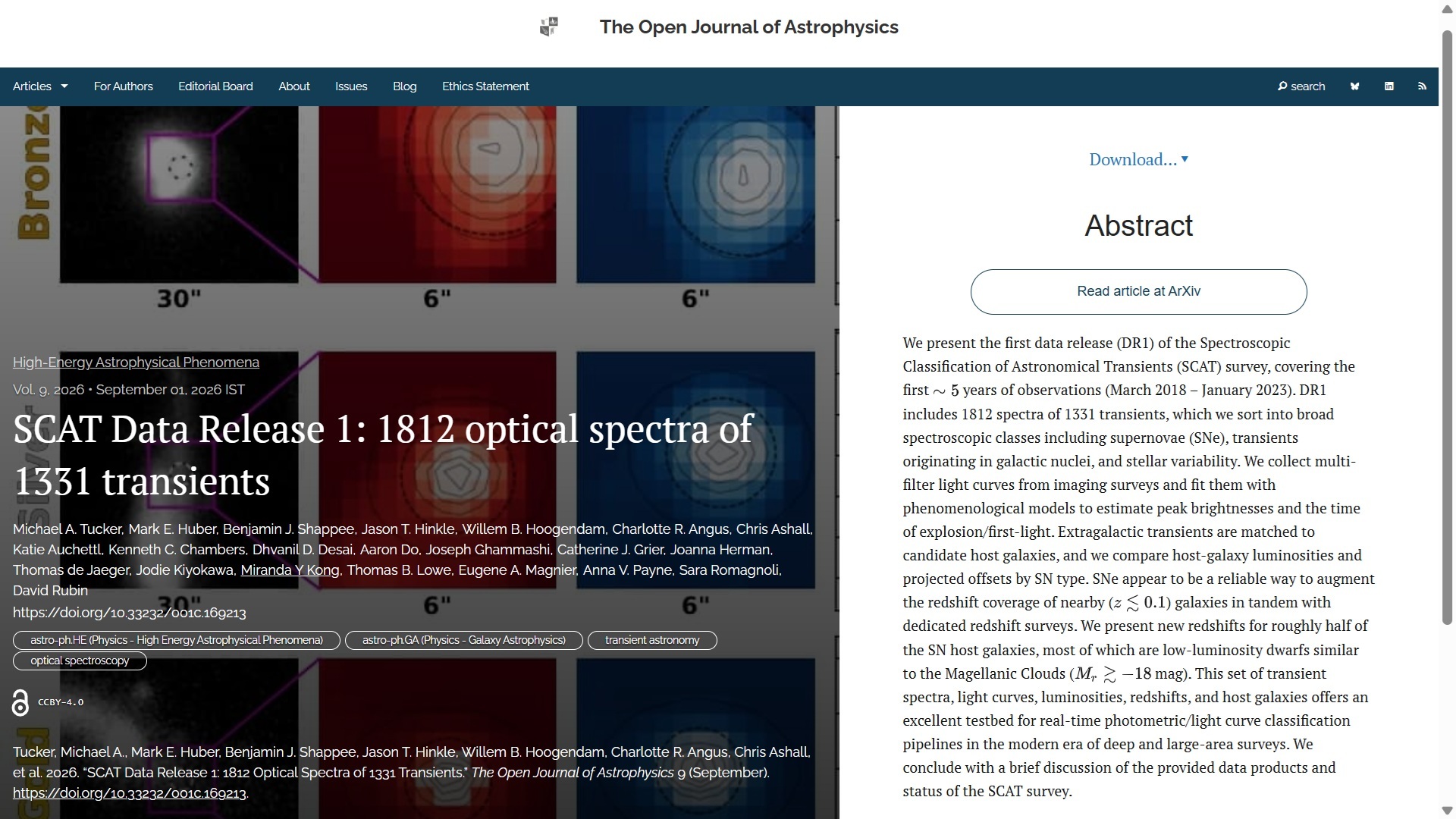
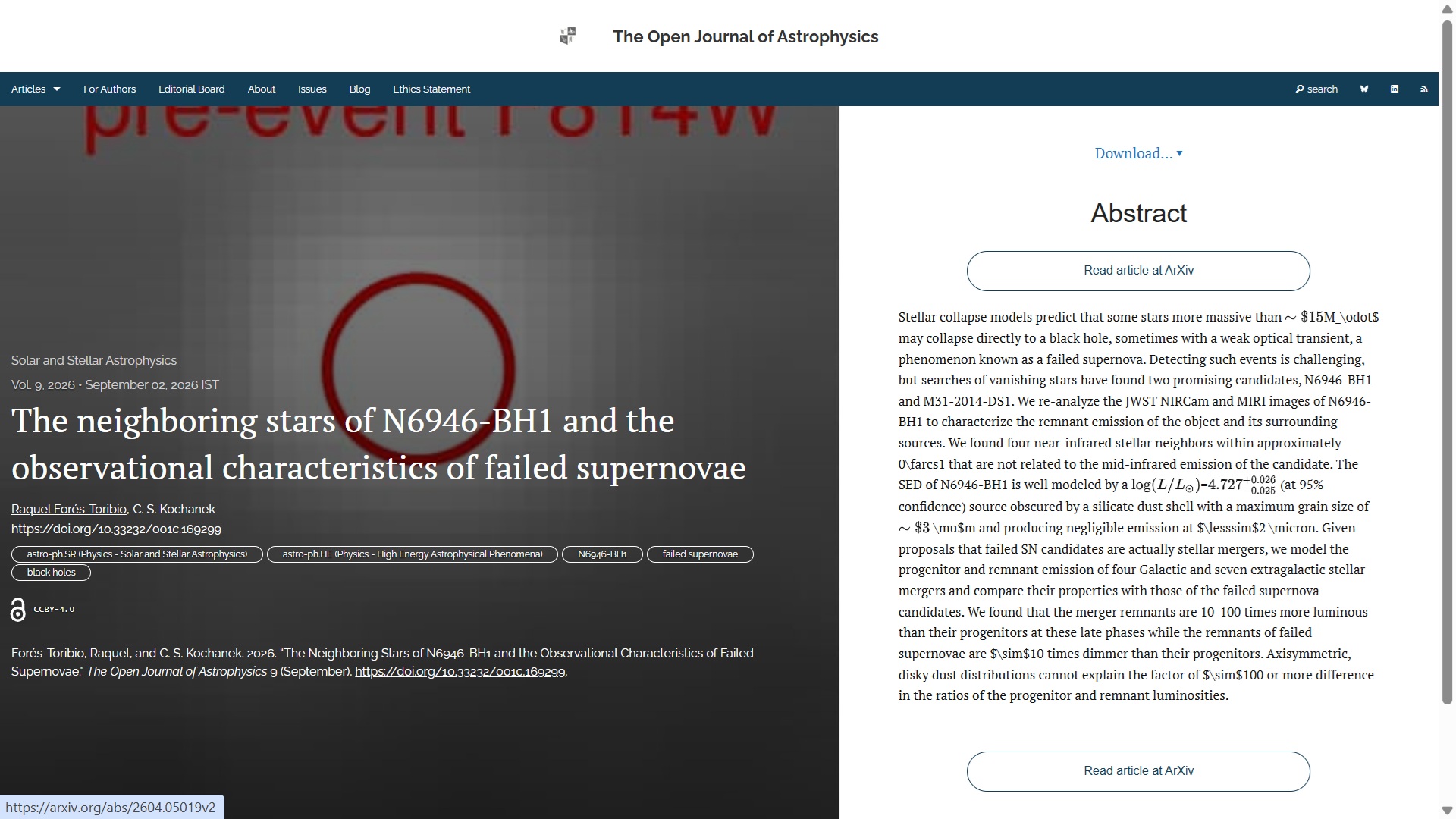
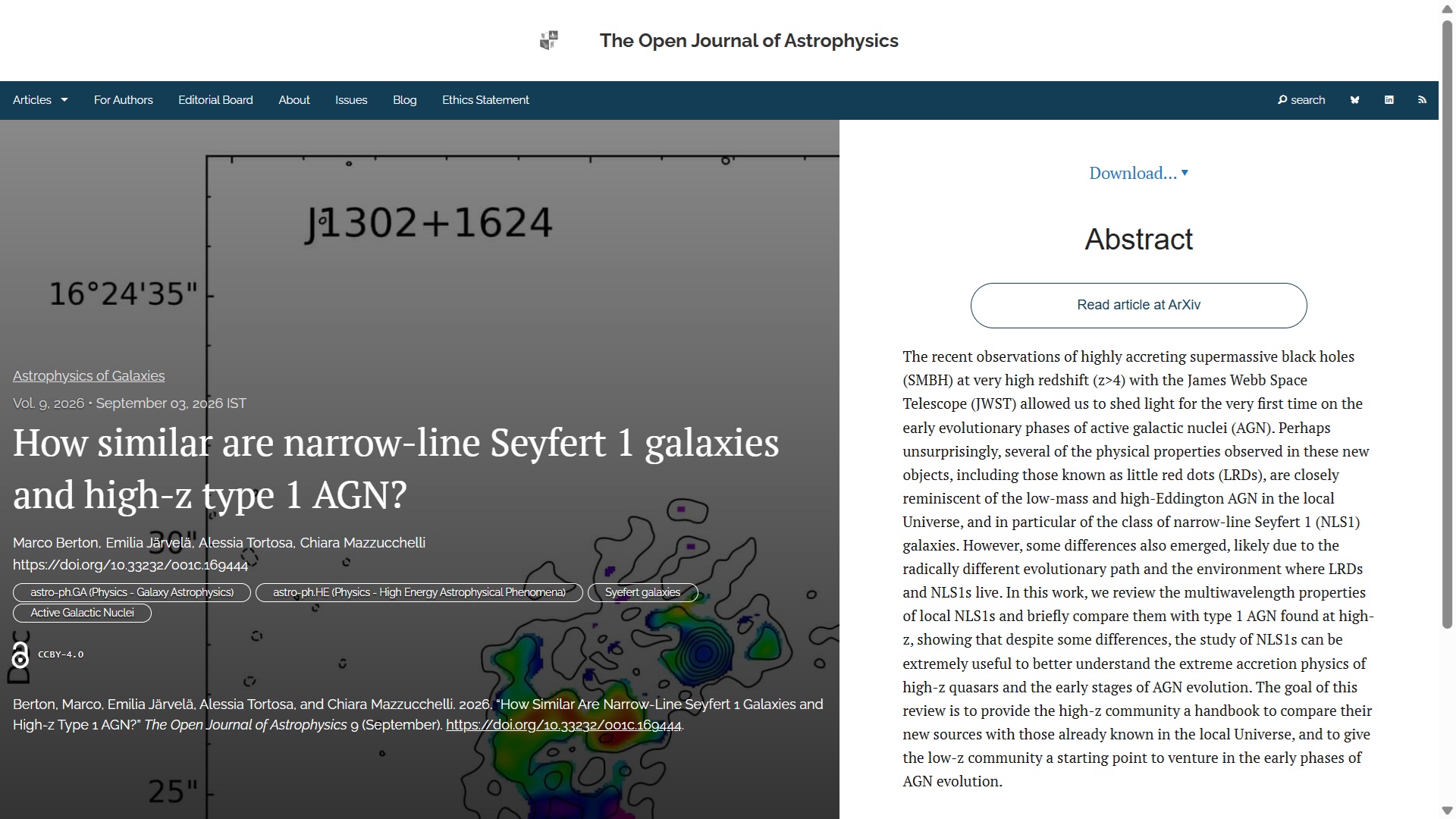
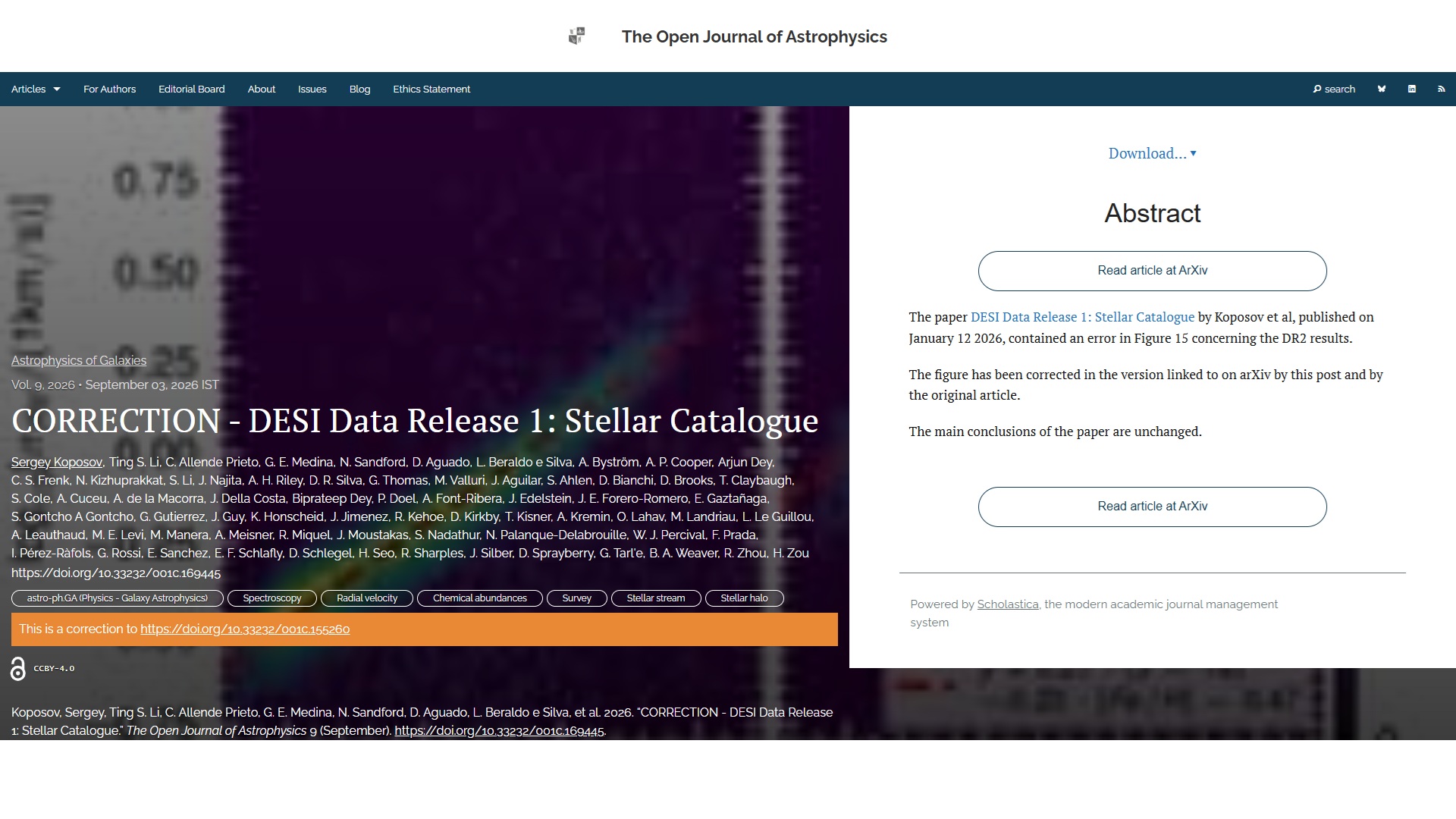
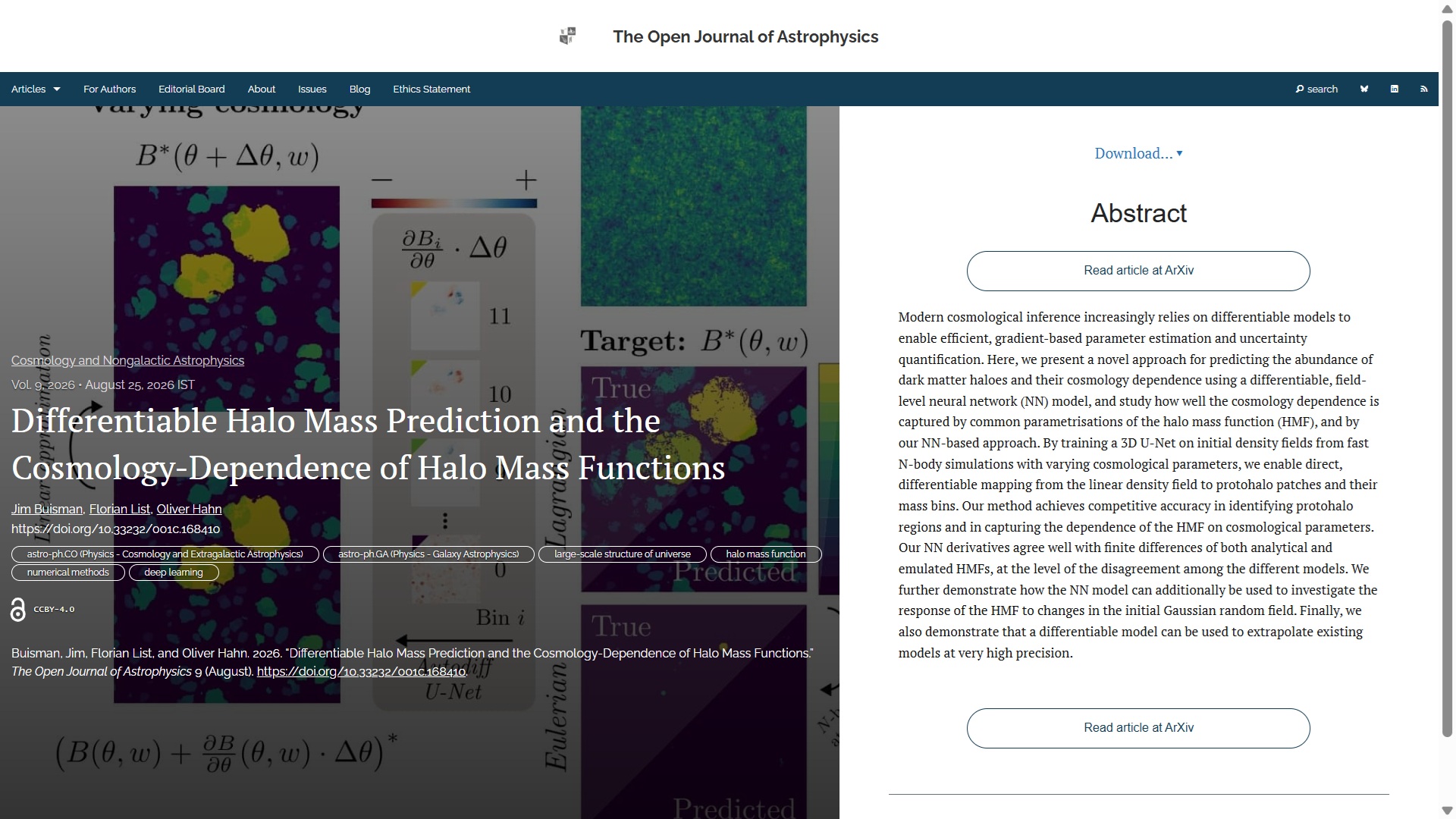
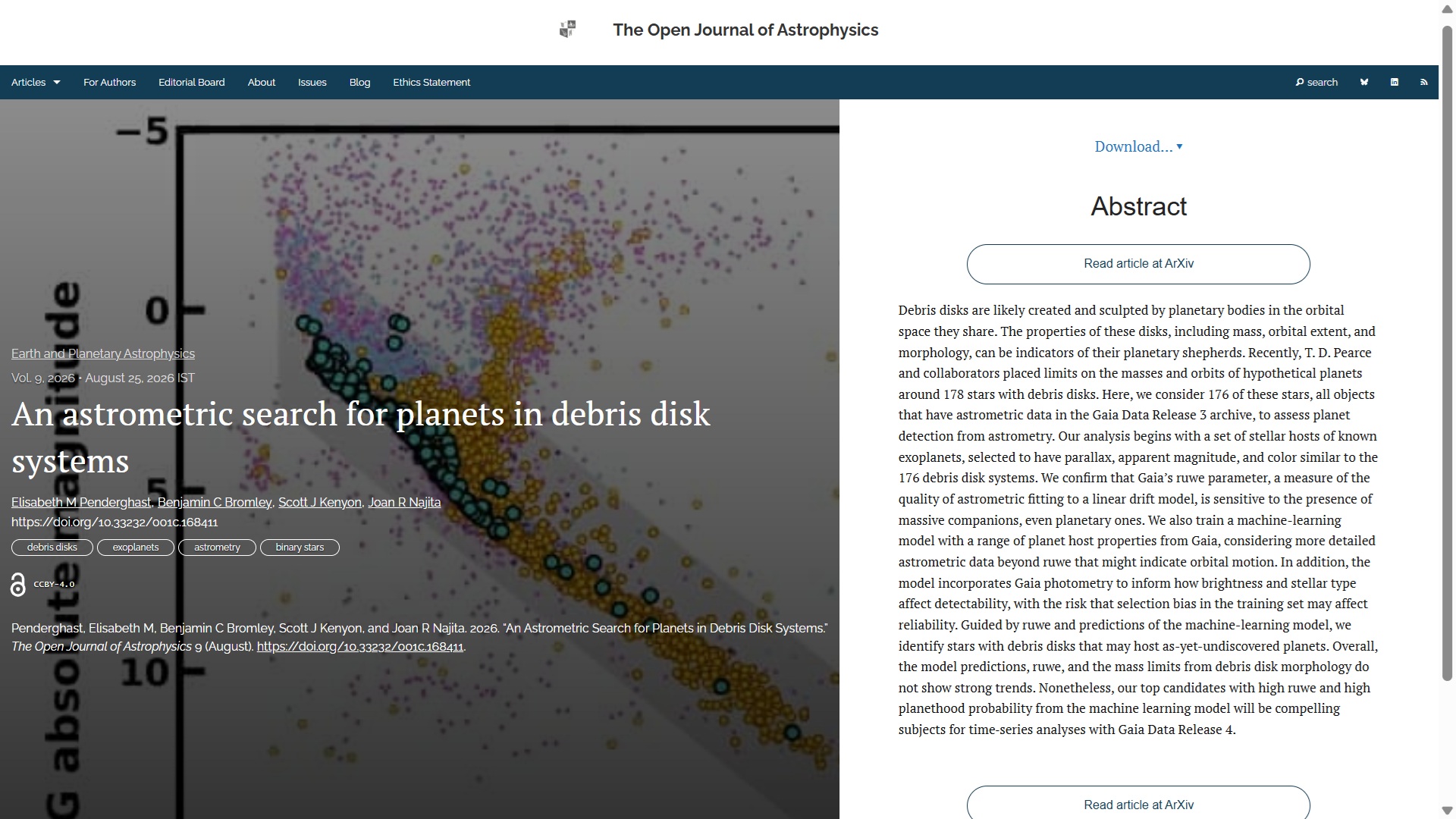
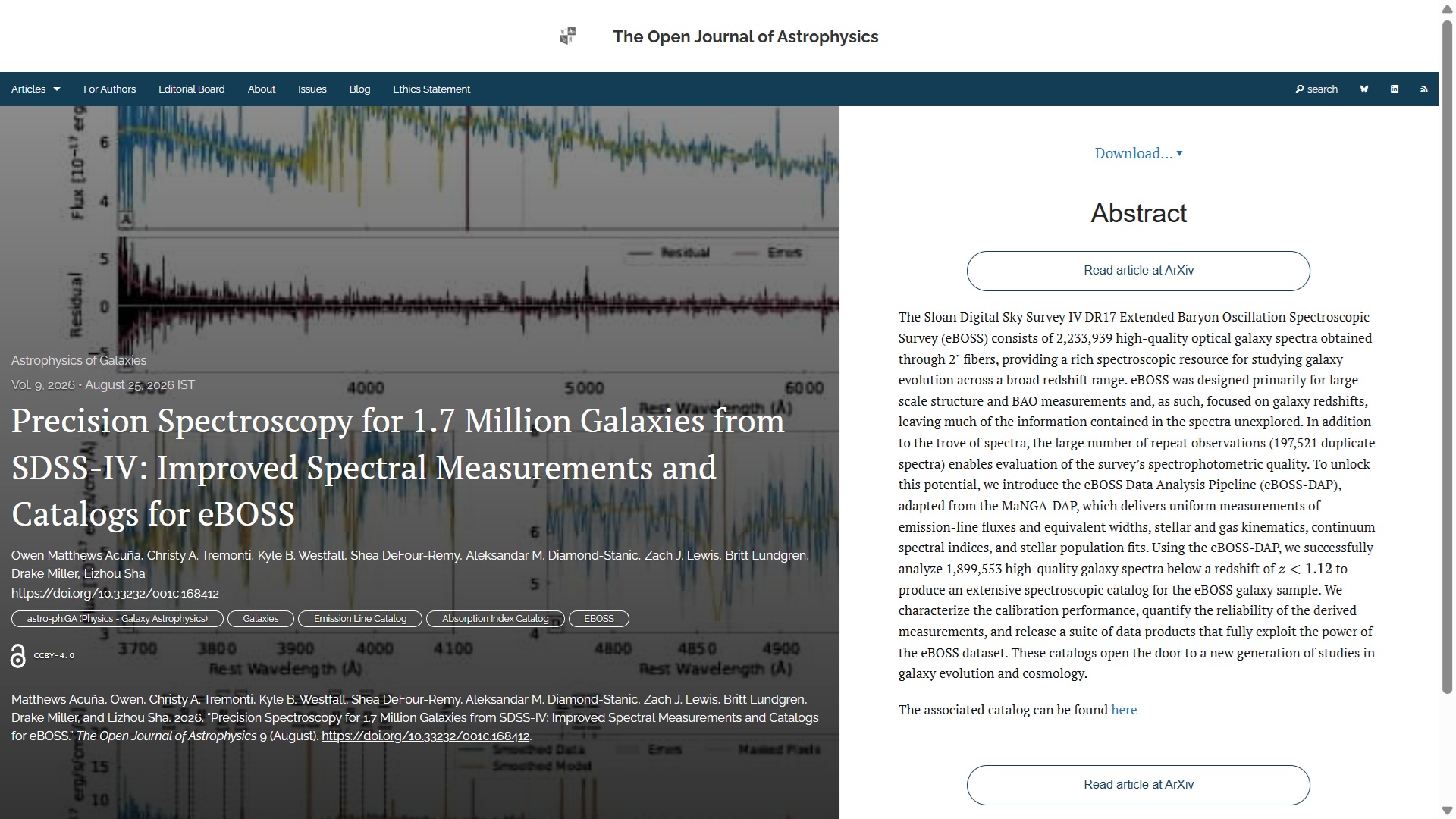
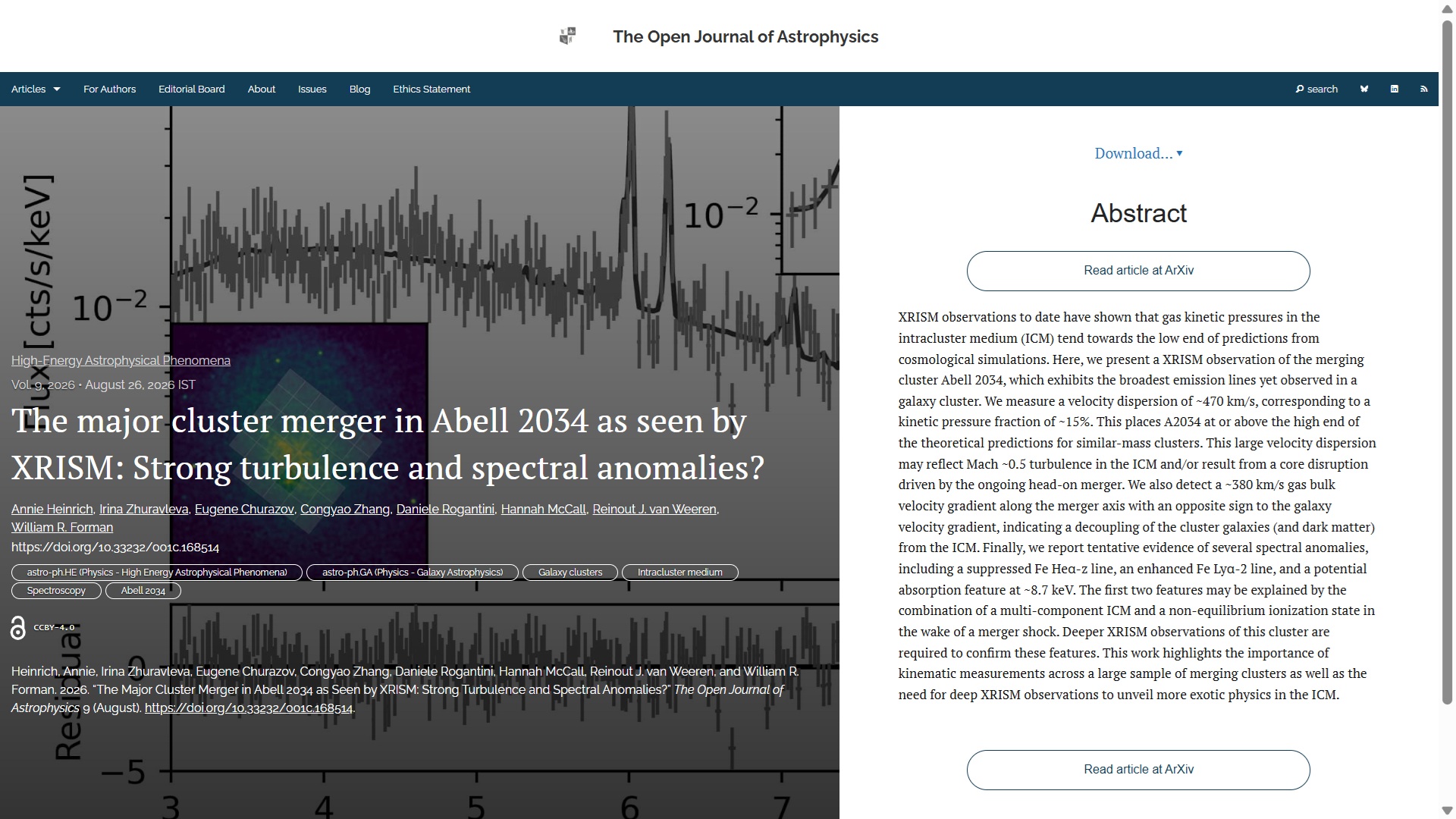
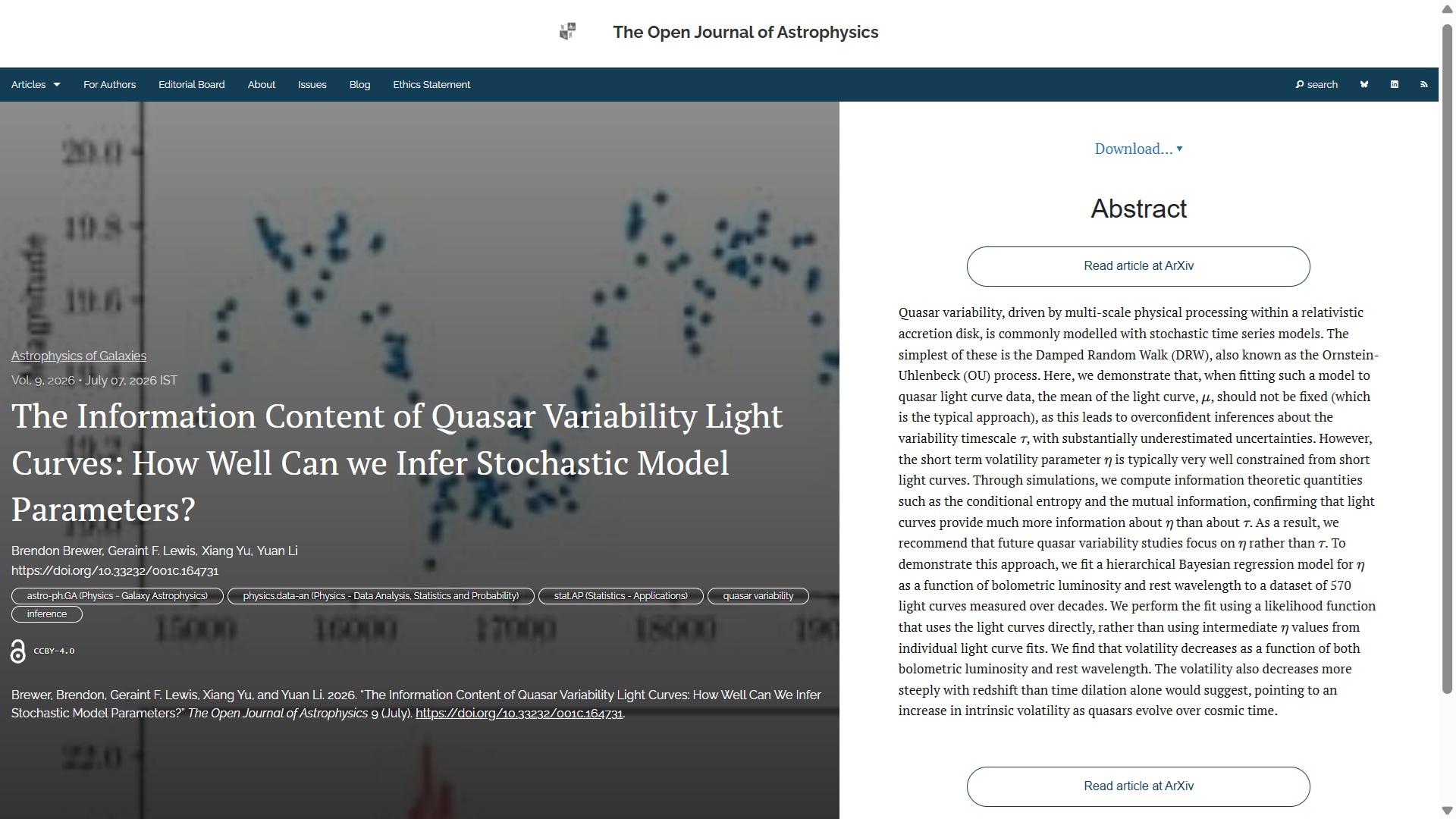
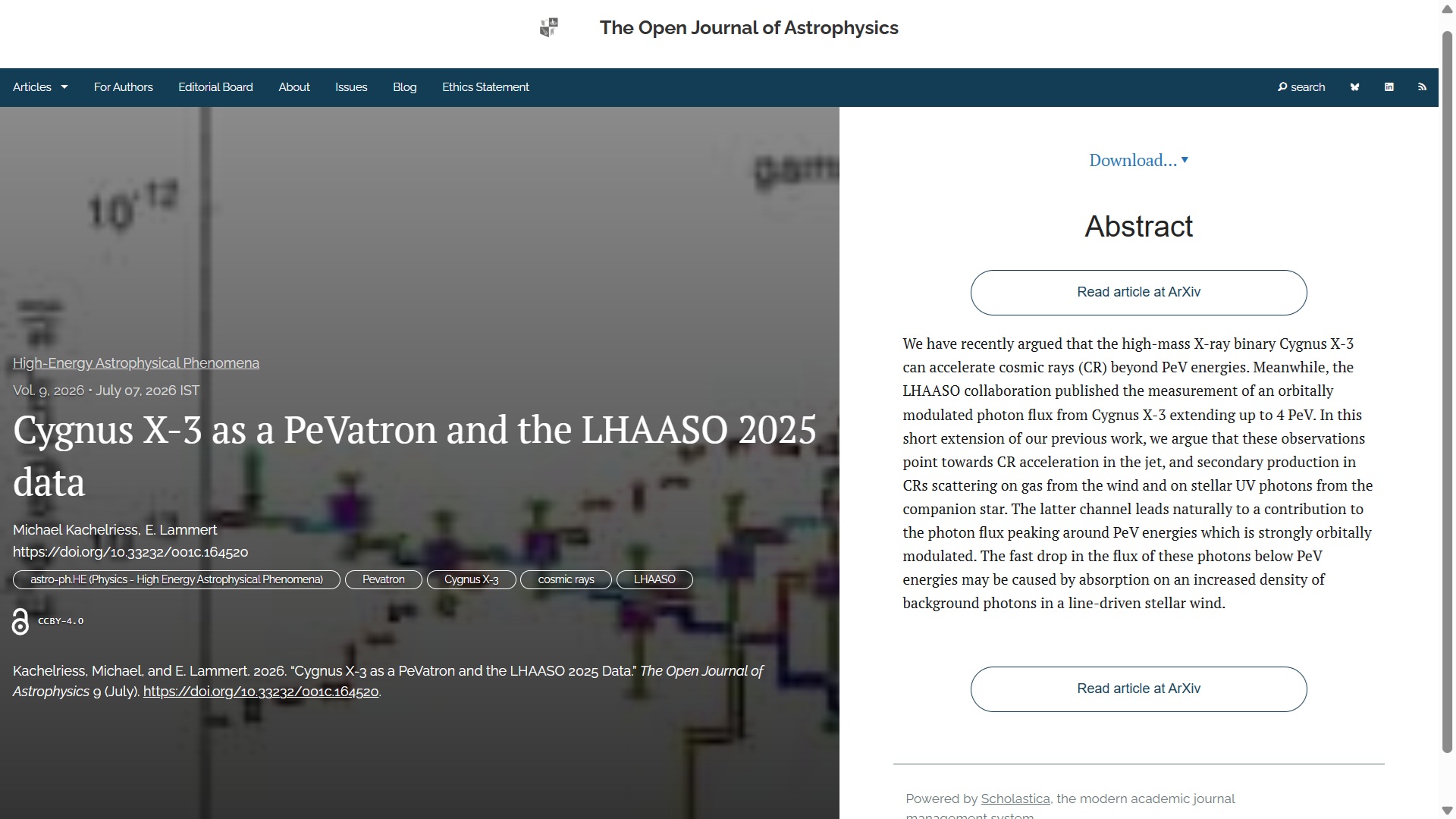
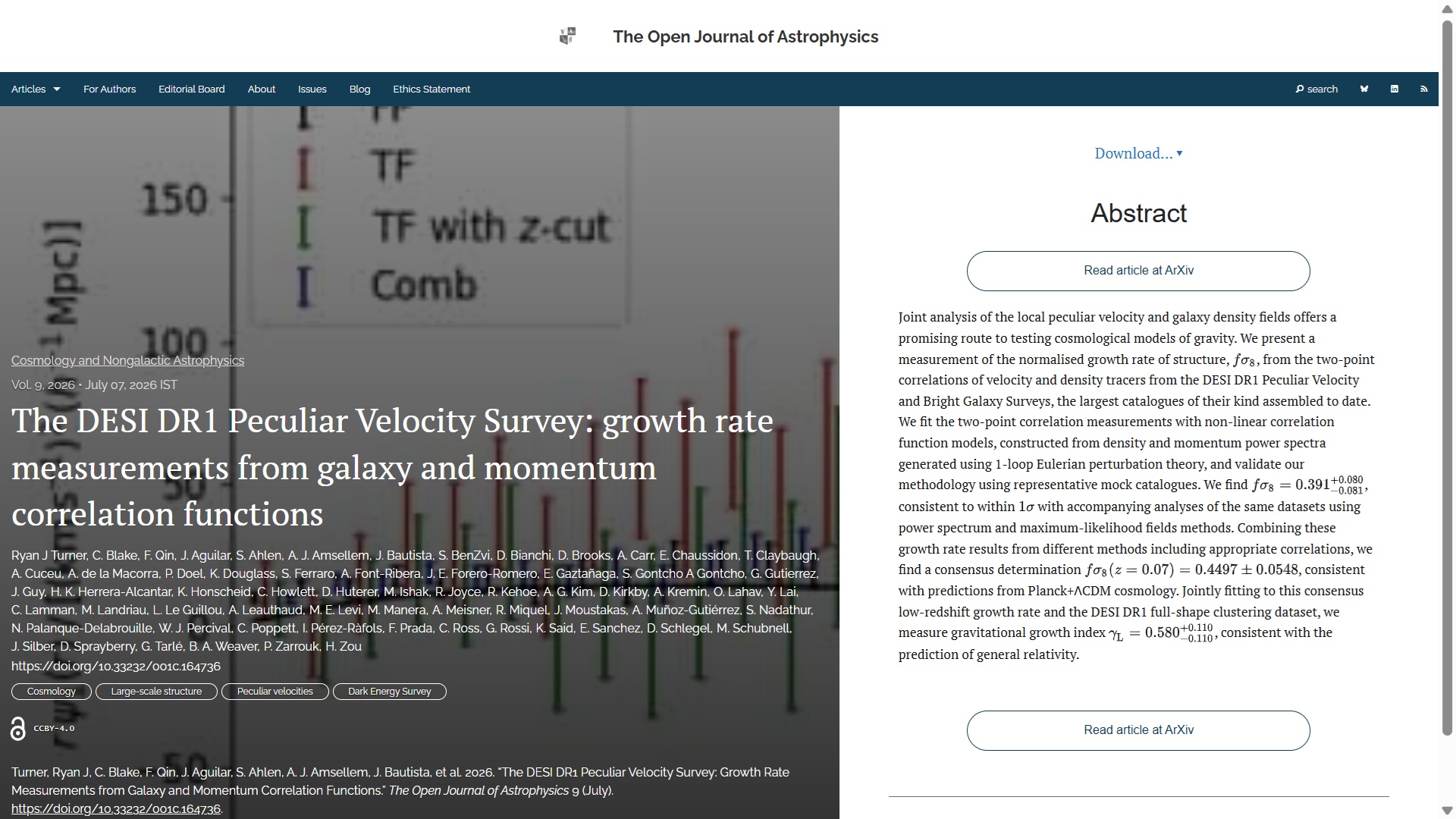
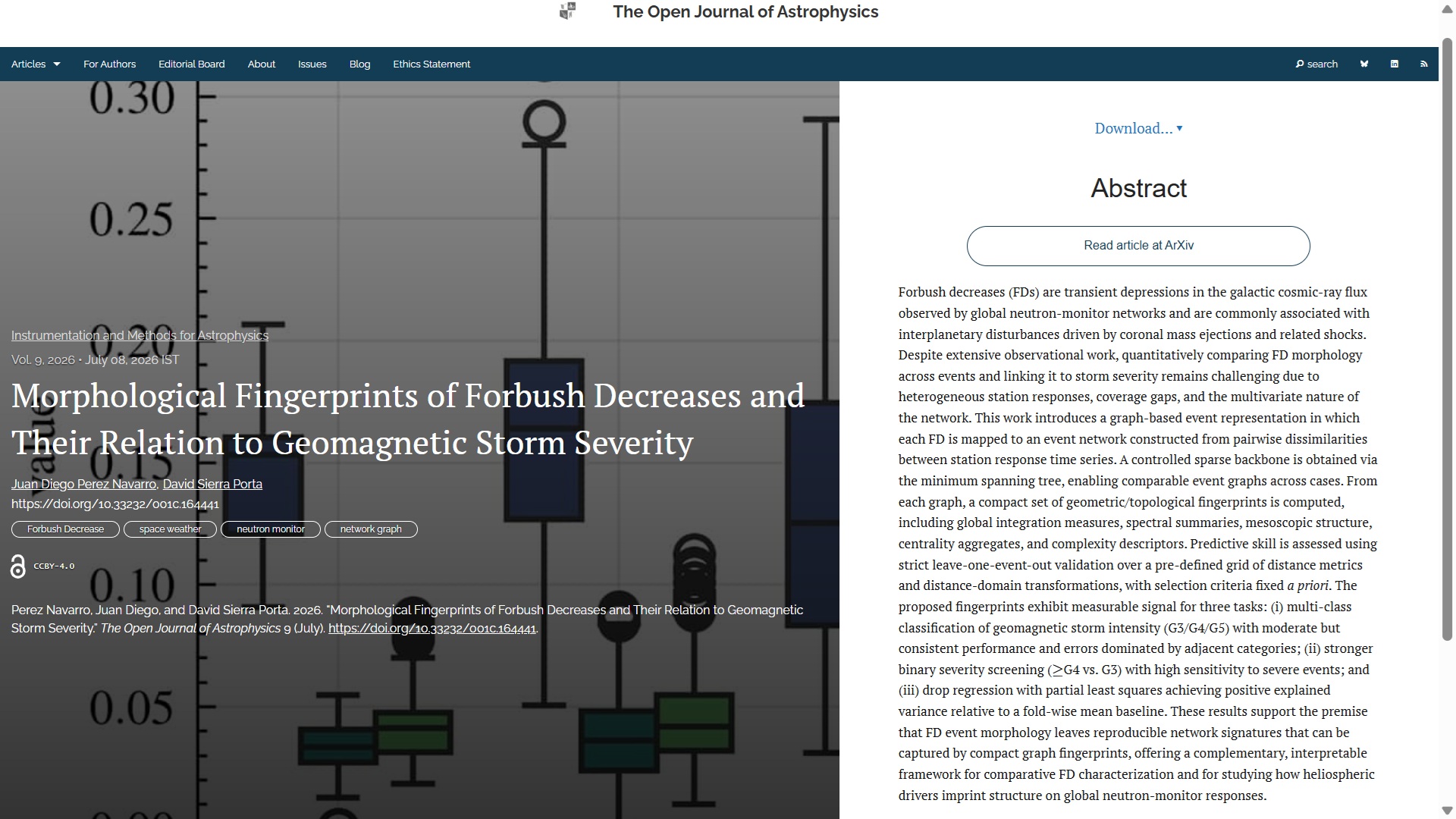
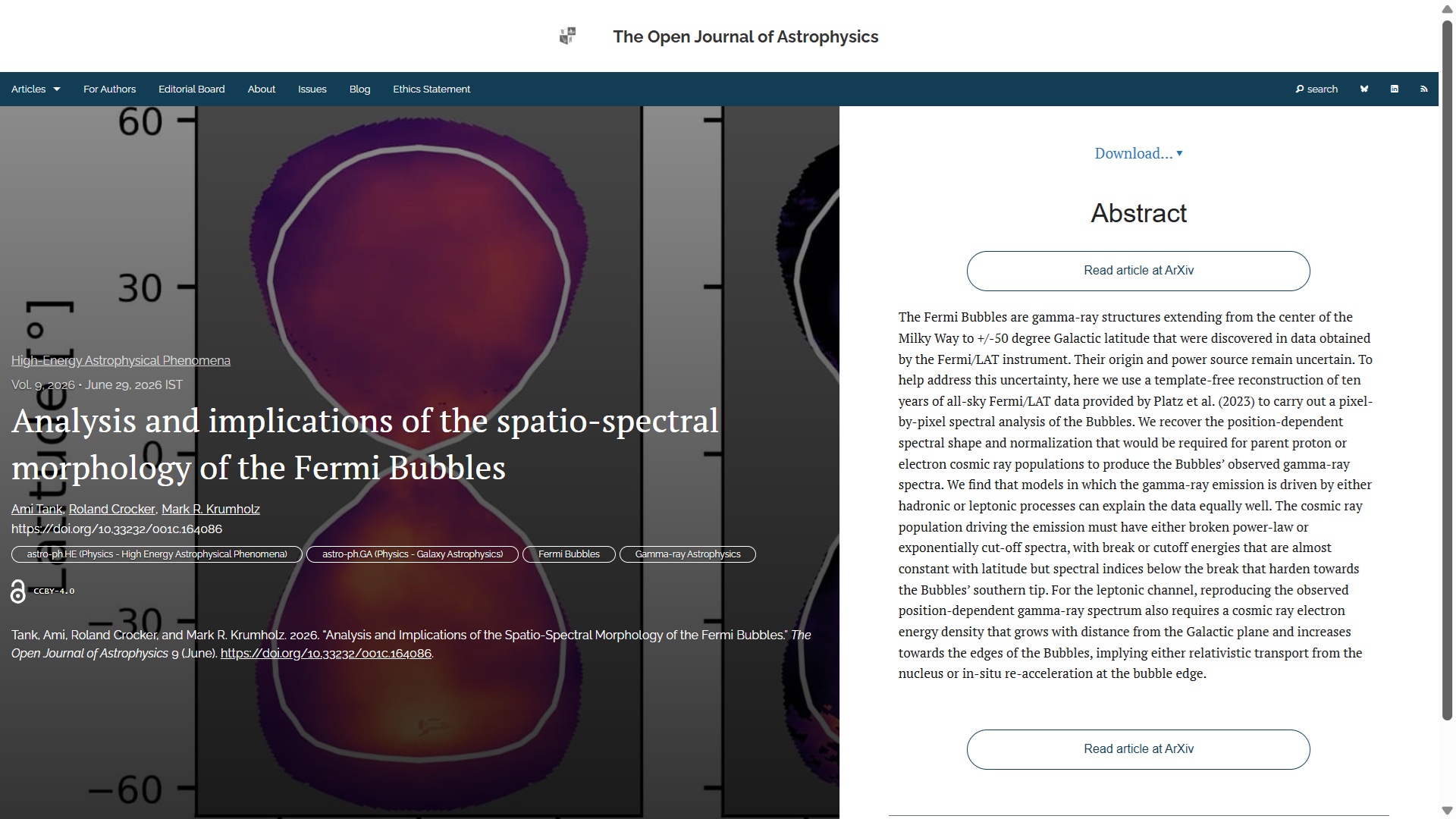
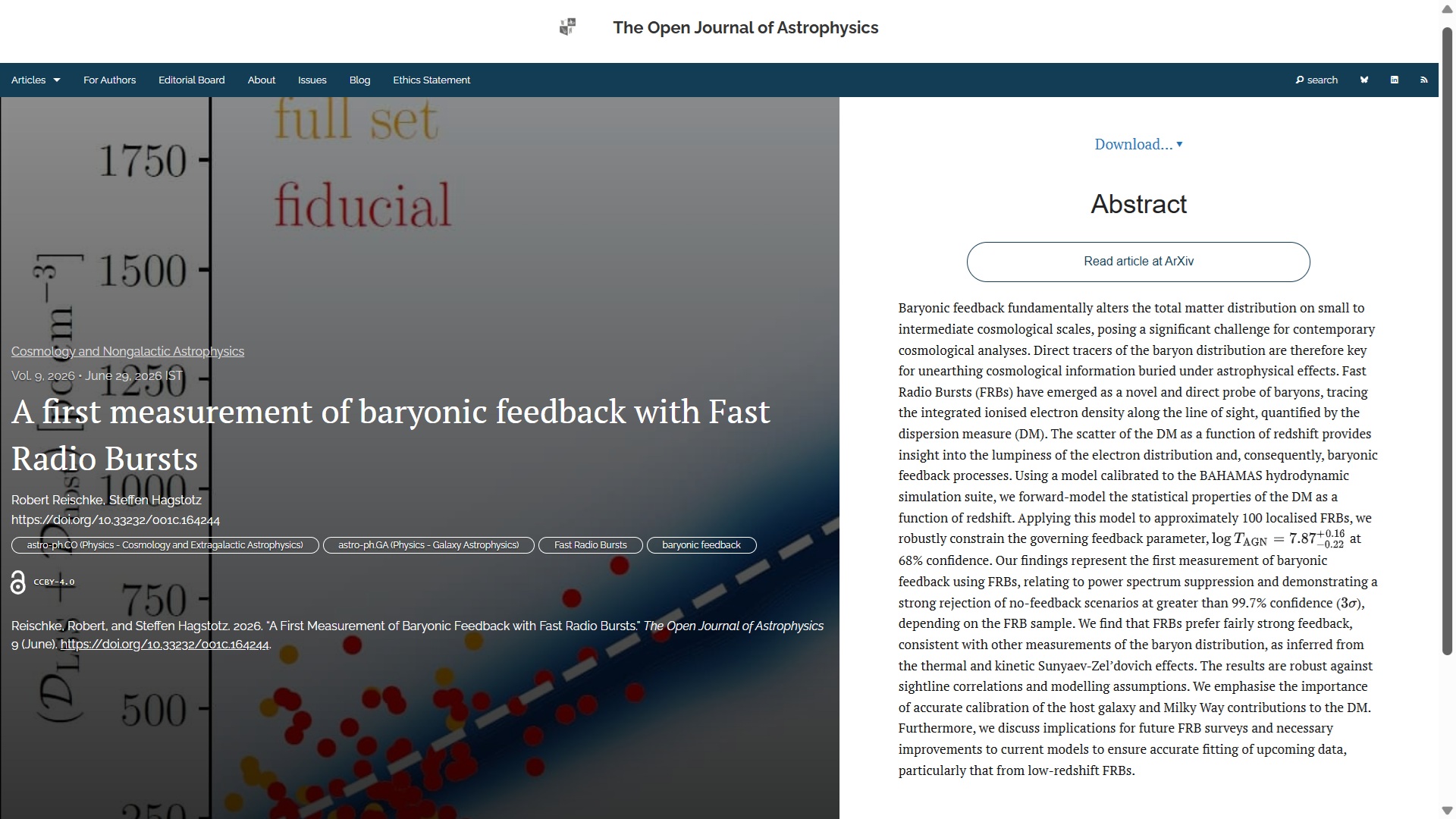
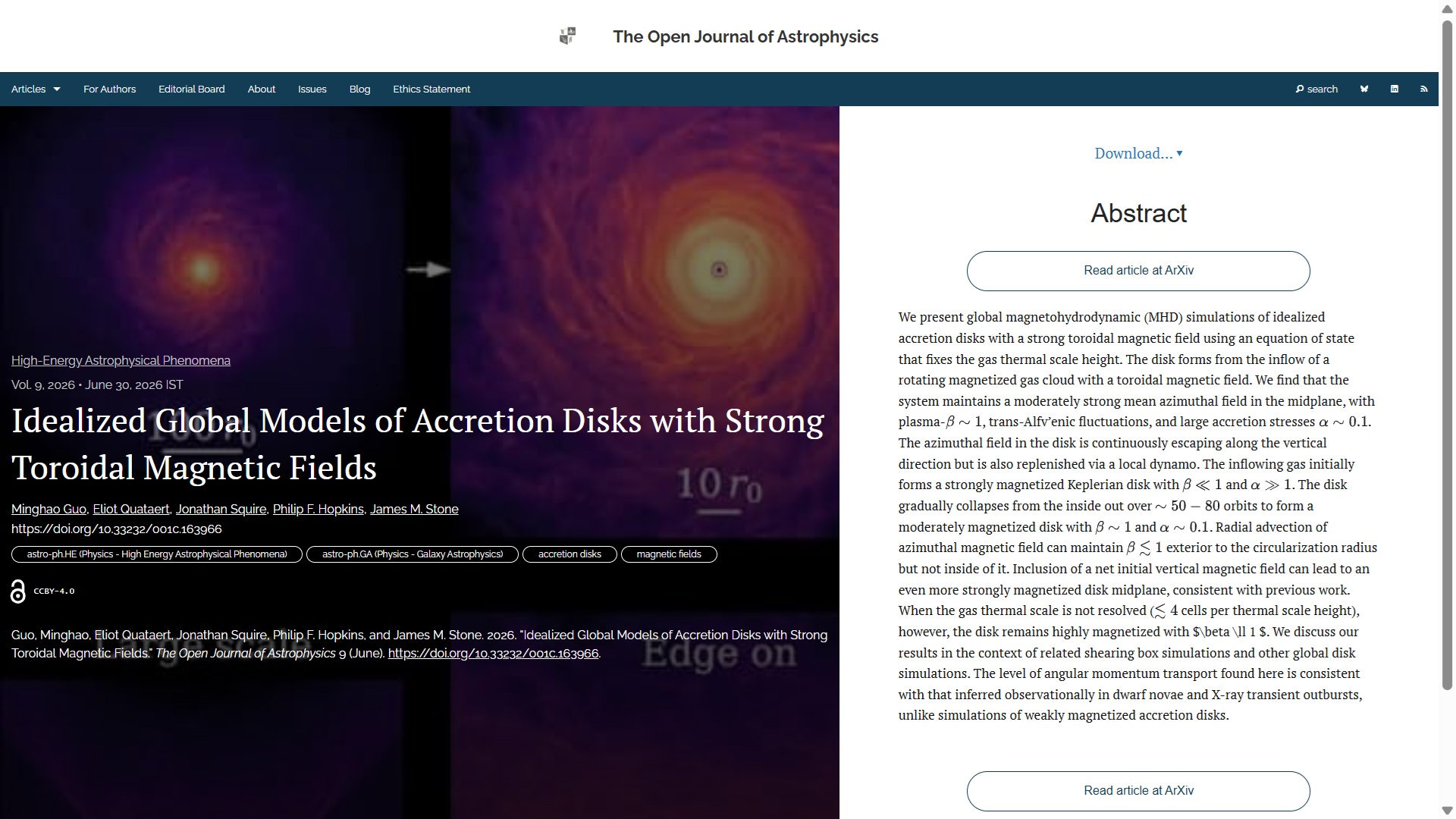
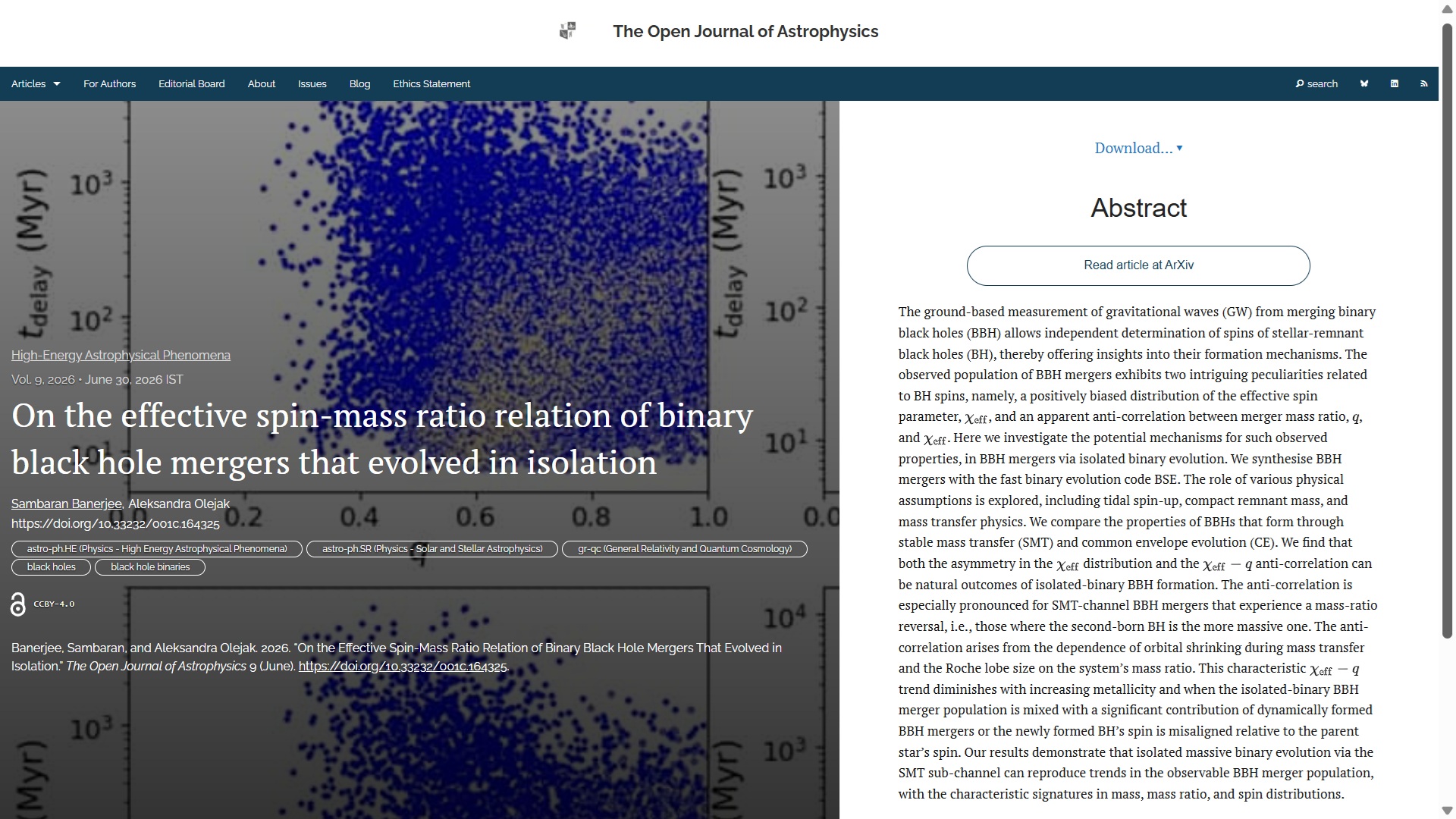
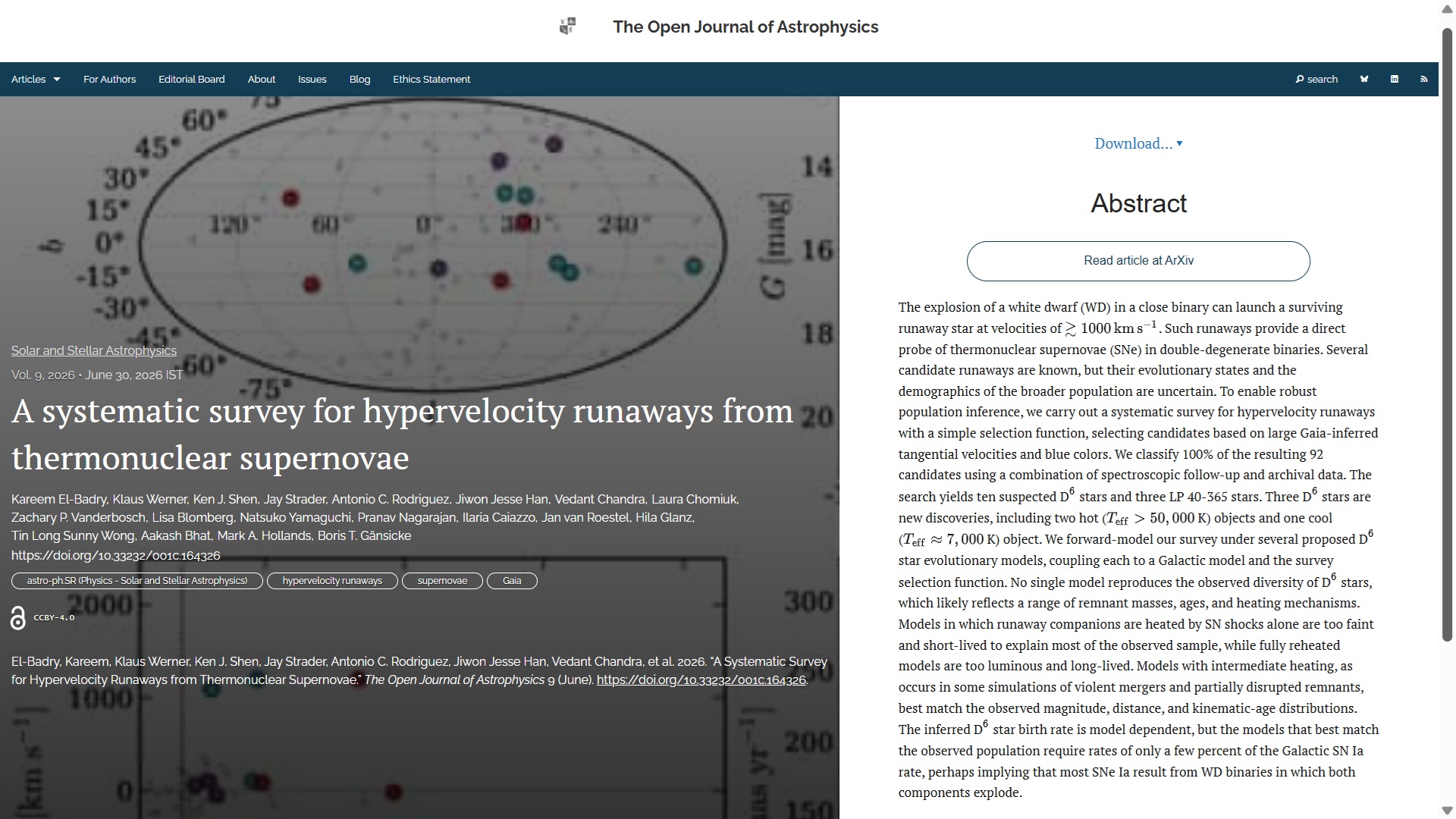
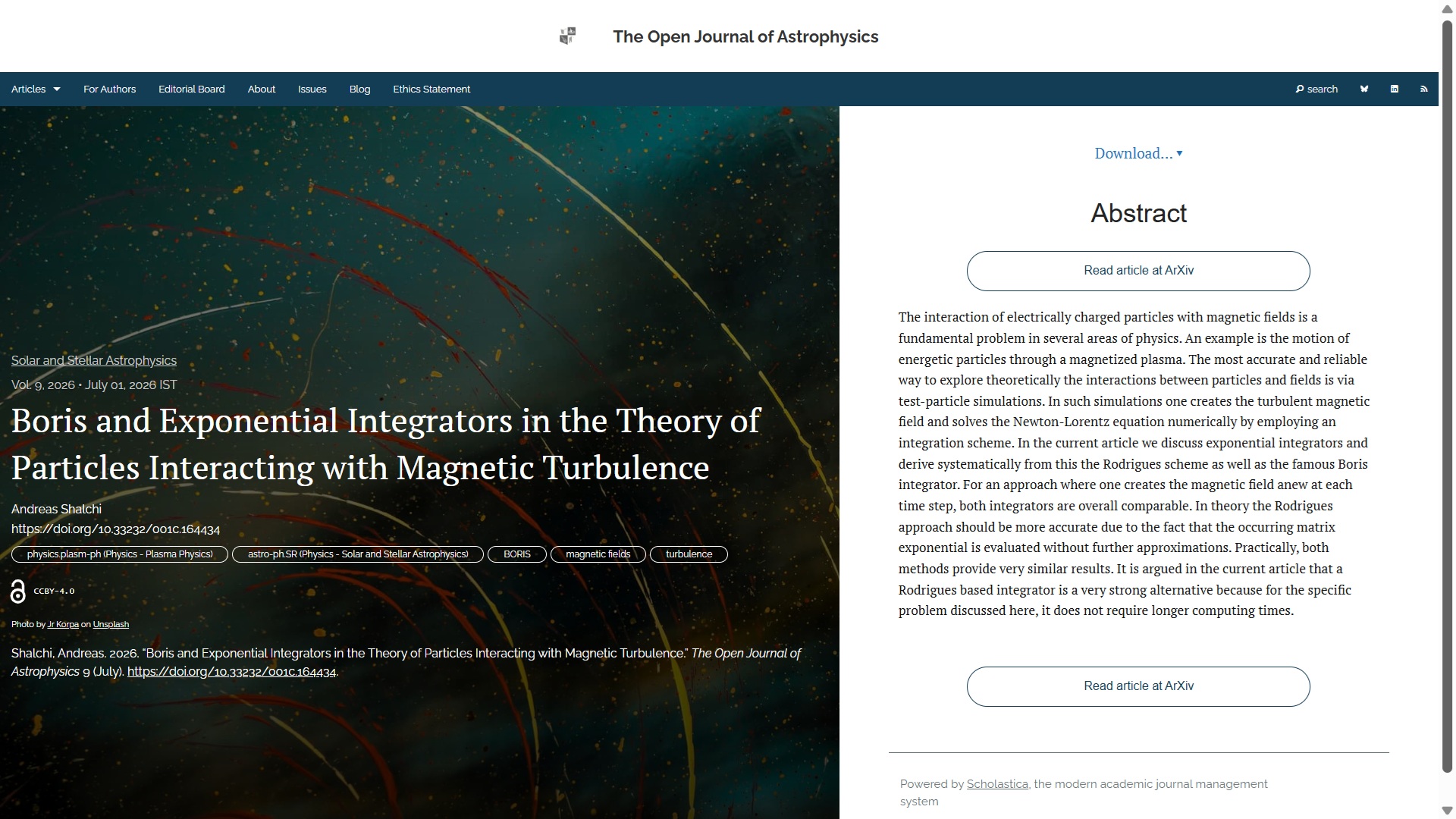
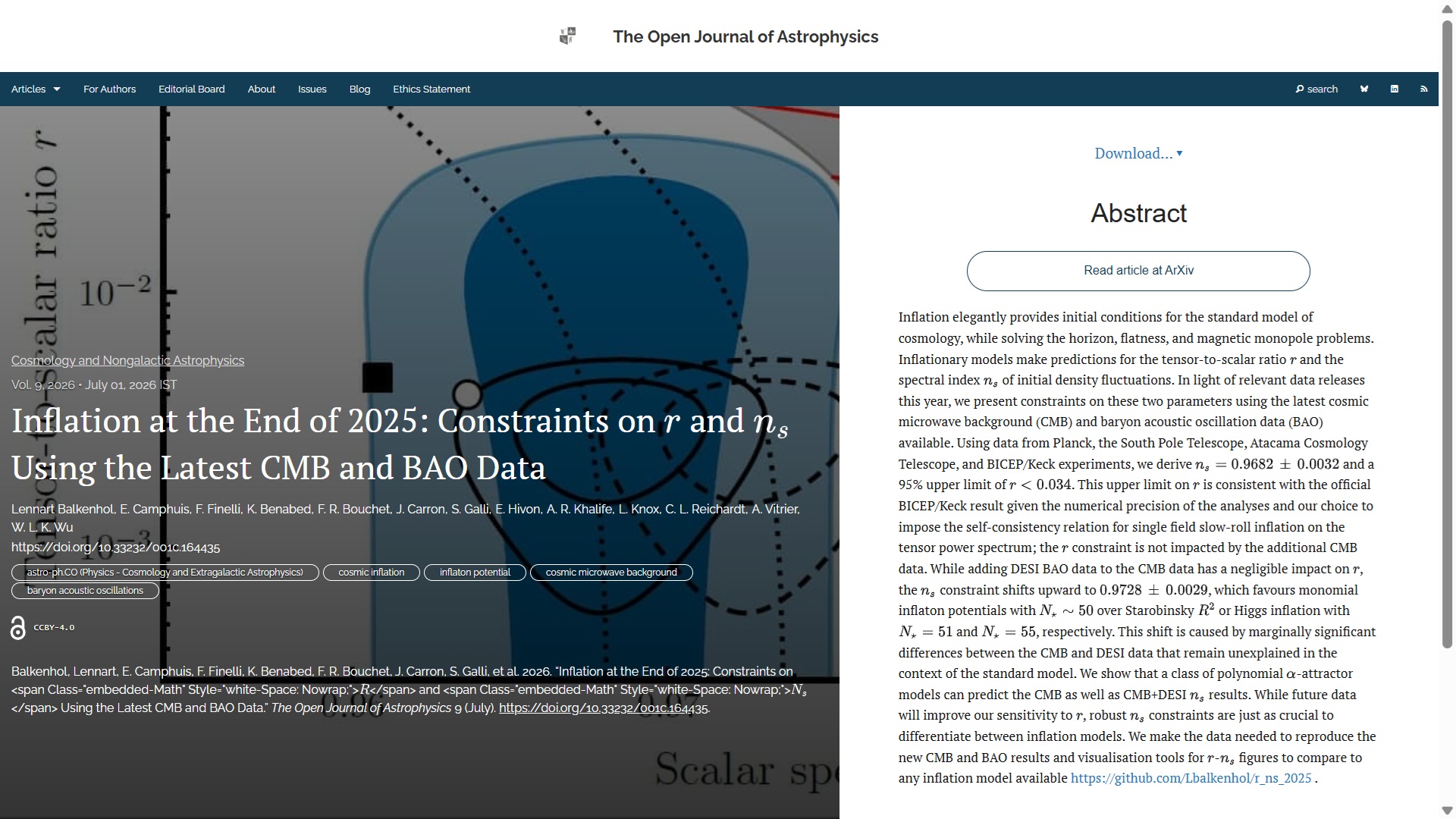
It’s Saturday again so it’s time for another update of activity at the Open Journal of Astrophysics. Since the last update we have published a further three papers, bringing the number in Volume 9 (2026) to 122 and the total so far published by OJAp up to 570.
I will continue to include the posts made on our Mastodon account (on Fediscience); these announcements also show the DOI for each paper.
The first paper to report this week, published on Thursday 11th June, is “Dancing Streams In Merging Halos: Stellar Streams in a MW–LMC-like merger” by (all based in the USA): Sachi Weerasooriya (Carnegie Observatories), Tjitske Starkenburg (Northwestern U.), Emily C. Cunningham (Columbia U.) & Kathryn V. Johnston (Flatiron Institute). This article explores how galaxy mergers, like the Milky Way-Large Magellanic Cloud merger, significantly alter the properties and structures of stellar streams, challenging the recovery of their initial orbits. It is in the folder marked Astrophysics of Galaxies.
The overlay for this paper is here
You can find the officially accepted version on arXiv here and the announcement on Fediverse here:
New Publication at the Open Journal of Astrophysics: "Dancing Streams In Merging Halos: Stellar Streams in a MW–LMC-like merger" by (all based in the USA): Sachi Weerasooriya (Carnegie Observatories), Tjitske Starkenburg (Northwestern U.), Emily C. Cunningham (Columbia U.) & Kathryn V. Johnston (Flatiron Institute).
New Publication at the Open Journal of Astrophysics: "X-SORTER (X-ray Survey Of meRging clusTErs in Redmapper): X-ray and Spectroscopic Characterization of 12 Optically Selected Galaxy Cluster Merger Candidates" by Christopher Hopp, David Wittman, Rodrigo Stancioli, Zhuoran Gao & Faik Bouhrik (UC Davis) and Scott Adler (Rochester), all based in the USA.
The third and final paper of the week, published on Friday 12the June in the folder Earth and Planetary Astrophysics, is “JCMT Constraints on the Early-Time HCN and CO Emission and HCN Temporal Evolution of 3I/ATLAS” by Jason T. Hinkle (U. Illinois, USA) and 6 others based in the USA and Chile. This article presents observations of the third Interstellar Object, 3I/ATLAS, providing early sub-mm constraints on its activity. The findings suggest a steeper production rate slope than typical Solar System comets.
The overlay for this one is here:
The final, accepted version can be found on arXiv here and the Mastodon announcement is here:
New Publication at the Open Journal of Astrophysics: "JCMT Constraints on the Early-Time HCN and CO Emission and HCN Temporal Evolution of 3I/ATLAS" by Jason T. Hinkle (U. Illinois, USA) and 6 others based in the USA and Chile.
And that concludes this week’s update. It has been a slow week on the publishing front, but the main reason is that we have a big backlog of papers accepted but waiting for the authors to put their final versions on arXiv and we can’t do anything about that! I’ll do another update next Saturday.
Another Saturday, another update of activity at the Open Journal of Astrophysics. Since the last update we have published a further five papers, bringing the number in Volume 9 (2026) to 119 and the total so far published by OJAp up to 567.
I will continue to include the posts made on our Mastodon account (on Fediscience); these announcements also show the DOI for each paper.
The first paper to report this week, published on Tuesday 2nd June, is “The impact of the formation channel on gravitational-wave-galaxy cross-correlations” by Kabir Chakravarti (Chennai Mathematical Institute, India) and Federico R Urban (CEICO-FZU, Czech Republic). This article, published in the folder Cosmology and Nongalactic Astrophysics, explores how uncertainties in binary formation affect the cross-correlation signal between gravitational wave events and galaxy catalogues, finding that time-delay distribution significantly impacts the signal.
The overlay for this paper is here
You can find the officially accepted version on arXiv here and the announcement on Fediverse here:
New Publication at the Open Journal of Astrophysics: "The impact of the formation channel on gravitational-wave-galaxy cross-correlations" by Kabir Chakravarti (Chennai Mathematical Institute, India) and Federico R Urban (CEICO-FZU, Czech Republic)
New Publication at the Open Journal of Astrophysics: "Transient X-ray Sources as Extremely Eccentric Mass-Transfer Binaries with Compact Companions" by Jonathan I Katz and Michael A Nowak (Washington University, USA)
Next one up, the third paper of the week, also published on Tuesday 2nd June in the folder High-Energy Astrophysical Phenomena is “Resolving the (Debate About) Nozzle Shocks in Tidal Disruption Events” by Zachary L. Andalman & Eliot Quataert (Princeton U., USA), Eric R. Coughlin (Syracuse U. USA) and C. J. Nixon (U. Leeds, UK). This paper presents a model to understand the role of nozzle shocks in the circularization of stellar debris during a tidal disruption event when a star approaches a supermassive black hole (SMBH)
The overlay for this one is here:
The final, accepted version can be found on arXiv here and the Mastodon announcement is here:
New Publication at the Open Journal of Astrophysics: "Resolving the (Debate About) Nozzle Shocks in Tidal Disruption Events" by Zachary L. Andalman & Eliot Quataert (Princeton U., USA), Eric R. Coughlin (Syracuse U. USA) and C. J. Nixon (U. Leeds, UK)
The fourth paper this week, published on Wednesday 3rd June in the folder Cosmology and Nongalactic Astrophysics, is “Validating Digital Twins of the Local Universe with the Thermal Sunyaev-Zel’dovich Signal” by Richard Stiskalek (University of Oxford, UK) and Harry Desmond (University of Portsmouth, UK). The thermal Sunyaev-Zel’dovich effect and constrained simulations are used to analyze the thermal pressure of ionized gas in galaxy clusters and produce a set of digital twins for cosmological study.
The overlay is here:
The officially accepted version can be found on arXiv here and here is the Mastodon announcement:
New Publication at the Open Journal of Astrophysics: "Validating Digital Twins of the Local Universe with the Thermal Sunyaev-Zel’dovich Signal" by Richard Stiskalek (U. Oxford, UK) and Harry Desmond (U. Portsmouth, UK)
New Publication at the Open Journal of Astrophysics: "Photon (Non)Conservation in the Reduced Speed of Light Approximation and How to (Almost) Fix It" by Nickolay Y. Gnedin (U. Chicago, USA)
It’s Saturday once again, so time for another update of activity at the Open Journal of Astrophysics. Since the last update we have published a further six papers, bringing the number in Volume 9 (2026) to 110 and the total so far published by OJAp up to 558.
I will continue to include the posts made on our Mastodon account (on Fediscience); these announcements also show the DOI for each paper.
The first paper to report this week, published on Monday 18th May in the folder Instrumentation and Methods for Astrophysics is “Edges In Coadded Images” by Erin Sheldon (Brookhaven National Laboratory, USA). This paper describes a study exploring how image discontinuities and noise impact weak gravitational lensing measurements, finding no significant biases under typical conditions. Biases occur only in extreme cases, but can be mitigated.
The overlay for this paper is here
You can find the officially accepted version on arXiv here and the announcement on Fediverse here:
New Publication at the Open Journal of Astrophysics: "Joint cosmological fits to DESI-DR1 full-shape clustering and weak gravitational lensing in configuration space " by A. Semenaite (Swinburne Institute of Technology, Australia) and 72 others from all round the world.
Next one up, the third paper of the week, and the third published on Monday 18th May, and in the folder Cosmology and Nongalactic Astrophysics is “Probing Dark Energy Microphysics with kSZ Tomography” by Julius Adolff, Selim Hotinli and Neal Dalal (all of the Perimeter Institute, Canada). This paper explores how kinetic Sunyaev-Zel’dovich tomography and galaxy clustering can enhance our understanding of dark energy and its effects, potentially revealing its microphysical properties in future surveys.
The overlay for this one is here:
The final, accepted version can be found on arXiv here and the Mastodon announcement is here:
New Publication at the Open Journal of Astrophysics: "Probing Dark Energy Microphysics with kSZ Tomography" by Julius Adolff, Selim Hotinli and Neal Dalal (Perimeter Institute, Canada)
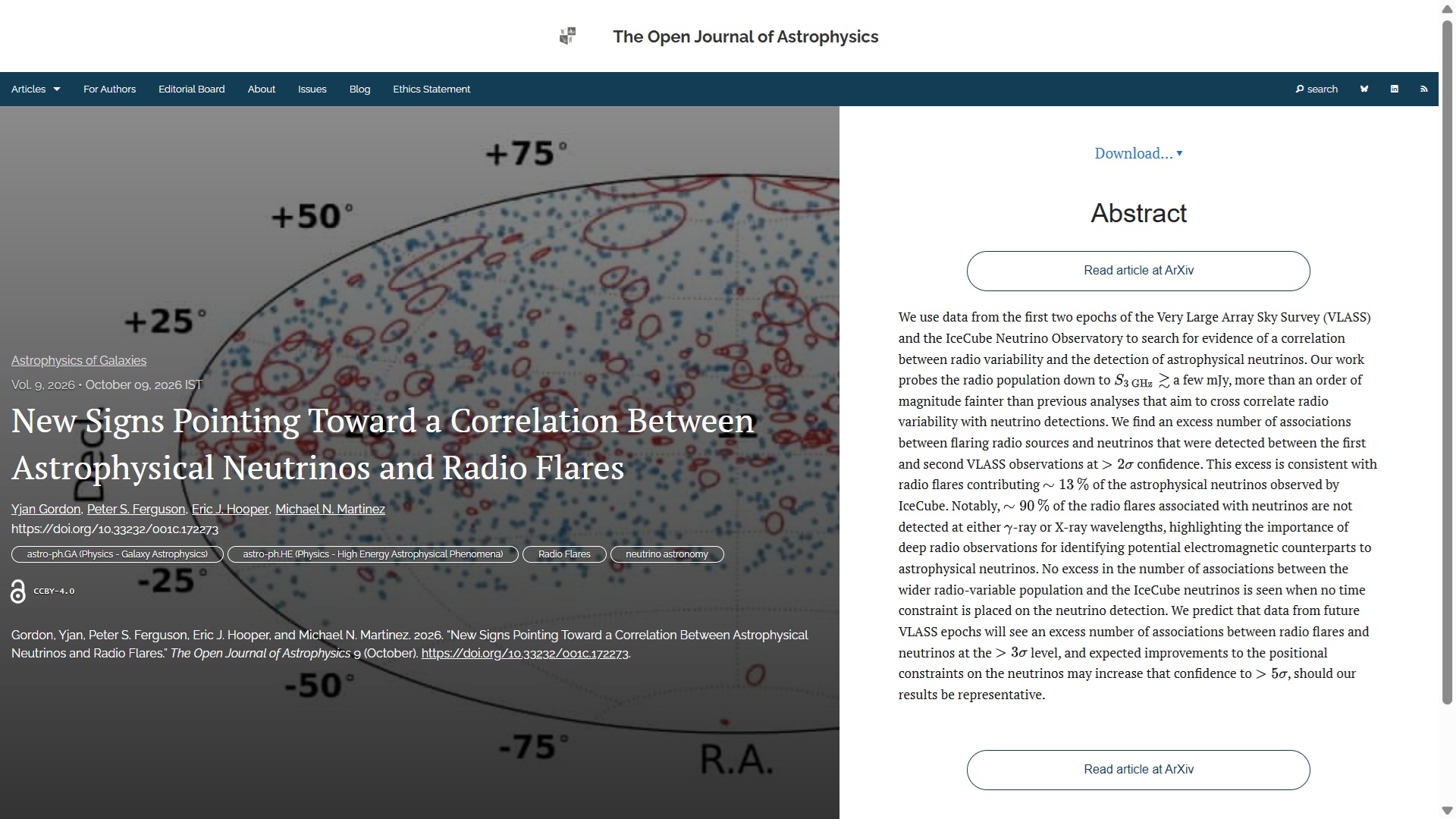
The fourth paper this week, published on Wednesday May 20th is “A Census of Variable Radio Sources at 3 GHz” by Yjan A. Gordon, Peter S. Ferguson, Michael N. Martinez and Eric J. Hooper (all of the University of Wisconsin, USA). This article, published in the folder Astrophysics of Galaxies, uses data from the Very Large Array Sky Survey to analyze variability in the radio sky, finding most changes consistent with blazars and quasars.
The overlay is here:
The officially accepted version can be found on arXiv here and here is the Mastodon announcement:
New Publication at the Open Journal of Astrophysics: "A Census of Variable Radio Sources at 3 GHz" by Yjan A. Gordon, Peter S. Ferguson, Michael N. Martinez & Eric J. Hooper (U. Wisconsin, USA)
The fifth article of this week was published on Friday 22nd May in the folder Instrumentation and Methods for Astrophysics. The title is “Uncovering the Next Galactic Supernova with the Vera C. Rubin Observatory” by John Banovetz (Lawrence Berkeley Lab., USA), Claire-Alice Hebert & Peter B. Denton (Brookhaven National Lab., USA), Dan Scolnic (Duke University, USA), Anze Slosar (Brookhaven) and Chris Walter (Duke). The paper presents a study simulating how effectively the Vera C. Rubin Observatory can localize supernovae using neutrino triggers, finding a 57-97% success rate based on stellar mass density predictions.
The overlay is here:
You can find the authorized version of this paper on arXiv here and the Fediverse announcement is here:
New Publlication at the Open Journal of Astrophysics: "Uncovering the Next Galactic Supernova with the Vera C. Rubin Observatory" by John Banovetz (Lawrence Berkeley Lab., USA), Claire-Alice Hebert & Peter B. Denton (Brookhaven National Lab., USA) , Dan Scolnic (Duke U., USA) , Anze Slosar (Brookhaven), and Chris Walter (Duke)
Last, but by no means least, this week we have “Pulsar timing solutions for 17 pulsars at 150 MHz from the Irish LOFAR station” by David J. McKenna (ASTRON, The Netherlands), Evan F. Keane (Trinity College Dublin, Ireland), Peter T. Gallagher (DIAS, Ireland) and Joe McCauley (Trinity). This was published on Friday 22nd May in the folder High-Energy Astrophysical Phenomena. It presents a demonstration of the use of international Low Frequency Array (LOFAR) stations in tracking and characterizing pulsars, providing new insights into these neutron stars’ emission properties.
The overlay for this one is here:
You can find the authorized version of this paper on arXiv here and the Fediverse announcement is here:
New Publication at the Open Journal of Astrophysics: "Pulsar timing solutions for 17 pulsars at 150 MHz from the Irish LOFAR station" by David J. McKenna (ASTRON, The Netherlands), Evan F. Keane (Trinity College Dublin, Ireland), Peter T. Gallagher (DIAS, Ireland) and Joe McCauley (Trinity)
It’s Saturday once again, so time for another update of activity at the Open Journal of Astrophysics. Since the last update we have published a further five papers, bringing the number in Volume 9 (2026) to 104 and the total so far published by OJAp up to 552. It took us until late July to pass 100 last year.
I will continue to include the posts made on our Mastodon account (on Fediscience) to encourage you to visit it. Mastodon is a really excellent service, and a more than adequate replacement for X/Twitter (which nobody should be using); these announcements also show the DOI for each paper.
The first paper to report this week, published on Monday 11th May in the folder High-Energy Astrophysical Phenomena is “Triaxial magnetars as sources of fast radio bursts” by Jonathan I Katz (Washington University, USA). This paper suggests that the mysterious properties of Fast Radio Bursts (FRB) could be explained by triaxial magnetars, with their activity levels influenced by precessional time scales.
The overlay for this paper is here
You can find the officially accepted version on arXiv here and the announcement on Fediverse here:
New Publication at the Open Journal of Astrophysics: "Triaxial magnetars as sources of fast radio bursts" by Jonathan I Katz (Washington University, USA)
The second paper for this week, published on Tuesday 12th May in the folder Astrophysics of Galaxies, is “The Abundance of Thin Dwarf Galaxies: a Challenge for Cosmological Simulations” by Jose Benavides & Laura V. Sales (UC Riverside, USA), Julio F. Navarro (U. Victoria, Canada), Simon D. M. White (MPA Garching, Germany), and Carlos S. Frenk, Kyle A. Oman & Shaun Cole (U. Durham, UK). Depending on mass up to 40% of galaxies are intrinsically flat, a fraction that numerical models of galaxy formation struggle to reproduce suggesting the models are incomplete.
The overlay for this one is here:
The official version of the paper can be found on arXiv here and the Fediverse announcement here:
New Publication at the Open Journal of Astrophysics: "The Abundance of Thin Dwarf Galaxies: a Challenge for Cosmological Simulations" by Jose Benavides & Laura V. Sales (UC Riverside, USA), Julio F. Navarro (U. Victoria, Canada), Simon D. M. White (MPA Garching, Germany), and Carlos S. Frenk, Kyle A. Oman & Shaun Cole (U. Durham, UK)
Next one up, the third paper of the week, also published on Tuesday 12th May but in the folder Cosmology and Nongalactic Astrophysics is “Cosmological peculiar velocities in general relativity” by Chris Clarkson (Queen Mary, University of London, UK) and Roy Maartens (U. Western Cape, South Africa). This paper refutes claims that the 1+3 covariant approach to cosmological perturbation theory predicts stronger growth of galaxy peculiar velocities, arguing that standard treatments are correct and fully relativistic.
The overlay for this one is here:
The final, accepted version can be found on arXiv here and the Mastodon announcement is here:
New Publication at the Open Journal of Astrophysics: "Cosmological peculiar velocities in general relativity" by Chris Clarkson (QMUL, UK) and Roy Maartens (U. Western Cape, South Africa)
The fourth paper this week, published on Wednesday May 13th “Possible evidence for a pair-instability supernova nature of ultra-early JWST sources” by Andrea Ferrara & Stefano Carniani (Scuola Normale Superiore, Pisa, Italy), Takahiro Morishita (California Institute of Technology, USA), and Massimo Stiavelli (Space Telescope Science Institute, USA). Published in the section Astrophysics of Galaxies. This paper argues that recent observations challenge early galaxy formation models, suggesting that the bright source, Capotauro, could be a supernova from a massive, metal-free star, not a luminous galaxy as initially thought.
The overlay is here:
The officially accepted version can be found on arXiv here and here is the Mastodon announcement:
New Publication at the Open Journal of Astrophysics: "Possible evidence for a pair-instability supernova nature of ultra-early JWST sources" by Andrea Ferrara & Stefano Carniani (Scuola Normale Superiore, Pisa, Italy), Takahiro Morishita (Caltech, USA) and Massimo Stiavelli (STScI, USA)
The fifth and final article of this week was also published on Wednesday 13th May but in the folder Cosmology and Nongalactic Astrophysics. The title is “Evolving and interacting dark energy: photometric and spectroscopic synergy with DES Y3 and DESI DR2” and it is by Maria Tsedrik and Benjamin Bose (University of Edinburgh, UK). The study investigates the Dark Scattering interacting dark energy scenario, using data from various sources. Results show no evidence of dark-sector interaction and a preference for the Chevallier-Polarski-Linder parametrisation.
The overlay is here:
You can find the authorized version of this paper on arXiv here and the Fediverse announcement is here:
New Publication at the Open Journal of Astrophysics: "Evolving and interacting dark energy: photometric and spectroscopic synergy with DES Y3 and DESI DR2" by Maria Tsedrik and Benjamin Bose (University of Edinburgh, UK)
Here we are, on schedule, with another update of activity at the Open Journal of Astrophysics. Since the last update we have published a further seven papers, bringing the number in Volume 9 (2026) to 94 and the total so far published by OJAp up to 542. I checked the corresponding update for last year (on 3rd May 2025), and we’ve had an increase from 54 to 94 in papers published (about 74%) between the first four months of 2025 and the first four months of 2026.
I will continue to include the posts made on our Mastodon account (on Fediscience) to encourage you to visit it. Mastodon is a really excellent service, and a more than adequate replacement for X/Twitter (which nobody should be using); these announcements also show the DOI for each paper.
The first paper to report this week is “DESI-DR1 3 × 2-pt analysis: consistent cosmology across weak lensing surveys” by Anna Porredon (CIEMAT, Madrid, Spain) and 72 others (DESI Colllaboration). This paper was published on Tuesday 28th April in the folder Cosmology and Nongalactic Astrophysics. This paper presents a joint cosmological analysis of galaxy clustering and gravitational lensing observations, providing consistent constraints on cosmological parameters. The analysis also introduces a new blinding procedure to prevent confirmation bias. See this post for news of an important DESI milestone.
The overlay for this paper is here
You can find the officially accepted version on arXiv here and the announcement on Fediverse here:
New Publication at the Open Journal of Astrophysics: "DESI-DR1 3 × 2-pt analysis: consistent cosmology across weak lensing surveys" by Anna Porredon (CIEMAT, Madrid, Spain) and 72 others (DESI Colllaboration)
The second paper for this week, also published on Tuesday 28th April but in the folder High-Energy Astrophysical Phenomena is “Masers and Broad-Line Mapping Favor Magnetically-Dominated AGN Accretion Disks” by Philip F. Hopkins (Caltech, USA), Dalya Baron (Stanford U., USA) and Joanna M. Piotrowska (Caltech). This one presents a new constraint on supermassive black hole accretion disks physics, suggesting that outer regions are likely in a ‘hyper-magnetized’ state, as thermal or radiation pressure models appear inconsistent.
The overlay for this one is here:
The official version of the paper can be found on arXiv here and the Fediverse announcement here:
New Publication at the Open Journal of Astrophysics: "Masers and Broad-Line Mapping Favor Magnetically-Dominated AGN Accretion Disks" by Philip F. Hopkins (Caltech, USA), Dalya Baron (Stanford U., USA) and Joanna M. Piotrowska (Caltech)
Next one up, the third paper of the week, is “Galaxy mergers and disk angular momentum evolution: stellar halos as a critical test” by Eric F. Bell (U. Michigan, Ann Arbor, USA), Richard D’Souza (Vatican Observatory), Monica Valluri & Katya Gozman (U. Michigan). This was published on Wednesday 29th April in the folder Astrophysics of Galaxies. The paper argues that satellite accretion impacts the angular momentum evolution of galaxies, often causing significant reorientation. This process is detectable in Milky Way-mass galaxies so the idea is testable observationally.
The overlay for this one is here:
The final, accepted version can be found on arXiv here and the Mastodon announcement is here:
New Publication at the Open Journal of Astrophysics: "Galaxy mergers and disk angular momentum evolution: stellar halos as a critical test" by Eric F. Bell (U. Michigan, Ann Arbor, USA), Richard D'Souza (Vatican Observatory), Monica Valluri & Katya Gozman (U. Michigan)
The fourth paper this week, published on Thursday April 30th, is “Time-Dilation Methods for Extreme Multiscale Timestepping Problems” by Philip F. Hopkins and Elias R. Most (Caltech, USA). This paper is in the folder Instrumentation and Methods for Astrophysics: it presents a new method for astrophysical simulations that modulates time evolution with a variable dilation/stretch factor, improving efficiency and accuracy in modeling processes across different scales.
The overlay is here:
The finally accepted version of this paper can be found here and the Mastodon announcement follows:
New Publication at the Open Journal of Astrophysics: "Time-Dilation Methods for Extreme Multiscale Timestepping Problems" by Philip F. Hopkins and Elias R. Most (Caltech, USA)
The fifth article of this week was also published on Thursday 30th April, but in the folder Astrophysics of Galaxies. The title is “Cosmic Rays on Galaxy Scales: Progress and Pitfalls for CR-MHD Dynamical Models” and the author is Philip F. Hopkins (Caltech, USA) who has three papers featured this week. The paper presents an overview of cosmic ray (CR) modeling, highlighting its influence on galactic physics and star formation. It addresses previous modeling errors and presents new methods for full-spectrum dynamics.
The overlay is here:
You can find the authorized version of this paper on arXiv here and the Fediverse announcement is here:
New Publication at the Open Journal of Astrophysics: "Cosmic Rays on Galaxy Scales: Progress and Pitfalls for CR-MHD Dynamical Models" by Philip F. Hopkins (Caltech, USA)
New Publication at the Open Journal of Astrophysics: "Baryonification III: An accurate analytical model for the dispersion measure probability density function of fast radio bursts" by MohammadReza Torkamani (Universität Bonn, Germany) and 8 others based in Germany, Switzerland, UK and Sweden
New Publication at the Open Journal of Astrophysics: "The stellar and dark matter distributions in early-type galaxies measured by stacked weak gravitational lensing" by Momoka Fujikawa & Masamune Oguri (Chiba University, Japan)
With permission, I have time for yet another Saturday morning update of activity at the Open Journal of Astrophysics. Since the last update we have published a further five papers, bringing the number in Volume 9 (2026) to 76 and the total so far published by OJAp up to 524.
I will continue to include the posts made on our Mastodon account (on Fediscience) to encourage you to visit it. Mastodon is a really excellent service, and a more than adequate replacement for X/Twitter (which nobody should be using); these announcements also show the DOI for each paper.
The first paper to report this week is “Lagrangian versus Eulerian Methods for Toroidally-Magnetized Isothermal Disks” by Yashvardhan Tomar and Philip F. Hopkins (California Institute of Technology, USA). This study re-evaluates previous research on toroidally-magnetized disks, using two Lagrangian methods. The results suggest that sustained midplane toroidal fields in recent simulations are not a numerical artefact. It was published on Tuesday April 7th 2026 in the folder High-Energy Astrophysical Phenomena.
The overlay is here:
You can find the officially accepted version on arXiv here and the announcement on Fediverse here:
New Publication at the Open Journal of Astrophysics: "Lagrangian versus Eulerian Methods for Toroidally-Magnetized Isothermal Disks" by Yashvardhan Tomar and Philip F. Hopkins (Caltech, USA)
The second paper for this week, published on Wednesday 8th Apil in the folder Instrumentation and Methods for Astrophysics, is “Teaching Astronomy with Large Language Models” by Yuan-Sen Ting and Teaghan O’Briain (Ohio State University, USA). The paper introduces AstroTutor, an AI-enhanced astronomy tutoring system, to improve undergraduate astronomy education and AI literacy. It found that structured AI integration can enhance learning and critical evaluation skills. The primary classification on arXiv for this paper is physics.ed-ph but it is cross-listed on astro-ph which qualifies it for consideration.
The overlay for this one is here:
The official version of the paper can be found on arXiv here and the Fediverse announcement here:
New Publication at the Open Journal of Astrophysics: "Teaching Astronomy with Large Language Models" by Yuan-Sen Ting and Teaghan O'Briain (Ohio State University, USA)
Next one up, the third paper of the week, also published on Wednesday 8th April, is “Statistical Predictions of the Accreted Stellar Halos around Milky Way-Like Galaxies” by J. Sebastian Monzon & Frank C. van den Bosch (Yale University, USA) and Martin P. Rey (University of Bath, UK). This one was published in the section Astrophysics of Galaxies; it describes new model to track formation of stellar halos in Milky Way-like galaxies, revealing their sensitivity to the fate of the largest satellite and whether accretion is early or late.
The overlay for this one is here:
The final, accepted version can be found on arXiv here and the Mastodon announcement is here:
New Publication at the Open Journal of Astrophysics: "A Tale of Tails: Star Formation and Stripping in Jellyfish Galaxies in the Strong Lensing Cluster MACS J0138.0-2155" by Catherine C. Gibson, Jackson H. O'Donnell and Tesla E. Jeltema (UC Santa Cruz, USA)
The fifth and final paper for this week is “Investigating ionising sources and the complex interstellar medium of GHZ2 at z=12.3” by M. Castellano (INAF Osservatorio Astronomico di Roma, Italy) and 29 others based all around the world. This was also published on Thursday 9th April in the folder Astrophysics of Galaxies. The paper uses deep observations of galaxy GHZ2 to explore the sources of ionising radiation and interstellar medium properties at cosmic dawn. Findings suggest a stratified environment and a hard ionising radiation component.
The overlay for this one is here:
The officially-accepted version of this one can be found on arXiv here and the Mastodon announcement is here
New Publication at the Open Journal of Astrophysics: "Investigating ionising sources and the complex interstellar medium of GHZ2 at z=12.3" by M. Castellano (INAF Osservatorio Astronomico di Roma, Italy) and 29 others based around the world.
It’s Saturday once more so time for another update of activity at the Open Journal of Astrophysics. Since the last update we have published a further six papers, bringing the number in Volume 9 (2026) to 36 and the total so far published by OJAp up to 484.
I will continue to include the posts made on our Mastodon account (on Fediscience) to encourage you to visit it. Mastodon is a really excellent service, and a more than adequate replacement for X/Twitter (which nobody should be using); these announcements also show the DOI for each paper.
The first paper to report this week is “SKA-Low simulations for a cosmic dawn/epoch of reionisation deep field” by Anna Bonaldi, Philippa Hartley, Simon Purser & Omkar Bait (SKAO, UK), Eunseong Lee (U. Manchester, UK), Robert Braun (SKAO), Florent Mertens (Sorbonne Université, France), Andrea Bracco (Osservatorio Astrofisico di Arcetri, IT), Wendy Williams (SKAO) and Cath Trott (Curtin U., Australia). This paper presents a simulation of an SKA-Low cosmic dawn/epoch of reionisation observation to advance foreground-mitigation approaches: the simulation includes various sky components and modelled errors, allowing for efficacy assessment. It was published on Monday 16th February in the folder Cosmology and Nongalactic Astrophysics.
The overlay is here:
You can find the officially accepted version on arXiv here and the announcement on Fediverse here:
New Publication at the Open Journal of Astrophysics: "SKA-Low simulations for a cosmic dawn/epoch of reionisation deep field" by Anna Bonaldi, Philippa Hartley, Simon Purser & Omkar Bait (SKAO, UK), Eunseong Lee (U. Manchester, UK), Robert Braun (SKAO), Florent Mertens (Sorbonne Université, France), Andrea Bracco (Osservatorio Astrofisico di Arcetri, IT), Wendy Williams (SKAO) and Cath Trott (Curtin U., Australia)
The second paper is “V717 Andromedae: An Active Low Mass Ratio Contact Binary” by Surjit S. Wadhwa (Western Sydney U. Australia), Marko Grozdanovic (Astronomical Observatory Belgrade, Serbia), and Nicholas F.H Tothill, Miroslav D. Filipovic, Ain Y. De Horta (Western Sydney U.). This was also published on Monday 1th February, but in the folder Solar and Stellar Astrophysics. The article discusses the contact binary V717 Andromedae, an extreme low mass ratio system with high inclination and moderate contact, showing signs of chromospheric activity but stable and not a merger candidate
The overlay for this one is here:
The official version of the paper can be found on arXiv here and the Fediverse announcement here:
New Publication at the Open Journal of Astrophysics: "V717 Andromedae: An Active Low Mass Ratio Contact Binary" by Surjit S. Wadhwa (Western Sydney U. Australia), Marko Grozdanovic (Astronomical Observatory Belgrade, Serbia), and Nicholas F.H Tothill, Miroslav D. Filipovic, Ain Y. De Horta (Western Sydney U.)
New Publication at the Open Journal of Astrophysics: "DIPLODOCUS II: Implementation of transport equations and test cases relevant to micro-scale physics of jetted astrophysical sources" by Christopher N Everett (Oxford U., UK), Marc Klinger-Plaisier (U. Amsterdam, NL) and Garret Cotter (Oxford)
The fourth paper this week, also published on Tuesday 17th February, but in the folder Cosmology and Nongalactic Astrophysics is “Revisiting the Great Attractor: The Local Group’s streamline trajectory, cosmic velocity and dynamical fate” by Richard Stiskalek (Oxford U., UK), Harry Desmond (U. Portsmouth, UK), Stuart McAlpine (Stockholm, SE), Guilhem Lavaux (Sorbonne Université, FR), Jens Jasche (Stockholm) and Michael J. Hudson (U. Waterloo, Canada). This paper revisits the so-called “Great Attractor” concept, finding that it doesn’t dominate the Local Group’s cosmic velocity; multiple structures contribute to the motion, with no single attractor accounting for the flow.
Here is the overlay:
The official version can be found on arXiv here and the Fediverse announcement is here:
New Publication at the Open Journal of Astrophysics: "Revisiting the Great Attractor: The Local Group’s streamline trajectory, cosmic velocity and dynamical fate" by Richard Stiskalek (Oxford U., UK), Harry Desmond (U. Portsmouth, UK), Stuart McAlpine (Stockholm, SE), Guilhem Lavaux (Sorbonne Université, FR), Jens Jasche (Stockholm) and Michael J. Hudson (U. Waterloo, Canada)
The fifth paper this week, is “JWST observations of three long-period AM CVn binaries: detection of the donors and hints of magnetically truncated disks” by Kareem El-Badry (Caltech), Antonio C. Rodriguez (CfA Harvard), Matthew J. Green (U. Oklahoma) & Kevin B. Burdge (MIT); all based in the USA. The article was published on Thursday 19th February 2026 in the folder Solar and Stellar Astrophysics. The paper describes high-cadence infrared spectroscopy used to analyze three long-period, eclipsing AM CVn (AM Canum Venaticorum) binaries; findings suggest the presence of magnetized white dwarf accretors, with surface magnetic fields of 30-100 kG.
The overlay is here:
The accepted version can be found on arXiv here, and the fediverse announcement is here:
New Publication at the Open Journal of Astrophysics: "JWST observations of three long-period AM CVn binaries: detection of the donors and hints of magnetically truncated disks" by Kareem El-Badry (Caltech), Antonio C. Rodriguez (CfA Harvard), Matthew J. Green (U. Oklahoma) & Kevin B. Burdge (MIT); all in USA
Finally for this week we have “Ultra-long Gamma-ray Bursts from Micro-Tidal Disruption Events: The Case of GRB 250702B” by Paz Beniamini (Open University, IL), Hagai B. Perets (Technion, IL) and Jonathan Granot (Open University, IL); all based in Israel. The paper was published on Friday 18th February 2026 in the folder High-Energy Astrophysical Phenomena.
The overlay is here:
You can find the officially accepted version on arXiv here and the Mastodon announcement is here:
New Publication at the Open Journal of Astrophysics: "Ultra-long Gamma-ray Bursts from Micro-Tidal Disruption Events: The Case of GRB 250702B" by Paz Beniamini (Open University, IL), Hagai B. Perets (Technion, IL) and Jonathan Granot (Open University, IL)
And that concludes this week’s update. I will do another next Saturday, by which time I expect we will have published a similar number of papers to this week.
It’s Saturday once more so time for another update of activity at the Open Journal of Astrophysics. Since the last update we have published a further six papers, bringing the number in Volume 9 (2026) to 24 and the total so far published by OJAp up to 472.
I will continue to include the posts made on our Mastodon account (on Fediscience) to encourage you to visit it. Mastodon is a really excellent service, and a more than adequate replacement for X/Twitter which nobody should be using; these announcement also show the DOI for each paper.
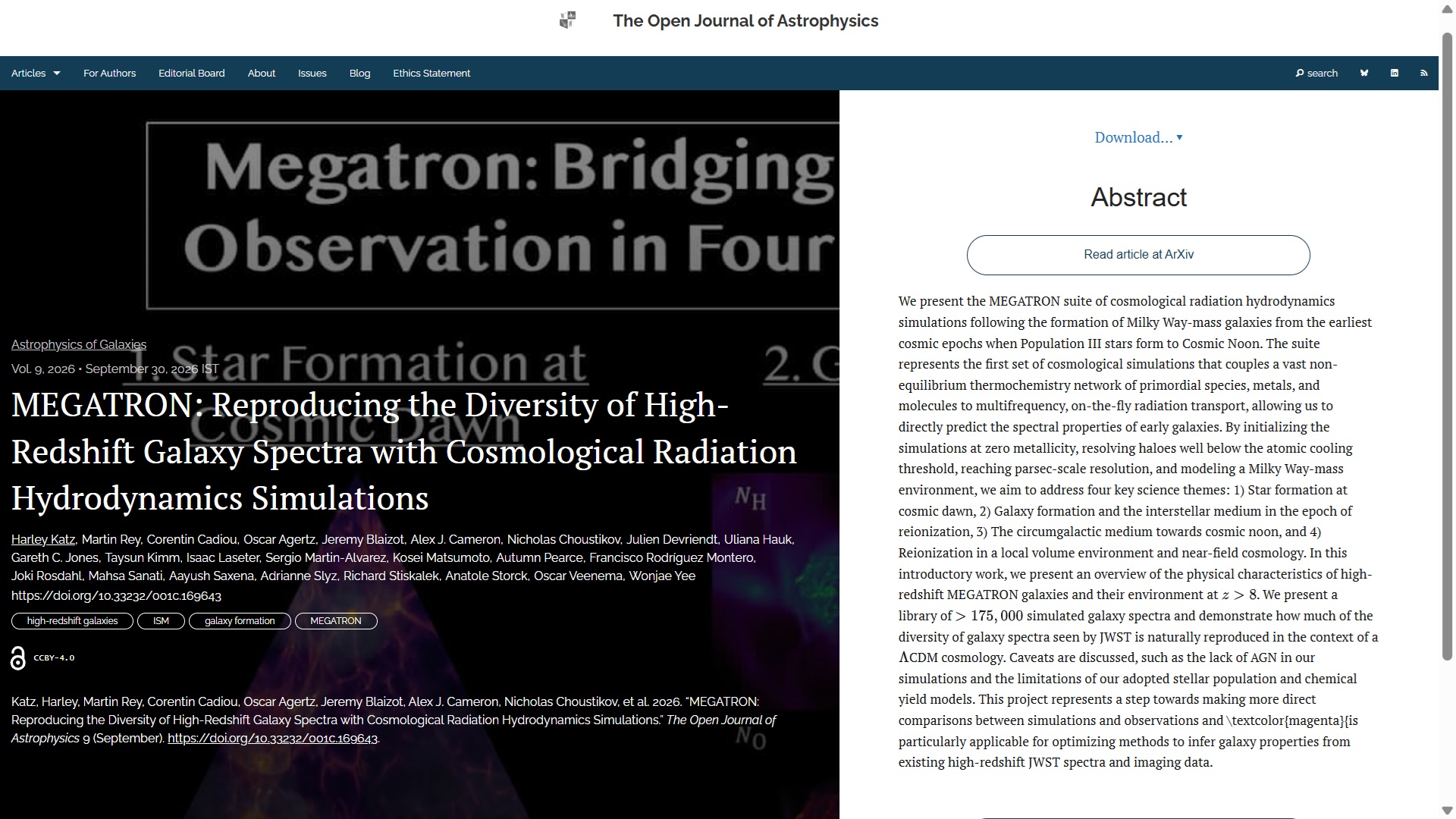
The first paper to report this week is “The Impact of Star Formation and Feedback Recipes on the Stellar Mass and Interstellar Medium of High-Redshift Galaxies” by Harley Katz (U. Chicago, USA), Martin P. Rey (U. Oxford, UK), Corentin Cadiou (Lund U., Sweden) Taysun Kimm (Yonsei U., Korea) and Oscar Agertz (Lund). This paper was published on Monday 2nd February 2026 in the folder Astrophysics of Galaxies. It introduces MEGATRON, a new model for galaxy formation simulations, highlighting that feedback energy controls star formation at high redshift and highlighting the importance of the interstellar medium.
The overlay is here:
You can find the officially accepted version on arXiv here and the announcement on Fediverse here:
New Publication at the Open Journal of Astrophysics: "The Impact of Star Formation and Feedback Recipes on the Stellar Mass and Interstellar Medium of High-Redshift Galaxies" by Harley Katz (U. Chicago, USA), Martin P. Rey (U. Oxford, UK), Corentin Cadiou (Lund U., Sweden) Taysun Kimm (Yonsei U., Korea) and Oscar Agertz (Lund)
The second paper is “Photometric Redshifts in JWST Deep Fields: A Pixel-Based Alternative with DeepDISC” by Grant Merz (U. Illinois at Urbana-Champaign) and 6 others, all based in the USA. This paper was published on Monday February 2nd 2026 in the folder Instrumentation and Methods for Astrophysics. This paper explores the effectiveness of the DeepDISC machine learning algorithm in estimating photometric redshifts from near-infrared data, demonstrating its potential for larger image volumes and spectroscopic samples
The overlay for this one is here:
The official version of the paper can be found on arXiv here and the Fediverse announcement here:
New Publication at the Open Journal of Astrophysics: "Photometric Redshifts in JWST Deep Fields: A Pixel-Based Alternative with DeepDISC" by Grant Merz (U. Illinois at Urbana-Champaign) and 6 others, all based in the USA
Next, published on Wednesday 4th February in the folder Astrophysics of Galaxies, is “Inferring Interstellar Medium Density, Temperature, and Metallicity from Turbulent H II Regions” by Larrance Xing (U. Chicago, USA), Nicholas Choustikov (U. Oxford, UK), Harley Katz (U. Chicago) and Alex J. Cameron (DAWN, Denmark). This paper argues that supersonic turbulenc affects the interpretation of H II region properties, potentially impacting inferred metallicity, ionization, and excitation from in nebular emission lines, motivating more extensive modelling.
The overlay is here:
The official version can be found on arXiv here and the Fediverse announcement is here:
New Publication at the Open Journal of Astrophysics: "Inferring Interstellar Medium Density, Temperature, and Metallicity from Turbulent H II Regions" by Larrance Xing (U. Chicago, USA), Nicholas Choustikov (U. Oxford, UK), Harley Katz (U. Chicago) and Alex J. Cameron (DAWN, Denmark)
The fourth paper this week, also published on Wednesday 4th February, but in the folder Solar and Stellar Astrophysics, is “A Systematic Search for Big Dippers in ASAS-SN” by B. JoHantgen, D. M. Rowan, R. Forés-Toribio, C. S. Kochanek, & K. Z. Stanek (Ohio State University, USA), B. J. Shappee (U. Hawaii, USA), Subo Dong (Peking University), J. L. Prieto Universidad Diego Portales, Chile) and Todd A. Thompson (Ohio State). This study identifies 4 new dipper stars and 15 long-period eclipsing binary candidates using ASAS-SN light curves and multi-wavelength data, categorizing them based on their characteristics.
Here is the overlay:
The official version can be found on arXiv here and the Fediverse announcement is here:
New Publication at the Open Journal of Astrophysics: "A Systematic Search for Big Dippers in ASAS-SN" by B. JoHantgen , D. M. Rowan, R. Forés-Toribio, C. S. Kochanek, & K. Z. Stanek (Ohio State University, USA), B. J. Shappee (U. Hawaii, USA), Subo Dong (Peking University), J. L. Prieto Universidad Diego Portales, Chile) and Todd A. Thompson (Ohio State)
Fifth, and next to last this week we have “Unveiling the drivers of the Baryon Cycles with Interpretable Multi-step Machine Learning and Simulations” by Mst Shamima Khanom, Benjamin W. Keller and Javier Ignacio Saavedra Moreno (U. Memphis, USA). This paper was published on Thursday 5th February 2026 in the folder Astrophysics of Galaxies. This study uses machine learning methods to understand how galaxies lose or retain baryons, highlighting the relationship between baryon fraction and various galactic measurements.
The overlay is here:
The accepted version can be found on arXiv here, and the fediverse announcement is here:
New Publication at the Open Journal of Astrophysics: "Unveiling the drivers of the Baryon Cycles with Interpretable Multi-step Machine Learning and Simulations" by Mst Shamima Khanom, Benjamin W. Keller and Javier Ignacio Saavedra Moreno (U. Memphis, USA)
Finally for this week we have “The Bispectrum of Intrinsic Alignments: II. Precision Comparison Against Dark Matter Simulations” by Thomas Bakx (Utrecht U., Netherlands), Toshiki Kurita (MPA Garching, Germany), Alexander Eggemeier (U. Bonn, Germany), Nora Elisa Chisari (Utrecht) and Zvonimir Vlah (Ruđer Bošković Institute, Croatia). This paper was accepted in December, but publication got delayed by the Christmas effect so was published on February 6th 2026, in the folder Cosmology and Nongalactic Astrophysics. This study uses N-body simulations to accurately measure three-dimensional bispectra of halo intrinsic alignments and dark matter overdensities, providing a method to determine higher order shape bias parameters.
The overlay is here:
You can find the published version of the article here, and the Mastodon announcement is here:
New Publication at the Open Journal of Astrophysics: "The Bispectrum of Intrinsic Alignments: II. Precision Comparison Against Dark Matter Simulations" by Thomas Bakx (Utrecht U., Netherlands), Toshiki Kurita (MPA Garching, Germany), Alexander Eggemeier (U. Bonn, Germany), Nora Elisa Chisari (Utrecht) and Zvonimir Vlah (Ruđer Bošković Institute, Croatia)
It’s Saturday once more so time for another update of activity at the Open Journal of Astrophysics. Since the last update we have published a further four papers, bringing the number in Volume 9 (2026) to 18 and the total so far published by OJAp up to 466.
I will continue to include the posts made on our Mastodon account (on Fediscience) to encourage you to visit it. Mastodon is a really excellent service, and a more than adequate replacement for X/Twitter which nobody should be using; these announcement also show the DOI for each paper.
The first paper to report this week is “Probing Stellar Kinematics with the Time-Asymmetric Hanbury Brown and Twiss Effect” by Lucijana Stanic (University of Zurich, Switzerland) and 13 others based in Zurich, Lausanne and Geneva (all in Switzerland). This was published on Monday 26th January 2026 in the folder Instrumentation and Methods for Astrophysics. This research demonstrates that intensity interferometry can reveal internal stellar kinematics, providing a new way to observe stellar dynamics with high time resolution.
The overlay is here:
You can find the officially accepted version on arXiv here and the announcement on Fediverse here:
New Publication at the Open Journal of Astrophysics: "Probing Stellar Kinematics with the Time-Asymmetric Hanbury Brown and Twiss Effect" by Lucijana Stanic (University of Zurich, Switzerland) and 13 others based in Zurich, Lausanne and Geneva.
New Publication at the Open Journal of Astrophysics: "DIPLODOCUS I: Framework for the evaluation of relativistic transport equations with continuous forcing and discrete particle interactions" by Christopher N Everett & Garret Cotter (University of Oxford, UK)
New Publication at the Open Journal of Astrophysics: "The Atacama Cosmology Telescope: DR6 Sunyaev-Zel’dovich Selected Galaxy Clusters Catalog" by M. Aguena et al. (101 authors altogether), on behalf of the ACT-DES-HSC Collaboration
And finally for this week we have a paper published yesterday, Friday 30th January 2026, in the folder Astrophysics of Galaxies. This is the paper I blogged about yesterday: “A Cosmic Miracle: A Remarkably Luminous Galaxy at zspec = 14.44 Confirmed with JWST” by Rohan Naidu (MIT Kavli Institute) and an international cast of 45 others. This article reports on the discovery by the James Webb Space Telescope (JWST) of a bright galaxy, MoM-z14, located 280 million years post-Big Bang, that challenges models of galaxy formation and the star-formation history of early galaxies.
The overlay is here:
The accepted version can be found on arXiv here, and the fediverse announcement is here:
New Publication at the Open Journal of Astrophysics: "A Cosmic Miracle: A Remarkably Luminous Galaxy at $z_{rm spec} = 14.44$ Confirmed with JWST" by Rohan Naidu (MIT Kavli Institute) and 45 others.
I wasn’t planning to do another update this week but I thought it would be best to complete the publications for 2025 at the Open Journal of Astrophysics, so that I don’t have to do a bigger update in the new year, and I have a bit of time this morning, so here we go.
Since the last update we have published four papers which brings the number in Volume 8 (2025) up to 201. Adding the 12 papers in the Supplement, this brings the final total for the year up to 213, and the total so far published by OJAp up to 448. In 2023 we published just 50 papers, so we have more than quadrupled in two years.
The first paper this week is “Transverse Velocities in Real-Time Cosmology: Position Drift in Relativistic N-Body Simulations” by Alexander Oestreicher (University of Southern Denmark), Chris Clarkson (QMUL, UK), Julian Adamek (Universität Zürich, CH) and Sofie Marie Koksbang (U. Southern Denmark). This study uses a general relativistic N-body simulation code to explore how cosmological structures affect position drift measurements, a new method for studying cosmic structure formation and velocity fields. This was published on Tuesday 23rd December 2025 in the folder Cosmology and Nongalactic Astrophysics.
The overlay is here:
You can find the officially accepted version on arXiv here and this is the announcement on Mastodon (Fediscience):
New Publication at the Open Journal of Astrophysics: "Transverse Velocities in Real-Time Cosmology: Position Drift in Relativistic N-Body Simulations" by Alexander Oestreicher (University of Southern Denmark), Chris Clarkson (QMUL, UK), Julian Adamek (Universität Zürich, CH) and Sofie Marie Koksbang (U. Southern Denmark)
The second paper of the week is “On the statistical convergence of N-body simulations of the Solar System” by Hanno Rein, Garett Brown and Mei Kanda (U. Toronto, Canada). This study presents numerical experiments to determine the minimum timestep for long-term simulations of the Solar System, finding that timesteps up to 32 days yield physical results. It was published on Tuesday December 23rd in the folder Earth and Planetary Astrophysics.
The overlay is here:
You can find the official version of this one on arXiv here. The federated announcement on Mastodon is here:
New Publication at the Open Journal of Astrophysics: "On the statistical convergence of N-body simulations of the Solar System" by Hanno Rein, Garett Brown and Mei Kanda (U. Toronto, Canada)
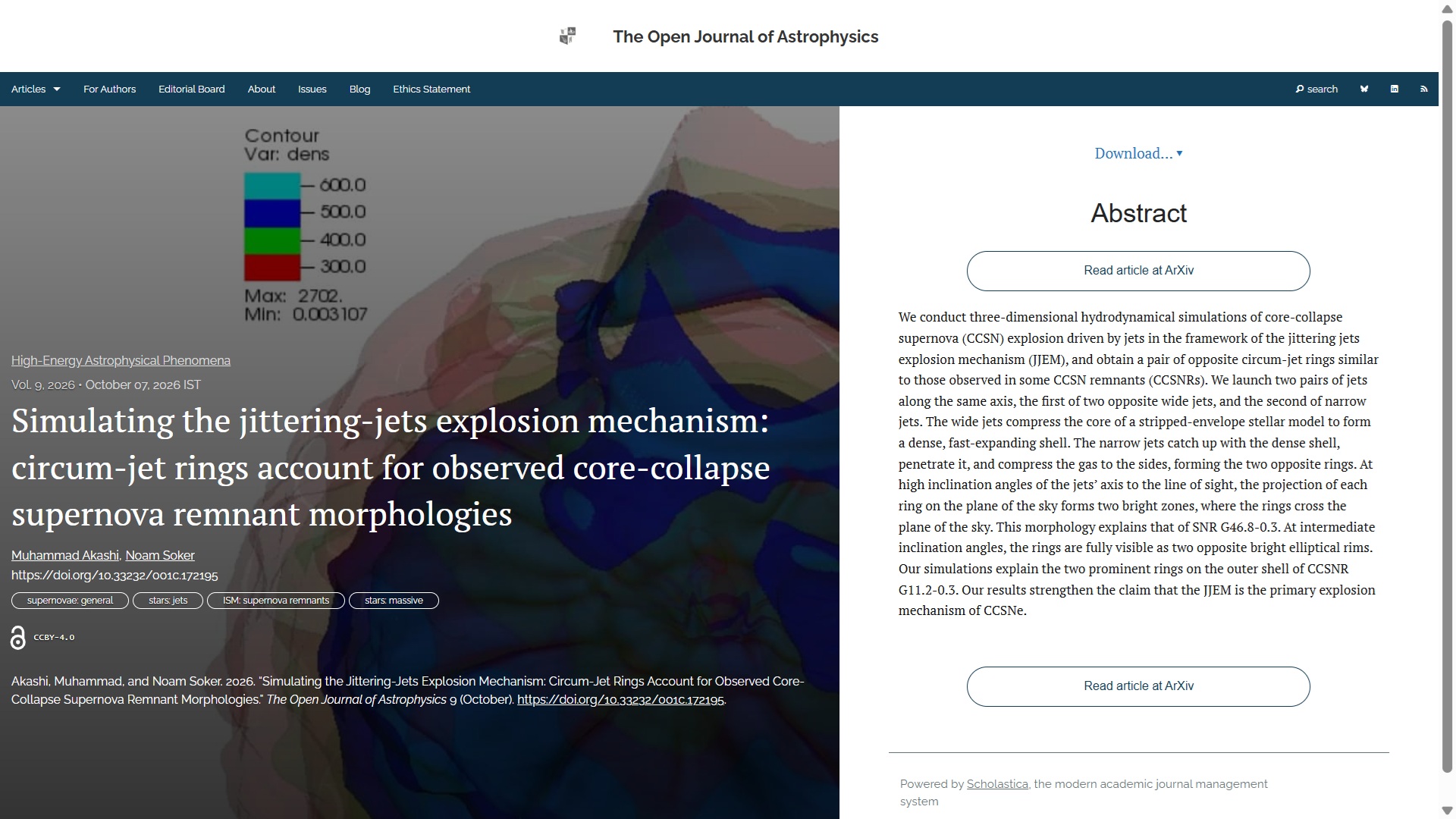
Next, published on 24th December 2025 in the folder High-Energy Astrophysical Phenomena, we have “The explosion jets of the core-collapse supernova remnant Circinus X-1” by Noam Soker and Muhammad Akashi (Technion, Haifa, Israel). This paper suggests that the rings in the Circinus X-1 supernova remnant resulted from jet-driven explosions, supporting the jittering-jets explosion mechanism theory for core collapse supernovae.
The overlay is here:
The officially accepted paper can be found on arXiv here and the announcement on Mastodon is here
New Publication at the Open Journal of Astrophysics: "The explosion jets of the core-collapse supernova remnant Circinus X-1" by Noam Soker and Muhammad Akashi (Technion, Haifa, Israel)
Finally for 2025 we have “Quantifying the Fermi paradox via passive SETI: a general framework” by Matthew Civiletti (City University of New York, USA). This was published on Wednesday 24th December in the folder Instrumentation and Methods for Astrophysics. The author uses SETI observations and the Drake Equation to calculate the probability of detecting at least one extraterrestrial signal, highlighting the model’s limitations and potential improvements. The overlay is here:
The officially accepted version can be found on arXiv here and the Mastodon announcement here:
New Publication at the Open Journal of Astrophysics: "Quantifying the Fermi paradox via passive SETI: a general framework" by Matthew Civiletti (City University of New York, USA)
And that concludes the updates for 2025. I’ll be back in a week with the first update of 2026, which will include the first paper(s) of Volume 9.
I’d like to thank everyone who has supported the Open Journal of Astrophysics this year – Editors, Reviewers, Authors and the excellent Library staff at Maynooth – and who have made it such a bumper year. In 2023 we published just 50 papers, so we have more than quadrupled in two years. How many will we publish in 2026?
The views presented here are personal and not necessarily those of my employer (or anyone else for that matter).
Feel free to comment on any of the posts on this blog but comments may be moderated; anonymous comments and any considered by me to be vexatious and/or abusive and/or defamatory will not be accepted. I do not necessarily endorse, support, sanction, encourage, verify or agree with the opinions or statements of any information or other content in the comments on this site and do not in any way guarantee their accuracy or reliability.