Oysters and Bones
A post on Bluesky got me thinking about the origin of the word “oyster”, which I shall bore you with shortly, but the post asks an interesting question about the well-known phrase “The World’s Mine Oyster”. This comes from Shakespeare’s The Merry Wives of Windsor and is spoken to Falstaff by Pistol, a swaggering soldier, in the line:
Why, then the world’s mine oyster, Which I with sword will open.
The meaning it has there is that Pistol thinks he can get whatever he wants by force of arms. In more modern usage, however, it is taken to mean that the speaker has everything on a plate. In modern usage it sometimes appears as “the world is your oyster” which means something like “take your pick”. At some point, it is claimed in the 20th Century, this meaning of this phrase changed. There’s a podcast about this here. How, where and why this happened I don’t know, and I don’t know who does. My usual source for information about things like this is the wonderful Brewer’s Dictionary of Phrase and Fable which has the phrase but sheds no light on its change of meaning. If you can shed light on this, please feel free to comment below through the box below.
Anyway, having had oysters in Ireland a few times – with Guinness, obviously- but not knowing the word in the Irish language, I looked it up: it is oisre. Interestingly close, I thought. So then I looked at the etymology of the English word oyster. This first appeared in Middle English via the Latin ostrea (and probably Norman French). The Latin word is derived from the Classical Greek ὄστρεον (ostreon), which is the origin of many words connected with bone, e.g. osteopath and ossuary. This is presumably because it was thought oyster shells were made of bone or at least bony in appearance.
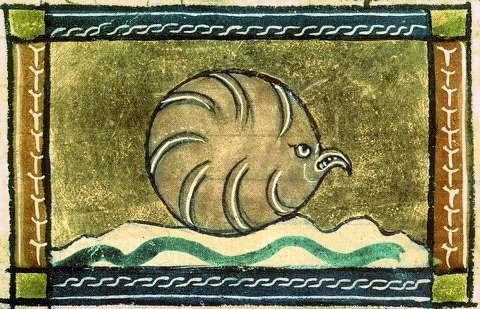
Just for a laugh, here’s a mediaeval representation of an oyster from a Bestiary:
Incidentally, the Romans used ostrea for mussels as well as oysters. This reminds me of my first year at the Royal Grammar School in Newcastle when we had a history teacher whose name escapes me but whose initials – from and old school report I still have – were `BM’ and who possessed a strong Scottish accent. In the first year we learnt a little bit about the Roman invasion of Britain. BM explained that one of the reasons the Romans came to Britain was that they were looking for “perils”. Although confused, I wrote that down unquestioningly in my exercise book. After the lesson was over I asked a classmate about it and he told me the teacher had meant “pearls”. These were very prized in Rome, and there was a rumour circulating there that they were abundant in Britain. But not in oysters. Freshwater mussels were the source of the perils pearls. I guess the Romans used the same word anyway.
Meanwhile, back at the oysters, I find that the Old English (Anglo-Saxon) word is ostre. This might itself have been borrowed from the Latin, but we know that the ancient Britons were eating oysters long before the Romans arrived. In fact, there are shell middens dating back to the mesolithic period. It seemed to me quite possible, therefore, that the word oyster may predate Classical Latin, and even Greek. The similarity of the Gaelic and Anglo-Saxon words may be because they are both linked to Latin, but look at the word for oyster in other languages, German: Auster, Danish østers, Polish: ostryga, etc. Like words for many things with which Europeans have been familiar with for a very long time indeed, could this one have a proto-Indo-European root? I recently read a fascinating book about this and was captivated by the idea of some of our ancient ancestors, thousands of years ago, eating oysters and using a very similar word to describe them.
It seems it does, but the common ancestor is a word not meaning “oyster” directly but “bone”. The Sanskrit word for “bone” is अस्थि (ásthi), which convinces me of its Indo-European origins. It was perhaps the Greeks, or their ancestors, who first adapted this word to refer to an oyster as a “bony thing”.


Leave a Reply