Weekly Update from the Open Journal of Astrophysics 21/11/2026
It’s time for another Saturday update of activity at the Open Journal of Astrophysics. Since the last update we have published a further five papers, bringing the number in Volume 9 (2026) to 269 and the total so far published by OJAp up to 717.
I continue to include the posts made on our Mastodon account (on Fediscience); these announcements also contain a clickable form of the DOI for each paper. Our Mastodon account has regular updates and other announcements from OJAp too, including posts from the OJAp blog.
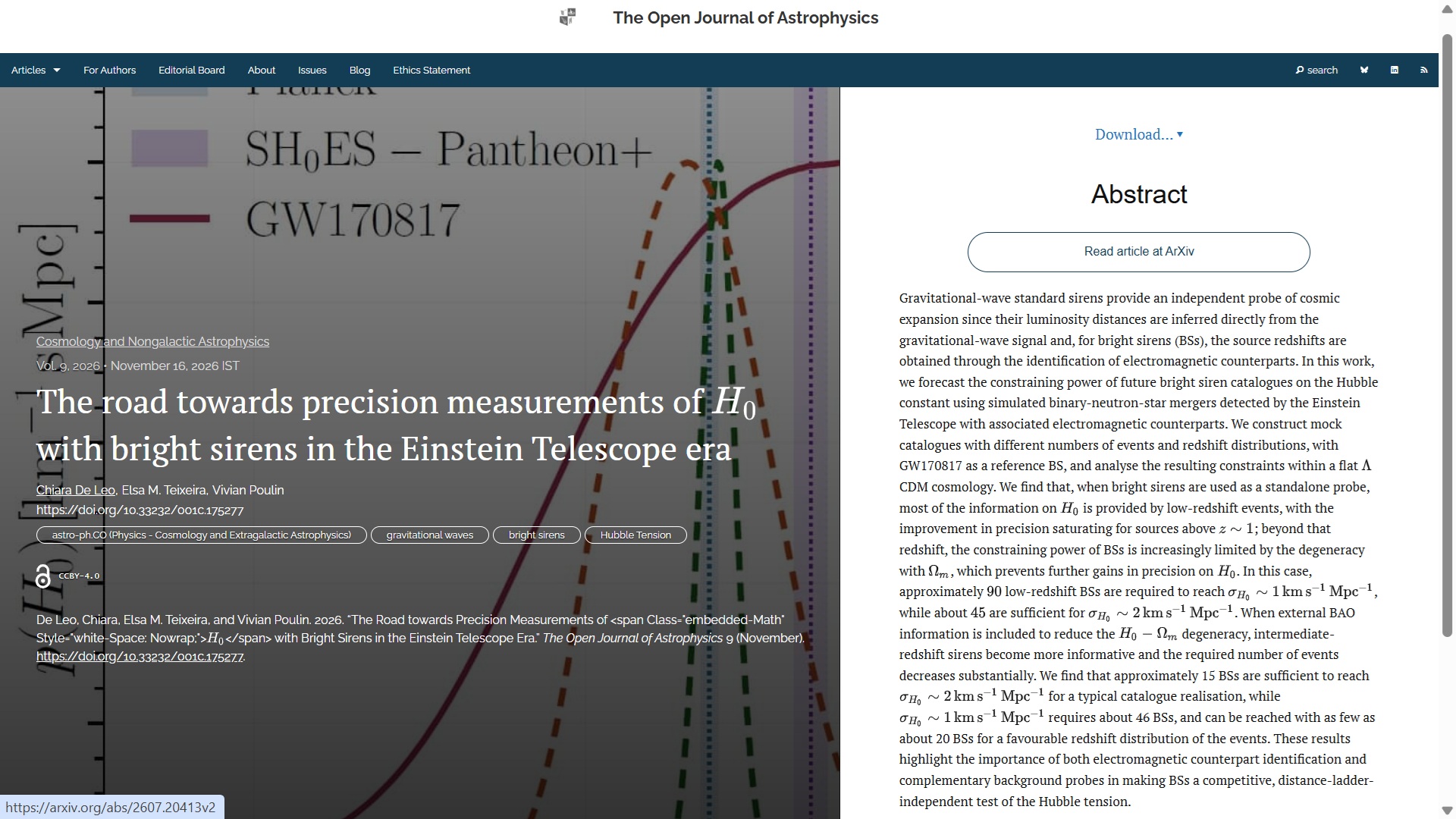
The first paper this week was published on Monday 16th November in the folder Cosmology and Nongalactic Astrophysics. The title is “The road towards precision measurements of H0 with bright sirens in the Einstein Telescope era” and the authors are Chiara De Leo (Sapienza University of Rome, Italy) and Elsa M. Teixeira & Vivian Poulin (Université de Montpellier, France). The paper describes how simulated Einstein Telescope bright-siren catalogues show that low-redshift events constrain the Hubble constant most effectively alone, while adding BAO data makes fewer, intermediate-redshift sirens sufficient for precise measurements.
The overlay for this one is here:
You can find the officially accepted version on arXiv here and the announcement on Fediverse here:

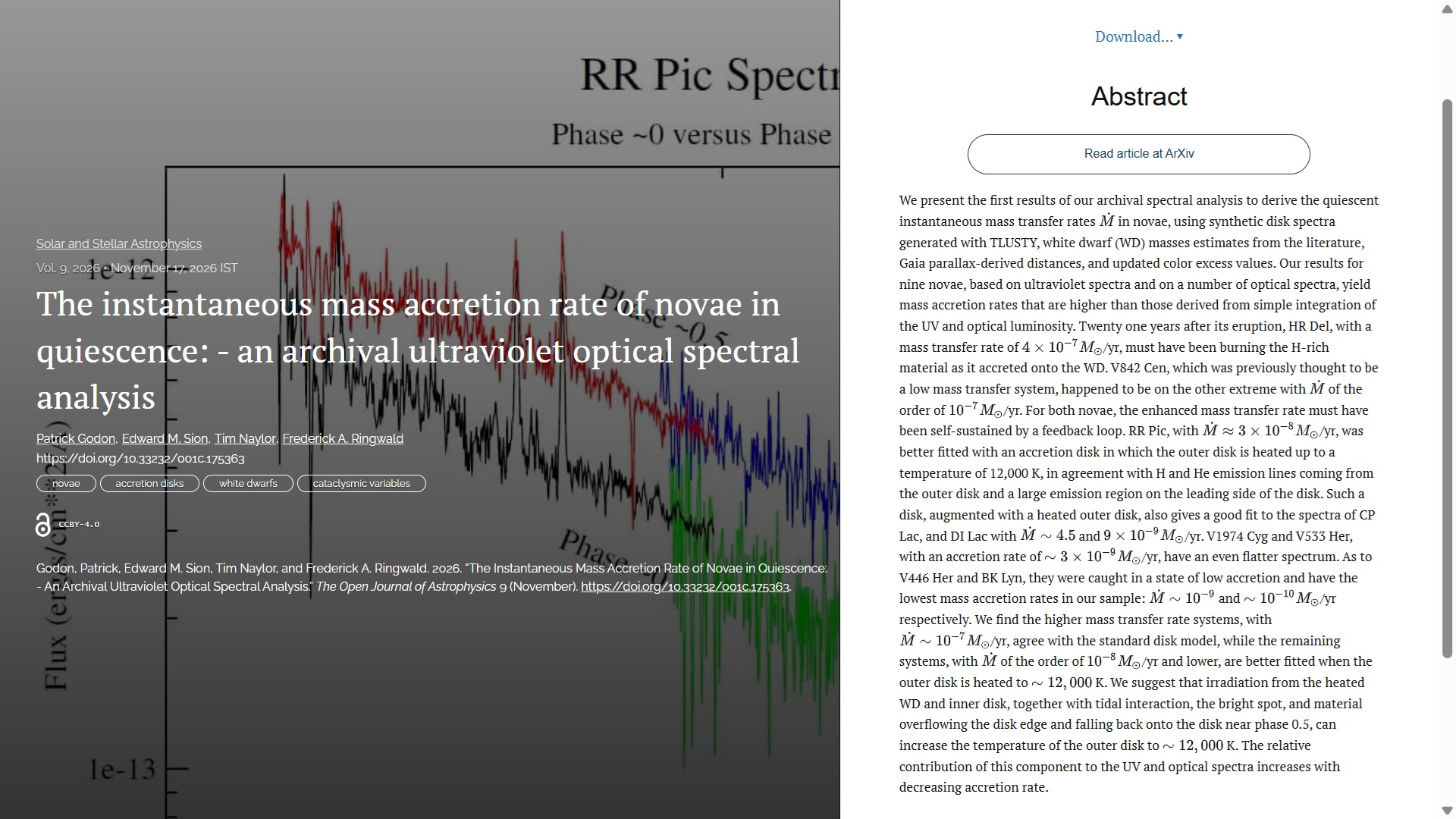
The second paper for this week, published on Tuesday 17th November in the folder Solar and Stellar Astrophysics is “The instantaneous mass accretion rate of novae in quiescence: – an archival ultraviolet optical spectral analysis” by Patrick Godon & Edward M. Sion (Villanova U.n USA), Tim Naylor (U. Exeter, UK) and Frederick A. Ringwald (California State U., USA). The article shows that spectral modeling of nine novae reveals a wide range of quiescent accretion rates. High-rate systems fit standard disk models, while lower-rate systems require heated outer disks, potentially sustained by irradiation.
The overlay looks like this:
The official version of the paper can be found on arXiv here and the Fediverse announcement here:
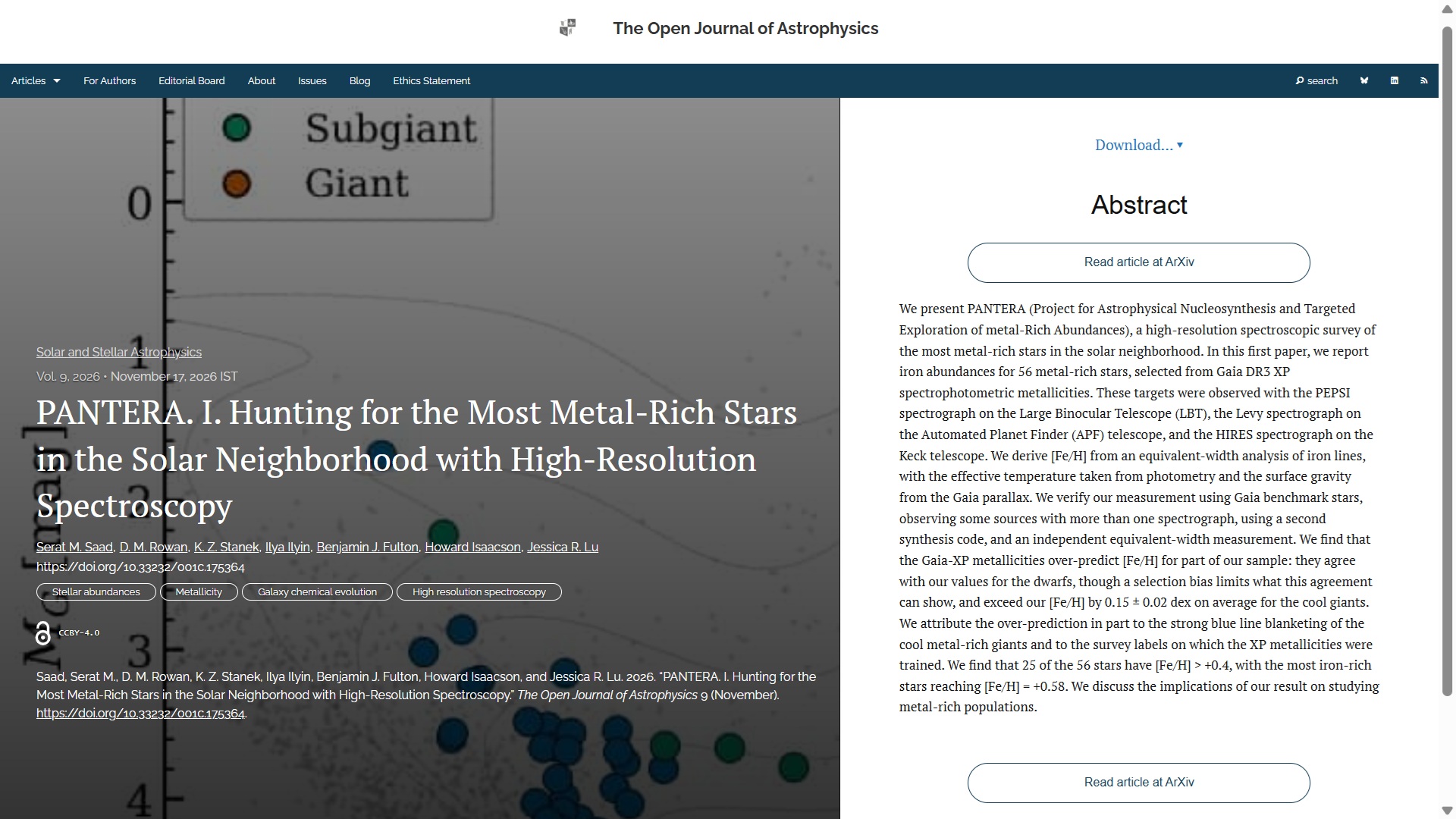
The third paper of the week, also published on Tuesday November 17th in the folder Solar and Stellar Astrophysics is “PANTERA. I. Hunting for the Most Metal-Rich Stars in the Solar Neighborhood with High-Resolution Spectroscopy” by Serat M. Saad (Ohio State U., USA) and 6 others based in the USA and Germany. This one describes PANTERA’s high-resolution analysis of 56 nearby metal-rich stars finds Gaia XP metallicities overestimate iron abundance in cool giants by about 0.15 dex; 25 stars exceed [Fe/H] +0.4.
The overlay for this is here:
The accepted version of this one can be found on the arXiv here and the Mastodon announcement here:
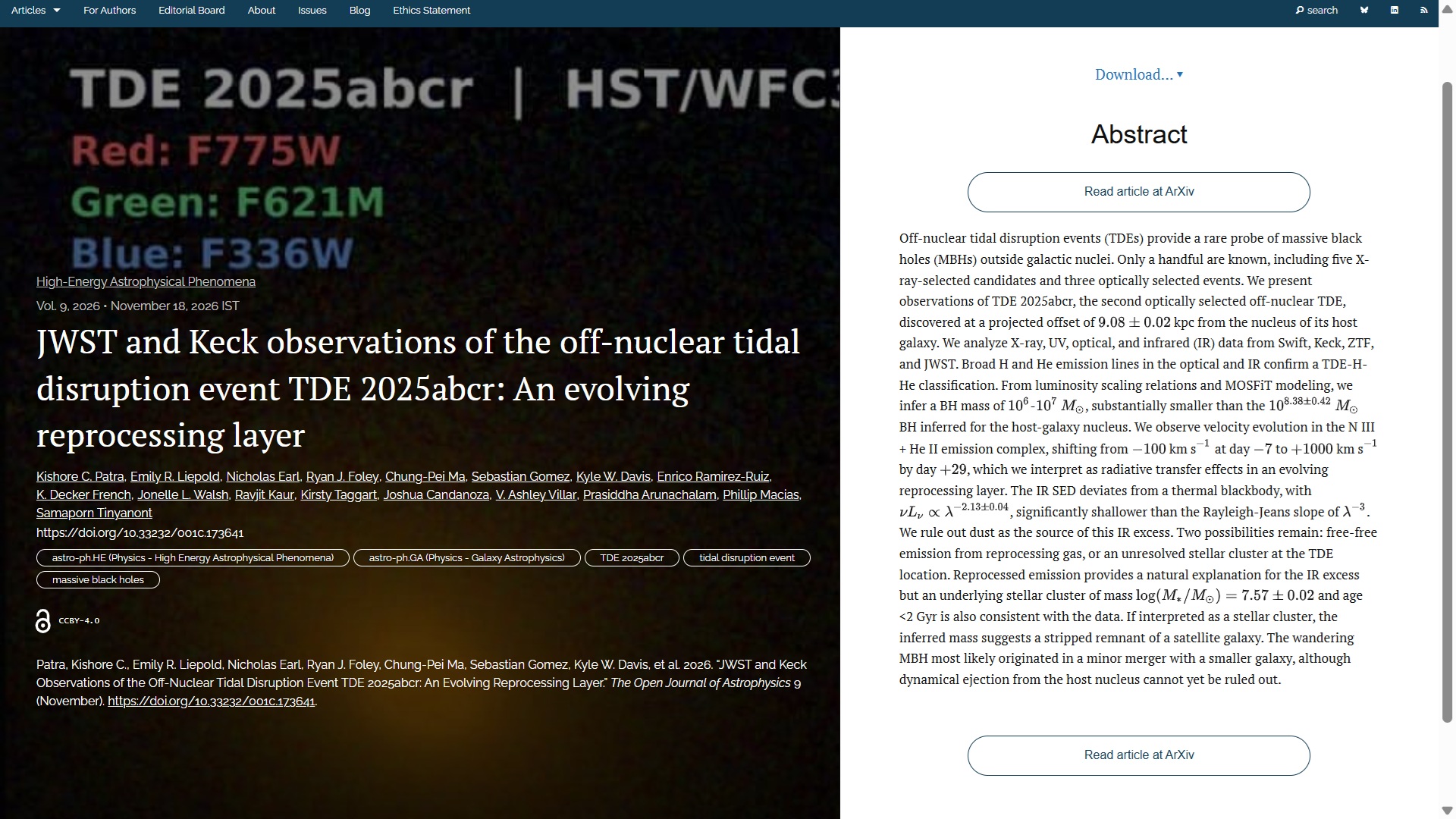
Our fourth paper of the week is “JWST and Keck observations of the off-nuclear tidal disruption event TDE 2025abcr: An evolving reprocessing layer” by Kishore C. Patra (UC Santa Cruz, USA) and 16 others. This paper was published on Wednesday 18th November in the folder High-Energy Astrophysical Phenomena. It discusses TDE 2025abcr, a rare off-nuclear tidal disruption event involving a relatively small black hole. Its unusual infrared emission may arise from surrounding gas or a young stellar cluster.
The overlay for this paper is here:
The officially accepted version can be found on arXiv here and the Mastodon announcement is here:
And the fifth and final paper for this week is “Steady-state Stellar Winds Driven by Recombination” by Eritas Yang and Eliot Quataert (Princeton U., USA). This was published on Thursday November 19th in the folder Solar and Stellar Astrophysics. The article discusses how recombination energy alone rarely launches a steady wind from a hydrostatic stellar envelope; it may instead help accelerate and unbind outflows initiated by other processes, such as binary orbital decay.
The overlay for this one is here:
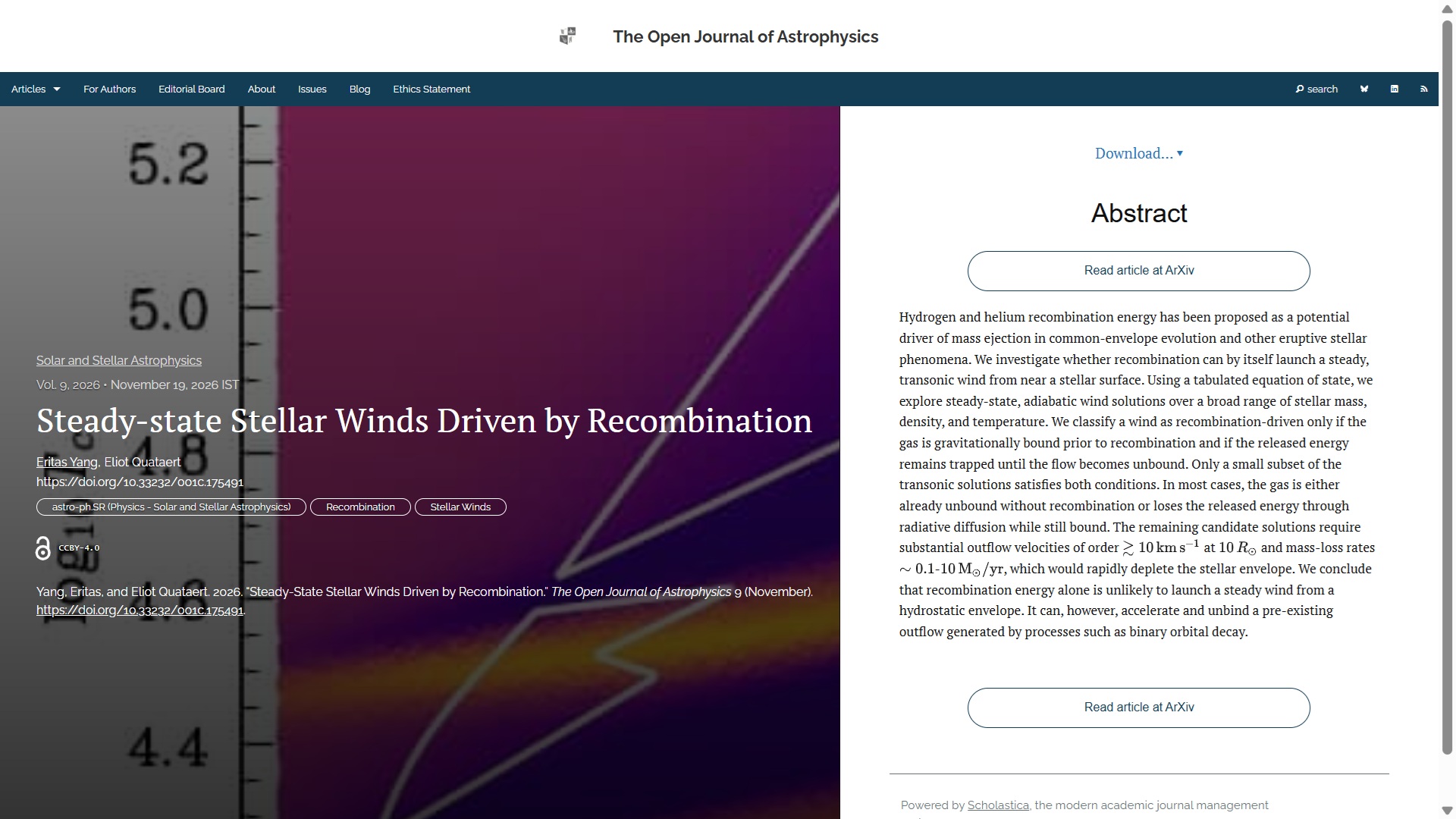
The officially accepted version of this paper can be found on arXiv here and the Mastodon announcement is here:
That concludes this week’s update. November continues to be a rather slow month on the publication side, but it’s good to see a number of papers in Solar and Stellar Astrophysics, suggesting increasing interest in that part of the astrophysics community.


Leave a Reply