Archive for arXiv:2604.16093v2

Weekly Update from the Open Journal of Astrophysics 21/11/2026

Posted in OJAp Papers, Open Access, The Universe and Stuff with tags , , , , , , , , , , , , on November 21, 2026 by telescoper

It’s time for another Saturday update of activity at the Open Journal of Astrophysics. Since the last update we have published a further five papers, bringing the number in Volume 9 (2026) to 269 and the total so far published by OJAp up to 717.

I continue to include the posts made on our Mastodon account (on Fediscience); these announcements also contain a clickable form of the DOI for each paper. Our Mastodon account has regular updates and other announcements from OJAp too, including posts from the OJAp blog.

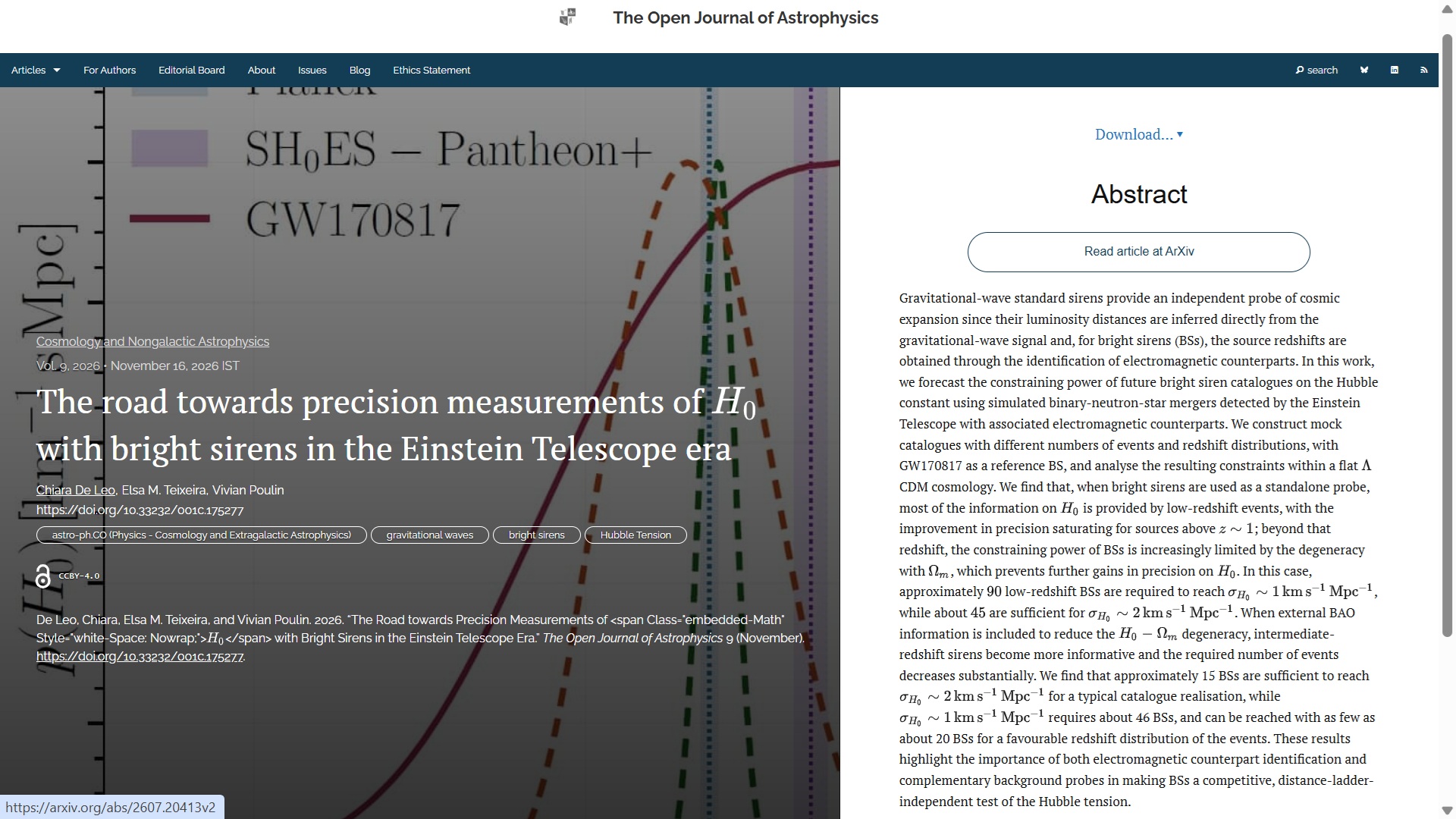
The first paper this week was published on Monday 16th November in the folder Cosmology and Nongalactic Astrophysics. The title is “The road towards precision measurements of H0 with bright sirens in the Einstein Telescope era” and the authors are Chiara De Leo (Sapienza University of Rome, Italy) and Elsa M. Teixeira & Vivian Poulin (Université de Montpellier, France). The paper describes how simulated Einstein Telescope bright-siren catalogues show that low-redshift events constrain the Hubble constant most effectively alone, while adding BAO data makes fewer, intermediate-redshift sirens sufficient for precise measurements.

The overlay for this one is here:
You can find the officially accepted version on arXiv here and the announcement on Fediverse here:

Open Journal of Astrophysics

New Publication at the Open Journal of Astrophysics: "The road towards precision measurements of $H_0$ with bright sirens in the Einstein Telescope era" by Chiara De Leo (Sapienza University of Rome, Italy) and Elsa M. Teixeira & Vivian Poulin (Université de Montpellier, France)

doi.org/10.33232/001c.175277

November 16, 2026, 8:33 am 0 boosts 0 favorites

The second paper for this week, published on Tuesday 17th November in the folder Solar and Stellar Astrophysics is “The instantaneous mass accretion rate of novae in quiescence: – an archival ultraviolet optical spectral analysis” by Patrick Godon & Edward M. Sion (Villanova U.n USA), Tim Naylor (U. Exeter, UK) and Frederick A. Ringwald (California State U., USA). The article shows that spectral modeling of nine novae reveals a wide range of quiescent accretion rates. High-rate systems fit standard disk models, while lower-rate systems require heated outer disks, potentially sustained by irradiation.

The overlay looks like this:
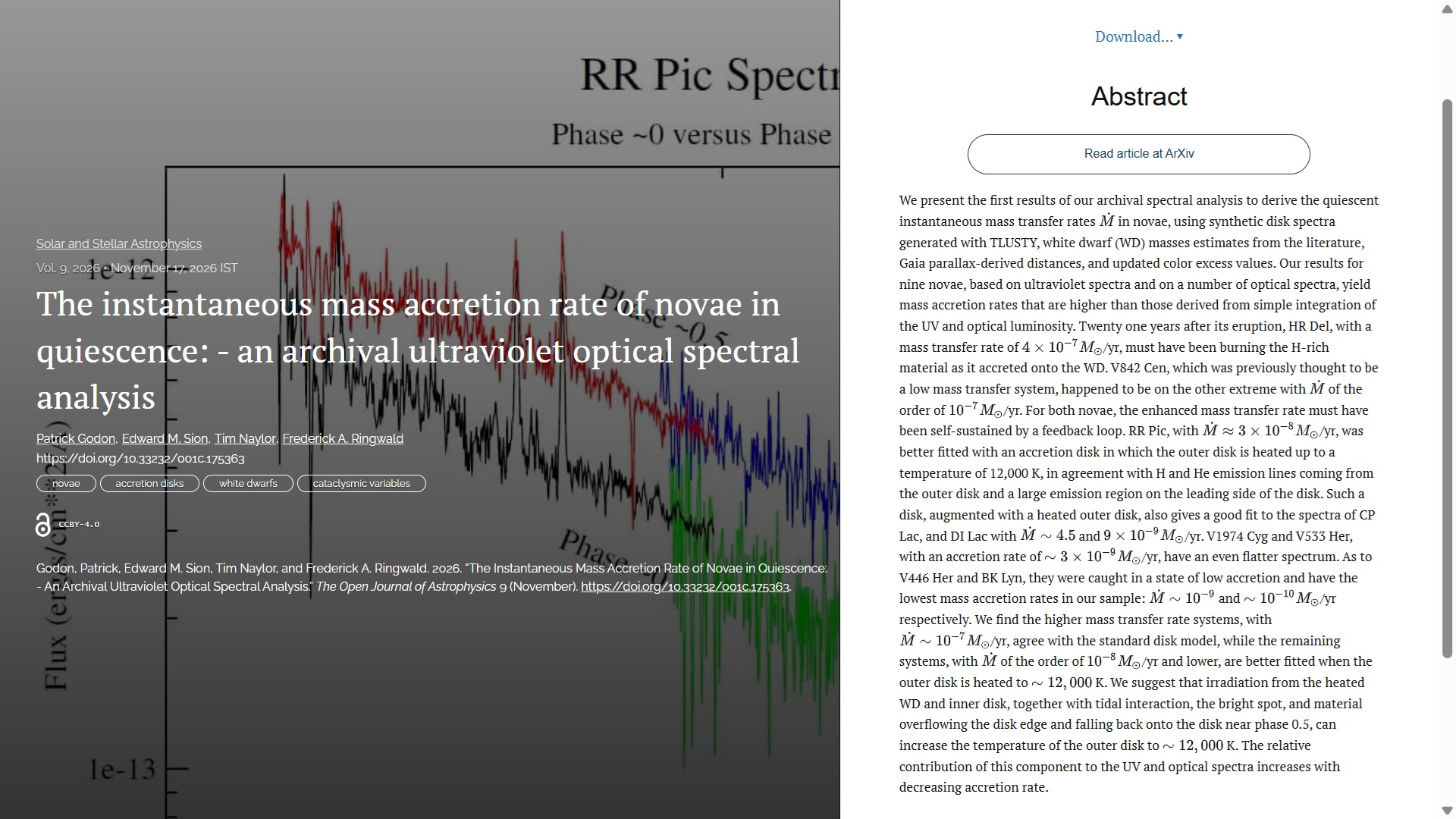
The official version of the paper can be found on arXiv here and the Fediverse announcement here:

Open Journal of Astrophysics

New Publication at the Open Journal of Astrophysics: "The instantaneous mass accretion rate of novae in quiescence: – an archival ultraviolet optical spectral analysis" by Patrick Godon & Edward M. Sion (Villanova U.n USA), Tim Naylor (U. Exeter, UK) and Frederick A. Ringwald (California State U., USA)

doi.org/10.33232/001c.175363

November 17, 2026, 9:31 am 1 boosts 1 favorites

The third paper of the week, also published on Tuesday November 17th in the folder Solar and Stellar Astrophysics is “PANTERA. I. Hunting for the Most Metal-Rich Stars in the Solar Neighborhood with High-Resolution Spectroscopy” by Serat M. Saad (Ohio State U., USA) and 6 others based in the USA and Germany. This one describes PANTERA’s high-resolution analysis of 56 nearby metal-rich stars finds Gaia XP metallicities overestimate iron abundance in cool giants by about 0.15 dex; 25 stars exceed [Fe/H] +0.4.

The overlay for this is here:
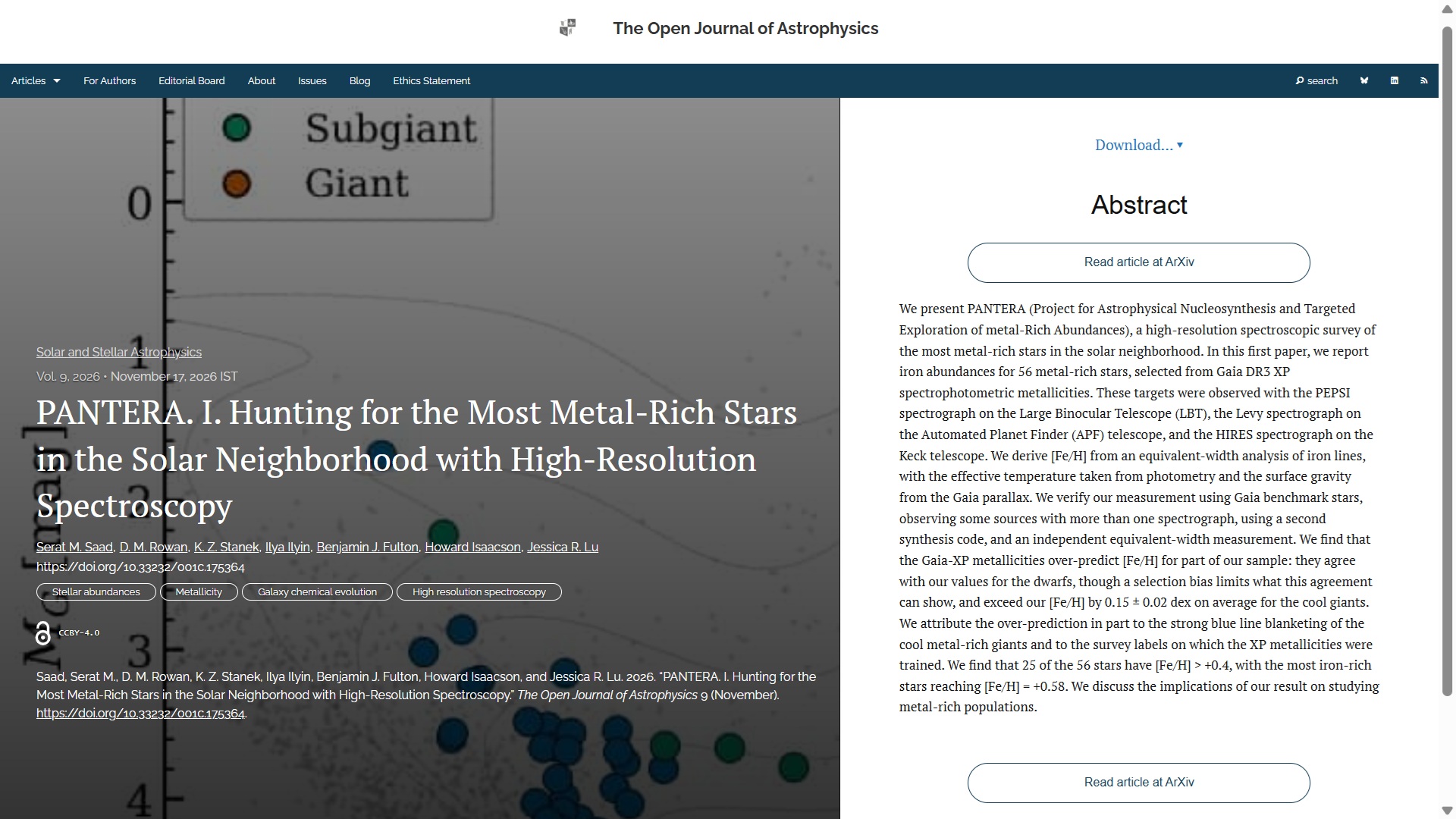
The accepted version of this one can be found on the arXiv here and the Mastodon announcement here:

Open Journal of Astrophysics

New Publication at the Open Journal of Astrophysics: "PANTERA. I. Hunting for the Most Metal-Rich Stars in the Solar Neighborhood with High-Resolution Spectroscopy" by Serat M. Saad (Ohio State U., USA) and 6 others based in the USA and Germany.

doi.org/10.33232/001c.175364

November 17, 2026, 9:36 am 2 boosts 2 favorites

Our fourth paper of the week is “JWST and Keck observations of the off-nuclear tidal disruption event TDE 2025abcr: An evolving reprocessing layer” by Kishore C. Patra (UC Santa Cruz, USA) and 16 others. This paper was published on Wednesday 18th November in the folder High-Energy Astrophysical Phenomena. It discusses TDE 2025abcr, a rare off-nuclear tidal disruption event involving a relatively small black hole. Its unusual infrared emission may arise from surrounding gas or a young stellar cluster.

The overlay for this paper is here:
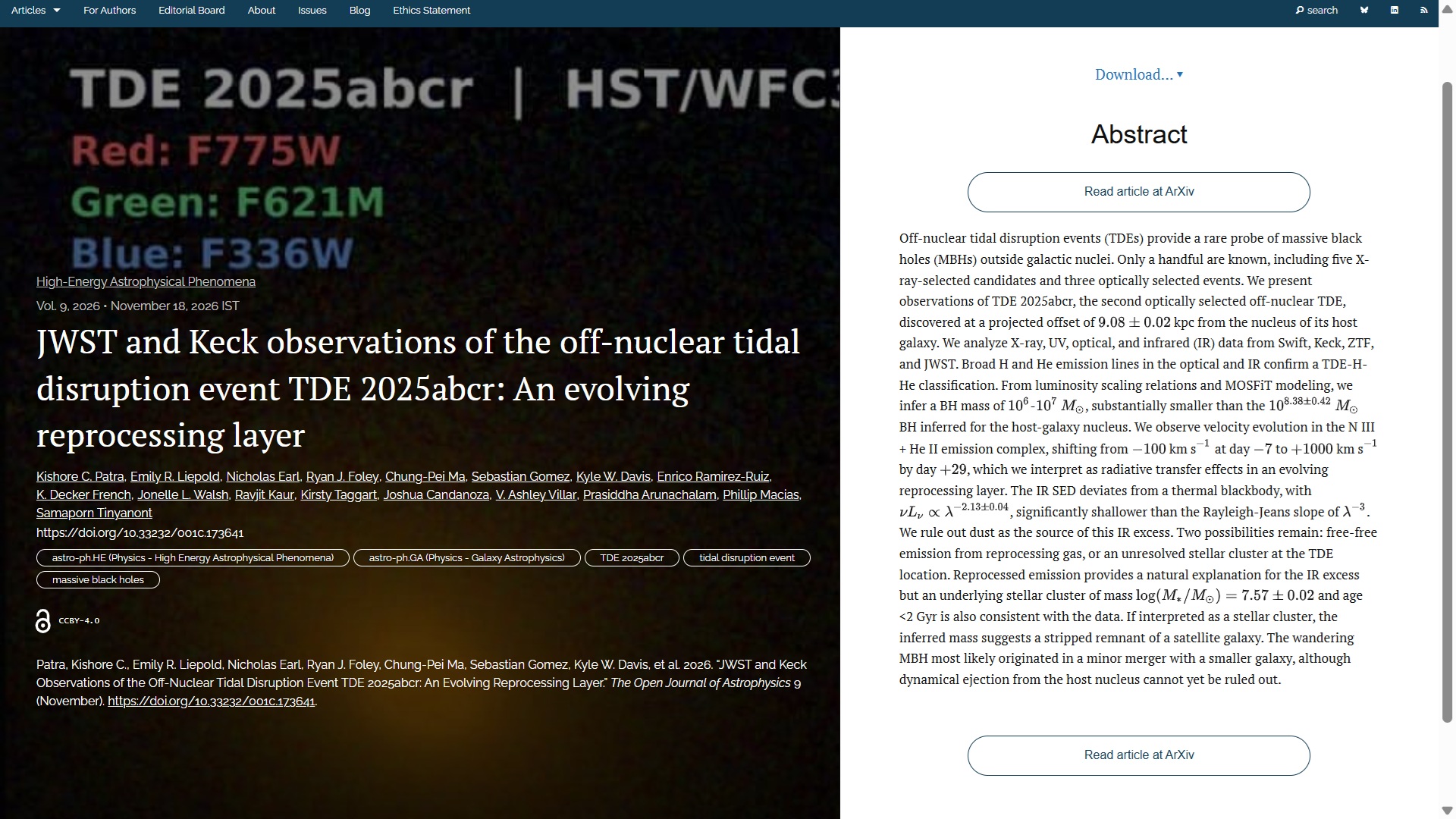
The officially accepted version can be found on arXiv here and the Mastodon announcement is here:

Open Journal of Astrophysics

New Publication at the Open Journal of Astrophysics: "JWST and Keck observations of the off-nuclear tidal disruption event TDE 2025abcr: An evolving reprocessing layer" by Kishore C. Patra (UC Santa Cruz, USA) and 16 others.

doi.org/10.33232/001c.173641

November 18, 2026, 9:08 am 1 boosts 0 favorites

And the fifth and final paper for this week is “Steady-state Stellar Winds Driven by Recombination” by Eritas Yang and Eliot Quataert (Princeton U., USA). This was published on Thursday November 19th in the folder Solar and Stellar Astrophysics. The article discusses how recombination energy alone rarely launches a steady wind from a hydrostatic stellar envelope; it may instead help accelerate and unbind outflows initiated by other processes, such as binary orbital decay.

The overlay for this one is here:
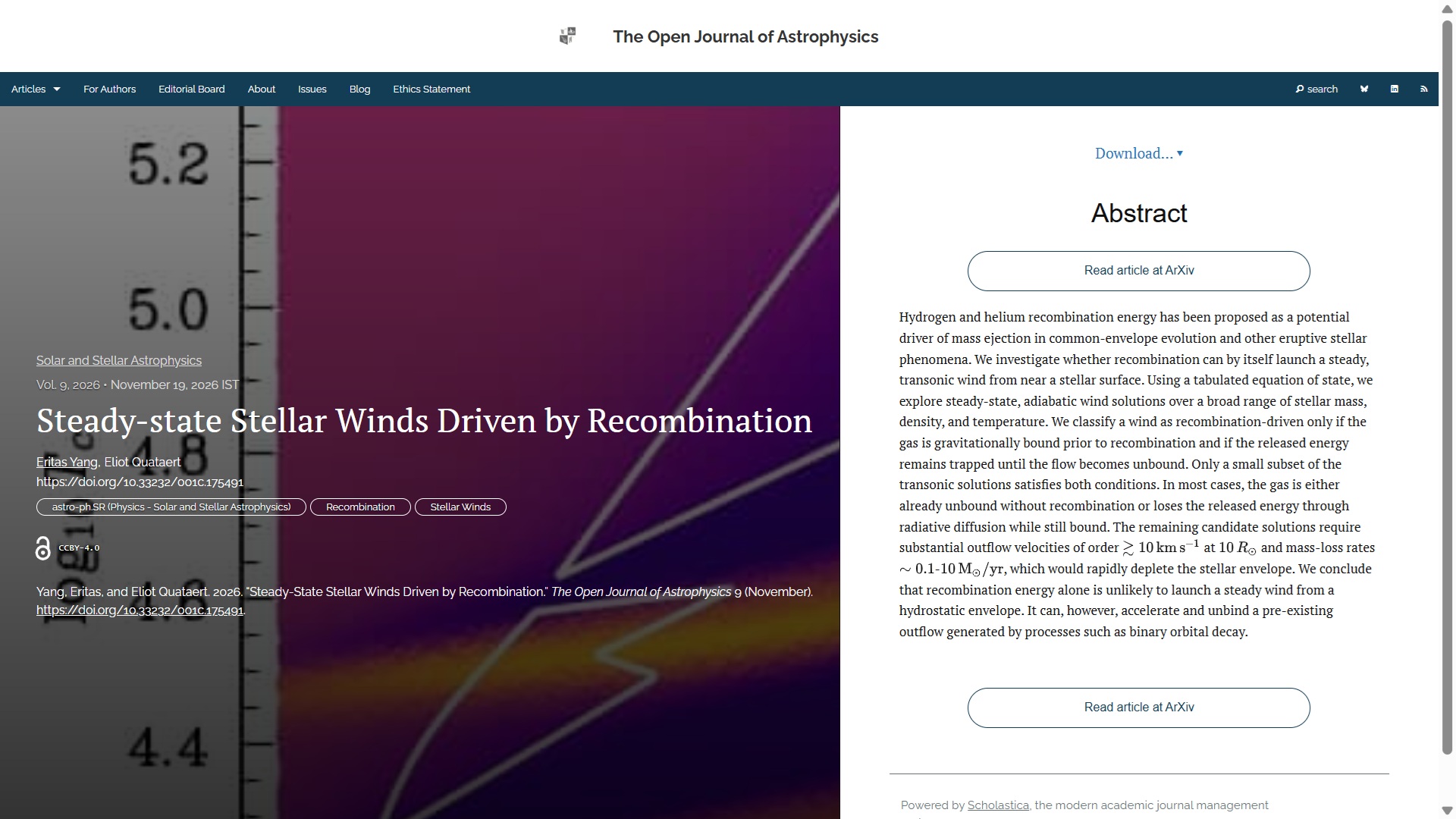
The officially accepted version of this paper can be found on arXiv here and the Mastodon announcement is here:

Open Journal of Astrophysics

New Publication at the Open Journal of Astrophysics: "Steady-state Stellar Winds Driven by Recombination" by Eritas Yang and Eliot Quataert (Princeton U., USA)

doi.org/10.33232/001c.175491

November 19, 2026, 10:02 am 1 boosts 0 favorites

That concludes this week’s update. November continues to be a rather slow month on the publication side, but it’s good to see a number of papers in Solar and Stellar Astrophysics, suggesting increasing interest in that part of the astrophysics community.
Weekly Update from the Open Journal of Astrophysics 14/11/2026

Posted in OJAp Papers, Open Access, The Universe and Stuff with tags , , , , , , , , , , , , on November 14, 2026 by telescoper

It’s time for another Saturday update of activity at the Open Journal of Astrophysics. Since the last update we have published a further five papers, bringing the number in Volume 9 (2026) to 264 and the total so far published by OJAp up to 712.

I continue to include the posts made on our Mastodon account (on Fediscience); these announcements also contain a clickable form of the DOI for each paper. Our Mastodon account has regular updates and other announcements from OJAp too, including posts from the OJAp blog.

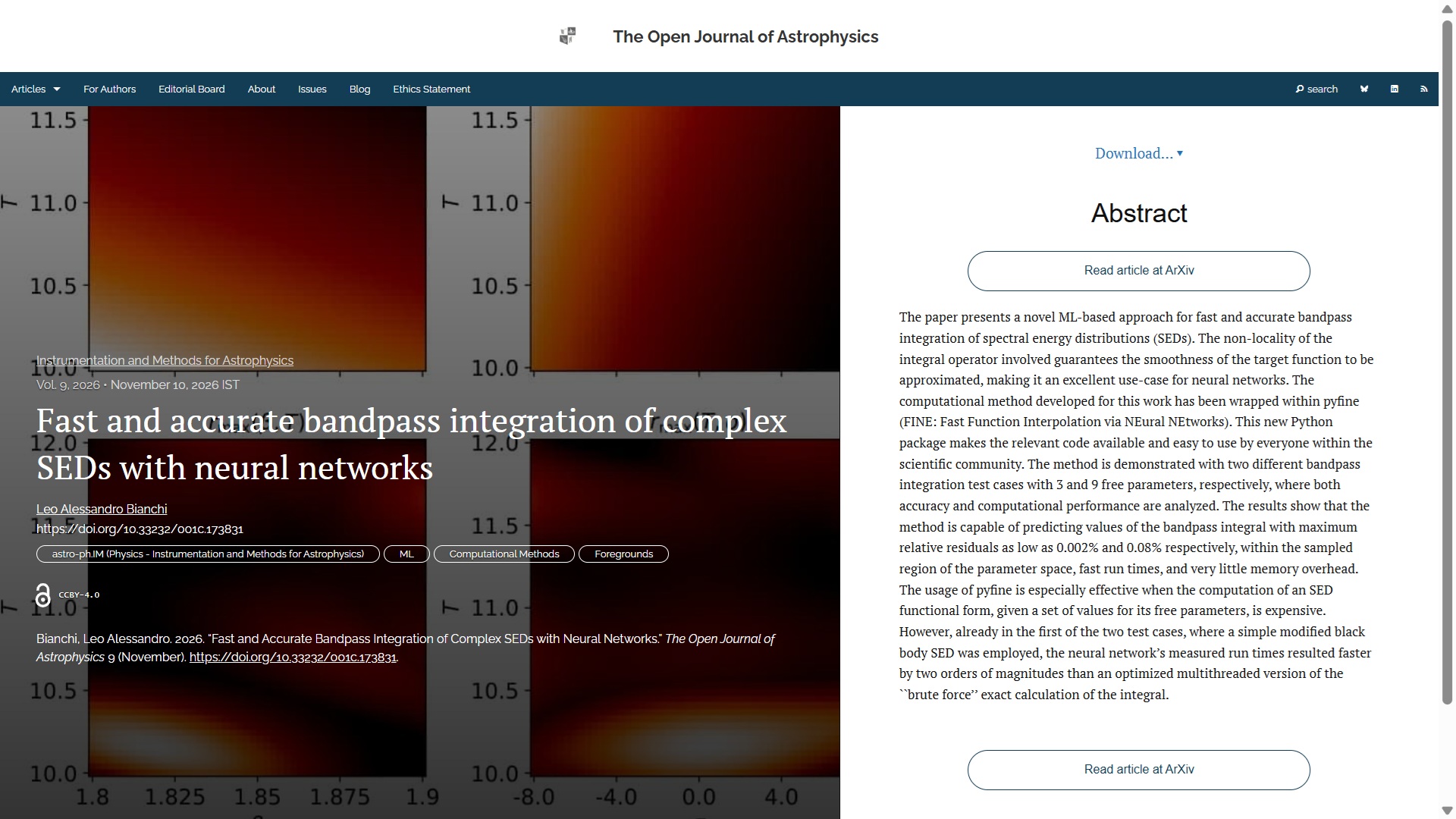
The first paper this week was published on Tuesday 10th November in the folder Instrumentation and Methods for Astrophysics . The title is “Fast and accurate bandpass integration of complex SEDs with neural networks” and it is writtenby Leo Alessandro Bianchi (U. Oslo, Norway). The authors introduce pyfine, a neural-network tool for fast, accurate spectral bandpass integration, achieving substantial speedups with minimal memory use across two test cases.

The overlay for this one is here:

You can find the officially accepted version on arXiv here and the announcement on Fediverse here:

Open Journal of Astrophysics

New Publication at the Open Journal of Astrophysics: "Fast and accurate bandpass integration of complex SEDs with neural networks" by Leo Alessandro Bianchi (U. Oslo, Norway)

doi.org/10.33232/001c.173831

November 10, 2026, 12:41 pm 1 boosts 0 favorites

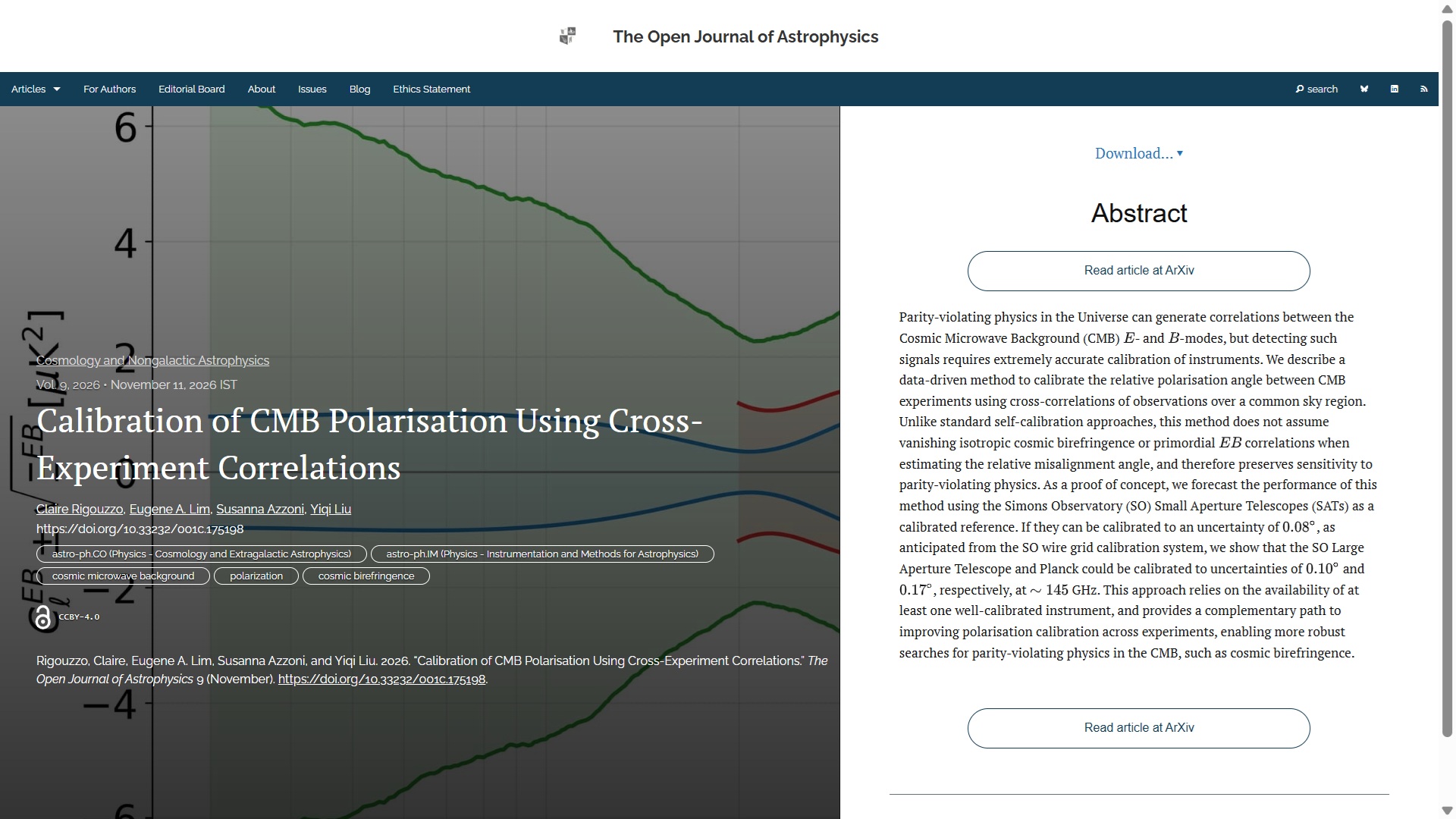
The second paper for this week, published on Wednesday 11th November in the folder Cosmology and Nongalactic Astrophysics is “Calibration of CMB Polarisation Using Cross-Experiment Correlations” by Claire Rigouzzo & Eugene A. Lim (King’s College London, UK) and Susanna Azzoni & Yiqi Liu (Princeton U. USA). This paper describes a cross-correlation method that calibrates polarization angles between CMB experiments without suppressing parity-violating signals, potentially improving calibration precision for searches for cosmic birefringence.

The overlay looks like this:

The official version of the paper can be found on arXiv here and the Fediverse announcement here:

Open Journal of Astrophysics

New Publication at the Open Journal of Astrophysics: "Calibration of CMB Polarisation Using Cross-Experiment Correlations" by Claire Rigouzzo & Eugene A. Lim (King's College London, UK) and Susanna Azzoni & Yiqi Liu (Princeton U. USA)

doi.org/10.33232/001c.175198

November 11, 2026, 10:21 am 1 boosts 1 favorites

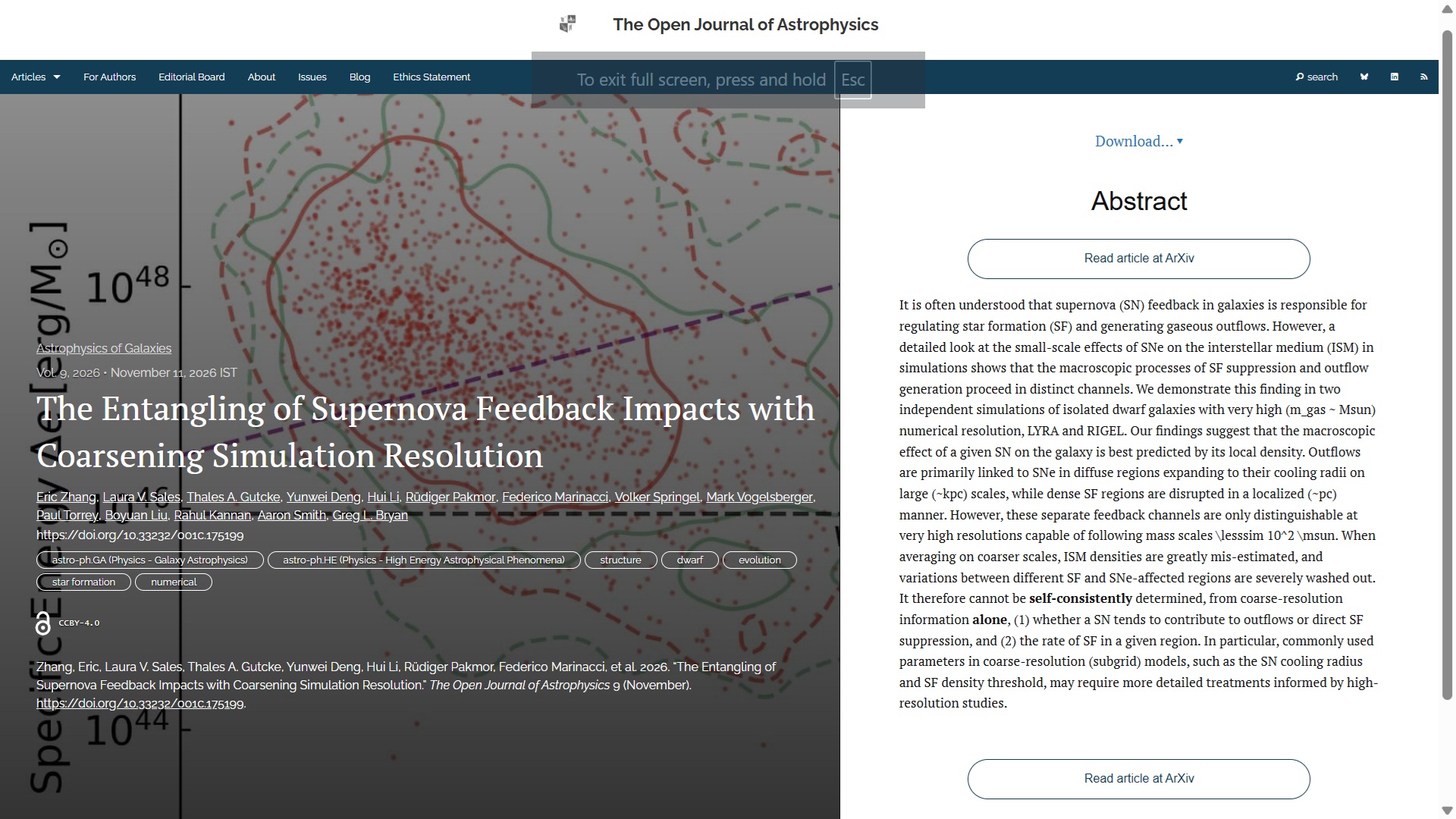
The third paper of the week, also published on Wednesday November 11th, but in the folder Astrophysics of Galaxies is “The Entangling of Supernova Feedback Impacts with Coarsening Simulation Resolution” by Eric Zhang (U.C. Riverside, USA) and 13 others from USA, China, Italy, Germany and Canada. High-resolution dwarf-galaxy simulations show that supernovae suppress star formation locally in dense regions but drive outflows from diffuse gas—processes that coarse-resolution models cannot reliably distinguish.

The overlay for this is here:

The accepted version of this one can be found on the arXiv here and the Mastodon announcement here:

Open Journal of Astrophysics

New Publication at the Open Journal of Astrophysics: "The Entangling of Supernova Feedback Impacts with Coarsening Simulation Resolution" by Eric Zhang (U.C. Riverside, USA) and 13 others from USA, China, Italy, Germany and Canada.

doi.org/10.33232/001c.175199

November 11, 2026, 10:45 am 1 boosts 2 favorites

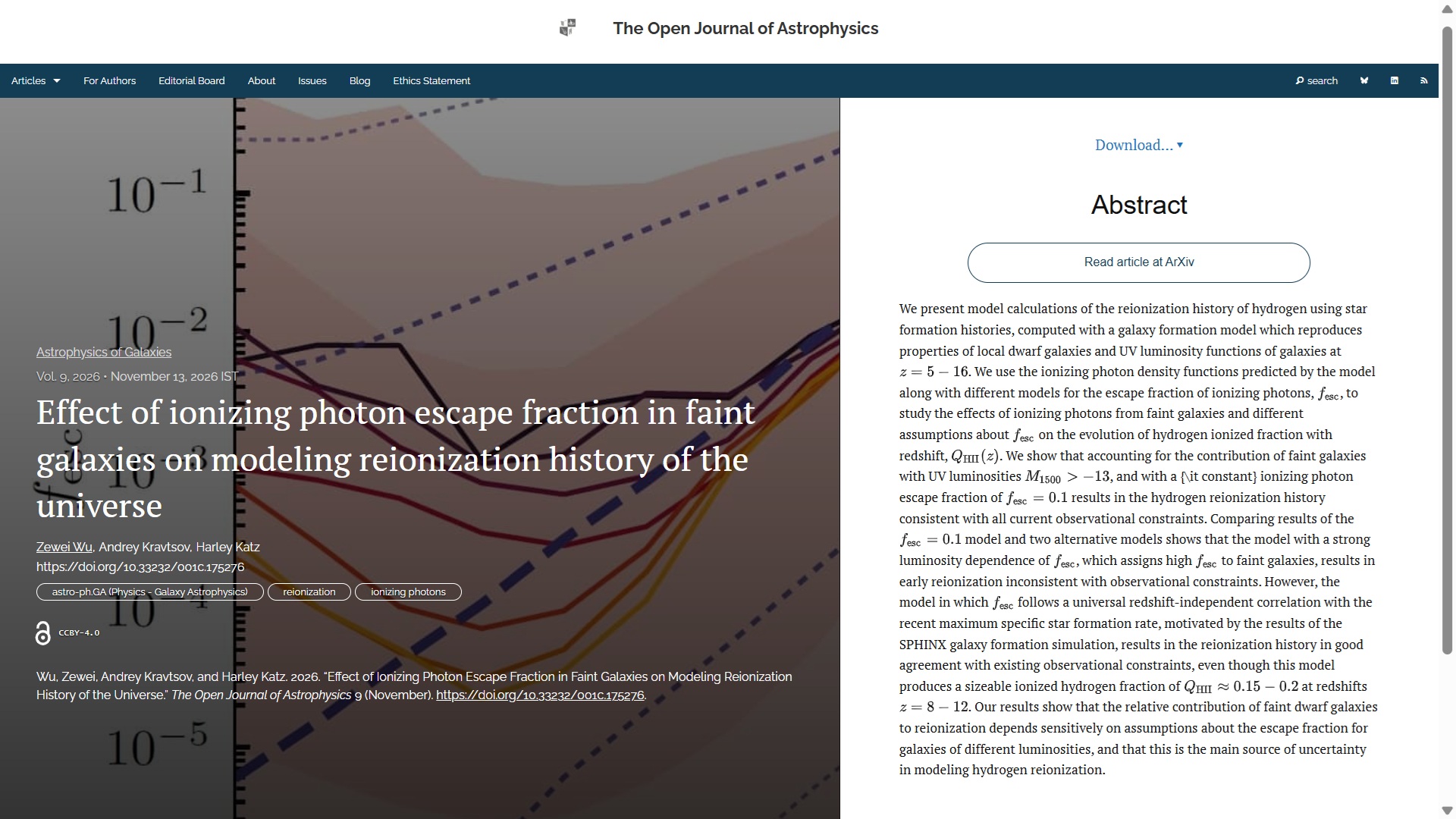
Our fourth paper of the week is “Effect of ionizing photon escape fraction in faint galaxies on modeling reionization history of the universe” by Zewei Wu, Andrey Kravtsov and Harley Katz (U. Chicago, USA). This was published on Friday November 13th in the folder Astrophysics of Galaxies. It explains how modelling suggests faint galaxies can drive hydrogen reionization, but their contribution depends strongly on ionizing-photon escape assumptions; constant or star-formation-based escape models fit observations better than strongly luminosity-dependent escape.

The overlay is here:

The officially accepted version of this paper can be found on arXiv here and the Mastodon announcement is:

Open Journal of Astrophysics

New Publication at the Open Journal of Astrophysics: "Effect of ionizing photon escape fraction in faint galaxies on modeling reionization history of the universe" by Zewei Wu, Andrey Kravtsov and Harley Katz (U. Chicago, USA)

doi.org/10.33232/001c.175276

November 13, 2026, 8:10 am 2 boosts 2 favorites

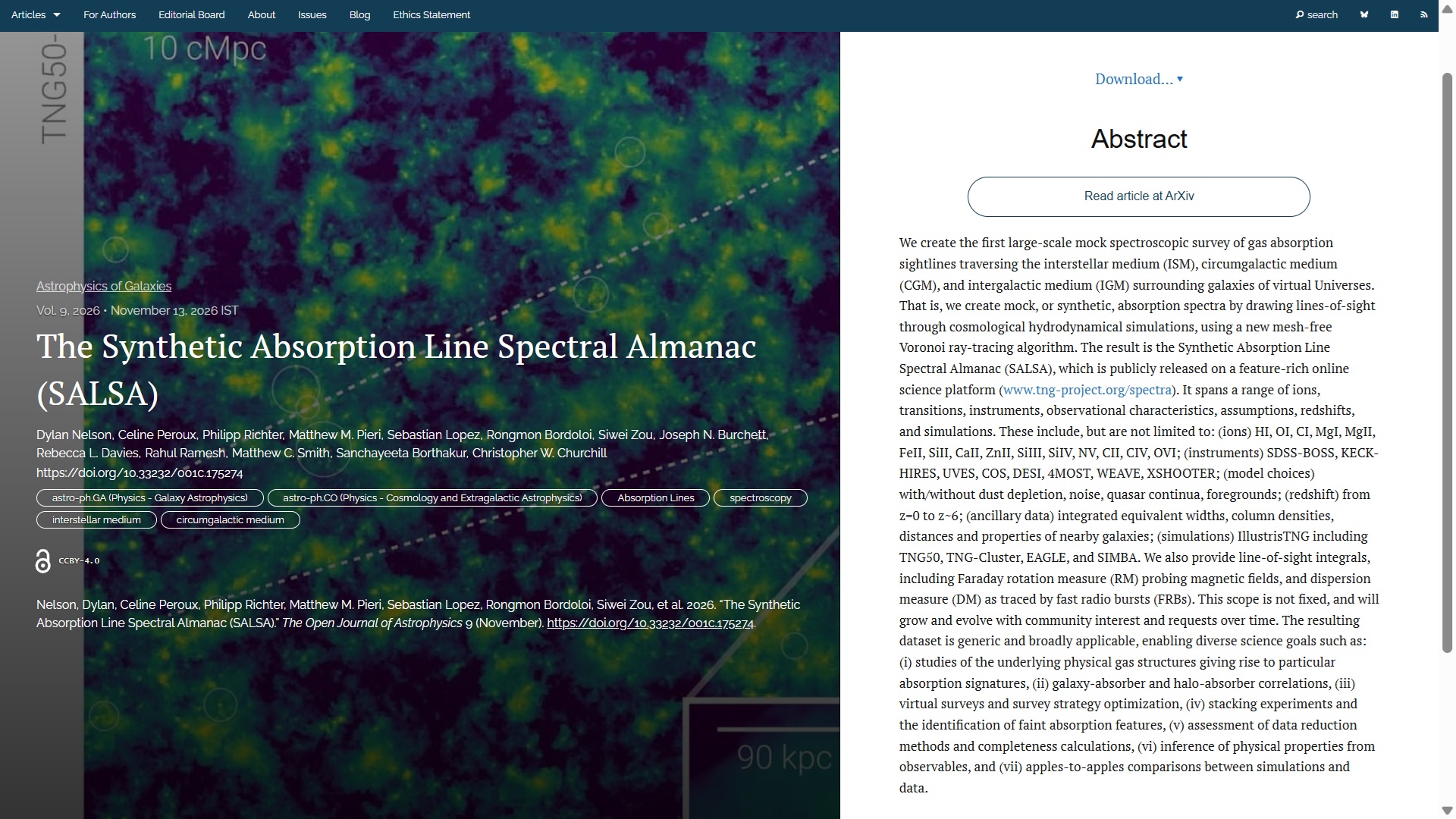
And the fifth and final paper for the week is “The Synthetic Absorption Line Spectral Almanac (SALSA)” by Dylan Nelson (U. Heidelberg, Germany) and 12 others distributed around the world. This was also published on Friday November 13th in the folder Astrophysics of Galaxies. SALSA is a public, extensive library of synthetic absorption spectra from cosmological simulations, designed to support studies of gas around galaxies, survey planning, and comparisons between simulations and observations.

The overlay for this one is here:

The officially accepted version of this paper can be found on arXiv here and the Mastodon announcement is here:

Open Journal of Astrophysics

New Publication at the Open Journal of Astrophysics: "The Synthetic Absorption Line Spectral Almanac (SALSA)" by Dylan Nelson (U. Heidelberg, Germany) and 12 others distributed around the world.

doi.org/10.33232/001c.175274

November 13, 2026, 8:23 am 2 boosts 1 favorites

That concludes this week’s update. There was a holiday in the USA on Wednesday 11th November, which meant no arXiv announcement the following day. I’ll do another update next week by which time we should have caught up on the backlog.