Weekly Update from the Open Journal of Astrophysics – 09/05/2026
It’s Saturday once again, so time for another update of activity at the Open Journal of Astrophysics. Since the last update we have published a further five papers, bringing the number in Volume 9 (2026) to 99 and the total so far published by OJAp up to 547. We didn’t quite make it to a hundred for the year last week, but will do so with the next paper.
I will continue to include the posts made on our Mastodon account (on Fediscience) to encourage you to visit it. Mastodon is a really excellent service, and a more than adequate replacement for X/Twitter (which nobody should be using); these announcements also show the DOI for each paper.
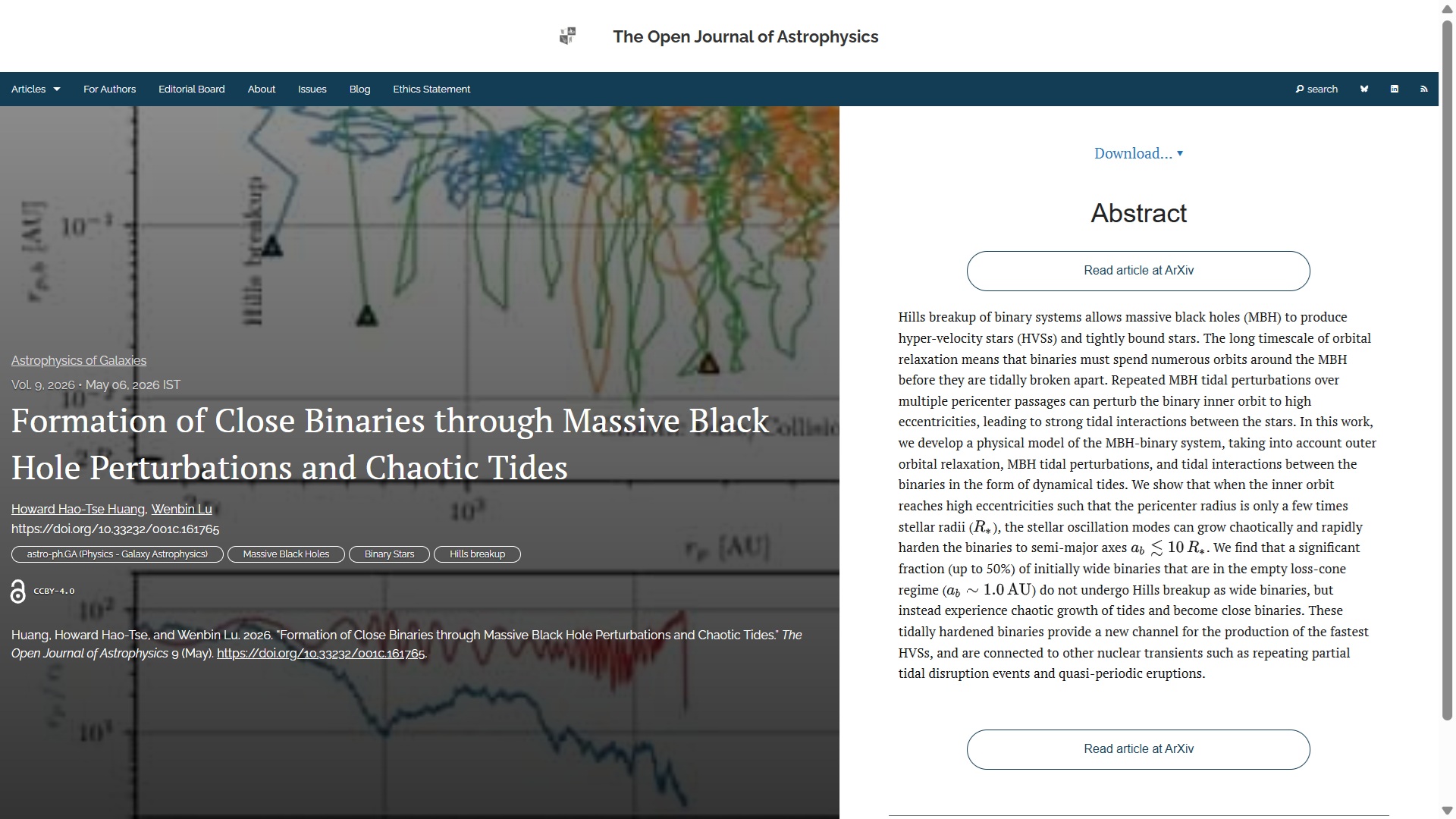
The first paper to report this week is “Formation of Close Binaries through Massive Black Hole Perturbations and Chaotic Tides” by Howard Hao-Tse Huang and Wenbin Lu (University of California at Berkeley, USA). This one was published on Wednesday 6th May 2026 in the folder Astrophysics of Galaxies. The paper presents a model of massive black hole-binary systems, showing that repeated tidal interactions can lead to the creation of hyper-velocity stars and other nuclear transients.
The overlay for this paper is here
You can find the officially accepted version on arXiv here and the announcement on Fediverse here:

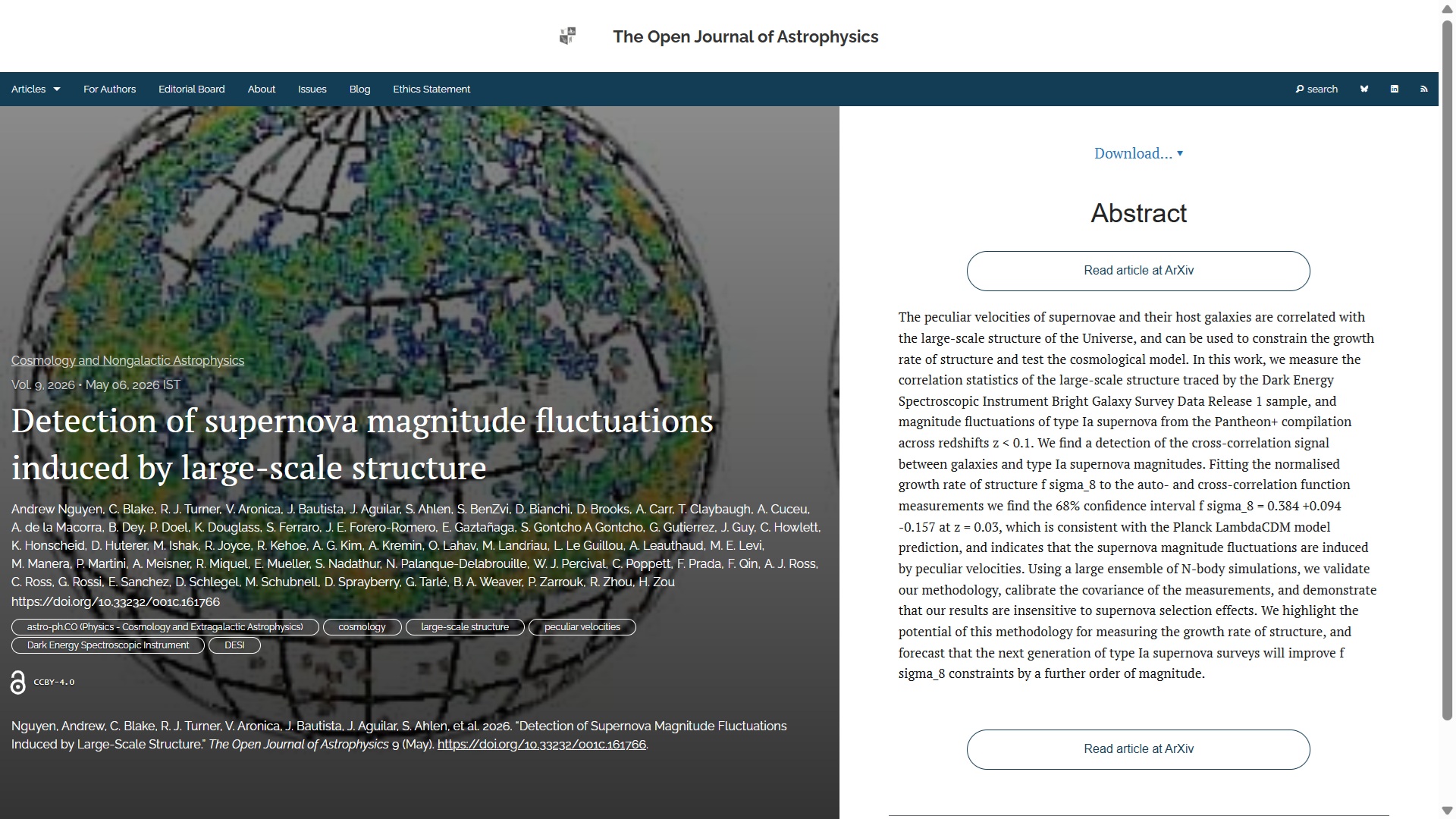
The second paper for this week, also Wednesday 6th May, but in the folder Cosmology and Nongalactic Astrophysics is “Detection of supernova magnitude fluctuations induced by large-scale structure” by Andrew Nguyen (Swinburne Institute of Technology, Australia) and 58 others based all around the world. This study uses supernovae and galaxy velocities to measure the universe’s structure growth rate, confirming the Planck LambdaCDM model prediction. The methodology is validated and shows potential for future research.
The overlay for this one is here:
The official version of the paper can be found on arXiv here and the Fediverse announcement here:
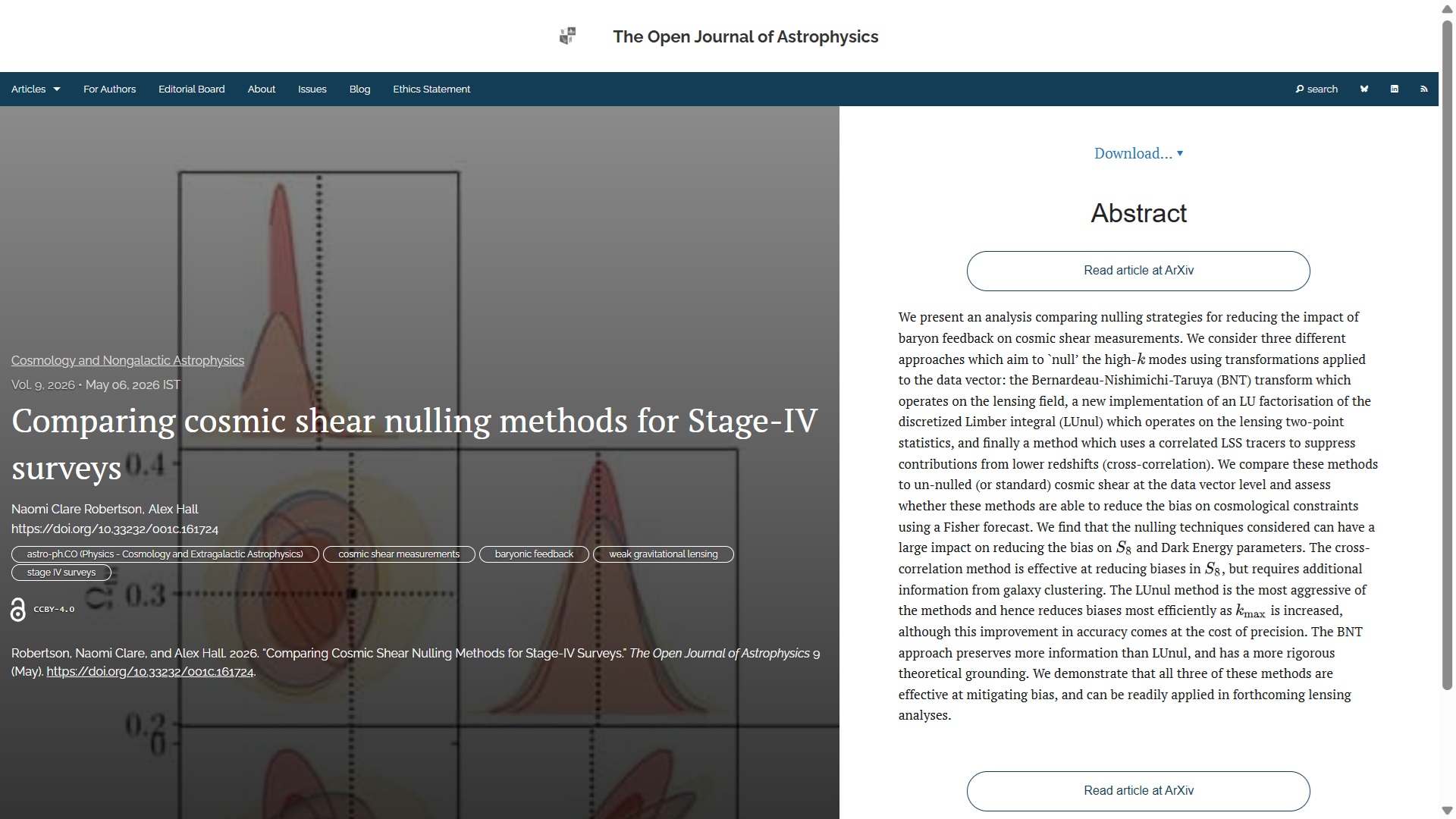
Next one up, the third paper of the week, also published on Wednesday 6th May in the folder Cosmology and Nongalactic Astrophysics is “Comparing cosmic shear nulling methods for Stage-IV surveys” by Naomi Clare Robertson and Alex Hall (University of Edinburgh, UK). This study compares three strategies for reducing baryon feedback impact on cosmic shear measurements. All methods effectively mitigate bias, with varying degrees of efficiency and information preservation.
The overlay for this one is here:
The final, accepted version can be found on arXiv here and the Mastodon announcement is here:
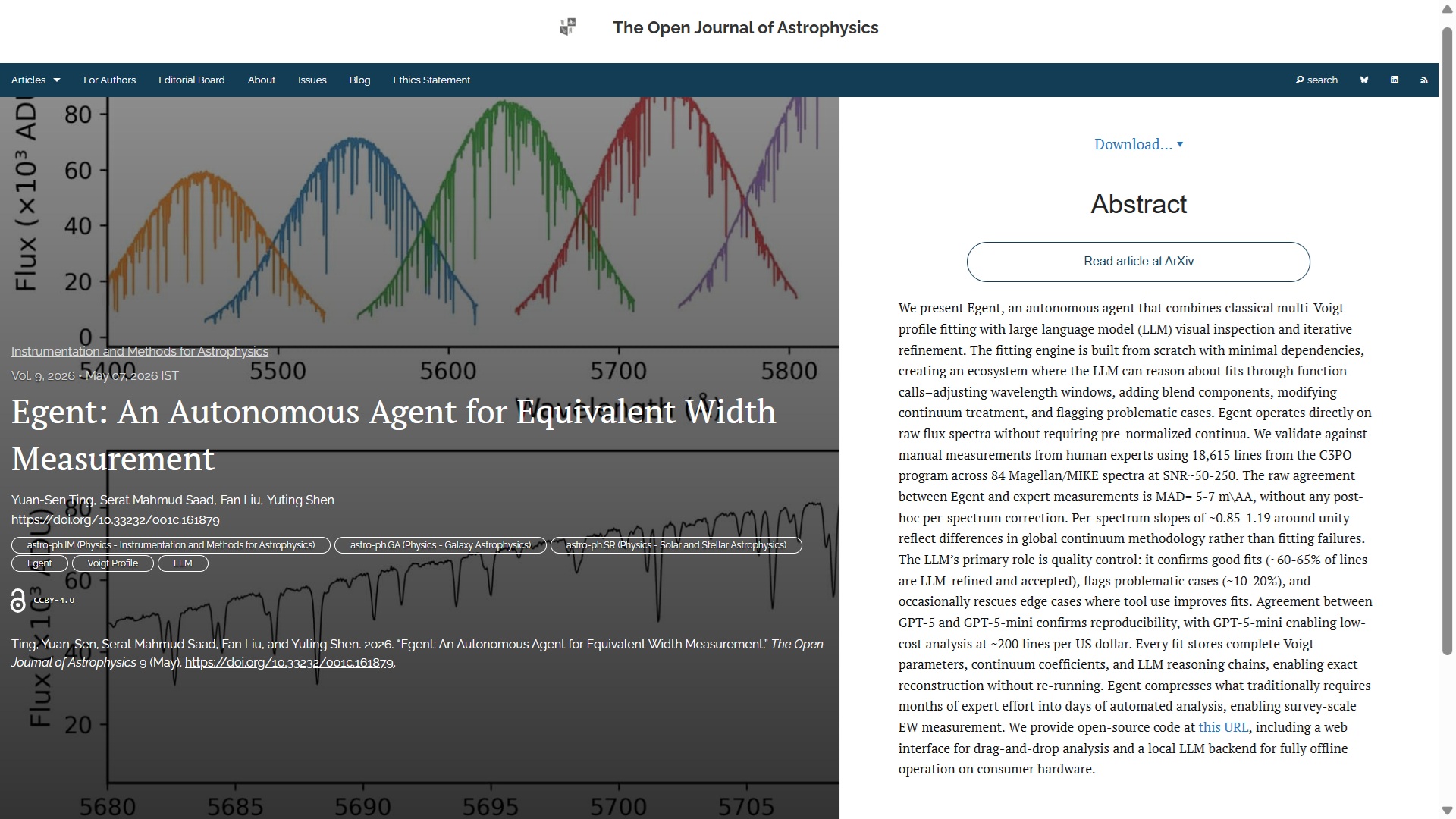
The fourth paper this week, published on Thursday May 7th, is “Egent: An Autonomous Agent for Equivalent Width Measurement” by Yuan-Sen Ting & Serat Mahmud Saad (Ohio State University, USA), Fan Liu (National Astronomical Observatories, Beijing, China), and Yuting Shen (Georgia Institute of Technology, USA). Egent is an autonomous agent that combines multi-Voigt profile fitting with large language model visual inspection for efficient, automated analysis of raw flux spectra, validated against expert measurements. This one is in the folder Instrumentation and Methods for Astrophysics. The associated software can be found here.
The overlay is here:
The officially accepted version can be found on arXiv here and here is the Mastodon announcement:
The fifth and final article of this week was published on Friday 8th May in the folder Astrophysics of Galaxies. The title is “DiffstarPop: A generative physical model of galaxy star formation history” and it is by Alex Alarcon (Institute of Space Sciences, Barcelona, Spain), Andrew P. Hearin , Matthew R. Becker & Gillian Beltz-Mohrmann (Argonne National Laborarory, USA), and Andrew Benson & Sachi Weerasooriya (Carnegie Observatories, USA). DiffstarPop is a model that accurately and rapidly reproduces statistical distributions of galaxy star formation histories (SFH), using parameters related to galaxy formation physics.
The overlay is here:
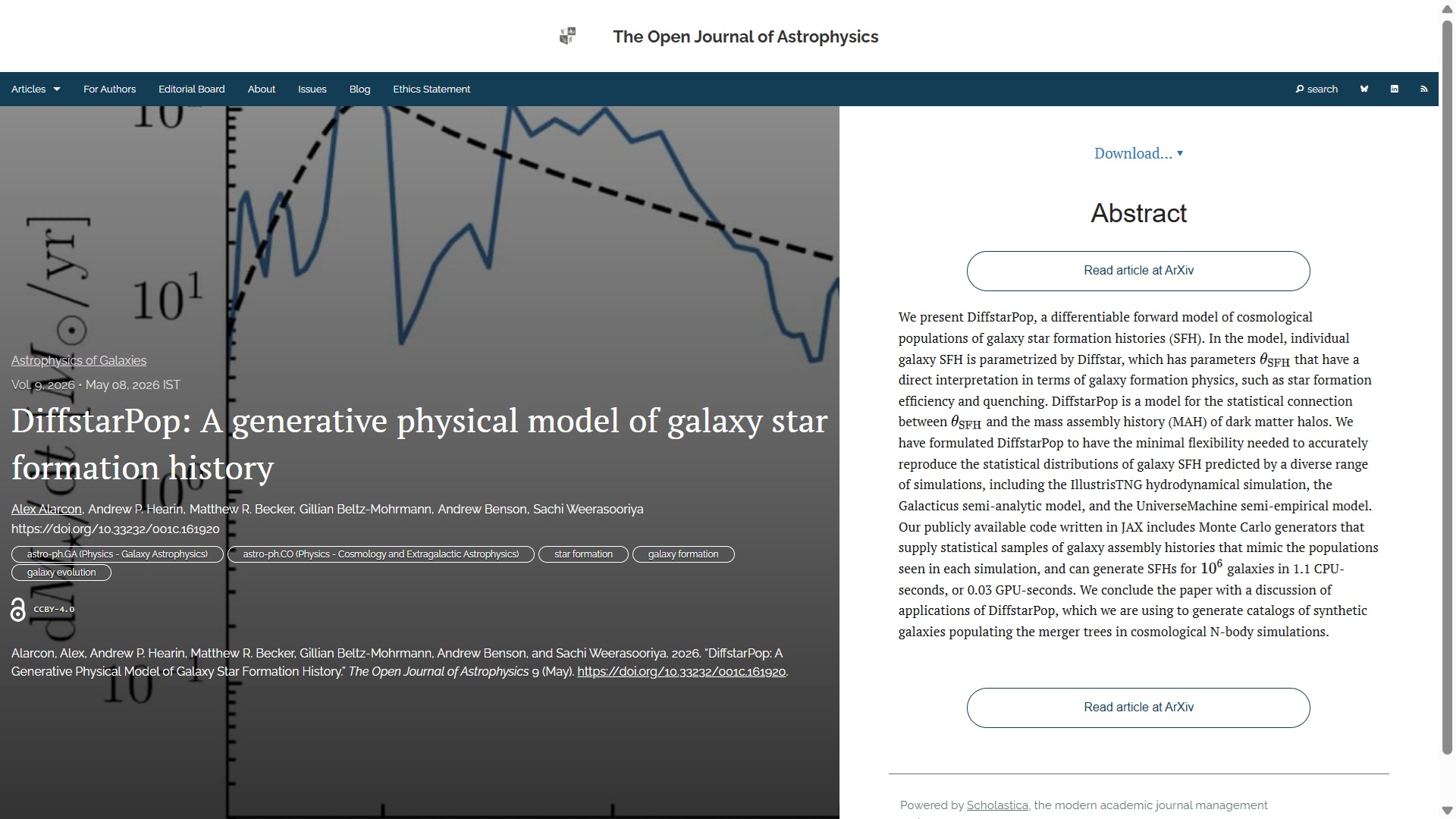
You can find the authorized version of this paper on arXiv here and the Fediverse announcement is here:
Here endeth this week’s update. There shall be another next Saturday.
P.S. Just a reminder that, thanks to the efforts of a member of our Editorial Board, the Open Journal of Astrophysics now has a Wikipedia page.
 In the Dark
May 16, 2026 at 2:05 pm
[…] time for another update of activity at the Open Journal of Astrophysics. Since the last update we have published a further five papers, bringing the number in Volume 9 (2026) to […]