Archive for galaxy evolution

Weekly Update from the Open Journal of Astrophysics – 02/05/2026

Posted in OJAp Papers, Open Access, The Universe and Stuff with tags , , , , , , , , , , , , , , , , , , , , , , , , , , , , , , , , , , , , , on May 2, 2026 by telescoper

Here we are, on schedule, with another update of activity at the Open Journal of Astrophysics. Since the last update we have published a further seven papers, bringing the number in Volume 9 (2026) to 94 and the total so far published by OJAp up to 542. I checked the corresponding update for last year (on 3rd May 2025), and we’ve had an increase from 54 to 94 in papers published (about 74%) between the first four months of 2025 and the first four months of 2026.

I will continue to include the posts made on our Mastodon account (on Fediscience) to encourage you to visit it. Mastodon is a really excellent service, and a more than adequate replacement for X/Twitter (which nobody should be using); these announcements also show the DOI for each paper.

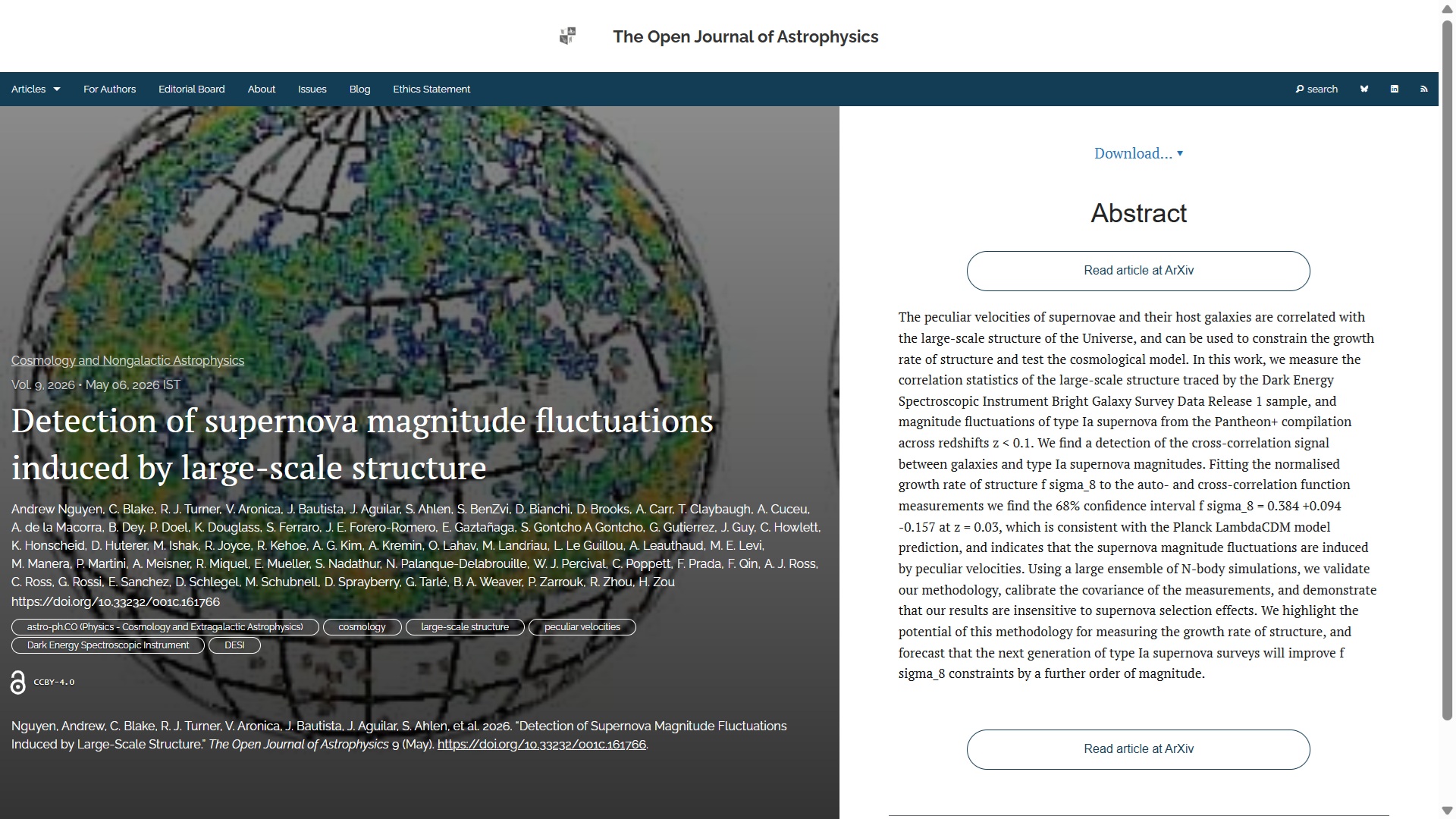
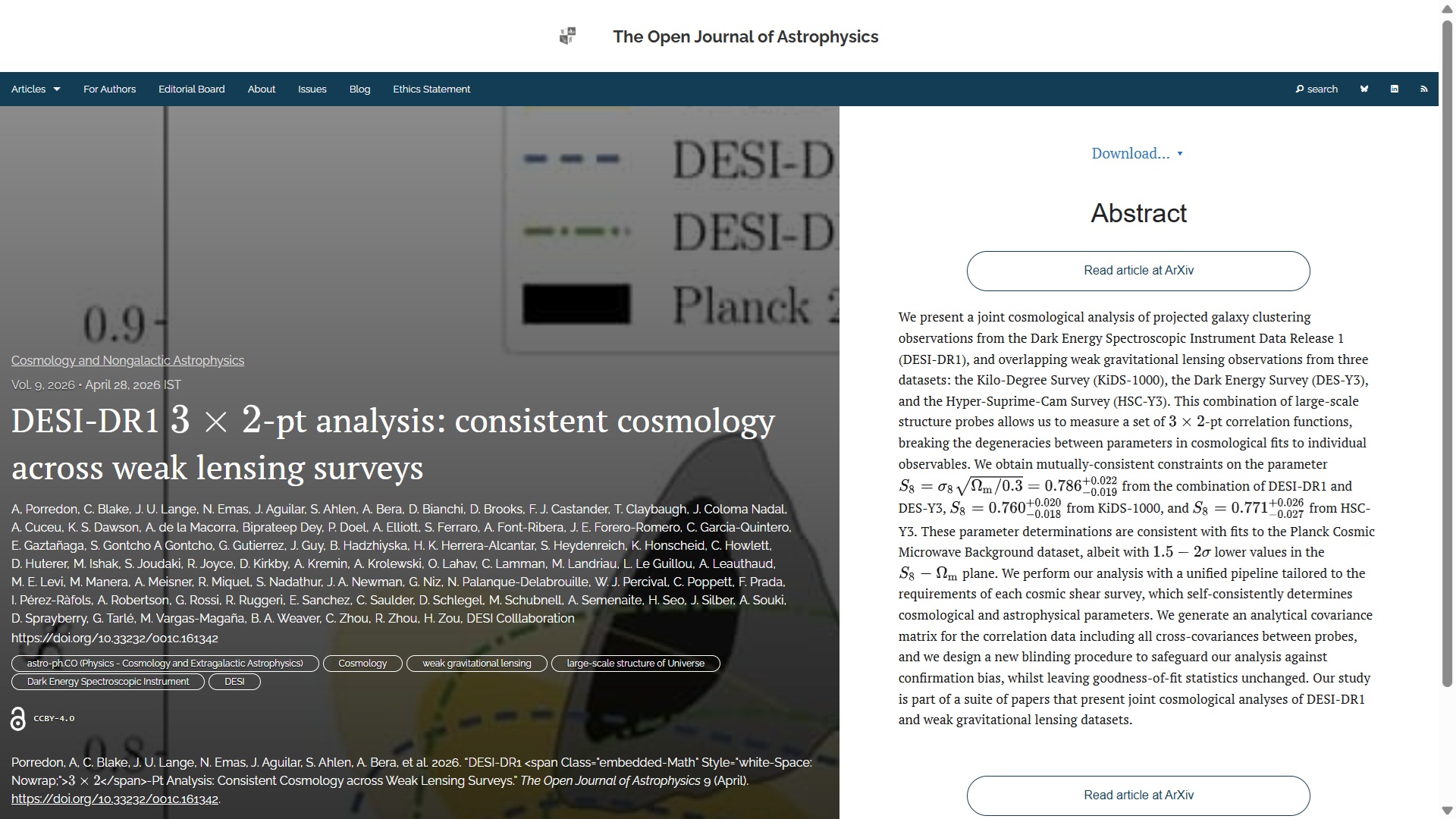
The first paper to report this week is “DESI-DR1 3 × 2-pt analysis: consistent cosmology across weak lensing surveys” by Anna Porredon (CIEMAT, Madrid, Spain) and 72 others (DESI Colllaboration). This paper was published on Tuesday 28th April in the folder Cosmology and Nongalactic Astrophysics. This paper presents a joint cosmological analysis of galaxy clustering and gravitational lensing observations, providing consistent constraints on cosmological parameters. The analysis also introduces a new blinding procedure to prevent confirmation bias. See this post for news of an important DESI milestone.

The overlay for this paper is here

You can find the officially accepted version on arXiv here and the announcement on Fediverse here:

Open Journal of Astrophysics

New Publication at the Open Journal of Astrophysics: "DESI-DR1 3 × 2-pt analysis: consistent cosmology across weak lensing surveys" by Anna Porredon (CIEMAT, Madrid, Spain) and 72 others (DESI Colllaboration)

doi.org/10.33232/001c.161342

April 28, 2026, 4:19 am 1 boosts 0 favorites

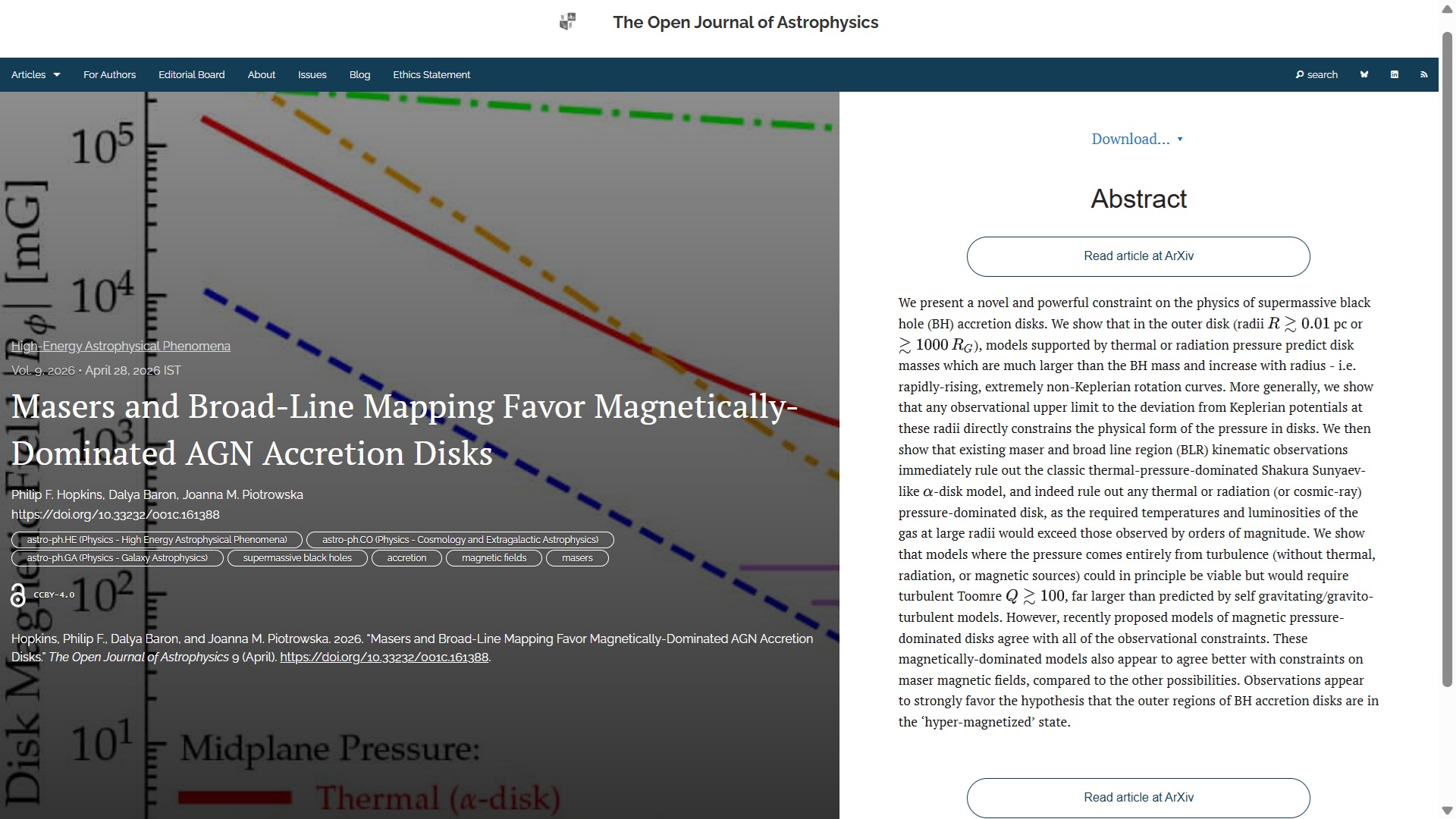
The second paper for this week, also published on Tuesday 28th April but in the folder High-Energy Astrophysical Phenomena is “Masers and Broad-Line Mapping Favor Magnetically-Dominated AGN Accretion Disks” by Philip F. Hopkins (Caltech, USA), Dalya Baron (Stanford U., USA) and Joanna M. Piotrowska (Caltech). This one presents a new constraint on supermassive black hole accretion disks physics, suggesting that outer regions are likely in a ‘hyper-magnetized’ state, as thermal or radiation pressure models appear inconsistent.

The overlay for this one is here:

The official version of the paper can be found on arXiv here and the Fediverse announcement here:

Open Journal of Astrophysics

New Publication at the Open Journal of Astrophysics: "Masers and Broad-Line Mapping Favor Magnetically-Dominated AGN Accretion Disks" by Philip F. Hopkins (Caltech, USA), Dalya Baron (Stanford U., USA) and Joanna M. Piotrowska (Caltech)

doi.org/10.33232/001c.161388

April 28, 2026, 4:44 am 0 boosts 1 favorites

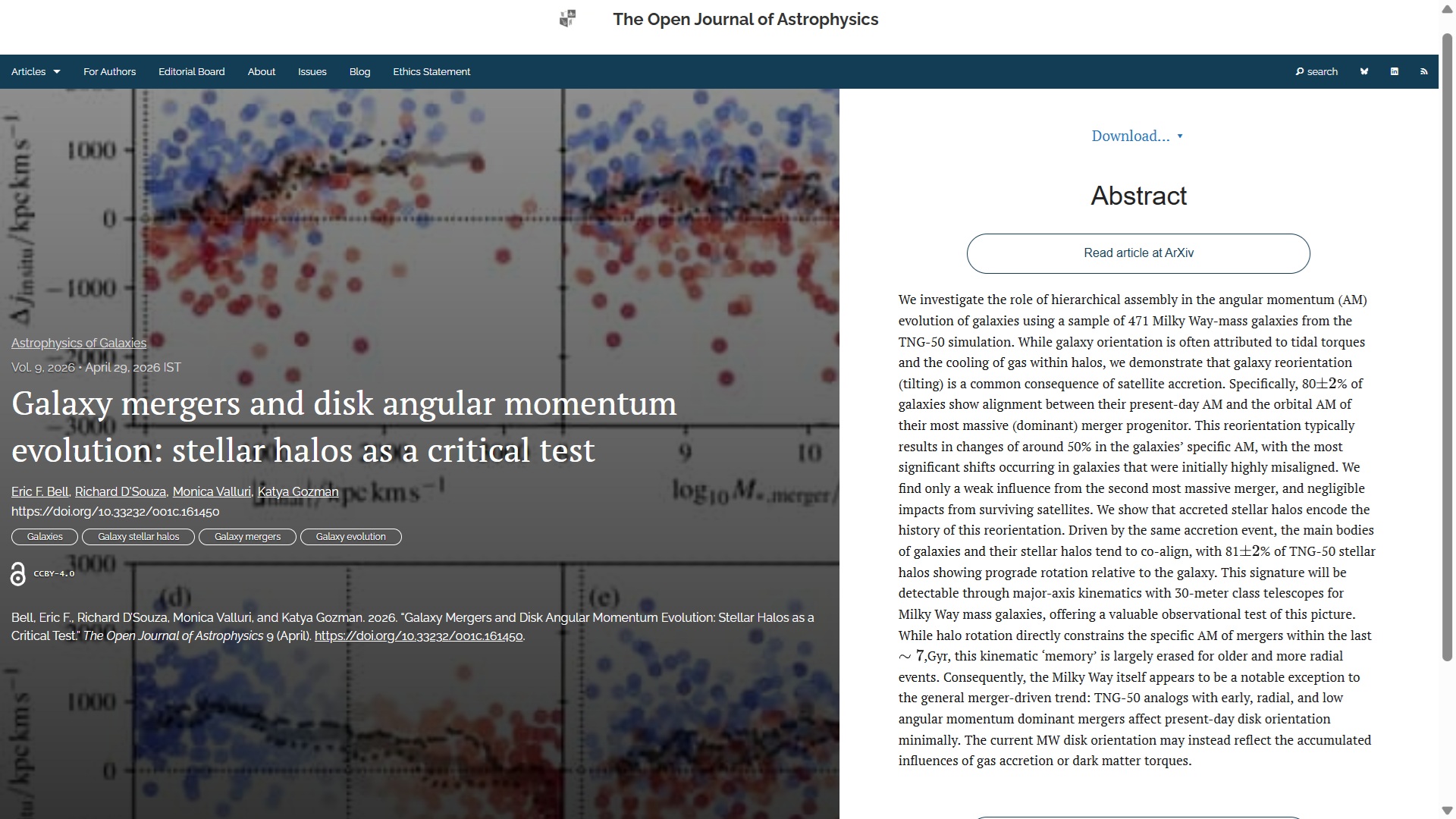
Next one up, the third paper of the week, is “Galaxy mergers and disk angular momentum evolution: stellar halos as a critical test” by Eric F. Bell (U. Michigan, Ann Arbor, USA), Richard D’Souza (Vatican Observatory), Monica Valluri & Katya Gozman (U. Michigan). This was published on Wednesday 29th April in the folder Astrophysics of Galaxies. The paper argues that satellite accretion impacts the angular momentum evolution of galaxies, often causing significant reorientation. This process is detectable in Milky Way-mass galaxies so the idea is testable observationally.

The overlay for this one is here:

The final, accepted version can be found on arXiv here and the Mastodon announcement is here:

Open Journal of Astrophysics

New Publication at the Open Journal of Astrophysics: "Galaxy mergers and disk angular momentum evolution: stellar halos as a critical test" by Eric F. Bell (U. Michigan, Ann Arbor, USA), Richard D'Souza (Vatican Observatory), Monica Valluri & Katya Gozman (U. Michigan)

doi.org/10.33232/001c.161450

April 29, 2026, 6:46 am 1 boosts 1 favorites

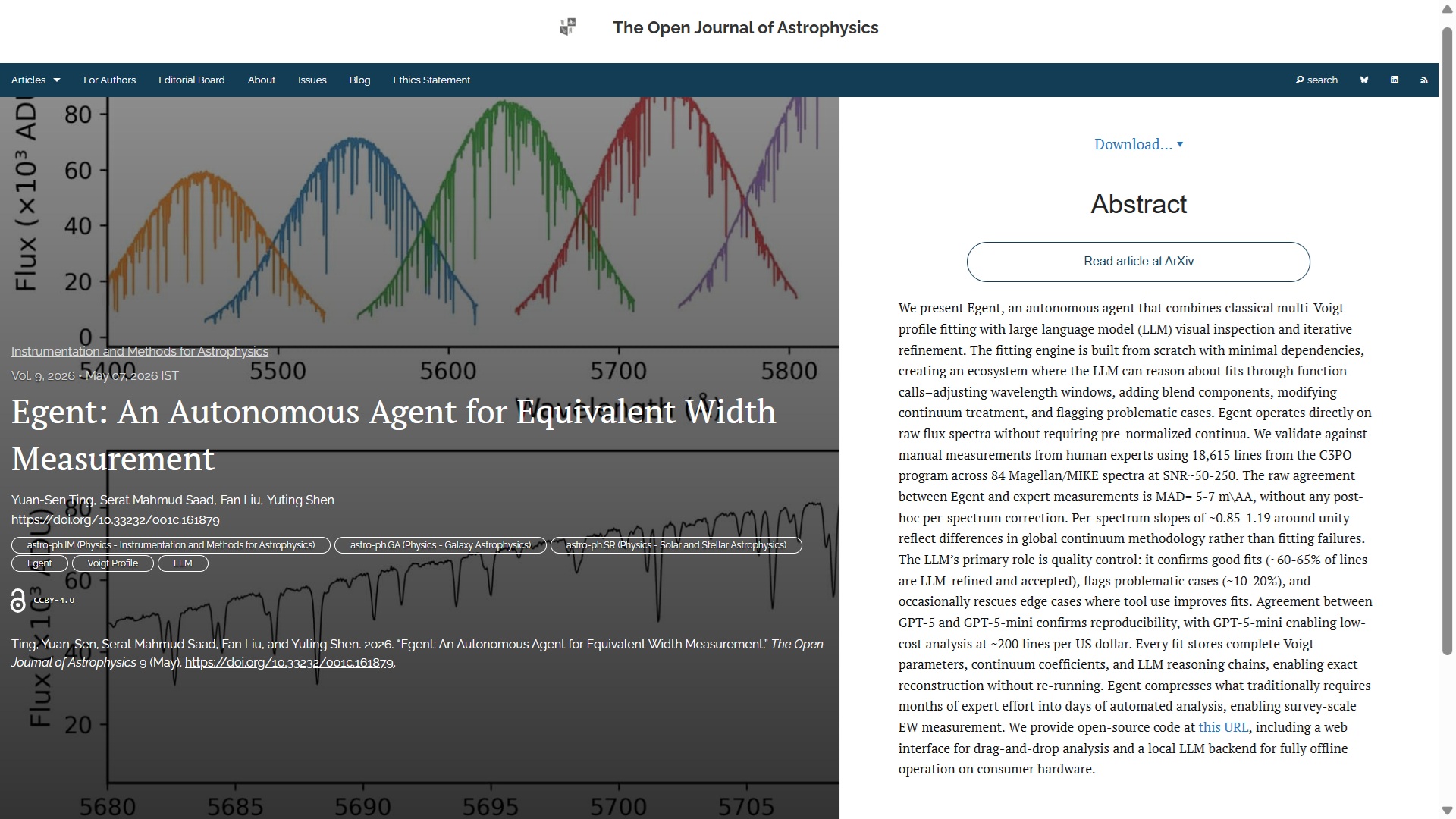
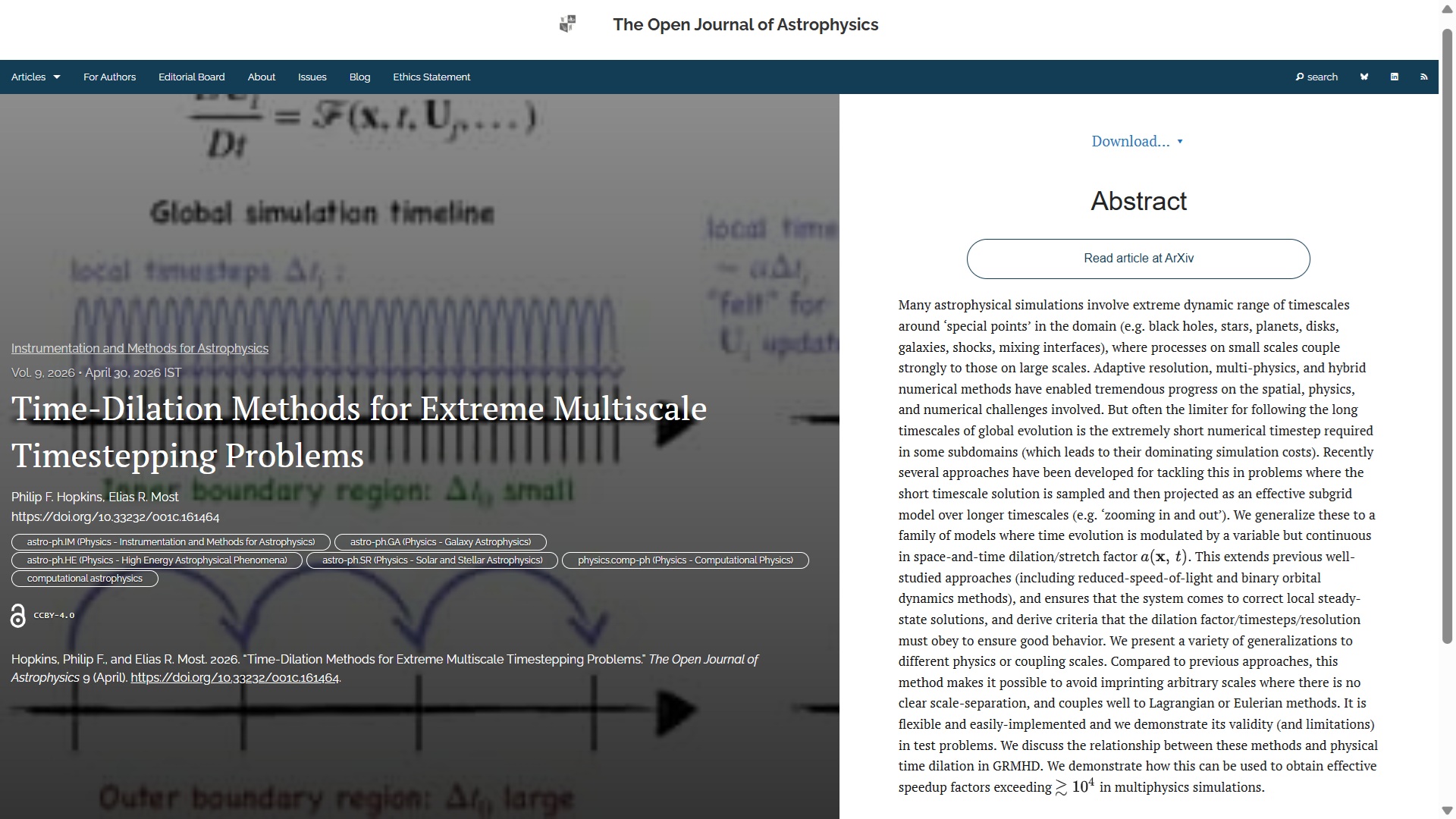
The fourth paper this week, published on Thursday April 30th, is “Time-Dilation Methods for Extreme Multiscale Timestepping Problems” by Philip F. Hopkins and Elias R. Most (Caltech, USA). This paper is in the folder Instrumentation and Methods for Astrophysics: it presents a new method for astrophysical simulations that modulates time evolution with a variable dilation/stretch factor, improving efficiency and accuracy in modeling processes across different scales.

The overlay is here:

The finally accepted version of this paper can be found here and the Mastodon announcement follows:

Open Journal of Astrophysics

New Publication at the Open Journal of Astrophysics: "Time-Dilation Methods for Extreme Multiscale Timestepping Problems" by Philip F. Hopkins and Elias R. Most (Caltech, USA)

doi.org/10.33232/001c.161464

April 30, 2026, 6:25 am 1 boosts 1 favorites

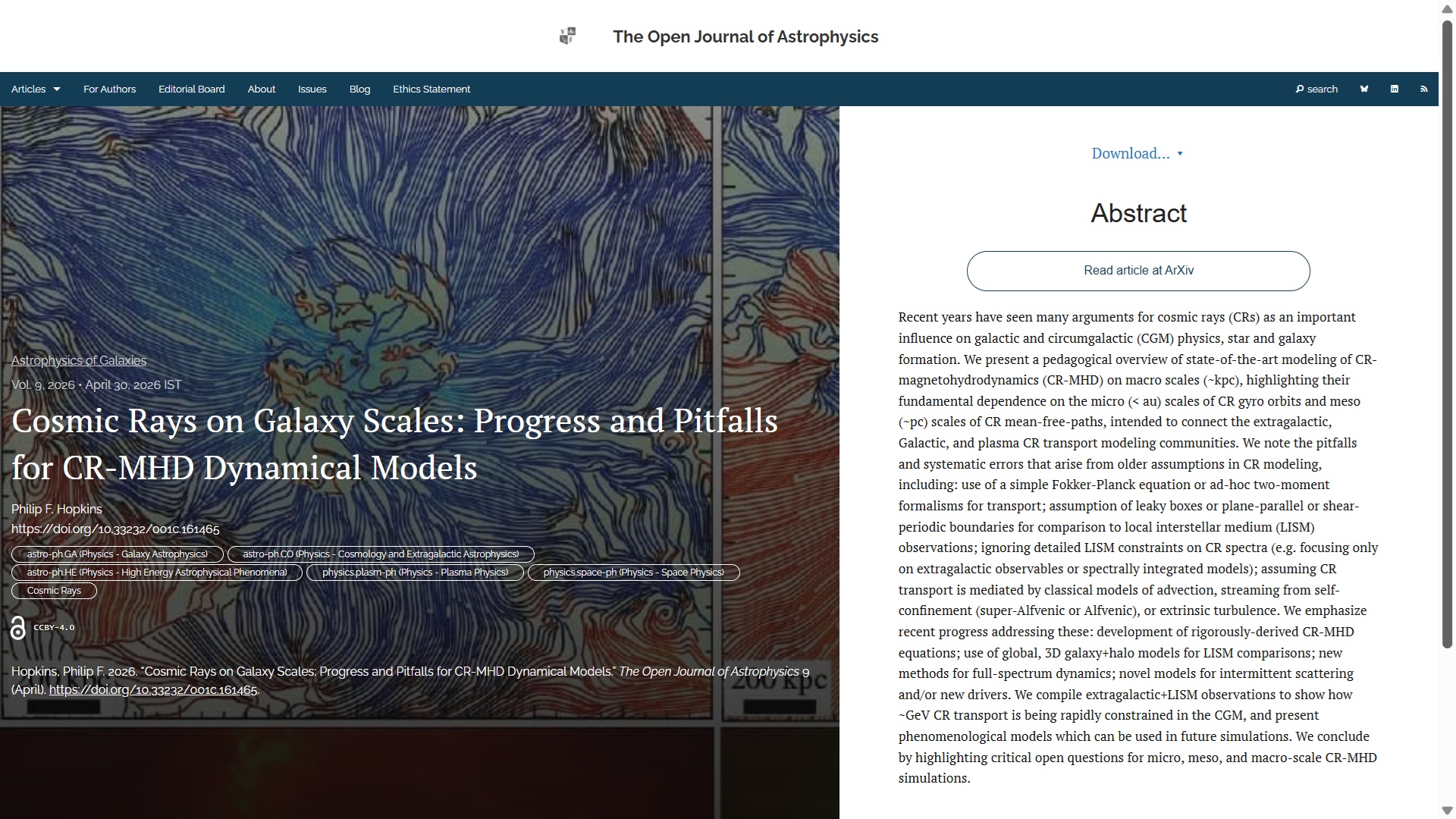
The fifth article of this week was also published on Thursday 30th April, but in the folder Astrophysics of Galaxies. The title is “Cosmic Rays on Galaxy Scales: Progress and Pitfalls for CR-MHD Dynamical Models” and the author is Philip F. Hopkins (Caltech, USA) who has three papers featured this week. The paper presents an overview of cosmic ray (CR) modeling, highlighting its influence on galactic physics and star formation. It addresses previous modeling errors and presents new methods for full-spectrum dynamics.

The overlay is here:

You can find the authorized version of this paper on arXiv here and the Fediverse announcement is here:

Open Journal of Astrophysics

New Publication at the Open Journal of Astrophysics: "Cosmic Rays on Galaxy Scales: Progress and Pitfalls for CR-MHD Dynamical Models" by Philip F. Hopkins (Caltech, USA)

doi.org/10.33232/001c.161465

April 30, 2026, 6:39 am 1 boosts 1 favorites

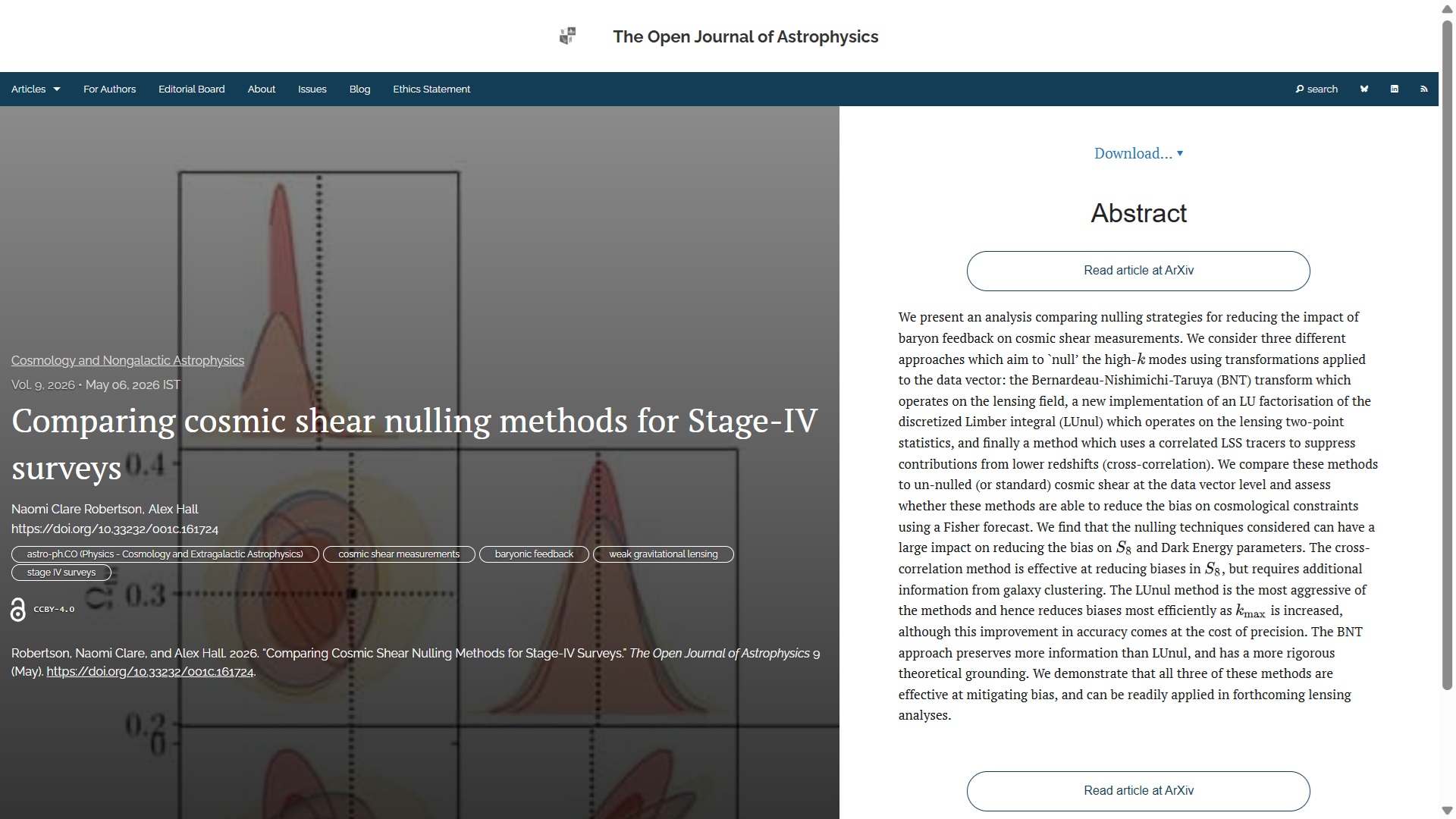
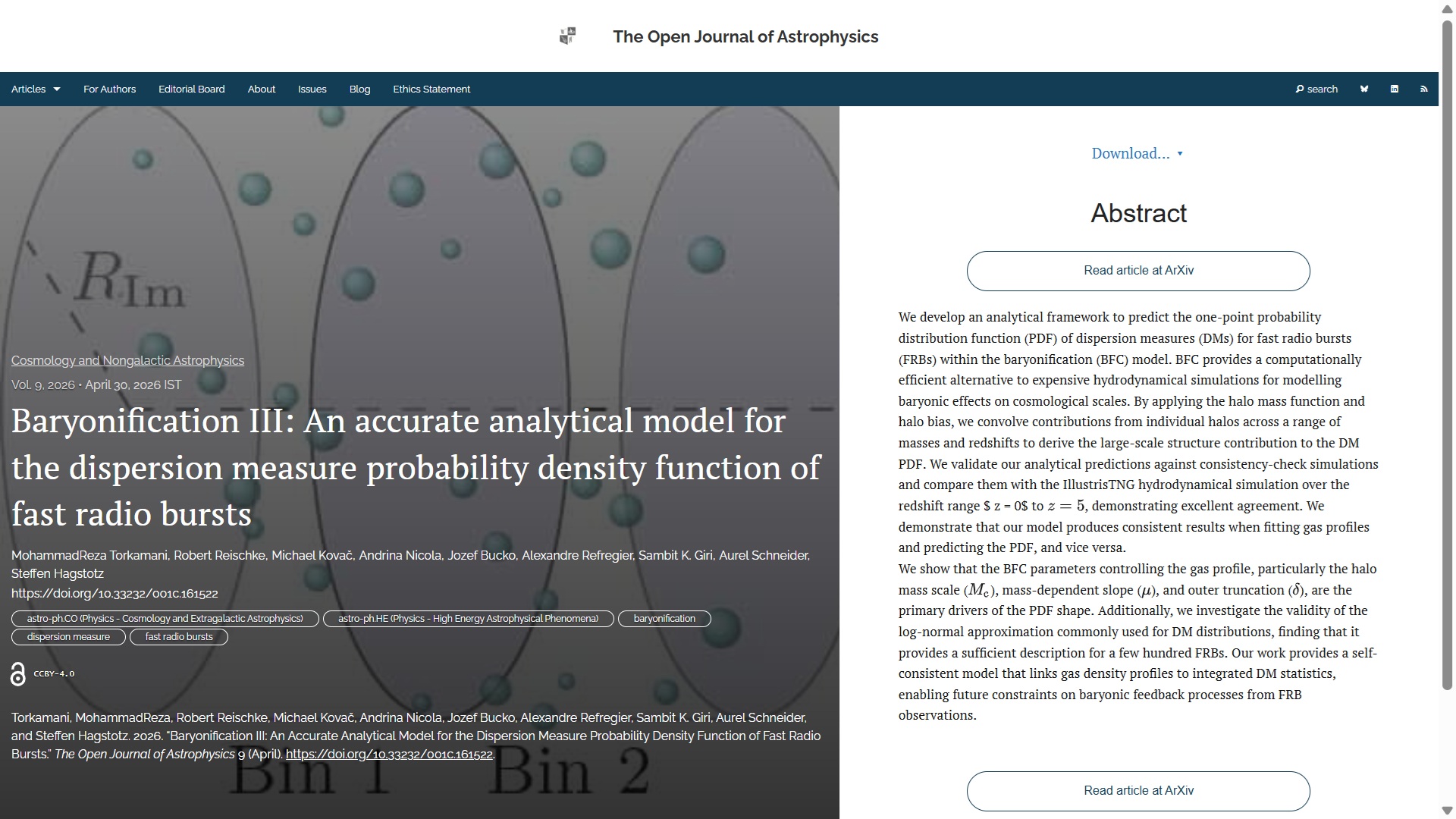
The sixth paper of the week is “Baryonification III: An accurate analytical model for the dispersion measure probability density function of fast radio bursts” by MohammadReza Torkamani (Universität Bonn, Germany) and 8 others based in Germany, Switzerland, UK and Sweden. This article was also published on Thursday April 30th in the folder Cosmology and Nongalactic Astrophysics. It presents a framework for predicting dispersion measures of fast radio bursts using the baryonification model, providing a cost-effective alternative to hydrodynamical simulations. The model’s accuracy is validated through full numerical simulations. The overlay is here:

You can find the officially-accepted version on arXiv here and the Mastodon announcement here:

Open Journal of Astrophysics

New Publication at the Open Journal of Astrophysics: "Baryonification III: An accurate analytical model for the dispersion measure probability density function of fast radio bursts" by MohammadReza Torkamani (Universität Bonn, Germany) and 8 others based in Germany, Switzerland, UK and Sweden

doi.org/10.33232/001c.161522

April 30, 2026, 7:10 am 1 boosts 2 favorites

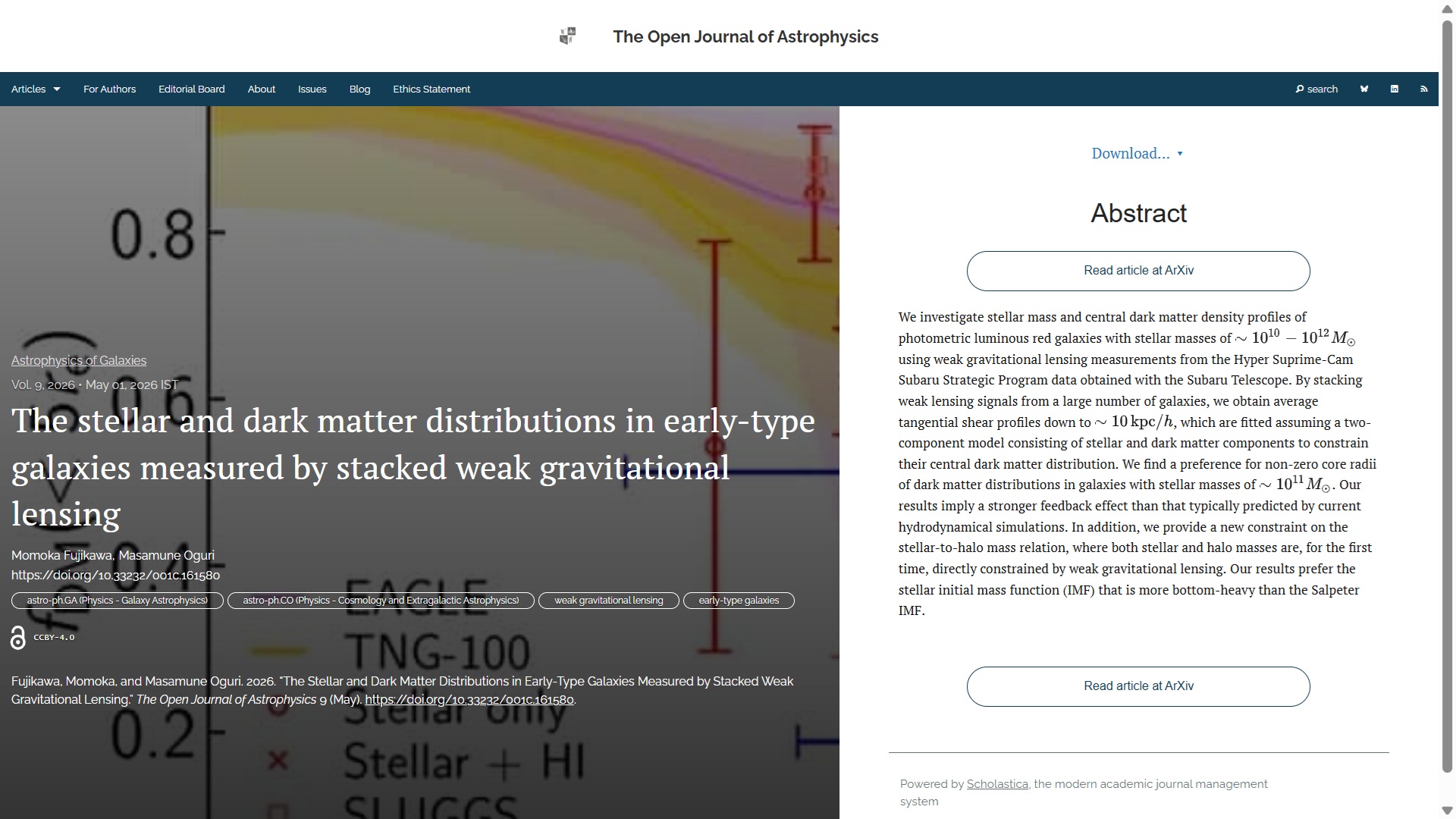
Seventh and finally for this week we have “The stellar and dark matter distributions in early-type galaxies measured by stacked weak gravitational lensing” by Momoka Fujikawa and Masamune Oguri (Chiba University, Japan). This study uses weak gravitational lensing to investigate stellar mass and dark matter density in red galaxies, suggesting a stronger feedback effect than current simulations predict. This was published on Friday 1st May 2026 in the folder Astrophysics of Galaxies. The overlay is here:

You can find the officially-accepted version on arXiv here and the Fediverse announcement is here:

Open Journal of Astrophysics

New Publication at the Open Journal of Astrophysics: "The stellar and dark matter distributions in early-type galaxies measured by stacked weak gravitational lensing" by Momoka Fujikawa & Masamune Oguri (Chiba University, Japan)

doi.org/10.33232/001c.161580

May 1, 2026, 6:50 am 1 boosts 1 favorites

And that concludes this week’s update. I’ll do another one at the end of next week. Will Vol. 9 have reached a hundred by then?

P.S. Just a reminder that, thanks to the efforts of a member of our Editorial Board, the Open Journal of Astrophysics now has a Wikipedia page.

Weekly Update from the Open Journal of Astrophysics – 25/04/2026

Posted in OJAp Papers, Open Access, The Universe and Stuff with tags , , , , , , , , , , , , , , , , , , , , , , , , , , , , , on April 25, 2026 by telescoper

So here we are again, on a Saturday morning, with another update of activity at the Open Journal of Astrophysics. Since the last update we have published a further five papers, bringing the number in Volume 9 (2026) to 87 and the total so far published by OJAp up to 535.

I will continue to include the posts made on our Mastodon account (on Fediscience) to encourage you to visit it. Mastodon is a really excellent service, and a more than adequate replacement for X/Twitter (which nobody should be using); these announcements also show the DOI for each paper.

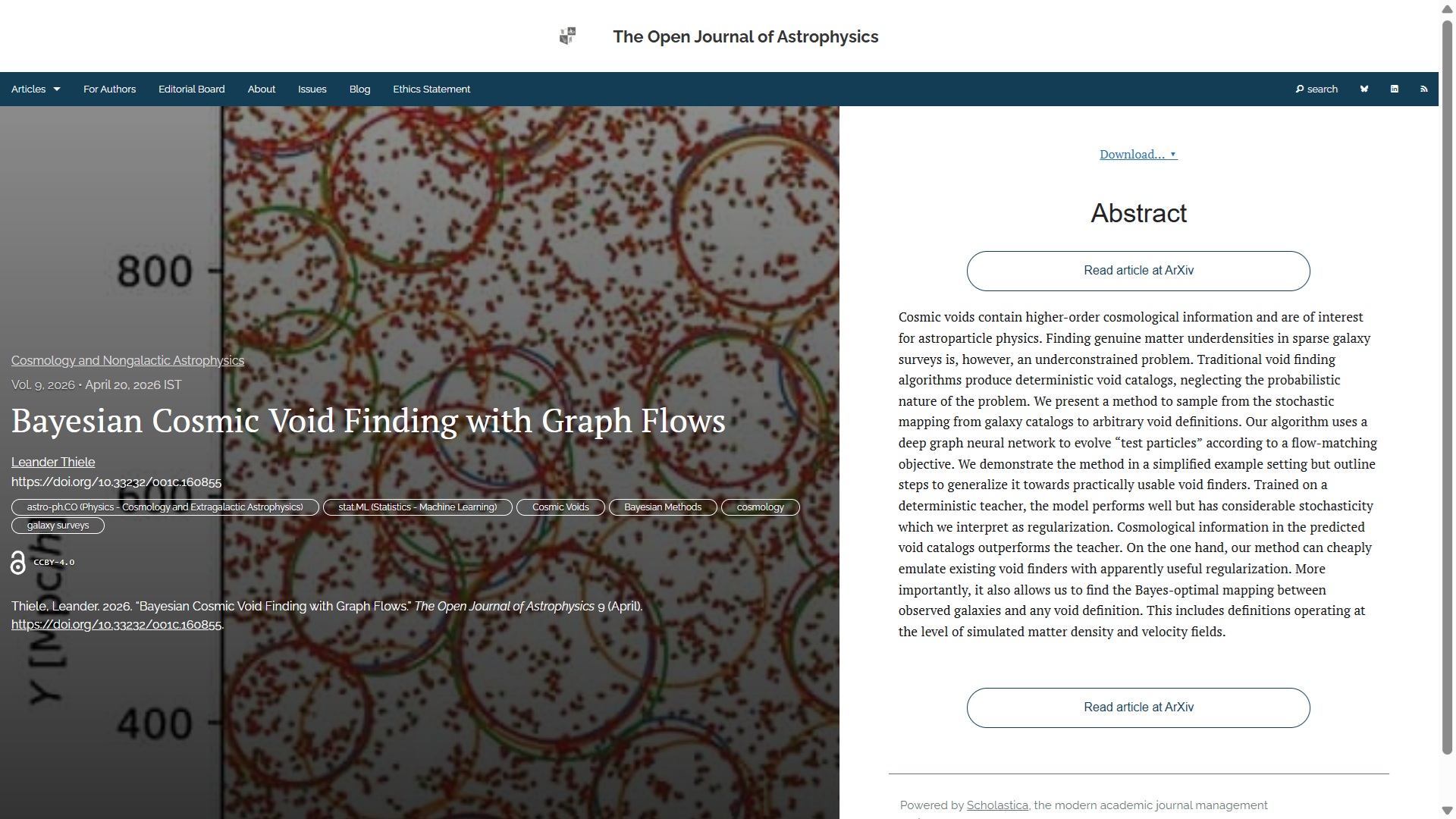
The first paper to report this week is “Bayesian Cosmic Void Finding with Graph Flows” by Leander Thiele (U. Tokyo, Japan). This was published on Monday 20th April in the folder Cosmology and Nongalactic Astrophysics. The paper presents a method using a deep graph neural network to identify cosmic voids in sparse galaxy surveys, improving upon traditional deterministic algorithms by considering the problem’s probabilistic nature. The overlay is here:

You can find the officially accepted version on arXiv here and the announcement on Fediverse here:

Open Journal of Astrophysics

New Publication at the Open Journal of Astrophysics: "Bayesian Cosmic Void Finding with Graph Flows" by Leander Thiele (U. Tokyo, Japan)

doi.org/10.33232/001c.160855

April 20, 2026, 7:31 am 1 boosts 2 favorites

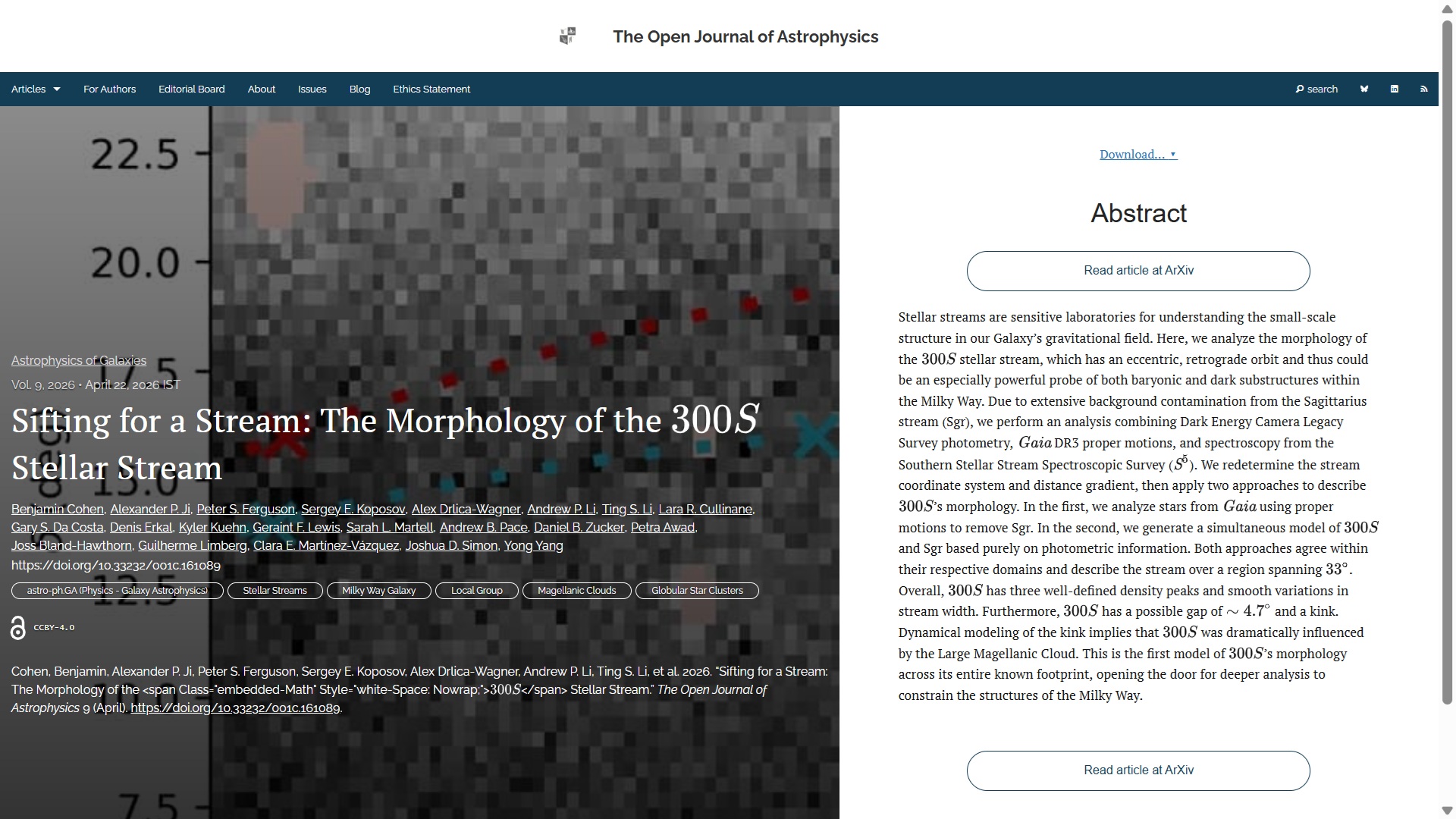
The second paper for this week, published on Wednesday 22nd April in the folder Astrophysics of Galaxies, is “Sifting for a Stream: The Morphology of the 300S Stellar Stream” by Benjamin Cohen (U. Chicago, USA) and 20 others distributed around the world. This study analyzes the morphology of the $300S$ stellar stream, revealing three density peaks, a possible gap, and a kink, suggesting significant influence from the Large Magellanic Cloud on its structure.

The overlay for this one is here:

The official version of the paper can be found on arXiv here and the Fediverse announcement here:

Open Journal of Astrophysics

New Publication at the Open Journal of Astrophysics: "Sifting for a Stream: The Morphology of the 300S Stellar Stream" by Benjamin Cohen (U. Chicago, USA) and 20 others distributed around the world.

doi.org/10.33232/001c.161089

April 22, 2026, 6:44 am 1 boosts 1 favorites

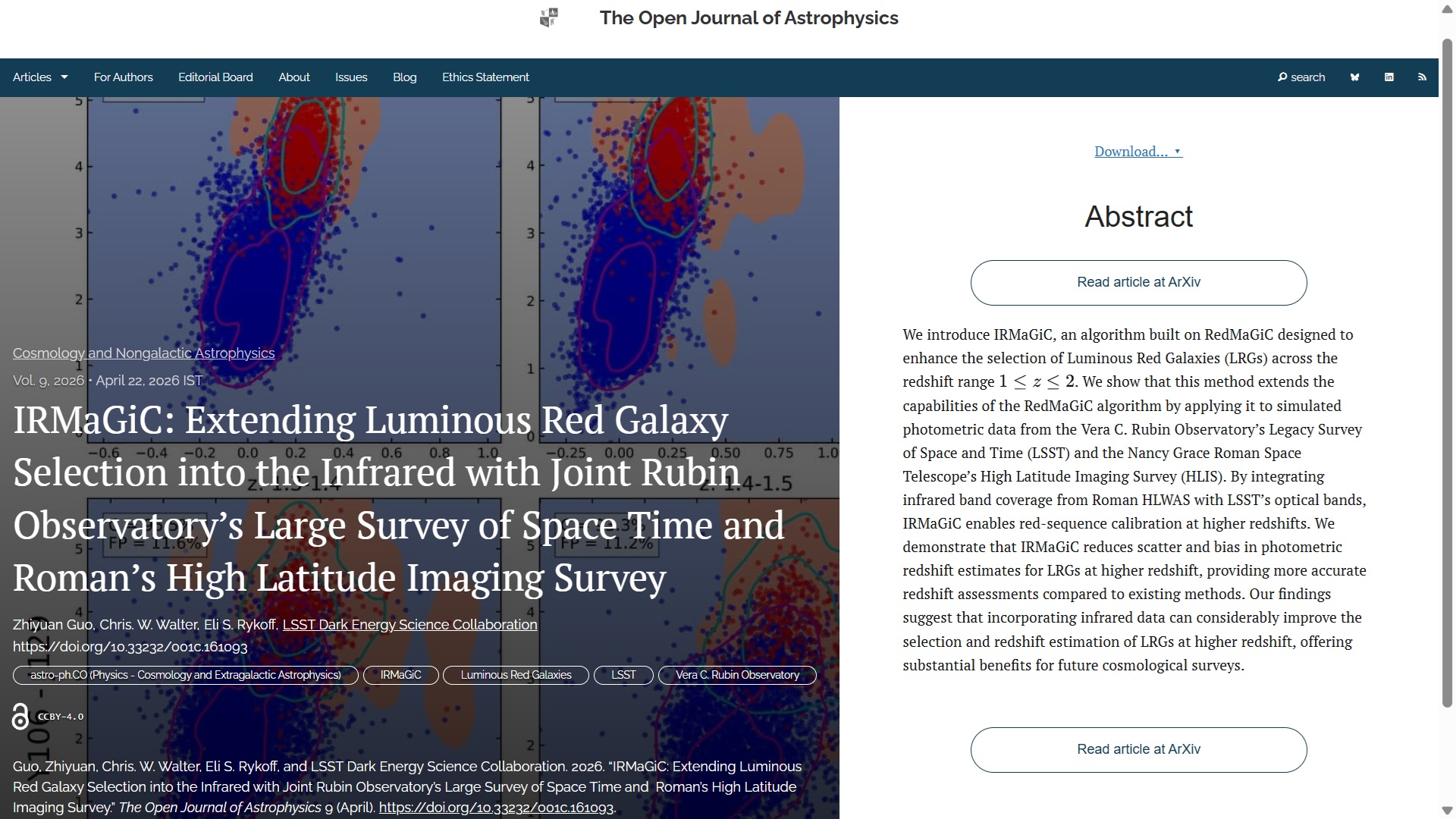
Next one up, the third paper of the week, is “IRMaGiC: Extending Luminous Red Galaxy Selection into the Infrared with Joint Rubin Observatory’s Large Survey of Space Time and Roman’s High Latitude Imaging Survey” by Zhiyuan Guo & Chris. W. Walter (Duke U., USA) and Eli S. Rykoff (Stanford U., USA) on behalf of the LSST Dark Energy Science Collaboration. This was published on Wednesday April 22nd in the folder Cosmology and Nongalactic Astrophysics. The paper introduces IRMaGiC, an algorithm that improves the selection and redshift estimation of Luminous Red Galaxies (LRGs) by incorporating infrared data, enhancing future cosmological surveys.

The overlay for this one is here:

The final, accepted version can be found on arXiv here and the Mastodon announcement is here:

Open Journal of Astrophysics

New Publication at the Open Journal of Astrophysics: "IRMaGiC: Extending Luminous Red Galaxy Selection into the Infrared with Joint Rubin Observatory’s Large Survey of Space Time and Roman’s High Latitude Imaging Survey" by Zhiyuan Guo & Chris. W. Walter (Duke U., USA) and Eli S. Rykoff (Stanford U., USA) on behalf of the LSST Dark Energy Science Collaboration

doi.org/10.33232/001c.161093

April 22, 2026, 7:00 am 2 boosts 2 favorites

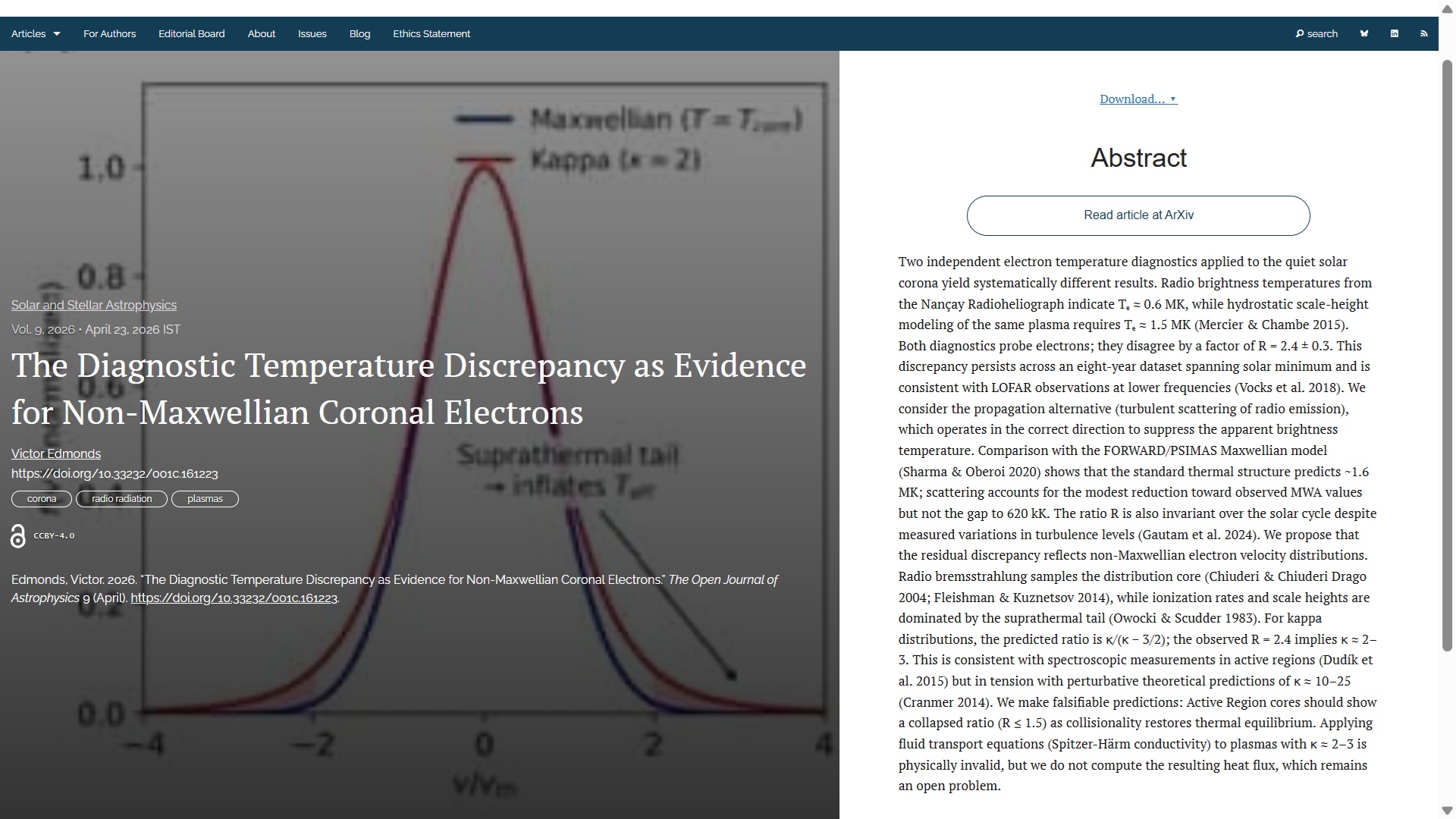
The fourth paper this week, published on Thursday April 23rd, is “The Diagnostic Temperature Discrepancy as Evidence for Non-Maxwellian Coronal Electrons” by Victor Edmonds (Final Stop Consulting, USA). This paper, in the folder Solar and Stellar Astrophysics, presents two methods of measuring electron temperature in the quiet solar corona yielding different results, suggesting non-Maxwellian electron velocity distributions may be responsible for the discrepancy.

The overlay is here:

The finally accepted version of this paper can be found here and the Mastodon announcement follows:

Open Journal of Astrophysics

New Publication at the Open Journal of Astrophysics: "The Diagnostic Temperature Discrepancy as Evidence for Non-Maxwellian Coronal Electrons" by Victor Edmonds (Final Stop Consulting, USA)

doi.org/10.33232/001c.161223

April 23, 2026, 7:12 am 1 boosts 1 favorites

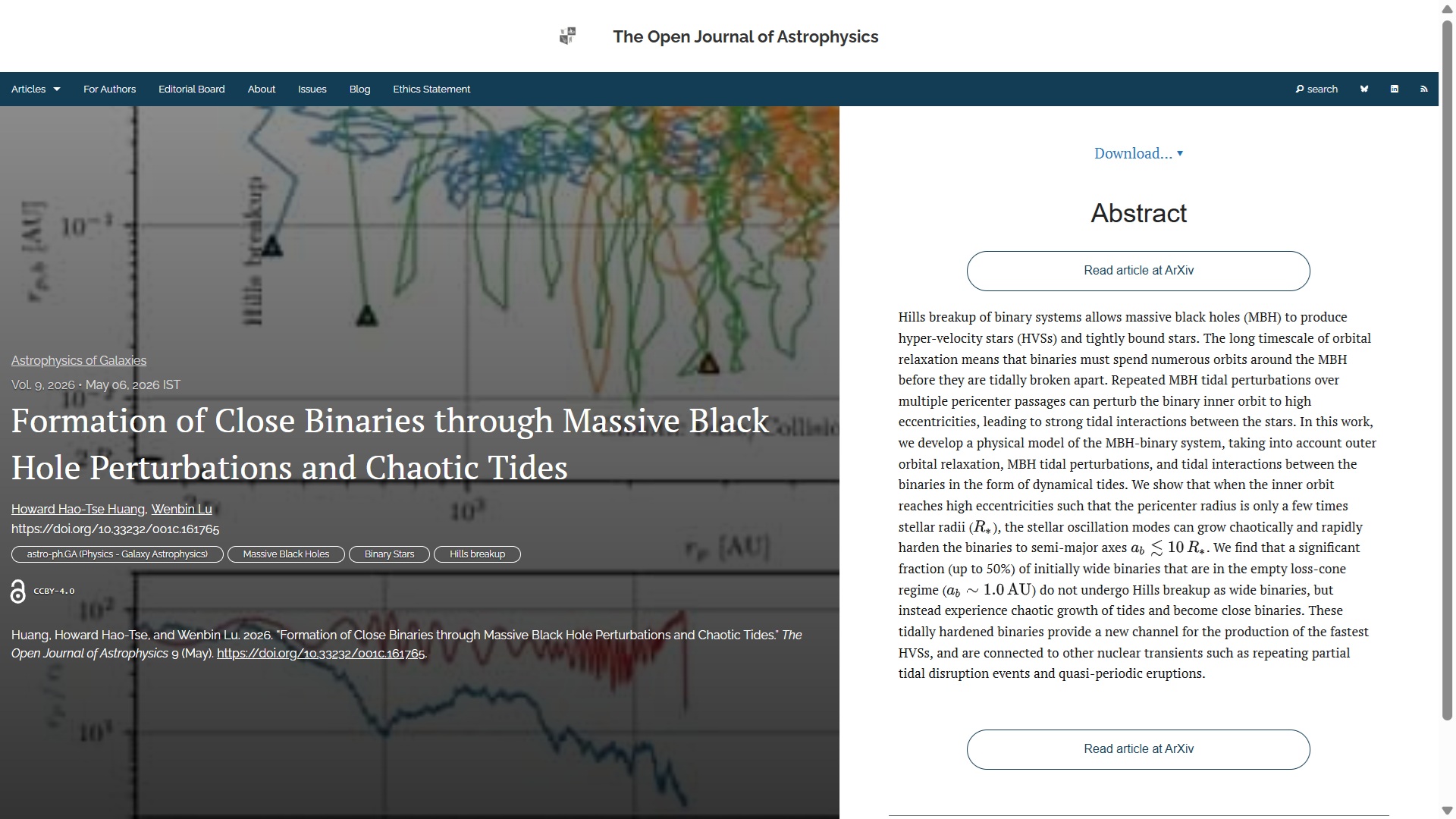
The fifth and final paper for this week was published on Friday 24th April in the folder Astrophysics of Galaxies. The title is “Galaxy evolution in the post-merger regime. IV – The long-term effect of mergers on galactic stellar mass growth and distribution” by Sara L. Ellison (U. Victoria, Canada) and Leonardo Ferreira (Universidade Federal do Rio Grande, Brazil). This study uses a large sample of post-merger galaxies to demonstrate that galaxy mergers trigger significant and extended stellar mass growth in their central regions, independent of stellar population modelling.

The overlay is here:

You can find the authorized version of this paper on arXiv here and the Fediverse announcement is here:

Open Journal of Astrophysics

New Publication at the Open Journal of Astrophysics: "Galaxy evolution in the post-merger regime. IV – The long-term effect of mergers on galactic stellar mass growth and distribution" by Sara L. Ellison (U. Victoria, Canada) and Leonardo Ferreira (Universidade Federal do Rio Grande, Brazil)

doi.org/10.33232/001c.161257

April 24, 2026, 6:41 am 3 boosts 4 favorites

The overlay for this one is here:

You can find the officially-accepted version on arXiv here and the Mastodon announcement here:

Open Journal of Astrophysics

New Publication at the Open Journal of Astrophysics: "Galaxy evolution in the post-merger regime. IV – The long-term effect of mergers on galactic stellar mass growth and distribution" by Sara L. Ellison (U. Victoria, Canada) and Leonardo Ferreira (Universidade Federal do Rio Grande, Brazil)

doi.org/10.33232/001c.161257

April 24, 2026, 6:41 am 3 boosts 4 favorites

And that concludes this week’s update. I’ll do another one at the end of next week.

P.S. Thanks to the efforts of a member of our Editorial Board, the Open Journal of Astrophysics now has a Wikipedia page.

HFLS3: the earliest Starburst yet!

Posted in The Universe and Stuff with tags , , , , on April 24, 2013 by telescoper

Once again I’ve spent all day engaged in the enjoyable but exhausting task of interview for new faculty positions, which means that I haven’t really got time for a proper blog today. What I can do, however, is shamelessly rip off a nice press release produced by the good folks here at the University of Sussex about a discovery that has been attracting a lot of press coverage since it was published last week in Nature; the paper is also available on the arXiv. If you’ve followed this blog for a while you will know than when I was at Cardiff I got interested in a large project called the Herschel Atlas survey, which is a large area galaxy survey carried out using the Herschel Space Observatory. This result is not from Herschel ATLAS but from a complementary deeper survey called Hermes, also performed using the Herschel Space Observatory and it is of a very distant and very bright starburst galaxy (a type of galaxy which, as its name suggests, in which stars are forming at a much higher rate than a “normal” galaxy).

Incidentally, although Herschel is now extremely short of the Helium it needs to keep itself cool, it is still making observations running on empty, as it were.

Anyway, that’s all I’ve got time to write. The rest is just copied from the press release I mentioned…

–o–

University of Sussex astronomers using the Herschel Space Observatory are part of an international team that has discovered a distant star-forming galaxy that challenges the current theories of galaxy evolution.

Seen when the Universe was less than a billion years old (880 million years) the galaxy, known only as “HFLS3”, is forming stars at a much faster rate than should be possible according to existing predictions. In the infant Universe, galaxies should have been forming stars at a much slower rate than is observed in HFLS3.

HFLS3 is so distant that the light we see from it has taken 13 billion years to get to Earth.

The Herschel observatory1 has been surveying the distant cosmos and finding hundreds of thousands of distant galaxies. Images produced by Herschel show how fast these distant galaxies are forming stars.

By determining the ages of the galaxies, astronomers have been building up a cosmic timeline of star formation, searching for when the first massive galaxies started churning out stars.

University of Sussex PhD student Peter Hurley, Dr Isaac Roseboom, Dr Anthony Smith, Dr Lingyu Wang and Professor Seb Oliver, who leads the HerMES2 survey that found the galaxy, analysed data from Herschel and built the HFLS3 galaxy as a computer model to discover what conditions are like in the galaxy.

Peter says: “The stars being born in HFLS3 heat up the surrounding material within the galaxy. This material contains gas molecules such as carbon monoxide and water, which emit their own unique signatures when heated. By comparing the telescope observations with models, we can gain a better understanding of the conditions within this extreme galaxy.”

The galaxy “HFLS3” was first seen as a small red dot in the Herschel images, and its colour is what first intrigued the team because red galaxies might be very distant.

2499.item

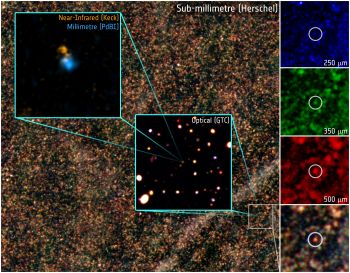
The galaxy HFLS3 as revealed by Herschel and further ground-based telescope observations. Images: ESA/Herschel/HerMES/IRAM/GTC/W.M. Keck Observatory

Further investigations using optical and near-infrared telescopes the Gran Telescopio Canarias in the Canary Islands and the Keck Telescope in Hawaii helped to rule out any other effects that might cause the HFLS3 galaxy to look so bright.

It was observations with radio and millimetre-wave telescopes, such as the Plateau de Bure Interferometer in the French Alps, which determined that this tiny galaxy, only around one twentieth the size of our Milky Way, is seen at such an immense distance. These additional observations also showed that HFLS3 is incredibly rich in carbon, nitrogen and oxygen, forming compounds such as carbon monoxide, water and ammonia. These compounds reveal the physical processes at work in this distant galaxy.

Combined with the Herschel observations, these measurements allow the astronomers to deduce that this tiny star factory is producing stars around two thousand times faster than our own Milky Way, making it a type of galaxy known as a “starburst”. Environments like this do not exist on galaxy-wide scales in the Universe today.

Professor Oliver says: “We’ve shown that Herschel data can find these extreme examples. “The next step is to sift through the Herschel data more carefully, and try to deduce just how common such galaxies were in the early Universe. I am also very pleased that a Sussex PhD student has been able to make an important contribution to this work.”

Jamie Bock (Caltech, USA), who co-leads the HerMES survey with Professor Oliver, says: “This galaxy is just one spectacular example, but it’s telling us that early star formation like this is possible,” explains Jamie Bock, Caltech, and one of the leaders.

Dominik Riechers (Cornell University, USA), who led the HFLS3 study, says: “Looking for the first examples of these massive star factories is like searching for a needle in a haystack. We were hoping to find a galaxy at such vast distances, but we could not expect that they even existed that early on in the Universe.”