It’s Saturday once again, so time for another update of activity at the Open Journal of Astrophysics. Since the last update we have published a further five papers, bringing the number in Volume 9 (2026) to 99 and the total so far published by OJAp up to 547. We didn’t quite make it to a hundred for the year last week, but will do so with the next paper.
I will continue to include the posts made on our Mastodon account (on Fediscience) to encourage you to visit it. Mastodon is a really excellent service, and a more than adequate replacement for X/Twitter (which nobody should be using); these announcements also show the DOI for each paper.
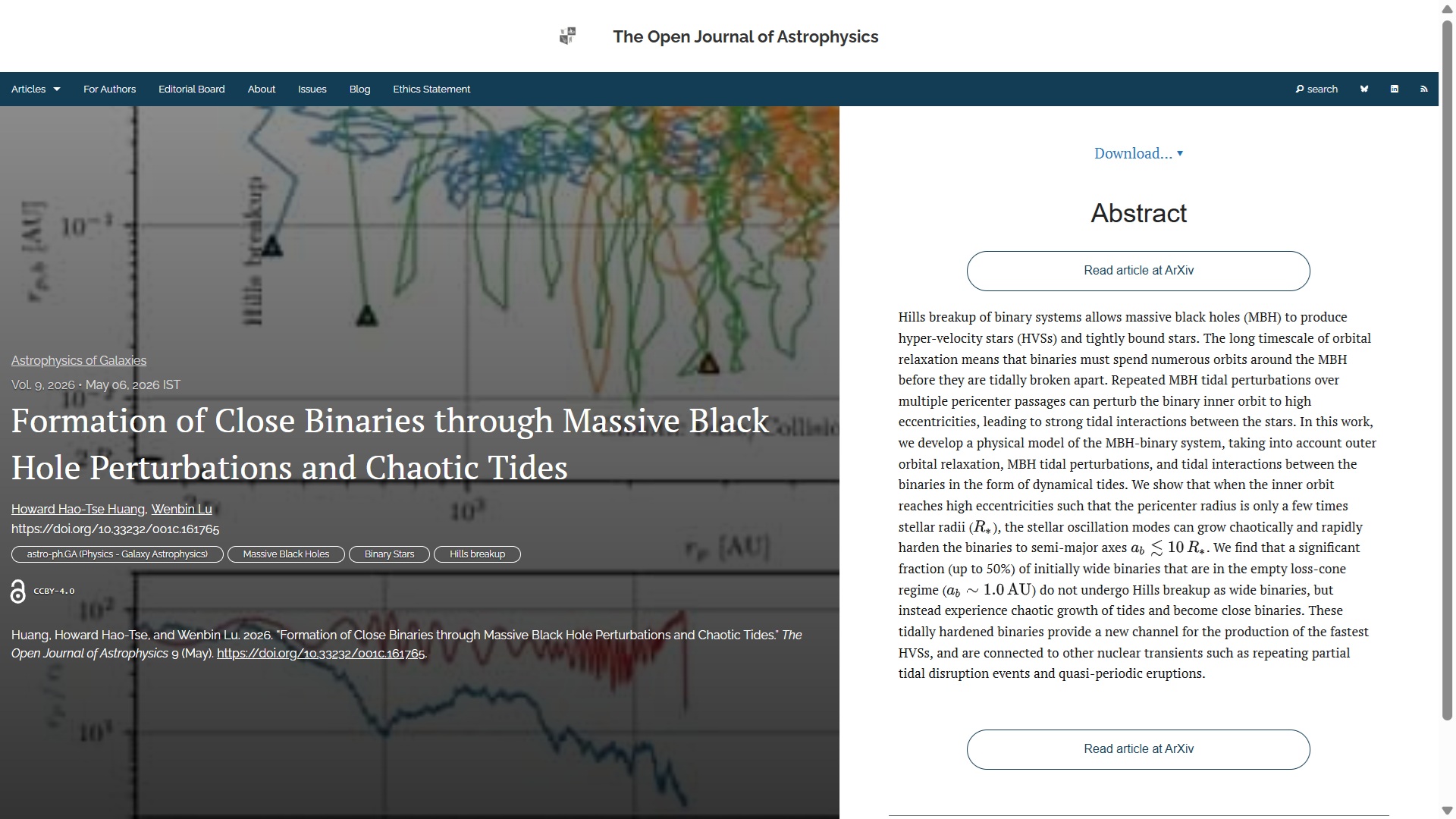
The first paper to report this week is “Formation of Close Binaries through Massive Black Hole Perturbations and Chaotic Tides” by Howard Hao-Tse Huang and Wenbin Lu (University of California at Berkeley, USA). This one was published on Wednesday 6th May 2026 in the folder Astrophysics of Galaxies. The paper presents a model of massive black hole-binary systems, showing that repeated tidal interactions can lead to the creation of hyper-velocity stars and other nuclear transients.
The overlay for this paper is here
You can find the officially accepted version on arXiv here and the announcement on Fediverse here:
New Publication at the Open Journal of Astrophysics: "Formation of Close Binaries through Massive Black Hole Perturbations and Chaotic Tides" by Howard Hao-Tse Huang & Wenbin Lu (U. California Berkeley, USA)
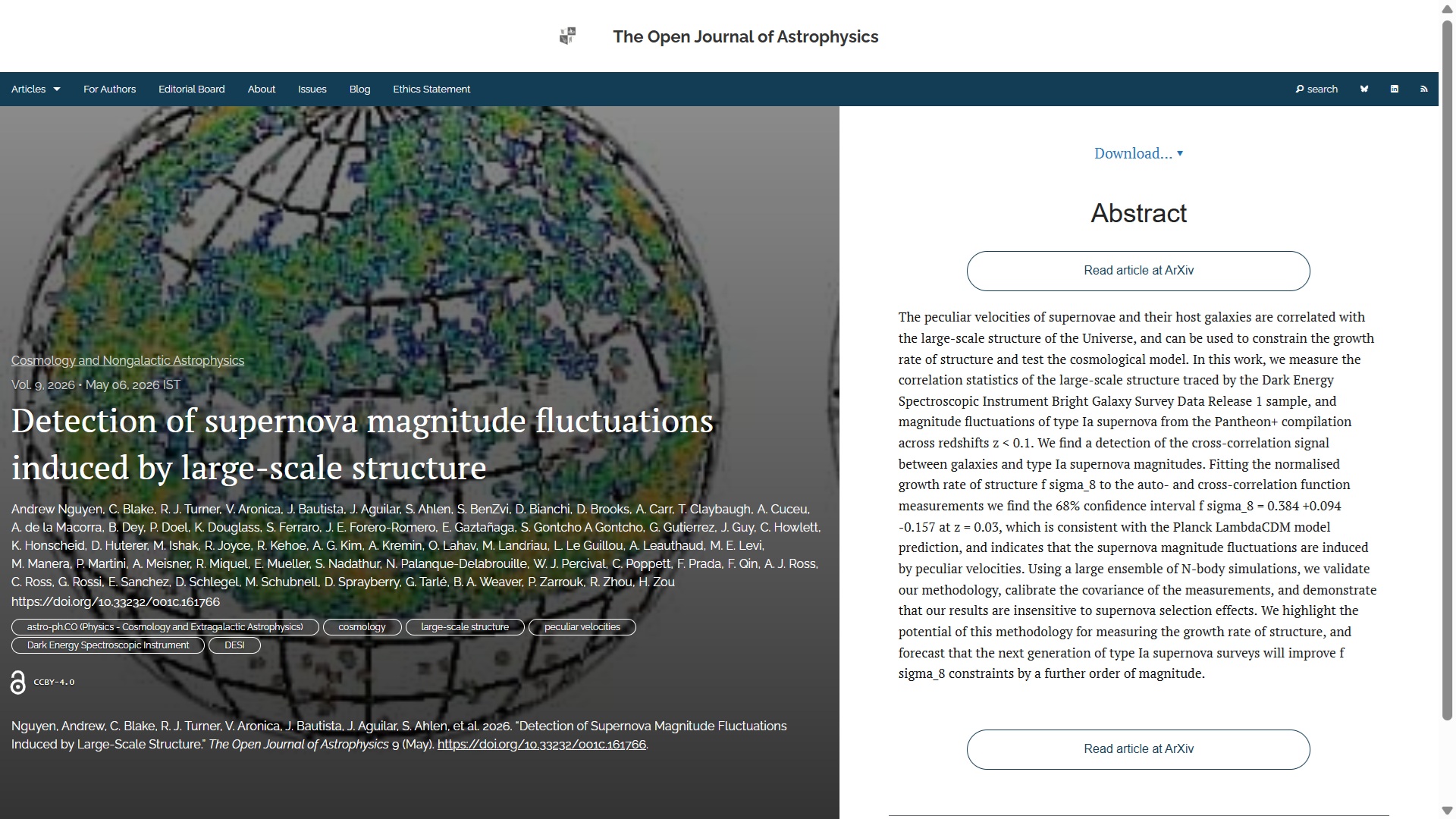
The second paper for this week, also Wednesday 6th May, but in the folder Cosmology and Nongalactic Astrophysics is “Detection of supernova magnitude fluctuations induced by large-scale structure” by Andrew Nguyen (Swinburne Institute of Technology, Australia) and 58 others based all around the world. This study uses supernovae and galaxy velocities to measure the universe’s structure growth rate, confirming the Planck LambdaCDM model prediction. The methodology is validated and shows potential for future research.
The overlay for this one is here:
The official version of the paper can be found on arXiv here and the Fediverse announcement here:
New Publication at the Open Journal of Astrophysics: "Detection of supernova magnitude fluctuations induced by large-scale structure" by Andrew Nguyen (Swinburne Institute of Technology, Australia) and 58 others based all around the world.
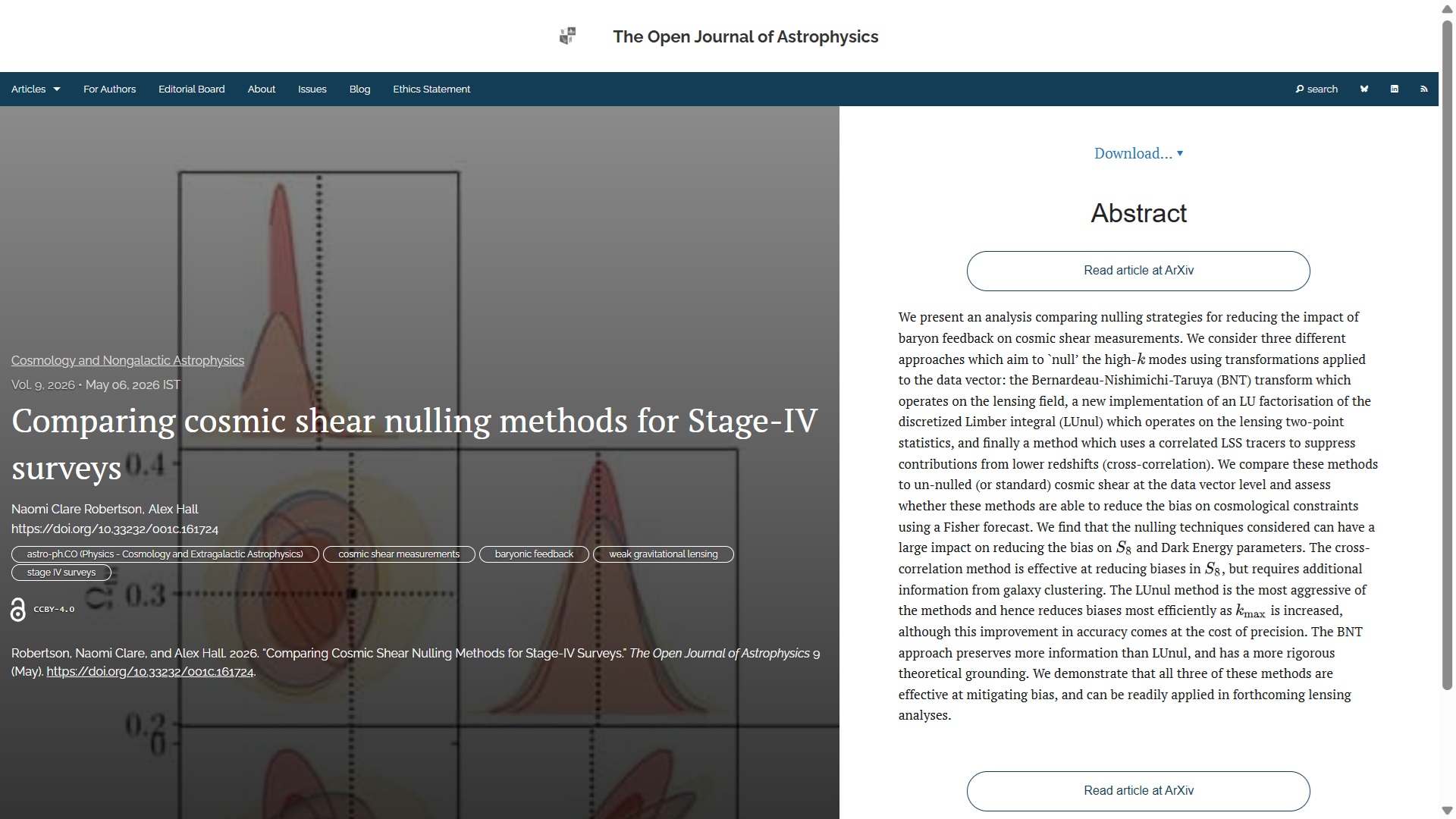
Next one up, the third paper of the week, also published on Wednesday 6th May in the folder Cosmology and Nongalactic Astrophysics is “Comparing cosmic shear nulling methods for Stage-IV surveys” by Naomi Clare Robertson and Alex Hall (University of Edinburgh, UK). This study compares three strategies for reducing baryon feedback impact on cosmic shear measurements. All methods effectively mitigate bias, with varying degrees of efficiency and information preservation.
The overlay for this one is here:
The final, accepted version can be found on arXiv here and the Mastodon announcement is here:
New Publication at the Open Journal of Astrophysics: "Comparing cosmic shear nulling methods for Stage-IV surveys" by Naomi Clare Robertson & Alex Hall (U. Edinburgh, UK)
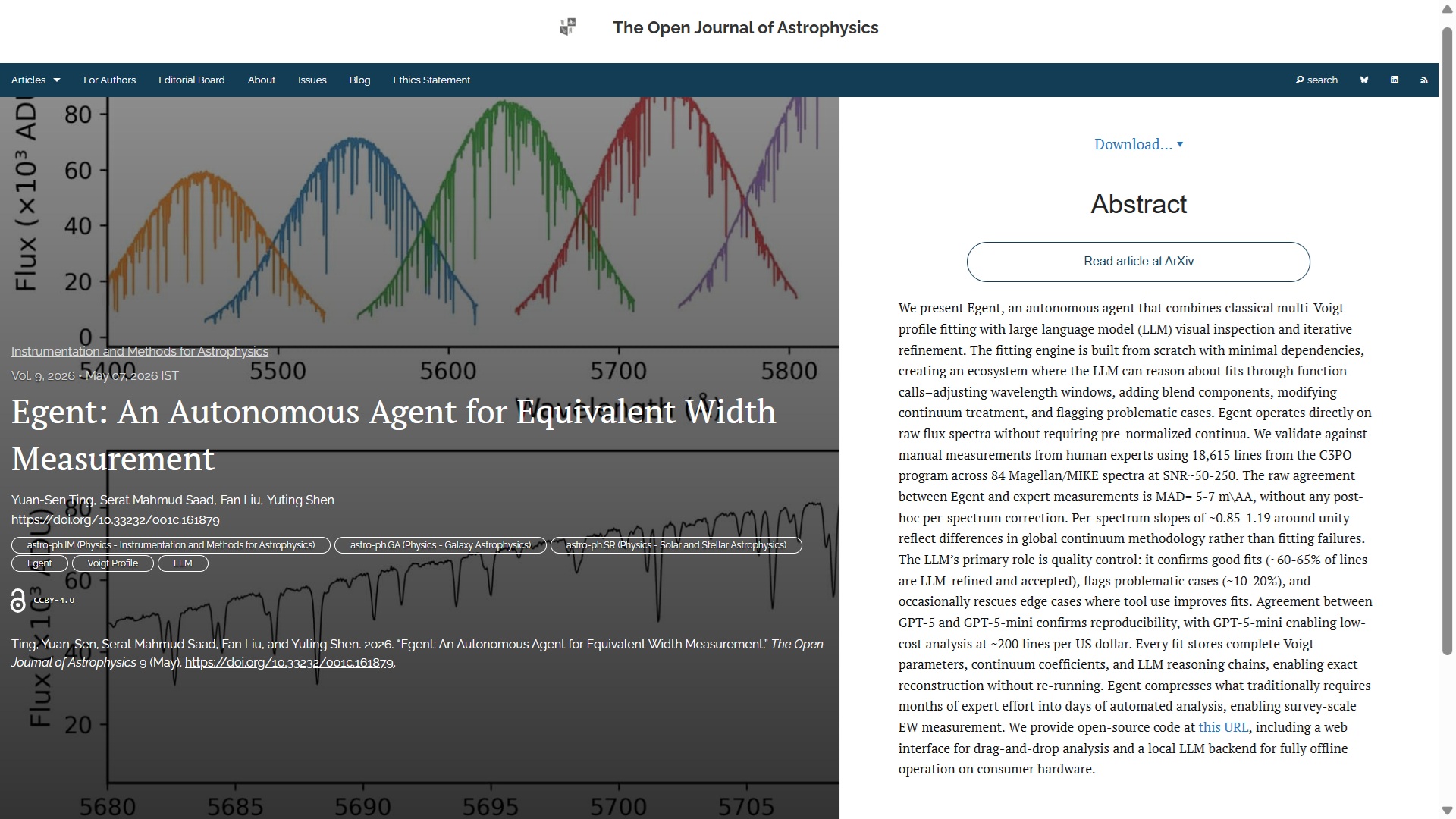
The fourth paper this week, published on Thursday May 7th, is “Egent: An Autonomous Agent for Equivalent Width Measurement” by Yuan-Sen Ting & Serat Mahmud Saad (Ohio State University, USA), Fan Liu (National Astronomical Observatories, Beijing, China), and Yuting Shen (Georgia Institute of Technology, USA). Egent is an autonomous agent that combines multi-Voigt profile fitting with large language model visual inspection for efficient, automated analysis of raw flux spectra, validated against expert measurements. This one is in the folder Instrumentation and Methods for Astrophysics. The associated software can be found here.
The overlay is here:
The officially accepted version can be found on arXiv here and here is the Mastodon announcement:
New Publication at the Open Journal of Astrophysics: "Egent: An Autonomous Agent for Equivalent Width Measurement" by Yuan-Sen Ting & Serat Mahmud Saad (Ohio State U., USA), Fan Liu (National Astronomical Observatories, China) and Yuting Shen (Georgia Institute of Technology, USA)
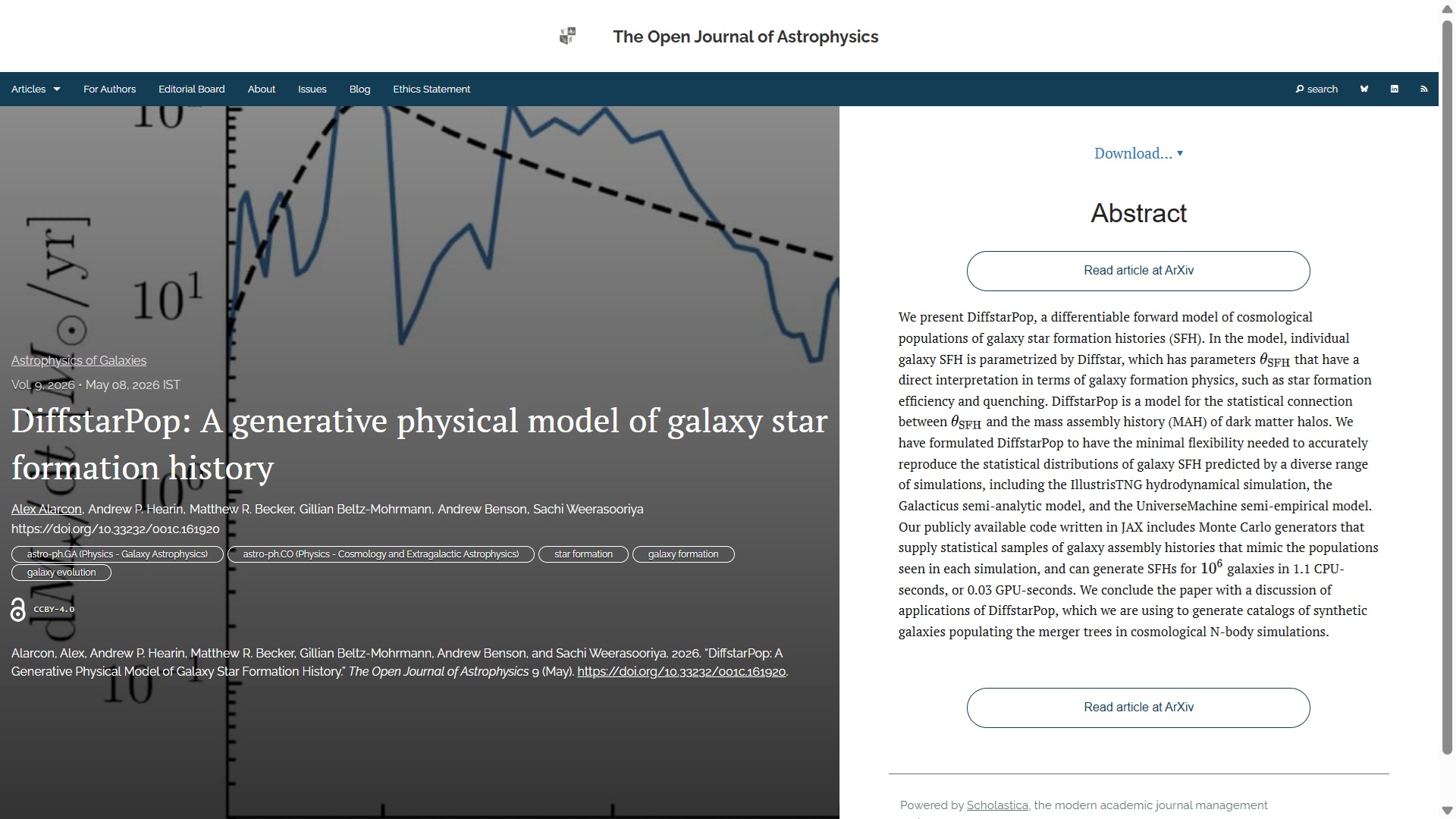
The fifth and final article of this week was published on Friday 8th May in the folder Astrophysics of Galaxies. The title is “DiffstarPop: A generative physical model of galaxy star formation history” and it is by Alex Alarcon (Institute of Space Sciences, Barcelona, Spain), Andrew P. Hearin , Matthew R. Becker & Gillian Beltz-Mohrmann (Argonne National Laborarory, USA), and Andrew Benson & Sachi Weerasooriya (Carnegie Observatories, USA). DiffstarPop is a model that accurately and rapidly reproduces statistical distributions of galaxy star formation histories (SFH), using parameters related to galaxy formation physics.
The overlay is here:
You can find the authorized version of this paper on arXiv here and the Fediverse announcement is here:
New Publication at the Open Journal of Astrophysics: "DiffstarPop: A generative physical model of galaxy star formation history" by Alex Alarcon (Institute of Space Sciences, Barcelona, Spain), Andrew P. Hearin , Matthew R. Becker & Gillian Beltz-Mohrmann (Argonne National Laborarory, USA), and Andrew Benson & Sachi Weerasooriya (Carnegie Observatories, USA)
It’s Saturday once more, so it’s time for another update of activity at the Open Journal of Astrophysics. Since the last update we have published a further eight papers, bringing the number in Volume 9 (2026) to 59 and the total so far published by OJAp up to 507. We passed the 500 mark on Monday, and the week was also notable because we once again published at least one paper each working day.
I will continue to include the posts made on our Mastodon account (on Fediscience) to encourage you to visit it. Mastodon is a really excellent service, and a more than adequate replacement for X/Twitter (which nobody should be using); these announcements also show the DOI for each paper.
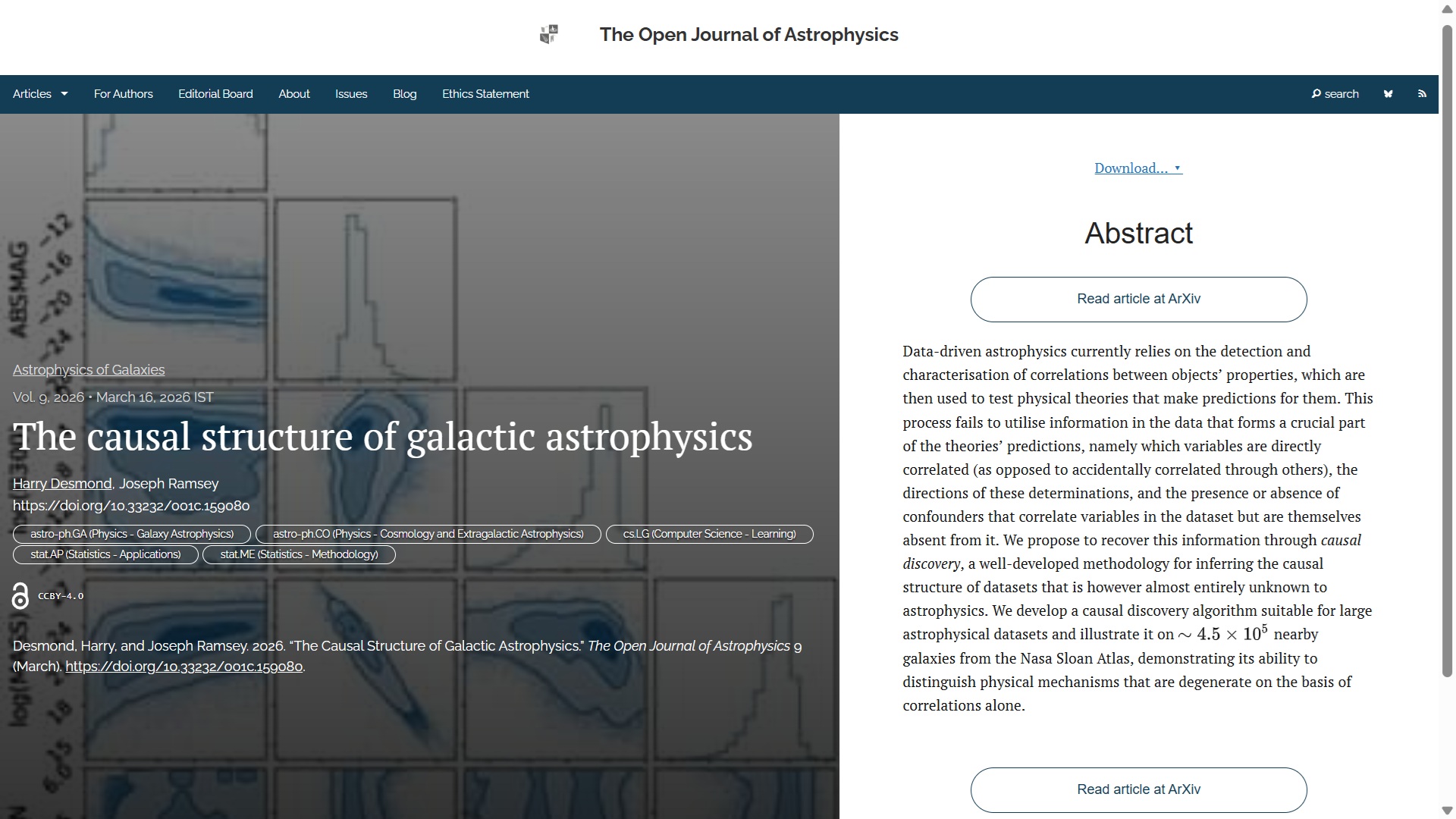
The first paper to report this week is our 500th publication. The title is “The causal structure of galactic astrophysics” and the authors are Harry Desmond (U. Portsmouth, UK) and Joseph Ramsey (Carnegie Mellon U., USA). This paper was published on Monday March 16th 2026 in the folder Astrophysics of Galaxies. It proposes using causal discovery, a method for inferring data structure, to better utilize information in astrophysical data, demonstrated through an algorithm applied to a large galaxy dataset.
The overlay is here:
You can find the officially accepted version on arXiv here and the announcement on Fediverse here:
New Publication at the Open Journal of Astrophysics: "The causal structure of galactic astrophysics" by Harry Desmond (U. Portsmouth, UK) and Joseph Ramsey (Carnegie Mellon U., USA)
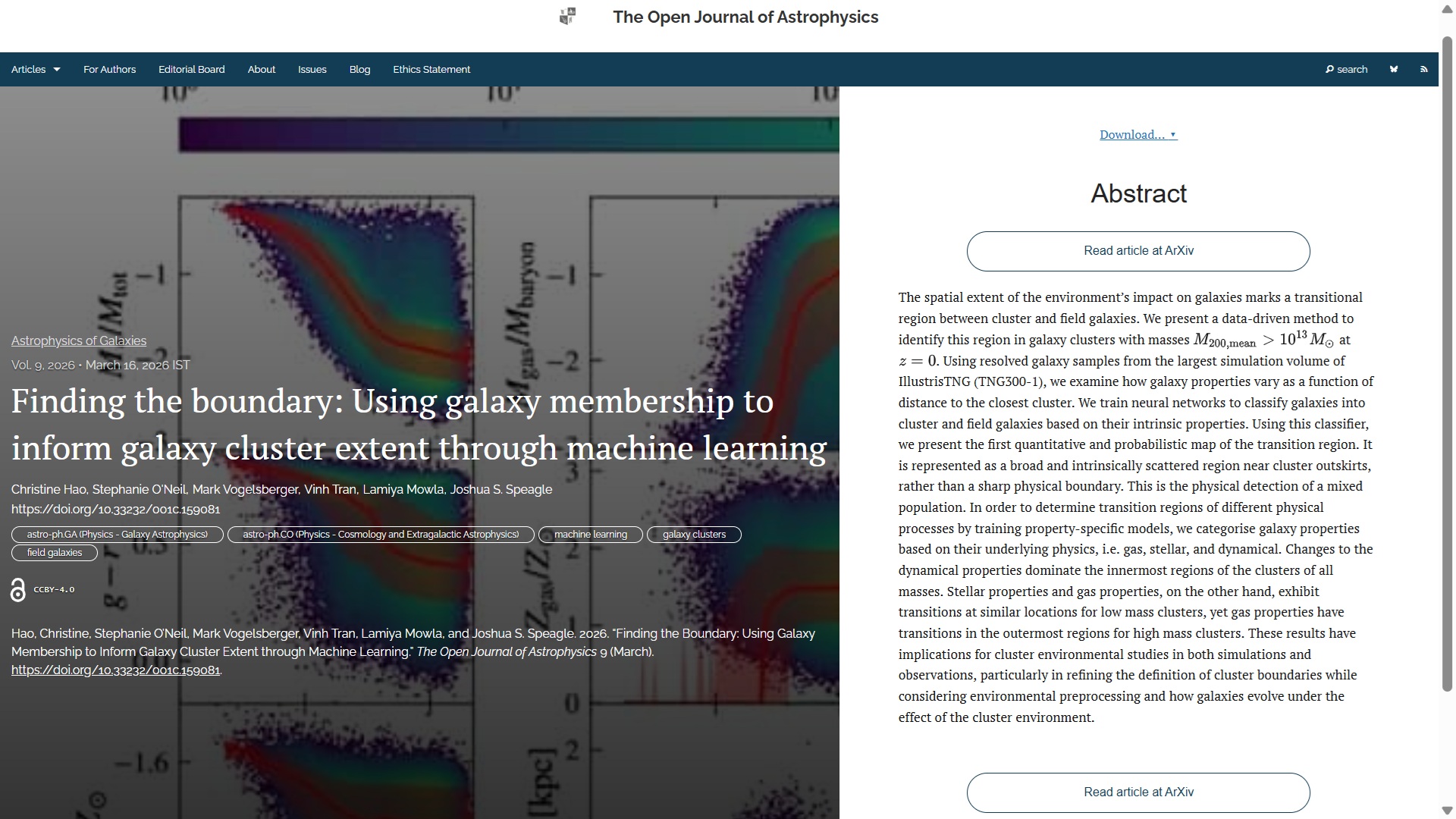
The second paper for this week, also published on March 16th in the folder Astrophysics of Galaxies, is “Finding the boundary: Using galaxy membership to inform galaxy cluster extent through machine learning” by Christine Hao, Stephanie O’Neil, Mark Vogelsberger, & Vinh Tran (MIT, USA), Lamiya Mowla (Wellesley College, USA) and Joshua S. Speagle (U. Toronto, Canada). This study uses neural networks and simulations to identify and map the transitional region between cluster and field galaxies, revealing it as a scattered area rather than a sharp boundary.
The overlay for this one is here:
The official version of the paper can be found on arXiv here and the Fediverse announcement here:
New Publication at the Open Journal of Astrophysics: "Finding the boundary: Using galaxy membership to inform galaxy cluster extent through machine learning" by Christine Hao, Stephanie O'Neil, Mark Vogelsberger, & Vinh Tran (MIT, USA), Lamiya Mowla (Wellesley College, USA) and Joshua S. Speagle (U. Toronto, Canada)
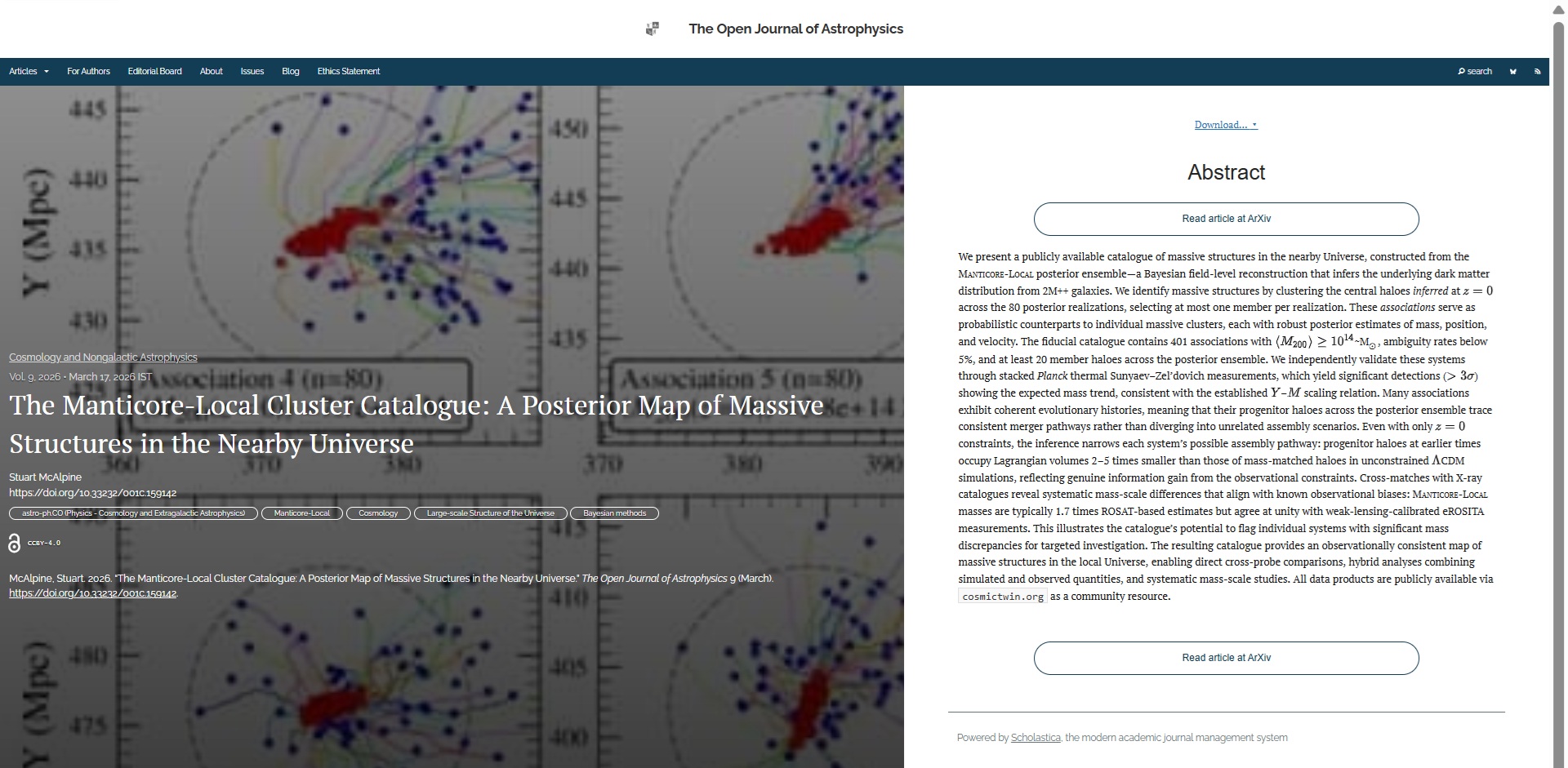
New Publication at the Open Journal of Astrophysics: "The Manticore-Local Cluster Catalogue: A Posterior Map of Massive Structures in the Nearby Universe" by Stuart McAlpine (Oskar Klein Centre, Stockholm U., Sweden)
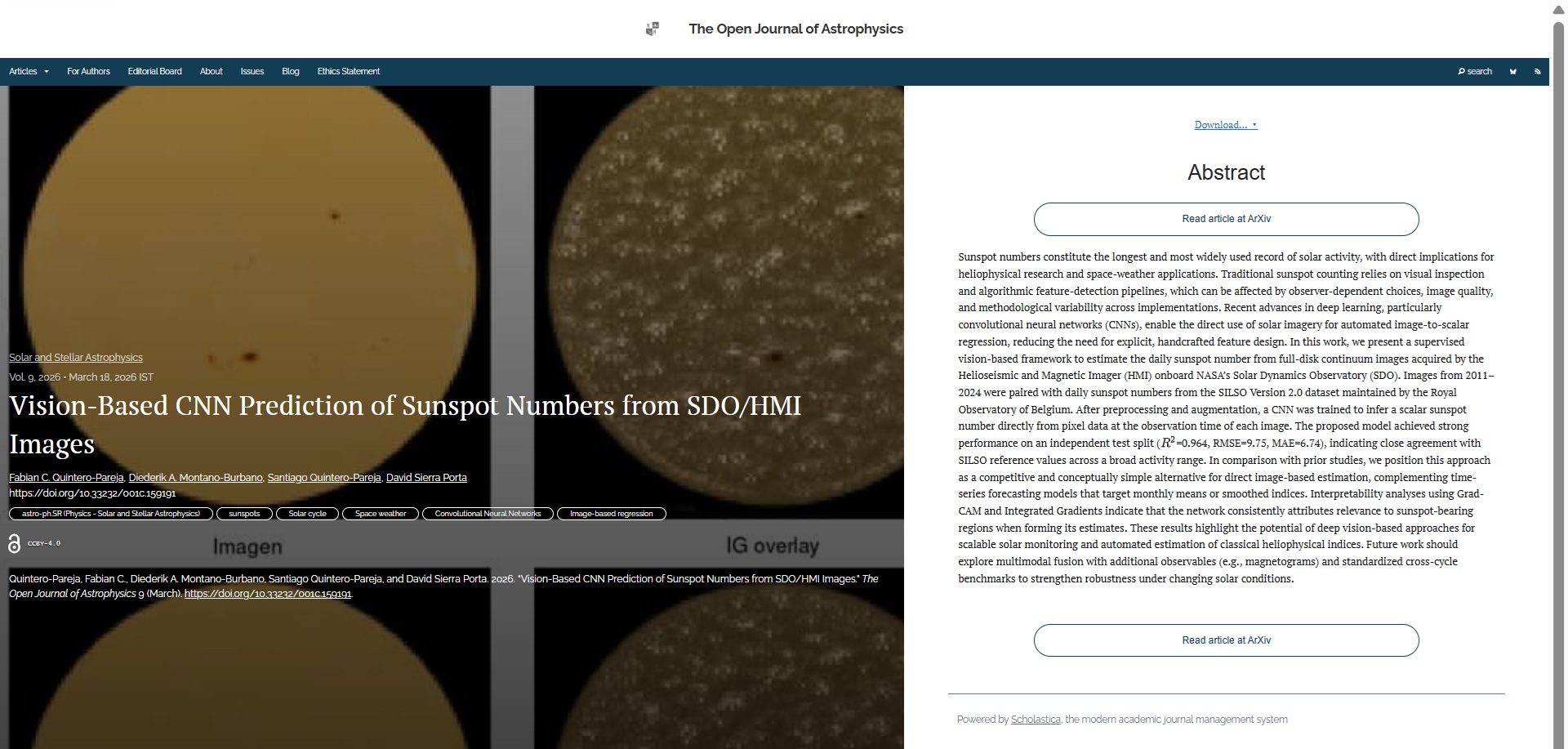
The fourth paper this week, published on 18th March 2026 in the folder Solar and Stellar Astrophysics is “Vision-Based CNN Prediction of Sunspot Numbers from SDO/HMI Images” by Fabian C. Quintero-Pareja, Diederik A. Montano-Burbano, Santiago Quintero-Pareja & David Sierra Porta (Universidad Tecnológica de Bolívar, Colombia). This article describes a deep learning framework that uses convolutional neural networks to estimate daily sunspot numbers from solar images, offering a scalable and accurate method for solar monitoring.
The overlay is here:
The finally accepted version of this paper can be found here and the Mastodon announcement is here:
New Publication at the Open Journal of Astrophysics: "Vision-Based CNN Prediction of Sunspot Numbers from SDO/HMI Images" by Fabian C. Quintero-Pareja, Diederik A. Montano-Burbano, Santiago Quintero-Pareja & David Sierra Porta (Universidad Tecnológica de Bolívar, Colombia)
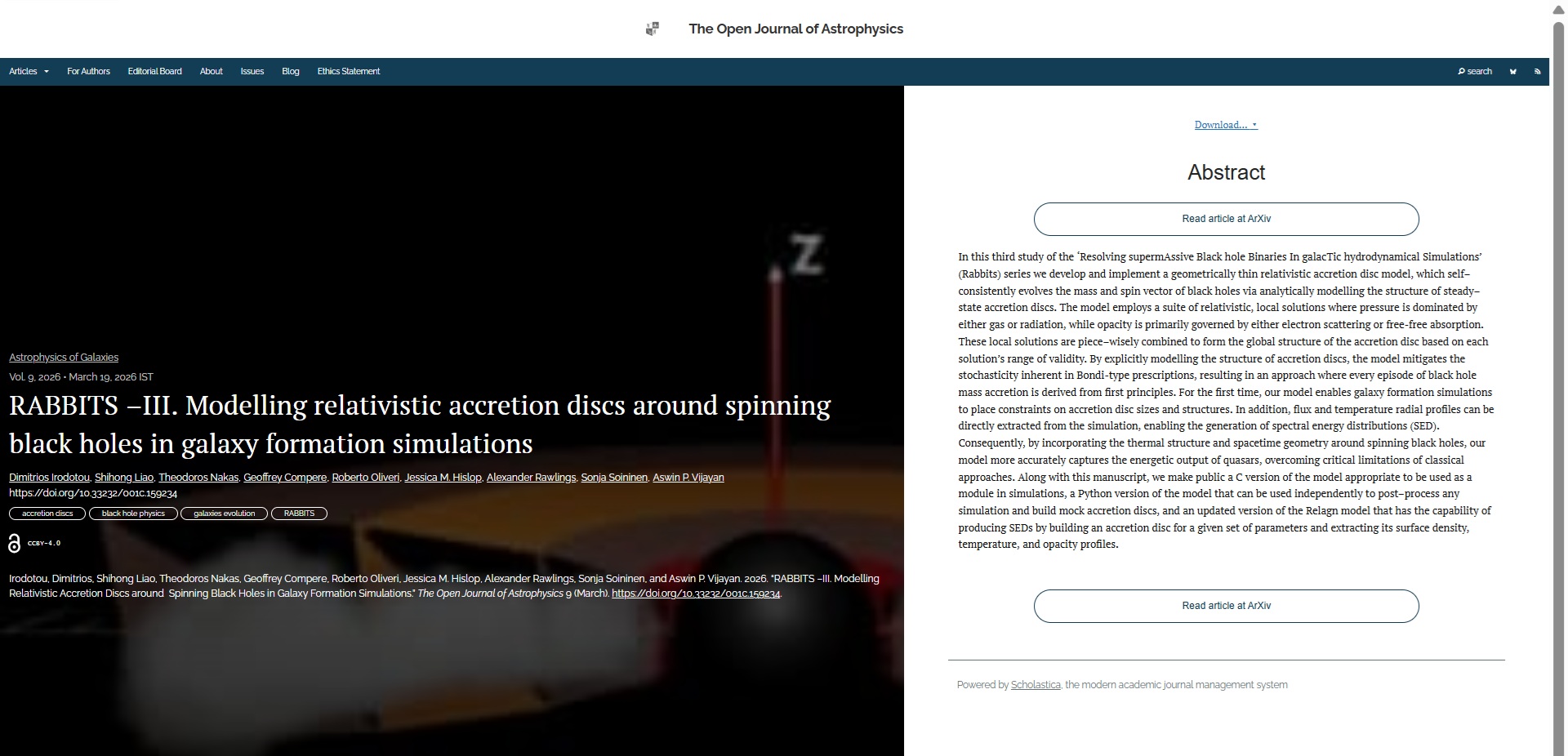
New Publication at the Open Journal of Astrophysics: "RABBITS –III. Modelling relativistic accretion discs around spinning black holes in galaxy formation simulations" by Dimitrios Irodotou (ICR, London) and 8 others based in China, Korea, Belgium, France, Finland and the UK.
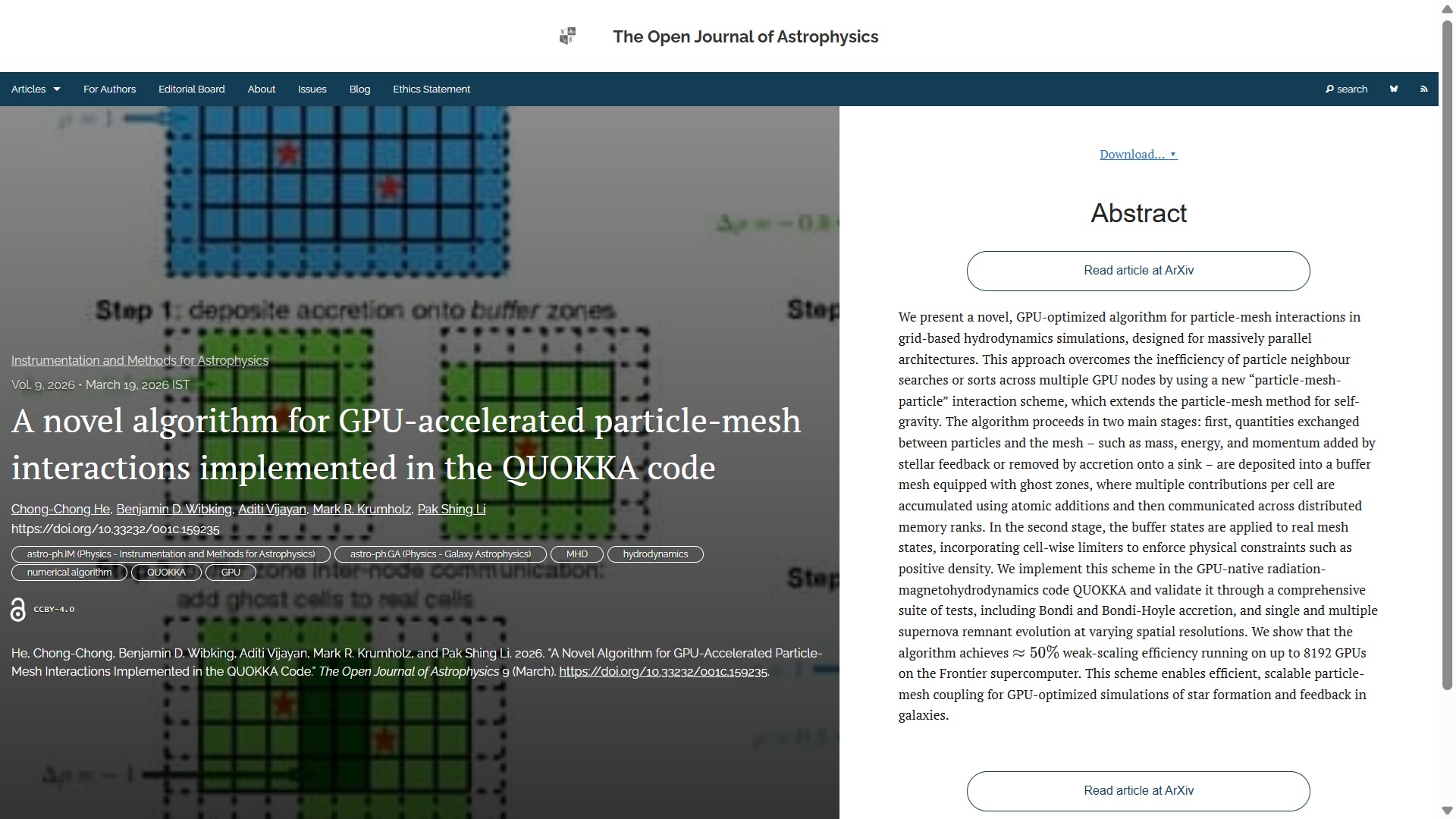
The sixth paper this week is “A novel algorithm for GPU-accelerated particle-mesh interactions implemented in the QUOKKA code” by Chong-Chong He (Australia National University), Benjamin D. Wibking (Michigan State U., USA), Aditi Vijayan (ANU), Mark R. Krumholz (ANU) and Pak Shing Li (Shanghai Astronomical Observatory, China). This was published on Thursday 19th March in the folder Instrumentation and Methods for Astrophysics. The article introduces a GPU-optimized algorithm for particle-mesh interactions in hydrodynamics simulations, improving efficiency and scalability in simulations of star formation and feedback in galaxies.
The overlay is here:
The officially accepted version of this paper can be found on arXiv here, and the Mastodon announcement is here:
New Publication at the Open Journal of Astrophysics: "A novel algorithm for GPU-accelerated particle-mesh interactions implemented in the QUOKKA code" by Chong-Chong He (Australia National University), Benjamin D. Wibking Michigan State U., USA), Aditi Vijayan (ANU), Mark R. Krumholz (ANU) and Pak Shing Li (Shanghai Astronomical Observatory, China)
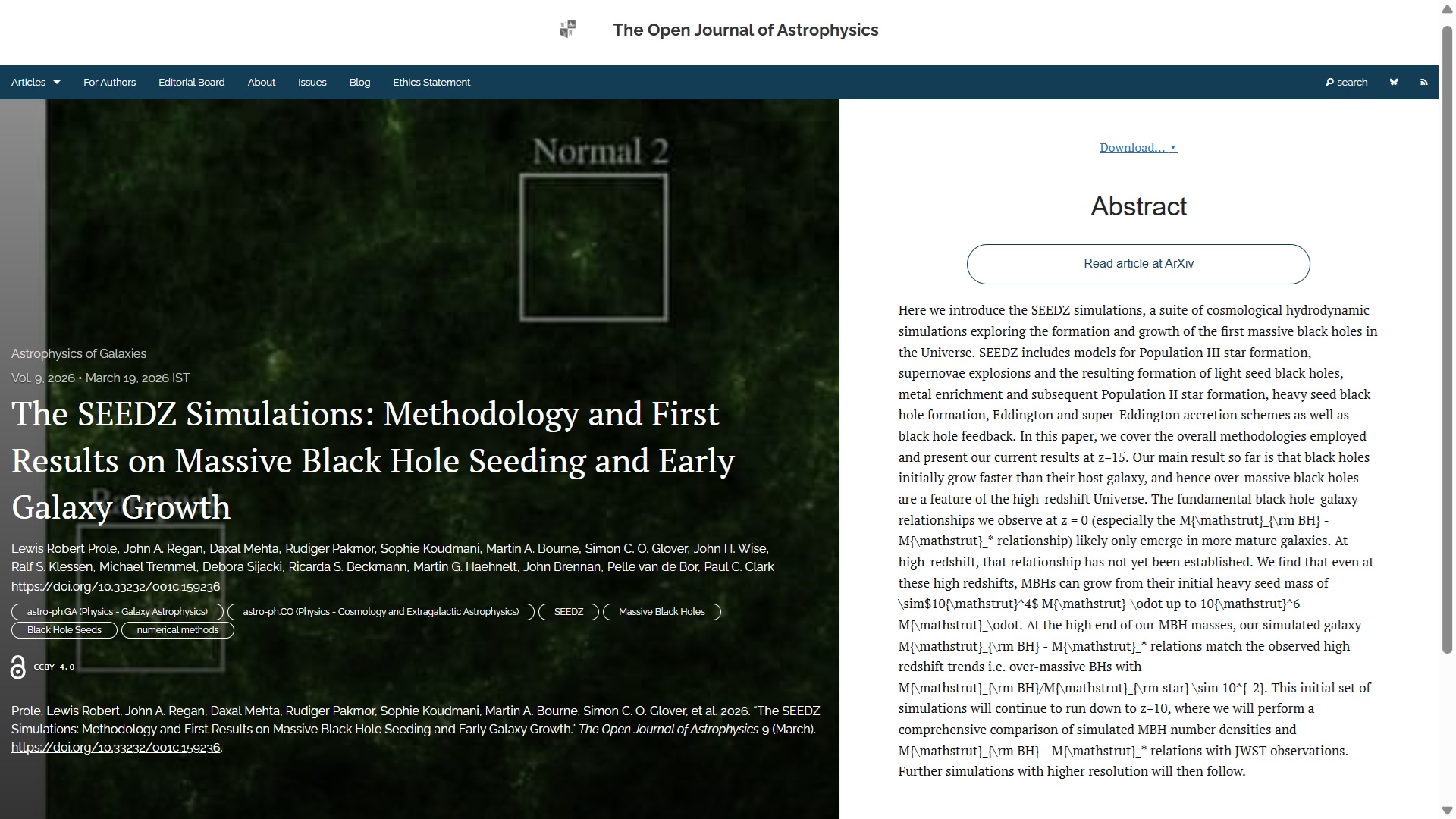
The penultimate, seventh, paper for this week is “The SEEDZ Simulations: Methodology and First Results on Massive Black Hole Seeding and Early Galaxy Growth” by Lewis Prole (NUI Maynooth, Ireland) and 15 others based in Ireland, Germany and the UK. This paper was also published on Thursday March 19th 2026 in the folder Astrophysics of Galaxies. Ir presents the SEEDZ simulations, studying the formation and growth of the universe’s first massive black holes, finding that these black holes initially grow faster than their host galaxies.
The overlay for this one is here:
The official version of this paper can be found here. This is the Mastodon announcement:
New Publication at the Open Journal of Astrophysics: "The SEEDZ Simulations: Methodology and First Results on Massive Black Hole Seeding and Early Galaxy Growth" by Lewis Prole (NUI Maynooth, Ireland) and 15 others based in Ireland, Germany and the UK.
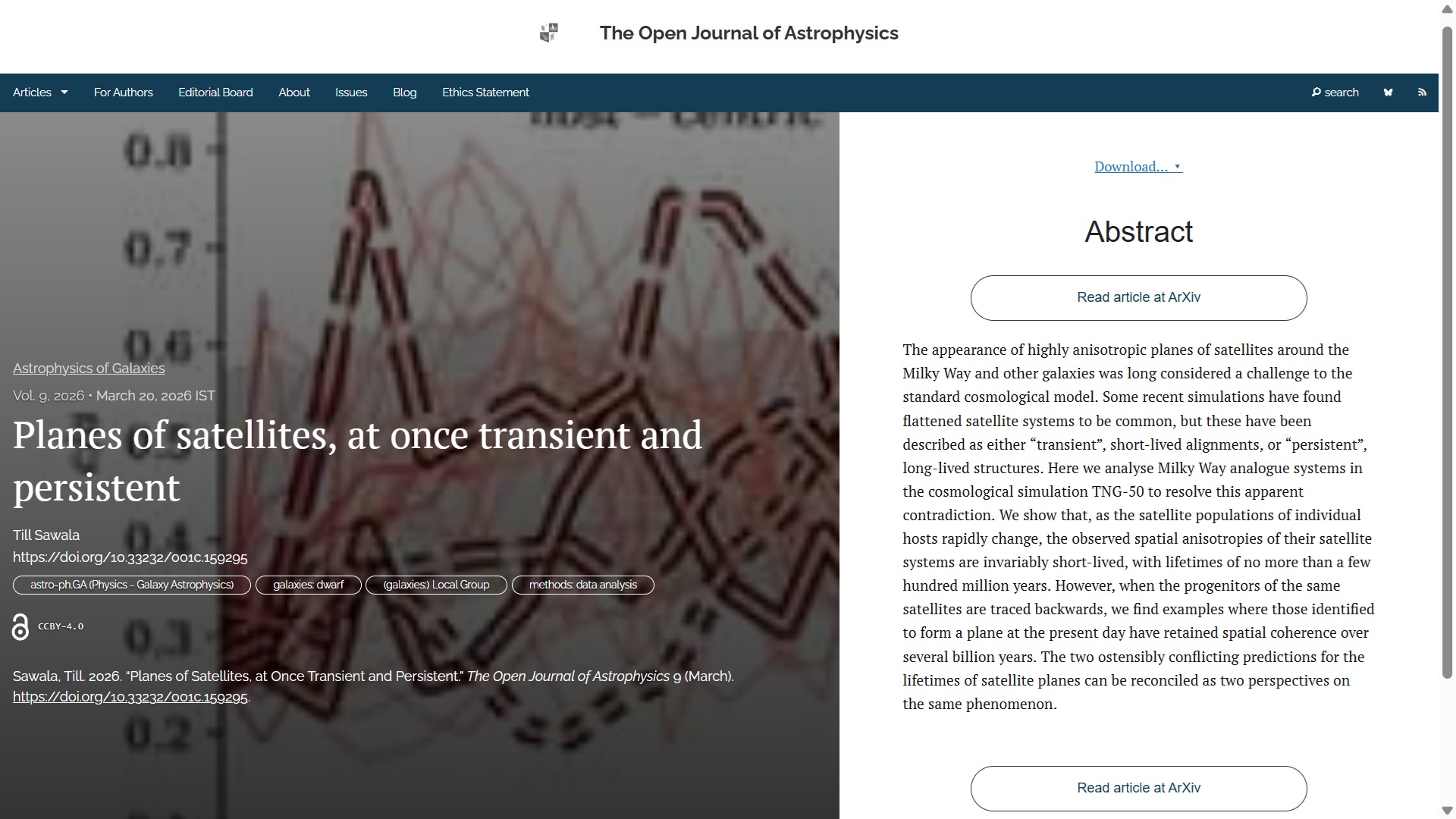
And finally for this week, published yesterday (Friday 20th March 2026) in the folder Astrophysics of Galaxies, we have “Planes of satellites, at once transient and persistent” by Till Sawala (University of Helsinki, Finland). This study resolves the contradiction in the lifespan of satellite systems around galaxies, showing they are short-lived but maintain spatial coherence over billions of years.
Here is the overlay for this one:
The officially accepted version can be found on arXiv here and the Mastodon announcement is here:
New Publication at the Open Journal of Astrophysics: "Planes of satellites, at once transient and persistent" by Till Sawala (University of Helsinki, Finland)
And that concludes the update for this week. Will we keep the rate up next week? Tune in next Saturday to find out!
P.S. Thank you once again to the many people who have responded to the latest call for editors. The Editorial Board has grown substantially over the last few weeks – an up-to-date version can be found here – and there are still some people waiting to get onboard, so please bear with me!
The views presented here are personal and not necessarily those of my employer (or anyone else for that matter).
Feel free to comment on any of the posts on this blog but comments may be moderated; anonymous comments and any considered by me to be vexatious and/or abusive and/or defamatory will not be accepted. I do not necessarily endorse, support, sanction, encourage, verify or agree with the opinions or statements of any information or other content in the comments on this site and do not in any way guarantee their accuracy or reliability.