Although it’s still holiday season for some, it’s time once more for another Saturday update of activity at the Open Journal of Astrophysics. Since the last update we have published a further four papers, bringing the number in Volume 9 (2026) to 171 and the total so far published by OJAp up to 619.
I continue to include the posts made on our Mastodon account (on Fediscience); these announcements also show the DOI for each paper.
New Publication at the Open Journal of Astrophysics: "Search for neutrino emission from blazar γ-ray flares accounting for possible neutrino time delays" by Egor Podlesny & Foteini Oikonomou (Norwegian University of Science & Technology, Trondheim, Norway)
The second paper for this week, published on Tuesday 11th August in the folder Cosmology and Nongalactic Astrophysics is “The velocity coherence scale: a novel probe of cosmic homogeneity and a potential standard ruler” by Leonardo Giani (Swinburne University of Technology), Cullan Howlet (U. Queensland), Chris Blake (Swinburne), Ryan J. Turner (Australia National University) and Tamara M. Davis (U. Queensland) – all in Australia. This paper argues that velocity coherence scale, a measure that identifies the transition point of galaxy motion from correlated to anti-correlated, could potentially characterize the onset of cosmic homogeneity.
The overlay looks like this:
The official version of the paper can be found on arXiv here and the Fediverse announcement here:
New Publication at the Open Journal of Astrophysics: "The velocity coherence scale: a novel probe of cosmic homogeneity and a potential standard ruler" by Leonardo Giani (Swinburne U. Tech.), Cullan Howlet (U. Queensland), Chris Blake (Swinburne), Ryan J. Turner (ANU) and Tamara M. Davis (U. Queensland) – all in Australia.
New Publication at the Open Journal of Astrophysics: "A GLIMPSE of the 99%: a census of the faintest galaxies during the epoch of reionization and its implications for galaxy formation models" by Hakim Atek (Sorbonne Université, Paris, France) and 21 others based around the world.
The fourth and final paper of the week was published on Wednesday 12th August in the folder Astrophysics of Galaxies: “Dust and Grain Size Evolution in Galaxy Simulations: What Matters and What Does Not” by Massimiliano Parente & Desika Narayanan (U. Florida, USA) and Paul Torrey (U. Virginia, USA) presents the first implementation of an evolving dust grain size distribution within a model of galaxy evolution, successfully reproducing key observational constraints and exploring the mechanisms shaping galaxies.
The overlay is here:
The officially-accepted version of the paper can be found on arXiv here and the Fediverse announcement here:
New Publication at the Open Journal of Astrophysics: "Dust and Grain Size Evolution in Galaxy Simulations: What Matters and What Does Not" by Massimiliano Parente & Desika Narayanan (U. Florida, USA) and Paul Torrey (U. Virginia, USA)
That’s all for this week. We’re just ticking over at the moment, and steadily building up a backlog of papers to publish while we wait for authors to put their final versions on arXiv. I have a feeling there’s going to be a big splurge sometime. Will it be next week? We’ll find out next Saturday!
Although it’s holiday season for some, it’s time once more for another Saturday update of activity at the Open Journal of Astrophysics. Since the last update we have published a further four papers, bringing the number in Volume 9 (2026) to 167 and the total so far published by OJAp up to 615.
I continue to include the posts made on our Mastodon account (on Fediscience); these announcements also show the DOI for each paper.
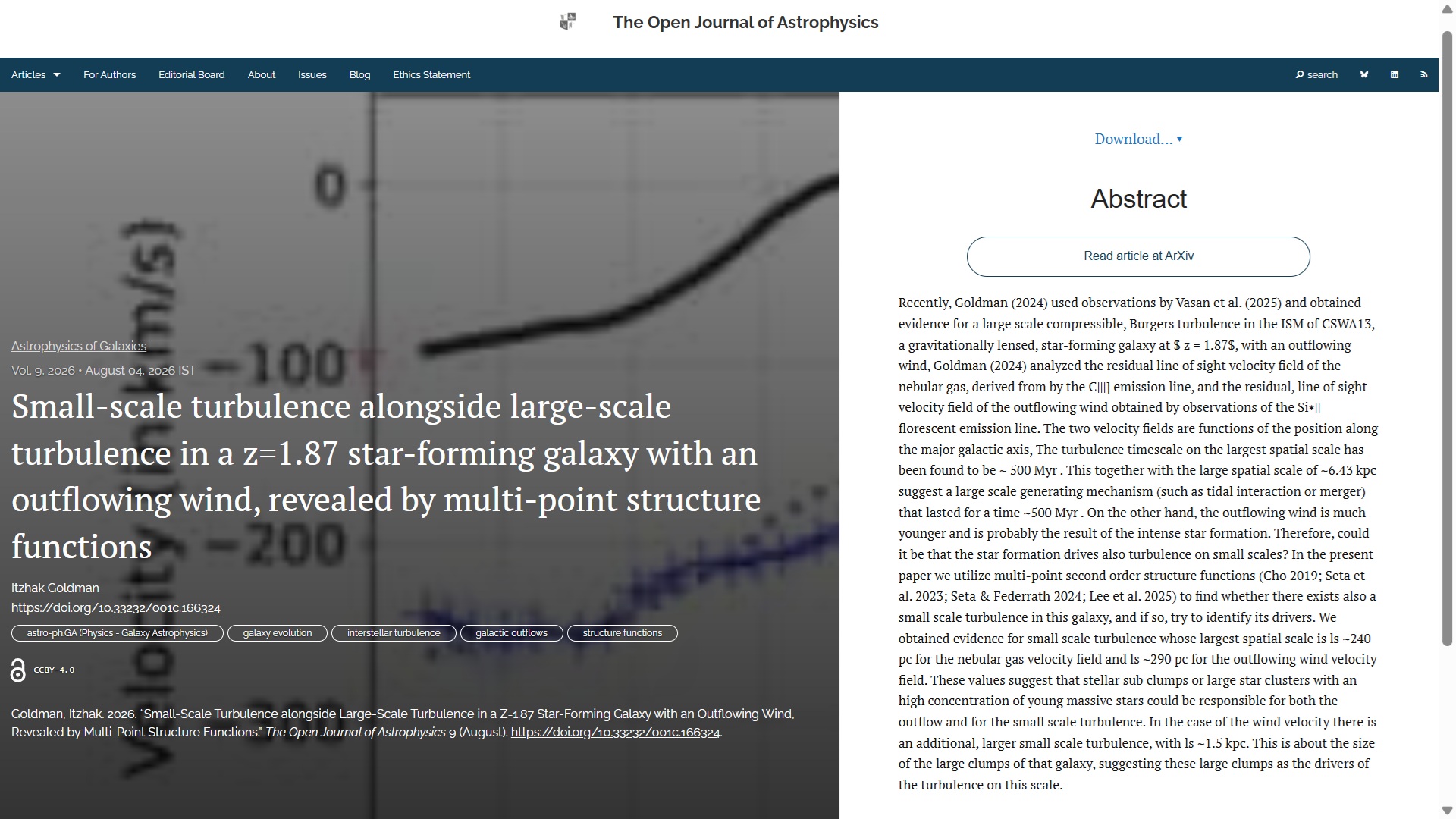
New Publication at the Open Journal of Astrophysics: "Small-scale turbulence alongside large-scale turbulence in a z=1.87 star-forming galaxy with an outflowing wind, revealed by multi-point structure functions" by Itzhak Goldman (Afeka College, Israel)
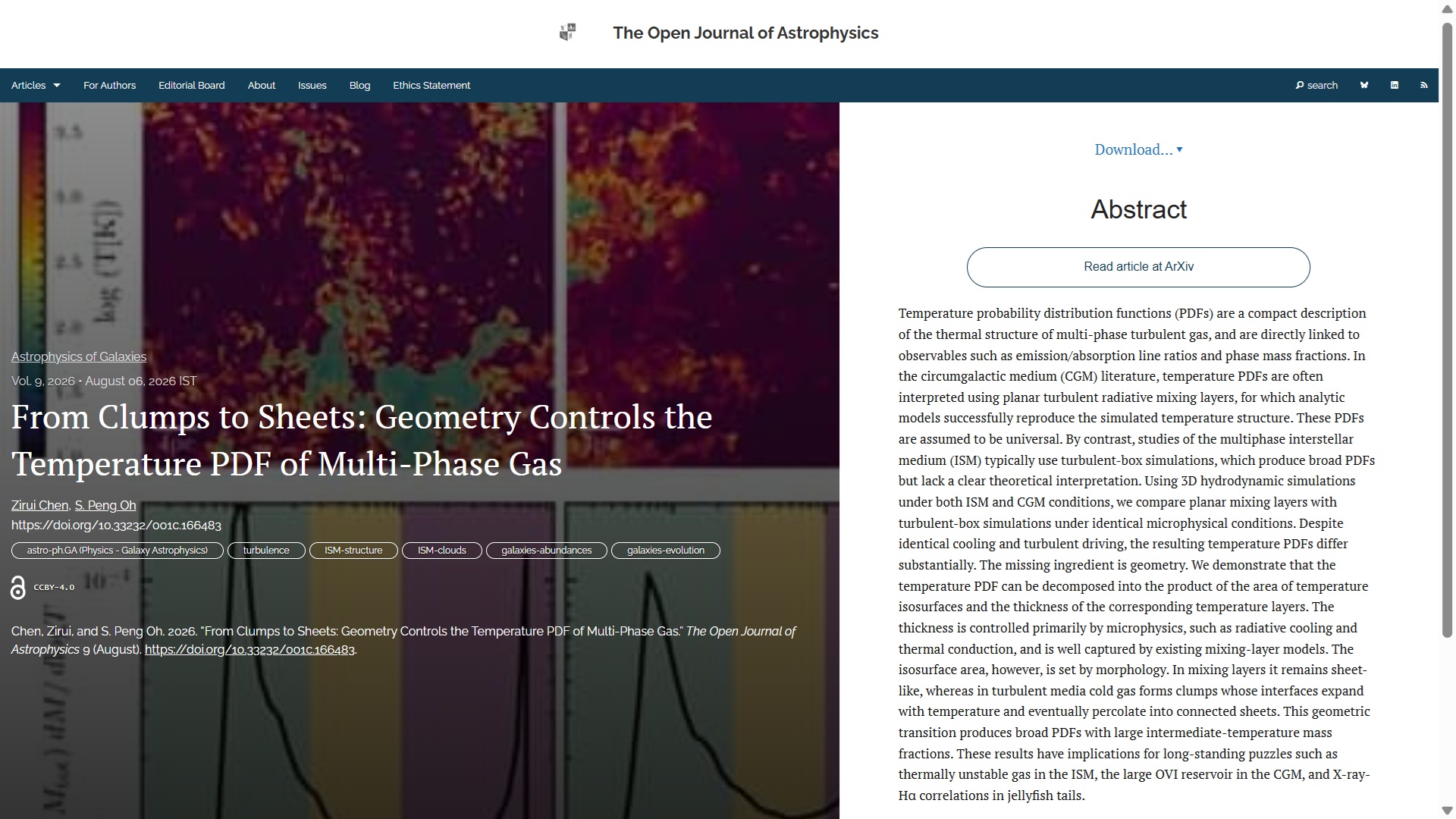
The second paper for this week, published on Thursday 6th August in the folder Astrophysics of Galaxies, is “From Clumps to Sheets: Geometry Controls the Temperature PDF of Multi-Phase Gas” by Zirui Chen and S. Peng Oh (UC Santa Barbara, USA). This study uses 3D hydrodynamic simulations to show that the temperature probability distribution functions (PDFs) of multi-phase turbulent gas differ significantly under interstellar medium (ISM) and circumgalactic medium (CGM) conditions.
The overlay looks like this:
The official version of the paper can be found on arXiv here and the Fediverse announcement here:
New Publication at the Open Journal of Astrophysics: "From Clumps to Sheets: Geometry Controls the Temperature PDF of Multi-Phase Gas" by Zirui Chen and S. Peng Oh (UC Santa Barbara, USA)
New Publication at the Open Journal of Astrophysics: "First Detection of Extensive Air Showers Using a Small-Aperture Fluorescence Telescope" by M. Zotov (M.V. Lomonosov Moscow State University, Russia) and 7 others based in Russia and Armenia
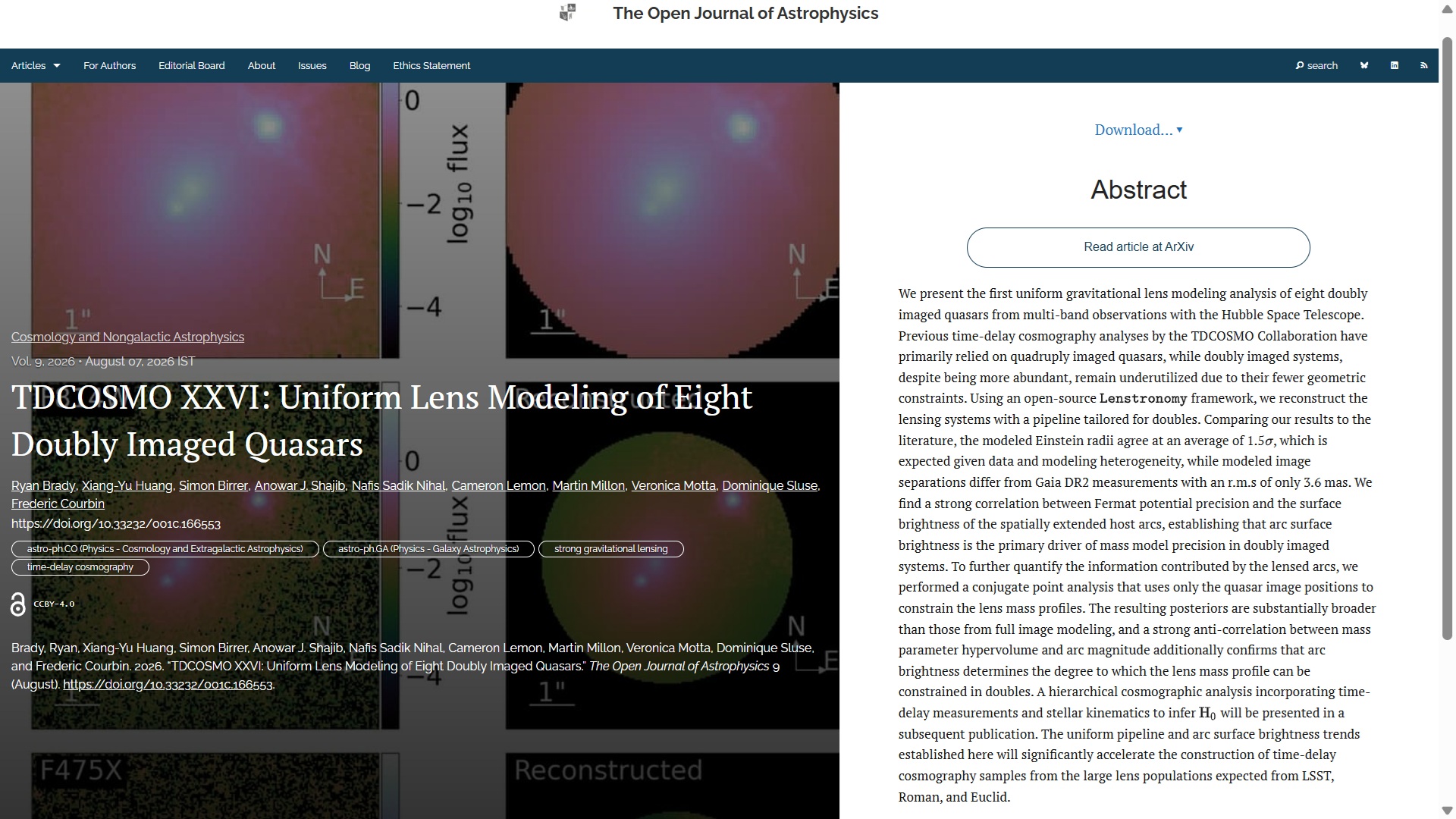
The fourth and final paper of the week was published on Friday 7th August in the folder Cosmology and Nongalactic Astrophysics: “TDCOSMO XXVI: Uniform Lens Modeling of Eight Doubly Imaged Quasars“, by Ryan Brady (Stony Brook University, USA) and 9 others based all around the world, presents a new method for analyzing doubly imaged quasars using the Hubble Space Telescope, revealing that arc surface brightness is key to precision in mass model measurements.
The overlay is here:
The officially-accepted version of the paper can be found on arXiv here and the Fediverse announcement here:
New Publication at the Copen Journal of Astrophysics: "TDCOSMO XXVI: Uniform Lens Modeling of Eight Doubly Imaged Quasars" by Ryan Brady (Stony Brook University, USA) and 9 others based around the world.
That’s all for this week. We have about a dozen more papers accepted and waiting for the authors to put the final version on arXiv, which they will presumably do when they’re back from holiday. I’ll do an update next weekend and we’ll see!
It’s time once more for another Saturday update of activity at the Open Journal of Astrophysics. Since the last update we have published a further three papers, bringing the number in Volume 9 (2026) to 163 and the total so far published by OJAp up to 611.
I continue to include the posts made on our Mastodon account (on Fediscience); these announcements also show the DOI for each paper.
The first paper to report this week was published on Tuesday 28th July in the folder Cosmology and Nongalactic Astrophysics. “The Origins of the Bulk Flow” by Richard Watkins & Trajan Clark (Willamett U., USA) and Hume A Feldman (U. Kansas, USA) analyzes the origin of large-scale bulk flow using the CosmicFlows-4 catalog, finding that it is largely influenced by structures beyond 200 h-1 Mpc, challenging previous assumptions.
The overlay for this paper is here
You can find the officially accepted version on arXiv here and the announcement on Fediverse here:
New Publication at the Open Journal of Astrophysics: "The Origins of the Bulk Flow" by Richard Watkins & Trajan Clark (Willamett U., USA) and Hume A Feldman (U. Kansas, USA).
The second paper for this week, also published on Tuesday 28th July in the folder Cosmology and Nongalactic Astrophysics is: “Enhancing weak lensing redshift distribution characterization by optimizing the Dark Energy Survey Self-Organizing Map Photo-z method” by A. Campos (Carnegie Mellon U., USA) and the DES collaboration (113 authors). This study improves the Self-Organizing Map methodology for estimating redshift distribution in galaxies, notably reducing overlap between redshift bins, in preparation for the Dark Energy Survey Year 6 data.Abstractfor Enhancing weak lensing redshift distribution characterization by optimizing the Dark Energy Survey Self-Organizing Map Photo-z method.
The overlay looks like this:
The official version of the paper can be found on arXiv here and the Fediverse announcement here:
New Publication at the Open Journal of Astrophysics: "Enhancing weak lensing redshift distribution characterization by optimizing the Dark Energy Survey Self-Organizing Map Photo-z method" by A. Campos (Carnegie Mellon U., USA) and the DES collaboration (113 authors)
New Publication at the Open Journal of Astrophysics: "The Ray Tracing Sampler: Bayesian Sampling of Neural Networks for Everyone" by Peter Behroozi (U. Arizona, USA)
Back home to Maynooth, just in time for another Saturday update of activity at the Open Journal of Astrophysics. Since the last update we have published a further nine papers, bringing the number in Volume 9 (2026) to 145 and the total so far published by OJAp up to 593.
I will continue to include the posts made on our Mastodon account (on Fediscience); these announcements also show the DOI for each paper.
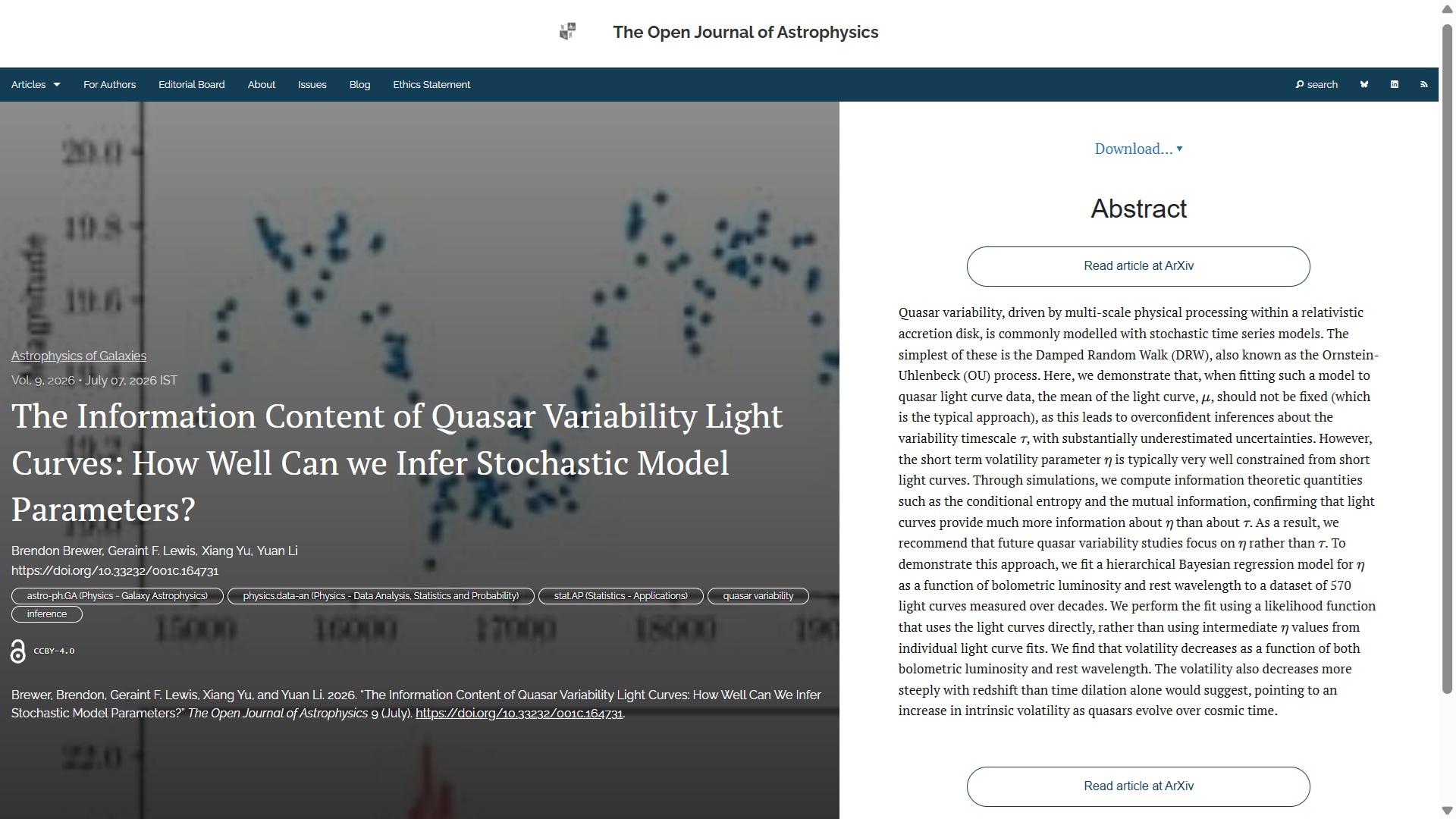
The first paper to report this week, published on Tuesday 7th July, is “The Information Content of Quasar Variability Light Curves: How Well Can we Infer Stochastic Model Parameters?” by Brendon Brewer (U. Auckland, NZ), Geraint F. Lewis (U. Sydney, AU), Xiang Yu & Yuan Li (Auckland). Published in the folder Astrophysics of Galaxies, this study suggests that quasar variability studies should focus on the short term volatility parameter, as it’s more informative than the variability timescale. Volatility decreases with redshift suggesting intrinsic effects.
The overlay for this paper is here
You can find the officially accepted version on arXiv here and the announcement on Fediverse here:
New Publication at the Open Journal of Astrophysics: "The Information Content of Quasar Variability Light Curves: How Well Can we Infer Stochastic Model Parameters?" by Brendon Brewer (U. Auckland, NZ), Geraint F. Lewis (U. Sydney, AU), Xiang Yu & Yuan Li (Auckland)
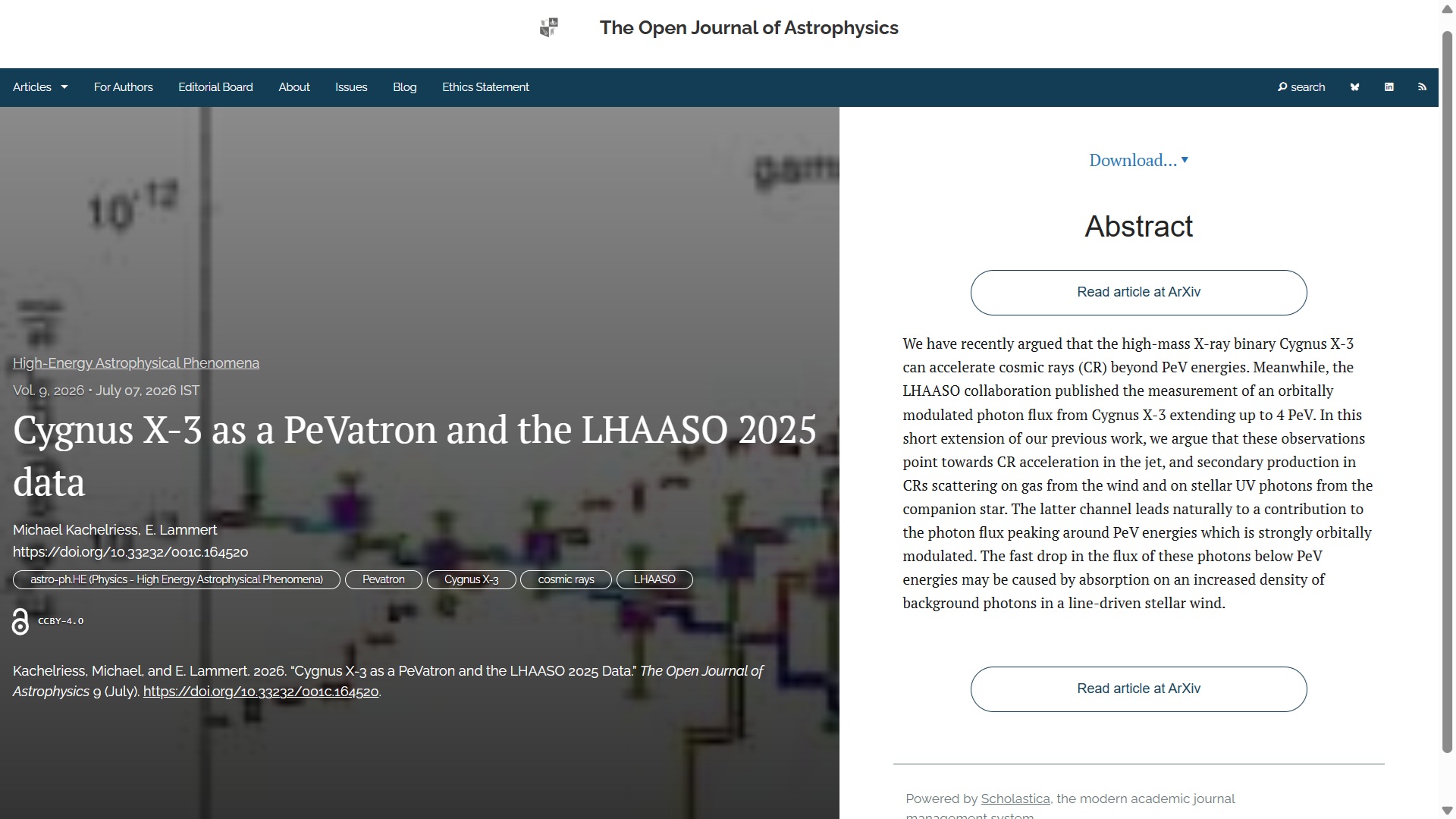
The second paper for this week, also published on Tuesday 7th July, but in the folder High-Energy Astrophysical Phenomena, is “Cygnus X-3 as a PeVatron and the LHAASO 2025 data” by Michael Kachelriess & E. Lammert (NTNU, Trondheim, Norway). This paper suggests that the high-mass X-ray binary Cygnus X-3 can accelerate cosmic rays beyond PeV energies, contributing to a photon flux peaking around PeV energies.
The overlay looks like this:
The official version of the paper can be found on arXiv here and the Fediverse announcement here:
New Publication at the Open Journal of Astrophysics: "Cygnus X-3 as a PeVatron and the LHAASO 2025 data" by Michael Kachelriess & E. Lammert (NTNU, Trondheim, Norway)
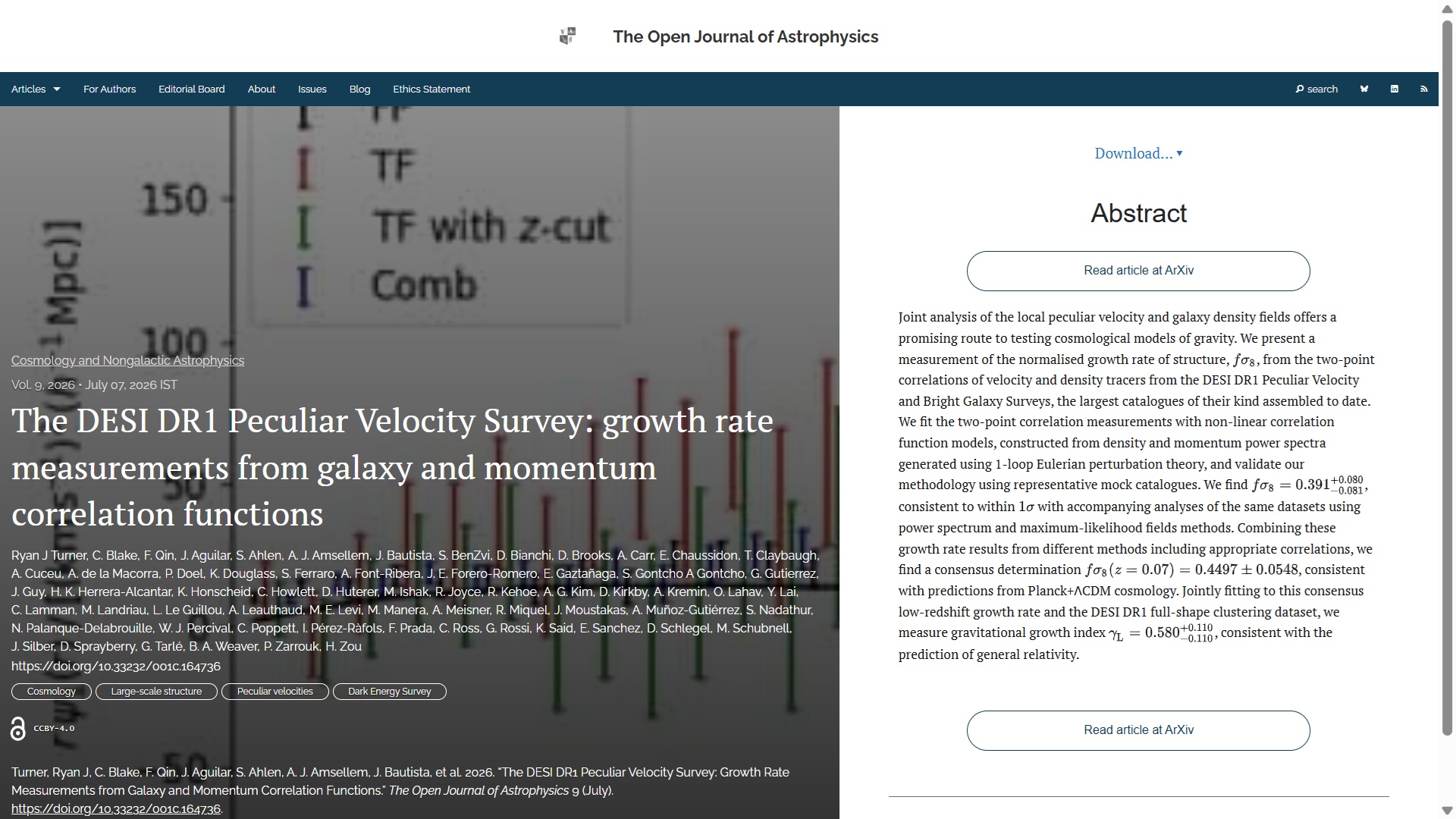
New Publication at the Open Journal of Astrophysics: "The DESI DR1 Peculiar Velocity Survey: growth rate measurements from galaxy and momentum correlation functions" by Ryan J Turner (Swinburne Institute of Technology, Australia) and 63 others from around the world.
New Publication at the Open Journal of Astrophysics: "On the effective spin-mass ratio relation of binary black hole mergers that evolved in isolation" by Sambaran Banerjee (Helmholtz-Instituts für Strahlen und Kernphysik, Germany) and Aleksandra Olejak (MPA Garching, Germany)
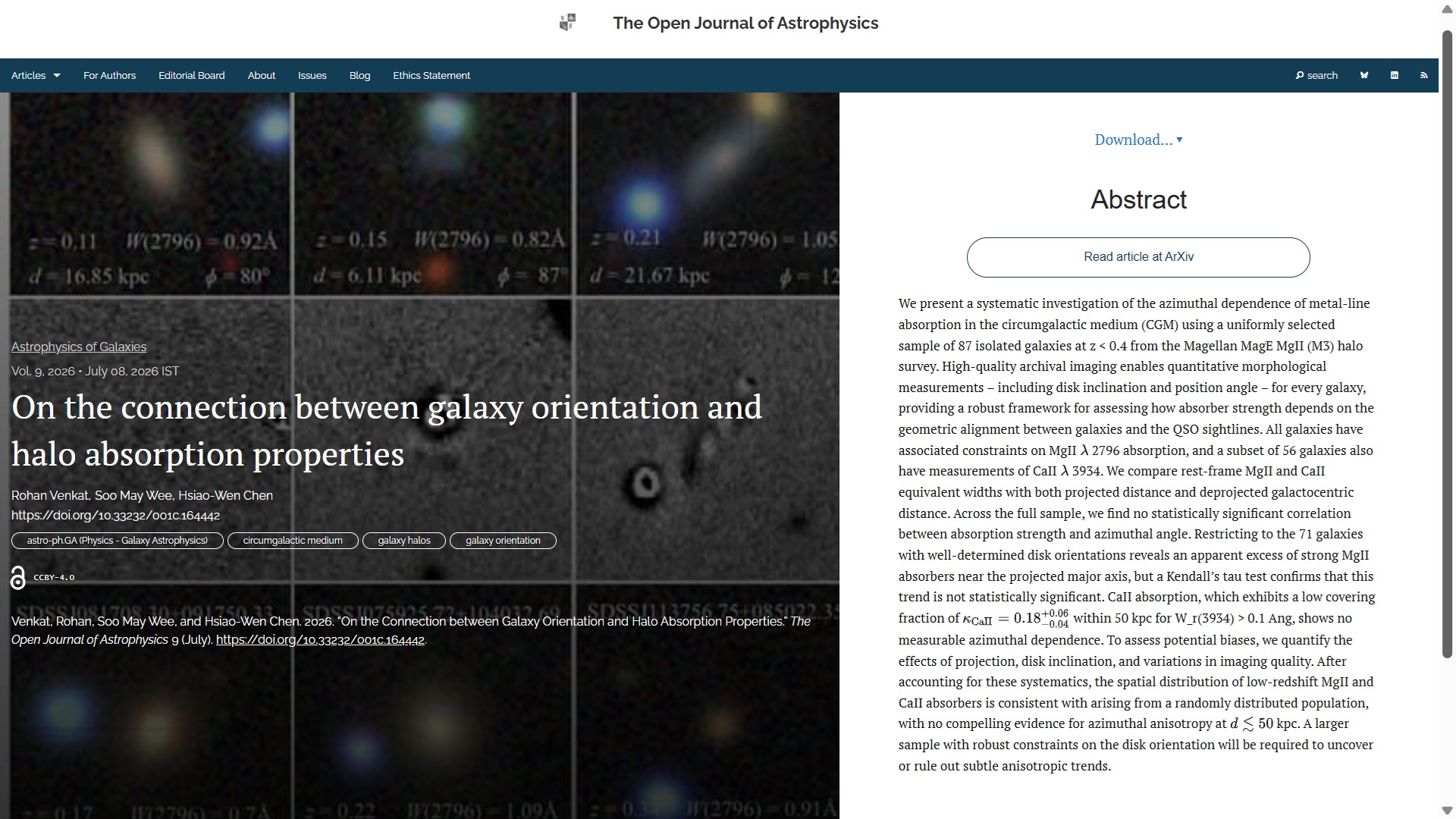
The fifth paper of the week, also published on Wednesday 8th July but in the folder Astrophysics of Galaxies, is “On the connection between galaxy orientation and halo absorption properties” by Rohan Venkat, Soo May Wee, and Hsiao-Wen Chen (U. Chicago, USA). This article investigates the azimuthal dependence of metal-line absorption in the circumgalactic medium of 87 isolated galaxies. The results show no significant correlation between absorption strength and azimuthal angle.
The overlay for this one is here:
You can read the final version of this one on arXiv here and the Mastodon announcement is here:
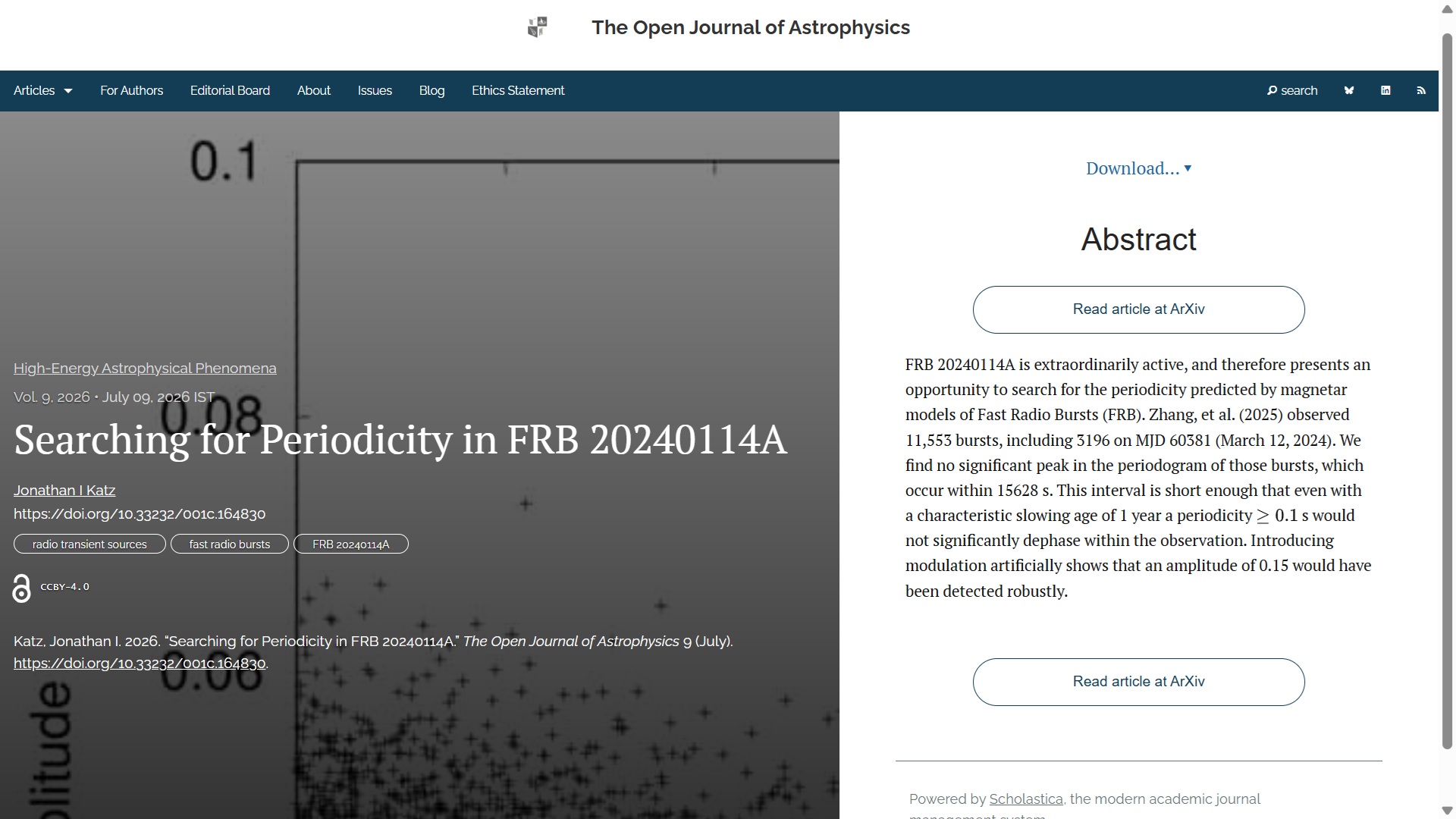
The sixth paper of this week is “Searching for Periodicity in FRB 20240114A” by Jonathan I Katz (Washington U., USA). This was published on Thursday 9th July in the folder High-Energy Astrophysical Phenomena. The study described in this paper observed FRB 20240114A, an active Fast Radio Burst, but found no significant periodicity in its bursts, contradicting magnetar models predictions.
The overlay for this one is here:
You can find the final accepted version on arXiv here and the Mastodon announcement is here:
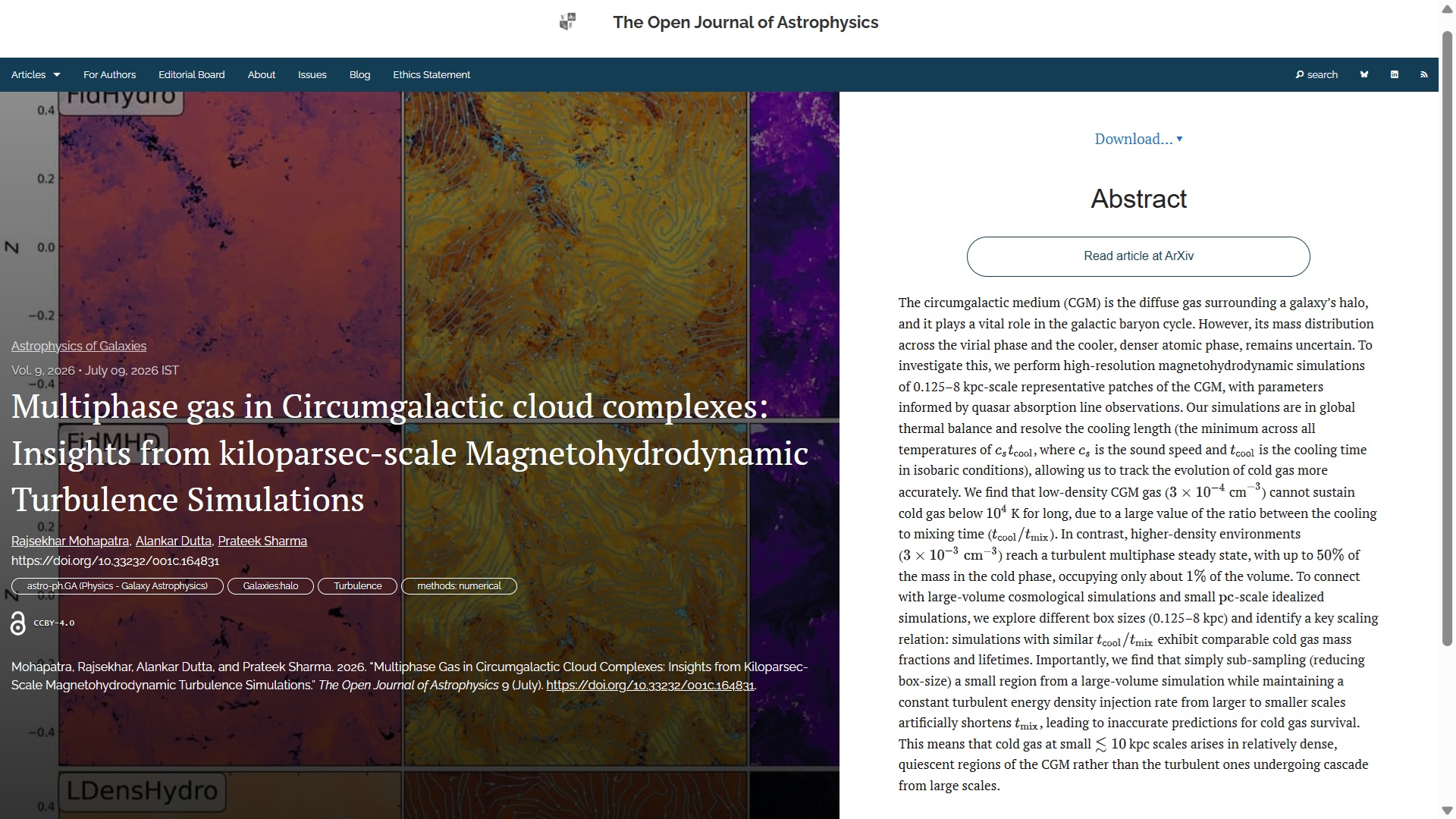
The seventh article for this week is “Multiphase gas in Circumgalactic cloud complexes: Insights from kiloparsec-scale Magnetohydrodynamic Turbulence Simulations” by Rajsekhar Mohapatra (Princeton U., USA), Alankar Dutta (MPA Garching, Germany) and Prateek Sharma (Indian Institute of Science, Bangalore). This -paper was also published on Thursday 9th July, in the folder Astrophysics of Galaxies. This paper uses high-resolution simulations to investigate the mass distribution of the circumgalactic medium (CGM), a diffuse gas surrounding a galaxy’s halo with small-scale clumps of cold gas forming in quiescent regions.
The overlay for this one is here:
You can find the final accepted version of this one on arXiv here and the Mastodon announcement is here:
New Publication at the Open Journal of Astrophysics: "Multiphase gas in Circumgalactic cloud complexes: Insights from kiloparsec-scale Magnetohydrodynamic Turbulence Simulations" by Rajsekhar Mohapatra (Princeton U., USA), Alankar Dutta (MPA Garching, Germany) and Prateek Sharma (Indian Institute of Science, Bangalore)
The (penultimate) eighth article for this week is “Line-of-sight shear in SLACS strong lenses I: shear and mass model parametrisations” by Natalie B. Hogg (U. Cambridge, UK), Daniel Johnson (U. Montpellier, France), Anowar J. Shajib (U. Chicago, USA) and Julien Larena (Montpellier). This was also published on Thursday 9th July, but in the folder Cosmology and Nongalactic Astrophysics. This article studies models of 23 strong gravitational lenses to measure line-of-sight shear for the first time, providing potential new constraints on cosmological parameters.
The overlay for this one is here:
You can find the final accepted version on arXiv here and the Mastodon announcement is here:
New Publication at the Open Journal of Astrophysics: "Line-of-sight shear in SLACS strong lenses I: shear and mass model parametrisations" by Natalie B. Hogg (U. Cambridge, UK), Daniel Johnson (U. Montpellier, France), Anowar J. Shajib (U. Chicago, USA) and Julien Larena (Montpellier)
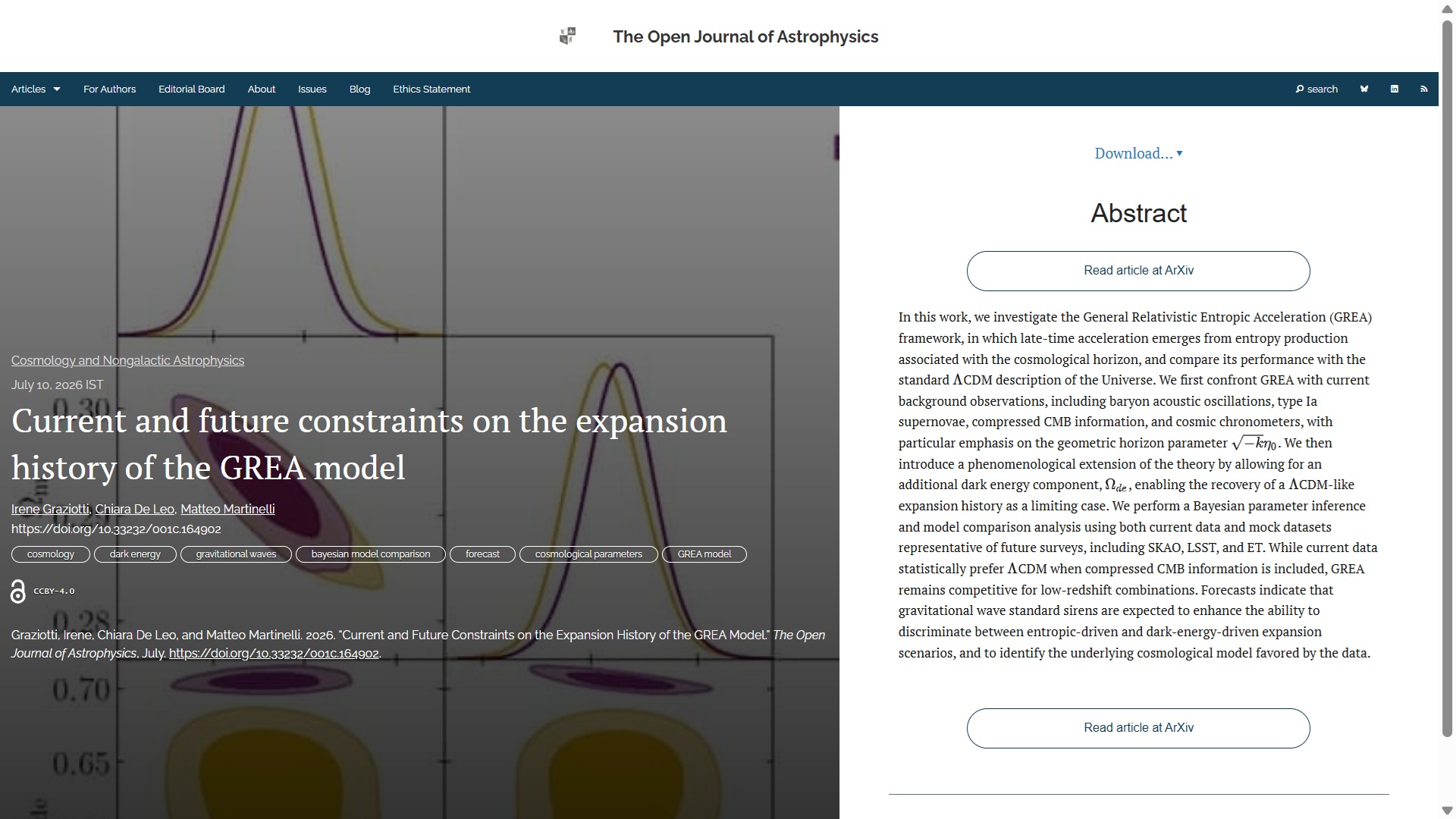
The ninth and last article for this week is “Current and future constraints on the expansion history of the GREA model” by Irene Graziotti (INAF-Osservatorio Astronomico di Capodimonte, Italy), Chiara De Leo (Sapienza University of Rome, Italy) and Matteo Martinelli (INAF-Osservatorio Astronomico di Roma, Italy). This study explores the General Relativistic Entropic Acceleration (GREA) framework, comparing it to the standard description of the universe. Current data favors the standard model, but GREA remains competitive.
The overlay for this one is here:
You can find the officially-accepted version on arXiv here and the Mastodon announcement here:
New Publication at the Open Journal of Astrophysics: "Current and future constraints on the expansion history of the GREA model" by Irene Graziotti (INAF-Osservatorio Astronomico di Capodimonte, Italy), Chiara De Leo (Sapienza University of Rome, Italy) and Matteo Martinelli (INAF-Osservatorio Astronomico di Roma, Italy)
As you can see, it has been a bumper week, especially when you consider that there was no arXiv mailing om Monday July 6th owing to the July 4th holiday in the USA. I should have known this would happen while I was travelling!
It’s Saturday once again, so time for another update of activity at the Open Journal of Astrophysics. Since the last update we have published a further five papers, bringing the number in Volume 9 (2026) to 104 and the total so far published by OJAp up to 552. It took us until late July to pass 100 last year.
I will continue to include the posts made on our Mastodon account (on Fediscience) to encourage you to visit it. Mastodon is a really excellent service, and a more than adequate replacement for X/Twitter (which nobody should be using); these announcements also show the DOI for each paper.
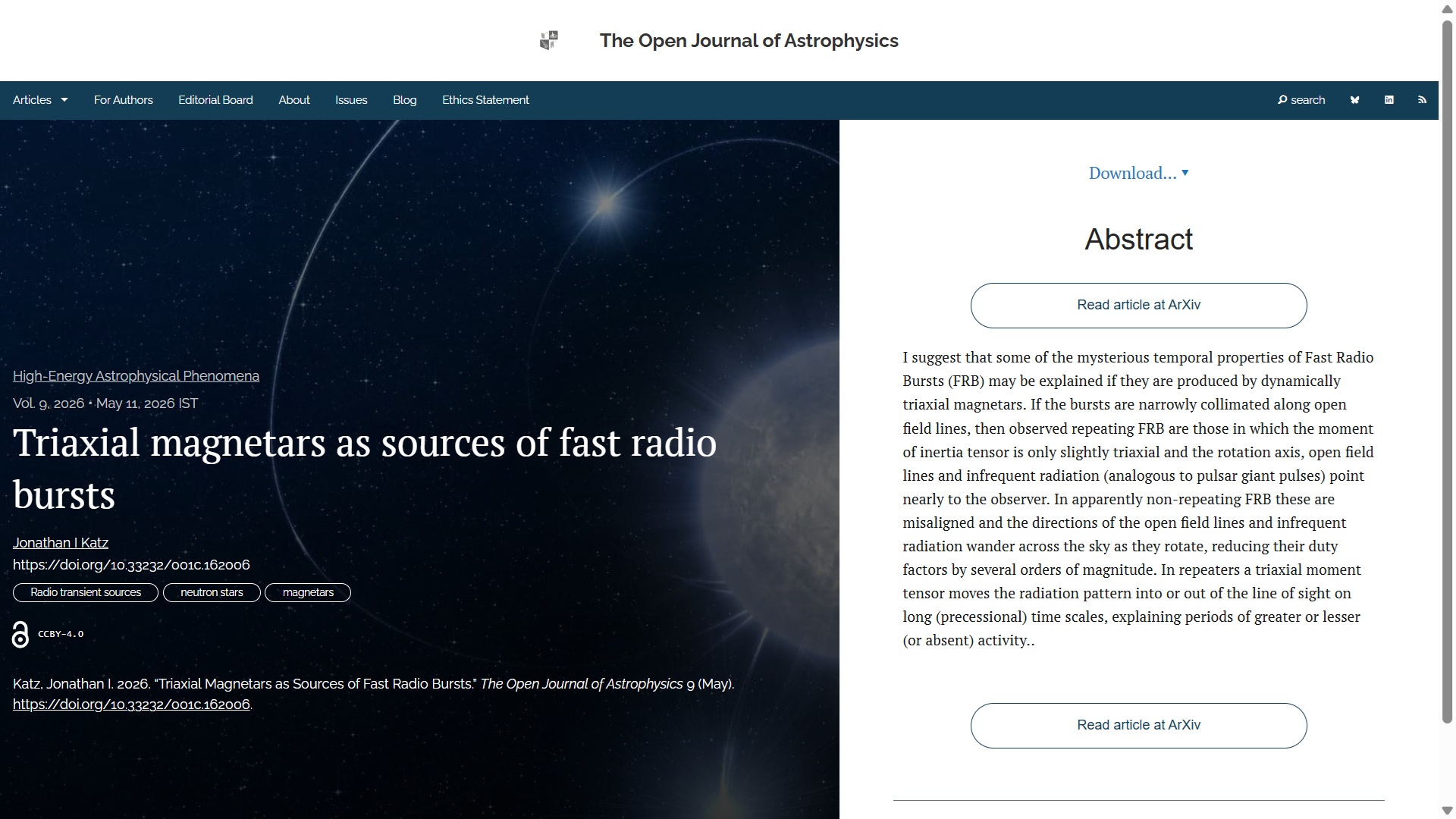
The first paper to report this week, published on Monday 11th May in the folder High-Energy Astrophysical Phenomena is “Triaxial magnetars as sources of fast radio bursts” by Jonathan I Katz (Washington University, USA). This paper suggests that the mysterious properties of Fast Radio Bursts (FRB) could be explained by triaxial magnetars, with their activity levels influenced by precessional time scales.
The overlay for this paper is here
You can find the officially accepted version on arXiv here and the announcement on Fediverse here:
New Publication at the Open Journal of Astrophysics: "Triaxial magnetars as sources of fast radio bursts" by Jonathan I Katz (Washington University, USA)
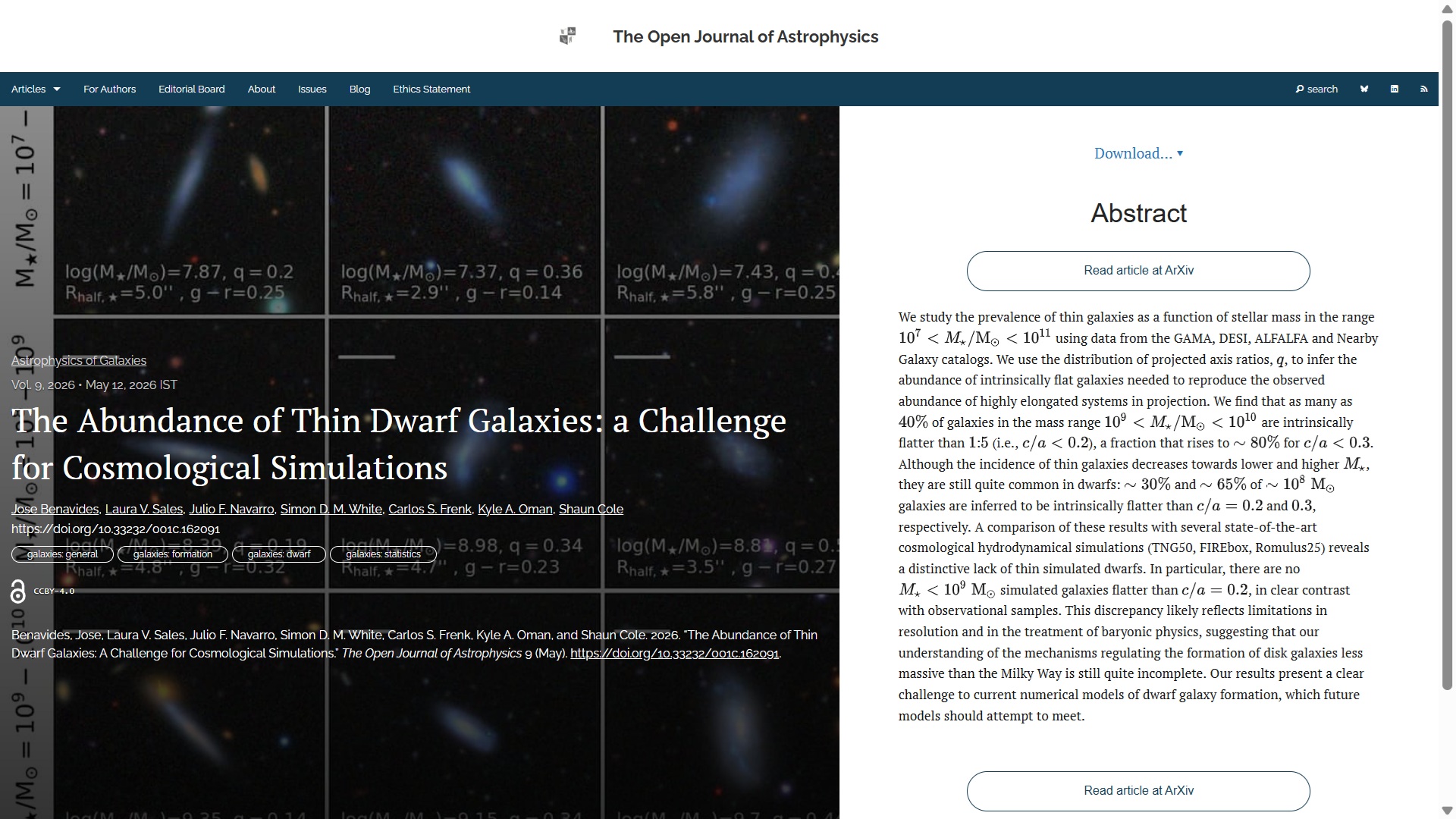
The second paper for this week, published on Tuesday 12th May in the folder Astrophysics of Galaxies, is “The Abundance of Thin Dwarf Galaxies: a Challenge for Cosmological Simulations” by Jose Benavides & Laura V. Sales (UC Riverside, USA), Julio F. Navarro (U. Victoria, Canada), Simon D. M. White (MPA Garching, Germany), and Carlos S. Frenk, Kyle A. Oman & Shaun Cole (U. Durham, UK). Depending on mass up to 40% of galaxies are intrinsically flat, a fraction that numerical models of galaxy formation struggle to reproduce suggesting the models are incomplete.
The overlay for this one is here:
The official version of the paper can be found on arXiv here and the Fediverse announcement here:
New Publication at the Open Journal of Astrophysics: "The Abundance of Thin Dwarf Galaxies: a Challenge for Cosmological Simulations" by Jose Benavides & Laura V. Sales (UC Riverside, USA), Julio F. Navarro (U. Victoria, Canada), Simon D. M. White (MPA Garching, Germany), and Carlos S. Frenk, Kyle A. Oman & Shaun Cole (U. Durham, UK)
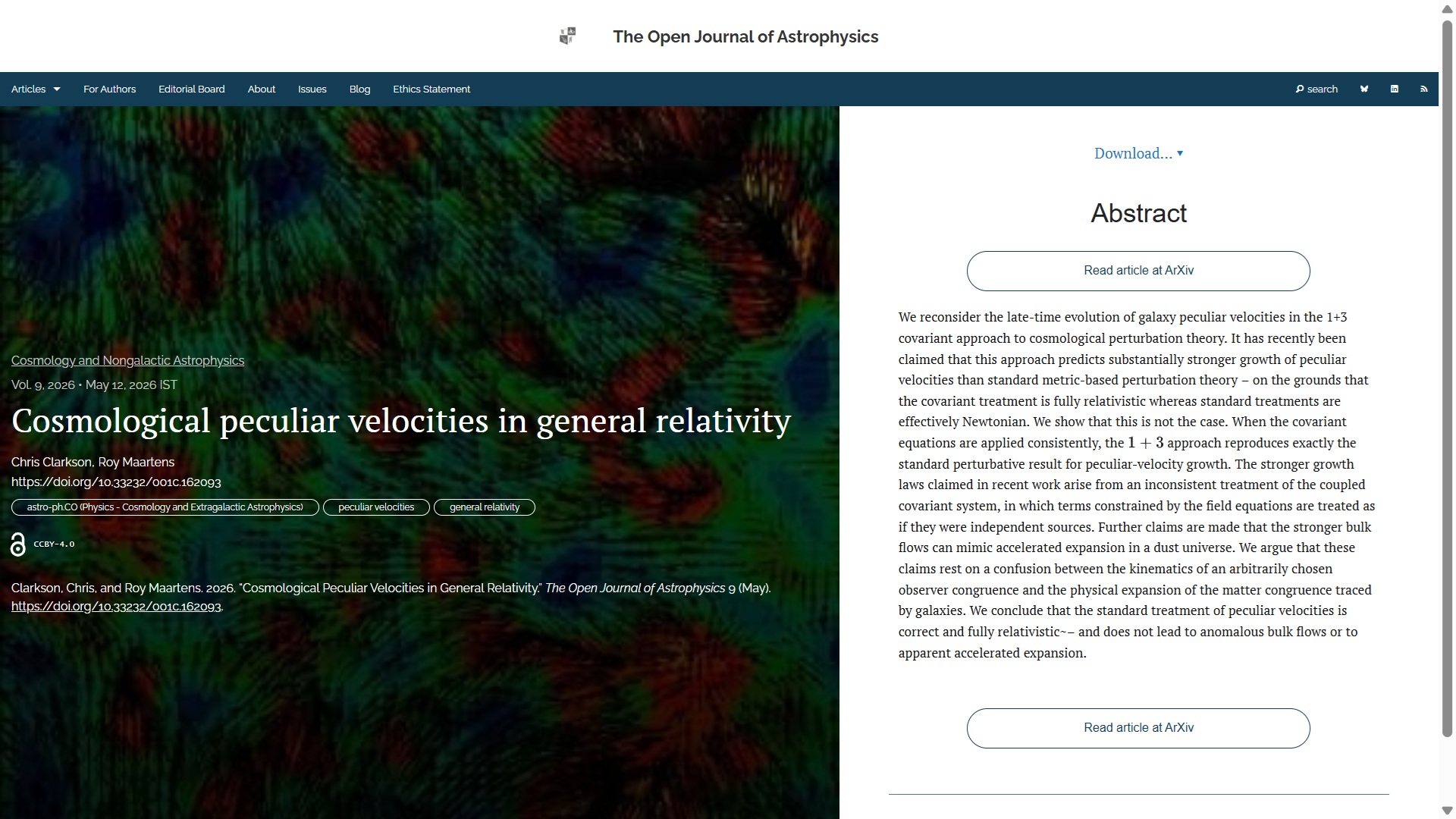
Next one up, the third paper of the week, also published on Tuesday 12th May but in the folder Cosmology and Nongalactic Astrophysics is “Cosmological peculiar velocities in general relativity” by Chris Clarkson (Queen Mary, University of London, UK) and Roy Maartens (U. Western Cape, South Africa). This paper refutes claims that the 1+3 covariant approach to cosmological perturbation theory predicts stronger growth of galaxy peculiar velocities, arguing that standard treatments are correct and fully relativistic.
The overlay for this one is here:
The final, accepted version can be found on arXiv here and the Mastodon announcement is here:
New Publication at the Open Journal of Astrophysics: "Cosmological peculiar velocities in general relativity" by Chris Clarkson (QMUL, UK) and Roy Maartens (U. Western Cape, South Africa)
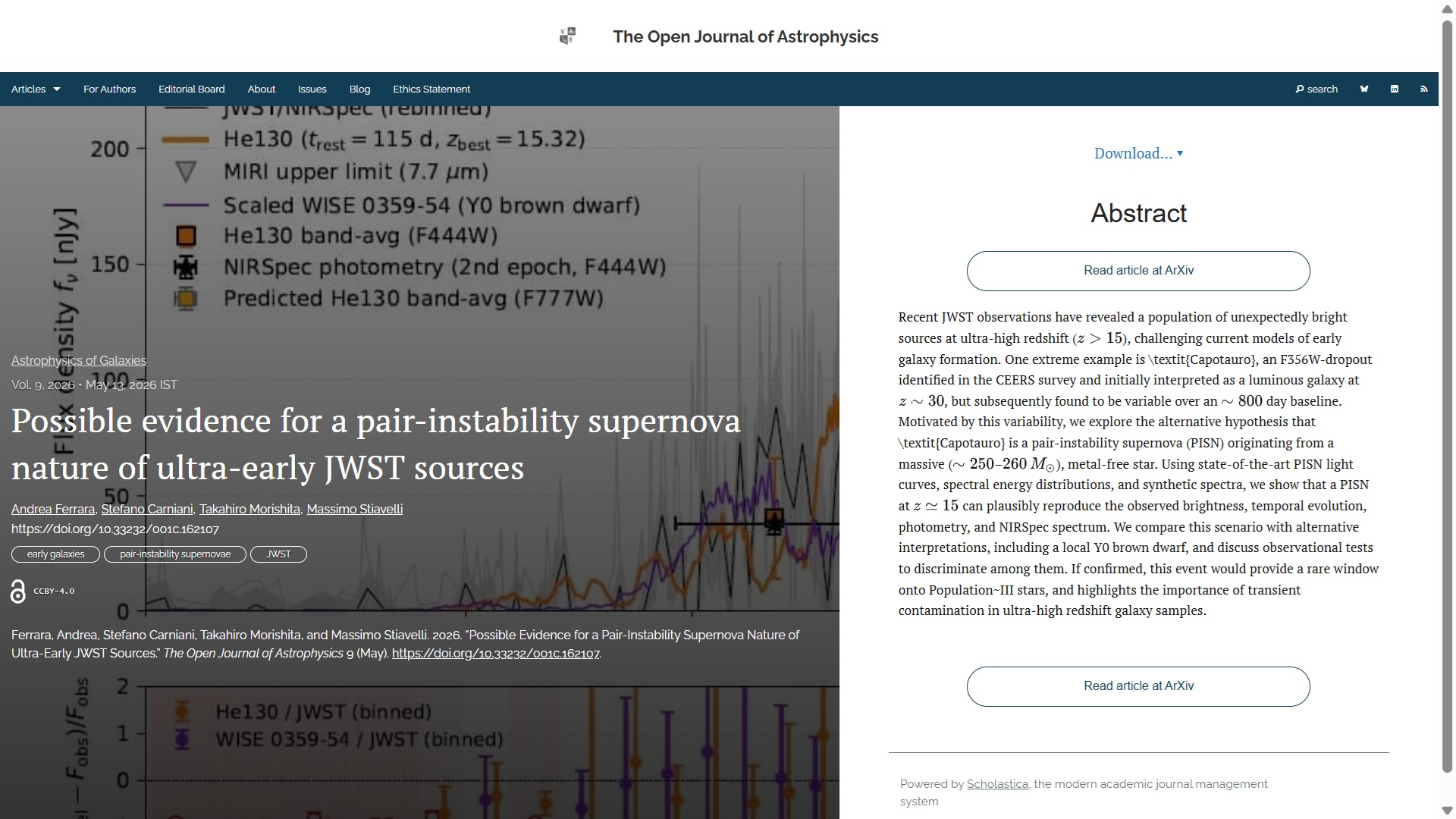
The fourth paper this week, published on Wednesday May 13th “Possible evidence for a pair-instability supernova nature of ultra-early JWST sources” by Andrea Ferrara & Stefano Carniani (Scuola Normale Superiore, Pisa, Italy), Takahiro Morishita (California Institute of Technology, USA), and Massimo Stiavelli (Space Telescope Science Institute, USA). Published in the section Astrophysics of Galaxies. This paper argues that recent observations challenge early galaxy formation models, suggesting that the bright source, Capotauro, could be a supernova from a massive, metal-free star, not a luminous galaxy as initially thought.
The overlay is here:
The officially accepted version can be found on arXiv here and here is the Mastodon announcement:
New Publication at the Open Journal of Astrophysics: "Possible evidence for a pair-instability supernova nature of ultra-early JWST sources" by Andrea Ferrara & Stefano Carniani (Scuola Normale Superiore, Pisa, Italy), Takahiro Morishita (Caltech, USA) and Massimo Stiavelli (STScI, USA)
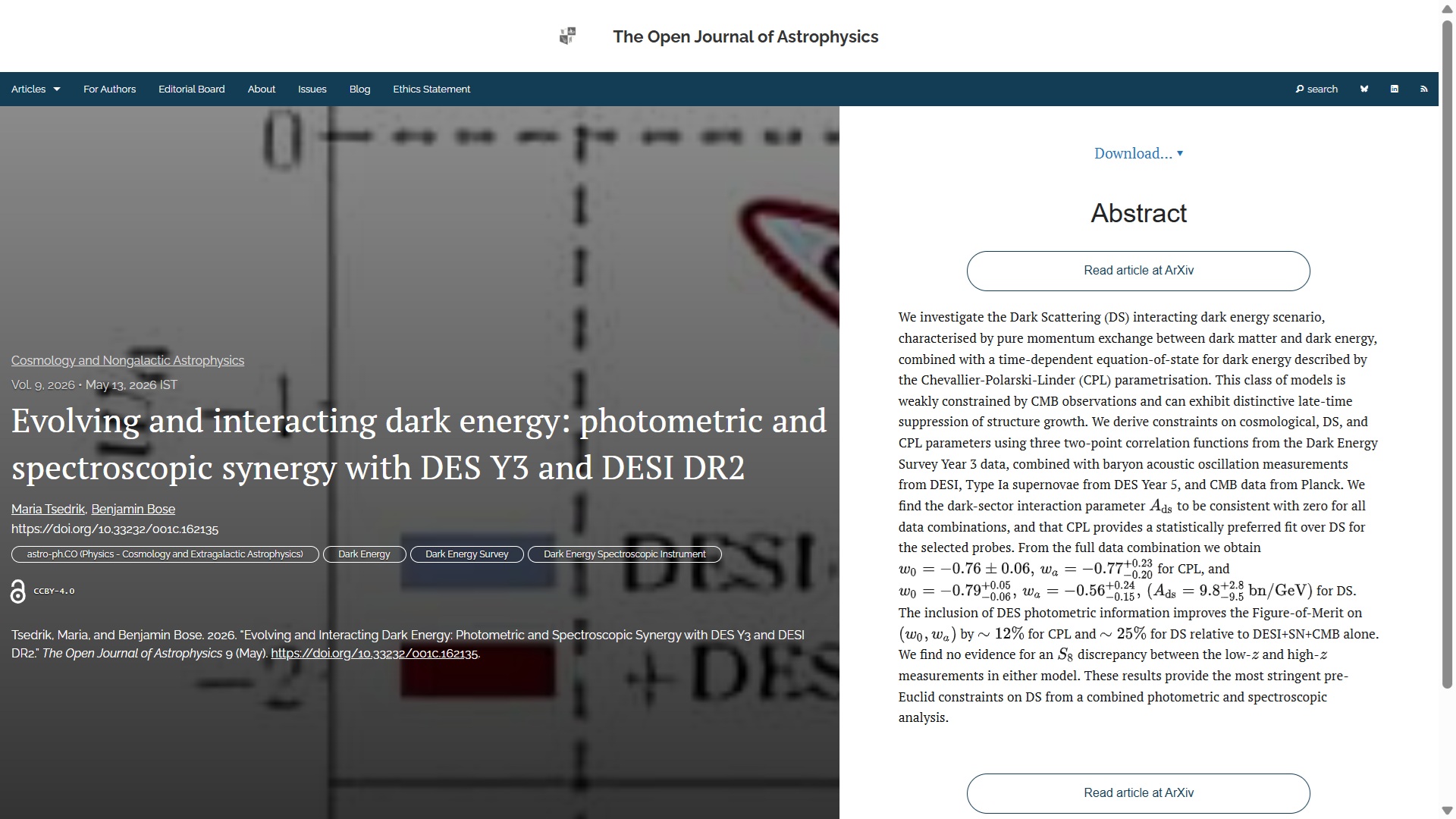
The fifth and final article of this week was also published on Wednesday 13th May but in the folder Cosmology and Nongalactic Astrophysics. The title is “Evolving and interacting dark energy: photometric and spectroscopic synergy with DES Y3 and DESI DR2” and it is by Maria Tsedrik and Benjamin Bose (University of Edinburgh, UK). The study investigates the Dark Scattering interacting dark energy scenario, using data from various sources. Results show no evidence of dark-sector interaction and a preference for the Chevallier-Polarski-Linder parametrisation.
The overlay is here:
You can find the authorized version of this paper on arXiv here and the Fediverse announcement is here:
New Publication at the Open Journal of Astrophysics: "Evolving and interacting dark energy: photometric and spectroscopic synergy with DES Y3 and DESI DR2" by Maria Tsedrik and Benjamin Bose (University of Edinburgh, UK)
It’s Saturday once again, so time for another update of activity at the Open Journal of Astrophysics. Since the last update we have published a further five papers, bringing the number in Volume 9 (2026) to 99 and the total so far published by OJAp up to 547. We didn’t quite make it to a hundred for the year last week, but will do so with the next paper.
I will continue to include the posts made on our Mastodon account (on Fediscience) to encourage you to visit it. Mastodon is a really excellent service, and a more than adequate replacement for X/Twitter (which nobody should be using); these announcements also show the DOI for each paper.
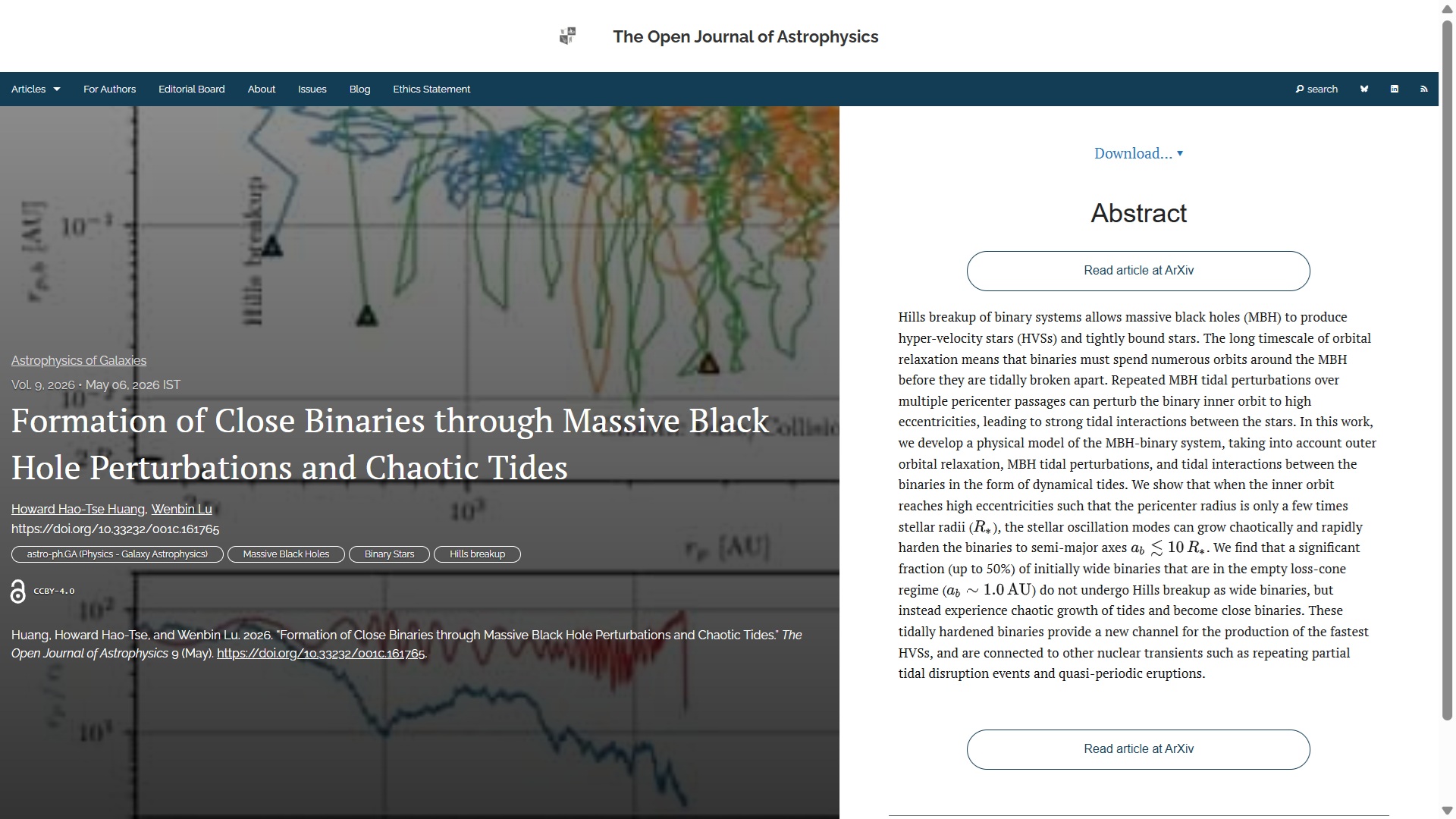
The first paper to report this week is “Formation of Close Binaries through Massive Black Hole Perturbations and Chaotic Tides” by Howard Hao-Tse Huang and Wenbin Lu (University of California at Berkeley, USA). This one was published on Wednesday 6th May 2026 in the folder Astrophysics of Galaxies. The paper presents a model of massive black hole-binary systems, showing that repeated tidal interactions can lead to the creation of hyper-velocity stars and other nuclear transients.
The overlay for this paper is here
You can find the officially accepted version on arXiv here and the announcement on Fediverse here:
New Publication at the Open Journal of Astrophysics: "Formation of Close Binaries through Massive Black Hole Perturbations and Chaotic Tides" by Howard Hao-Tse Huang & Wenbin Lu (U. California Berkeley, USA)
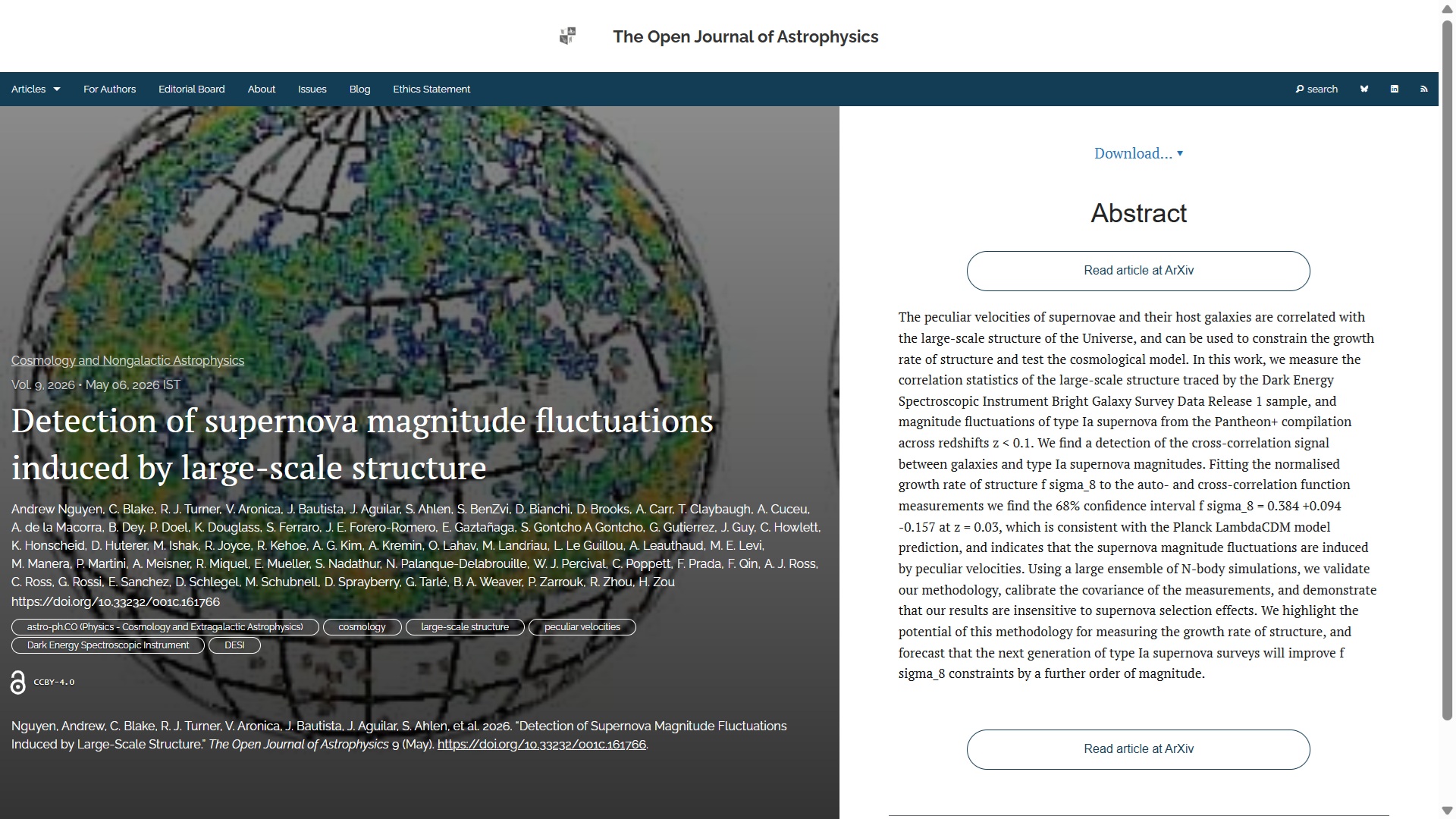
The second paper for this week, also Wednesday 6th May, but in the folder Cosmology and Nongalactic Astrophysics is “Detection of supernova magnitude fluctuations induced by large-scale structure” by Andrew Nguyen (Swinburne Institute of Technology, Australia) and 58 others based all around the world. This study uses supernovae and galaxy velocities to measure the universe’s structure growth rate, confirming the Planck LambdaCDM model prediction. The methodology is validated and shows potential for future research.
The overlay for this one is here:
The official version of the paper can be found on arXiv here and the Fediverse announcement here:
New Publication at the Open Journal of Astrophysics: "Detection of supernova magnitude fluctuations induced by large-scale structure" by Andrew Nguyen (Swinburne Institute of Technology, Australia) and 58 others based all around the world.
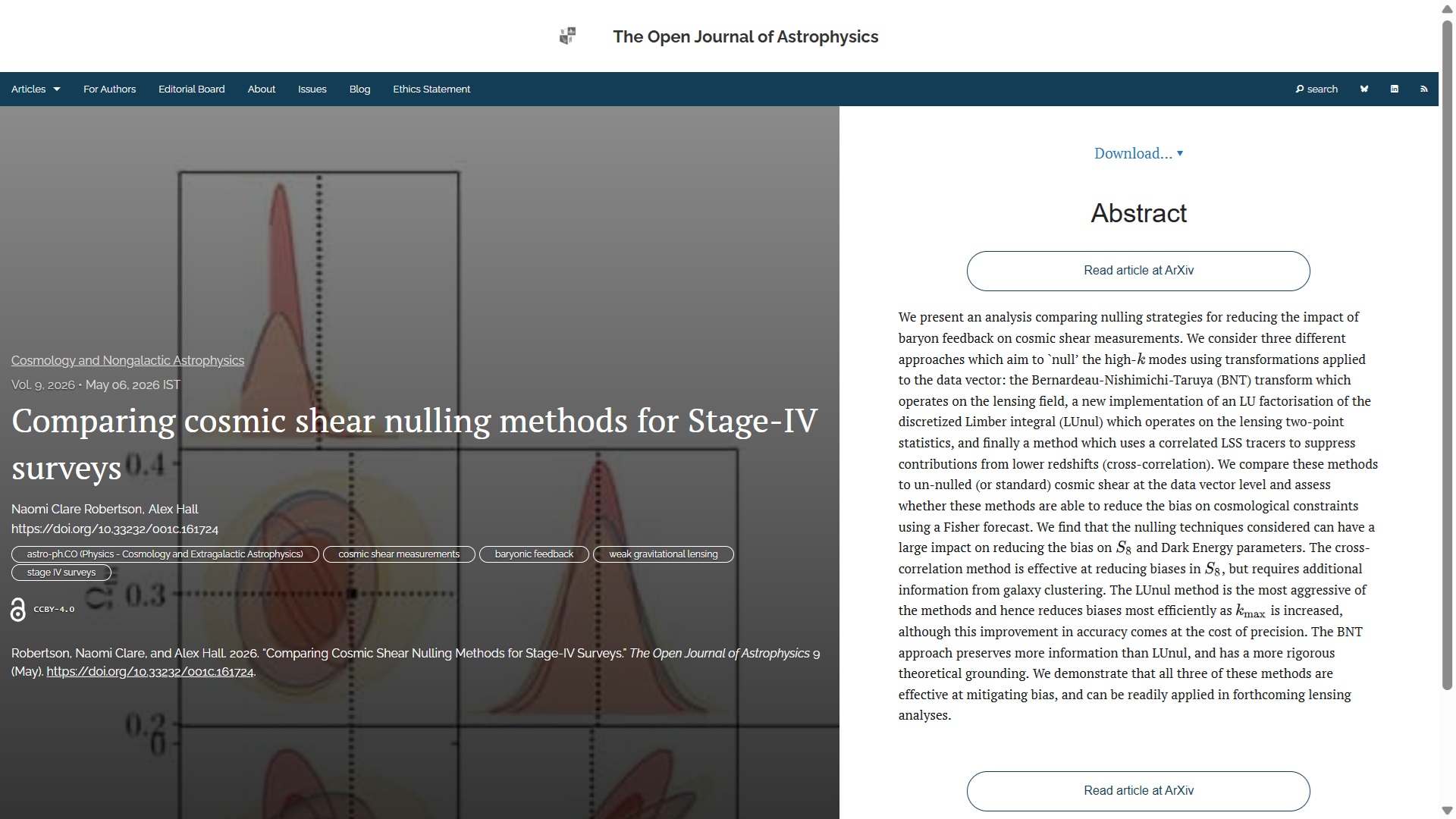
Next one up, the third paper of the week, also published on Wednesday 6th May in the folder Cosmology and Nongalactic Astrophysics is “Comparing cosmic shear nulling methods for Stage-IV surveys” by Naomi Clare Robertson and Alex Hall (University of Edinburgh, UK). This study compares three strategies for reducing baryon feedback impact on cosmic shear measurements. All methods effectively mitigate bias, with varying degrees of efficiency and information preservation.
The overlay for this one is here:
The final, accepted version can be found on arXiv here and the Mastodon announcement is here:
New Publication at the Open Journal of Astrophysics: "Comparing cosmic shear nulling methods for Stage-IV surveys" by Naomi Clare Robertson & Alex Hall (U. Edinburgh, UK)
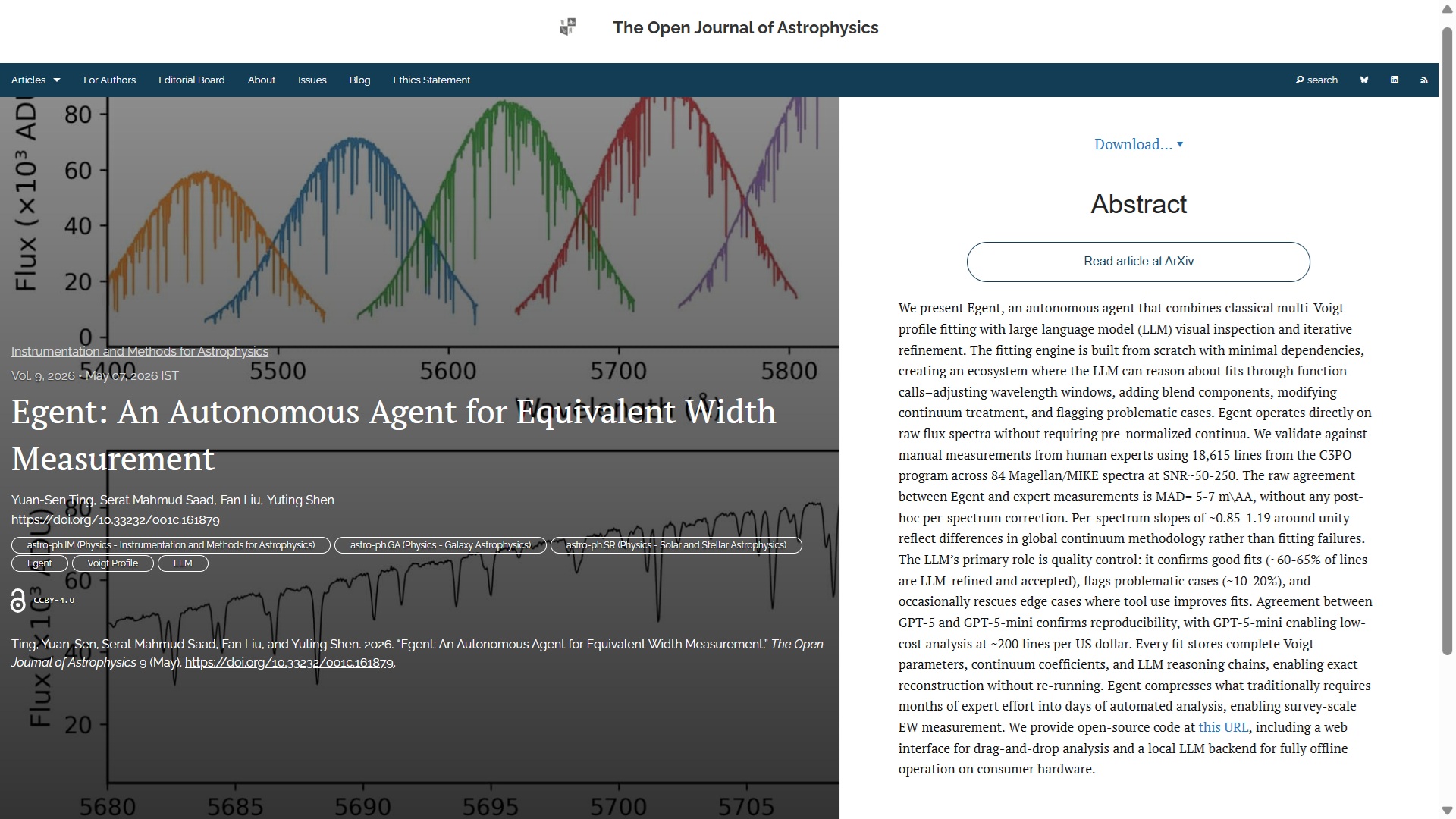
The fourth paper this week, published on Thursday May 7th, is “Egent: An Autonomous Agent for Equivalent Width Measurement” by Yuan-Sen Ting & Serat Mahmud Saad (Ohio State University, USA), Fan Liu (National Astronomical Observatories, Beijing, China), and Yuting Shen (Georgia Institute of Technology, USA). Egent is an autonomous agent that combines multi-Voigt profile fitting with large language model visual inspection for efficient, automated analysis of raw flux spectra, validated against expert measurements. This one is in the folder Instrumentation and Methods for Astrophysics. The associated software can be found here.
The overlay is here:
The officially accepted version can be found on arXiv here and here is the Mastodon announcement:
New Publication at the Open Journal of Astrophysics: "Egent: An Autonomous Agent for Equivalent Width Measurement" by Yuan-Sen Ting & Serat Mahmud Saad (Ohio State U., USA), Fan Liu (National Astronomical Observatories, China) and Yuting Shen (Georgia Institute of Technology, USA)
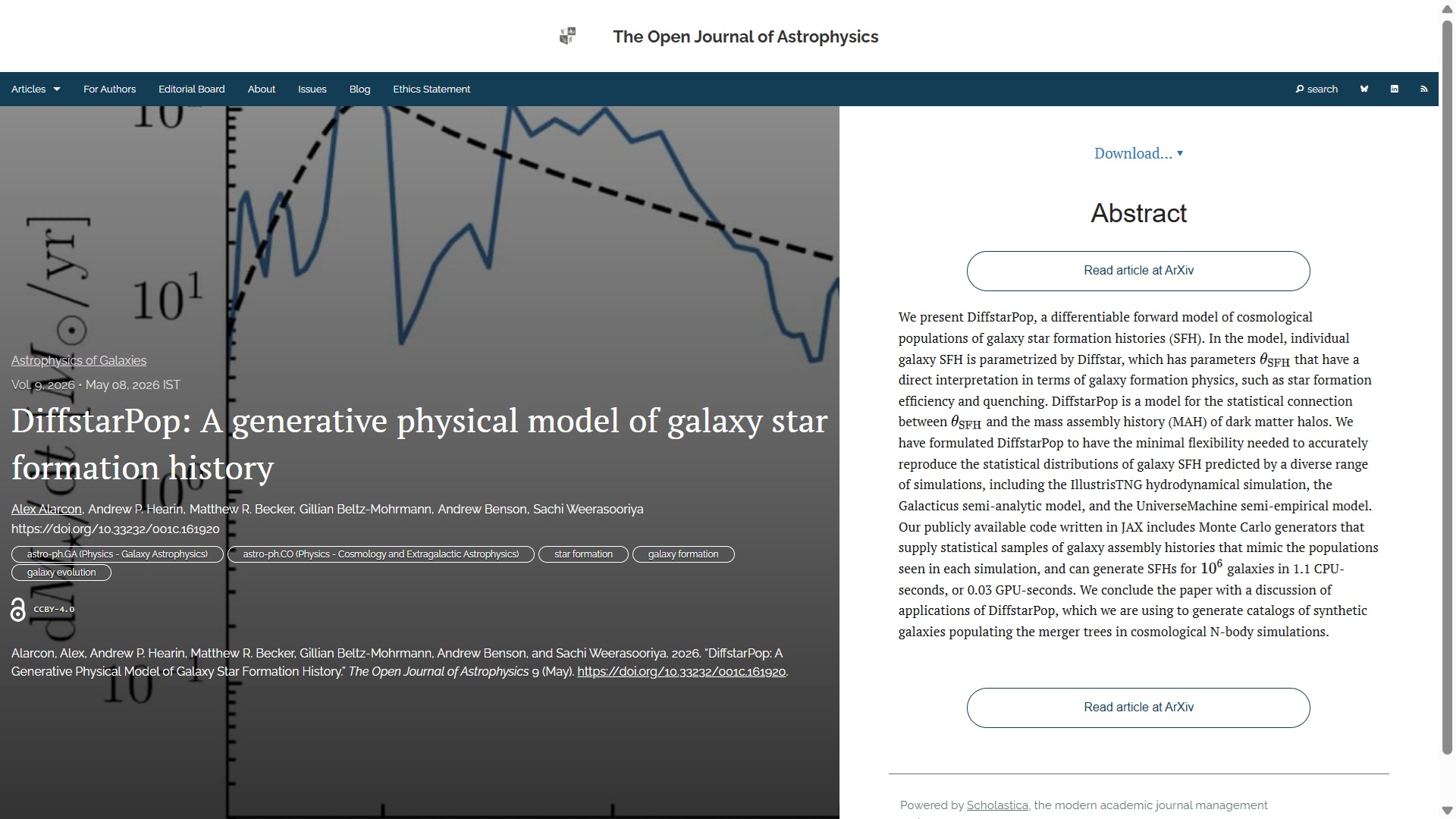
The fifth and final article of this week was published on Friday 8th May in the folder Astrophysics of Galaxies. The title is “DiffstarPop: A generative physical model of galaxy star formation history” and it is by Alex Alarcon (Institute of Space Sciences, Barcelona, Spain), Andrew P. Hearin , Matthew R. Becker & Gillian Beltz-Mohrmann (Argonne National Laborarory, USA), and Andrew Benson & Sachi Weerasooriya (Carnegie Observatories, USA). DiffstarPop is a model that accurately and rapidly reproduces statistical distributions of galaxy star formation histories (SFH), using parameters related to galaxy formation physics.
The overlay is here:
You can find the authorized version of this paper on arXiv here and the Fediverse announcement is here:
New Publication at the Open Journal of Astrophysics: "DiffstarPop: A generative physical model of galaxy star formation history" by Alex Alarcon (Institute of Space Sciences, Barcelona, Spain), Andrew P. Hearin , Matthew R. Becker & Gillian Beltz-Mohrmann (Argonne National Laborarory, USA), and Andrew Benson & Sachi Weerasooriya (Carnegie Observatories, USA)
The views presented here are personal and not necessarily those of my employer (or anyone else for that matter).
Feel free to comment on any of the posts on this blog but comments may be moderated; anonymous comments and any considered by me to be vexatious and/or abusive and/or defamatory will not be accepted. I do not necessarily endorse, support, sanction, encourage, verify or agree with the opinions or statements of any information or other content in the comments on this site and do not in any way guarantee their accuracy or reliability.