Invigilator Training?
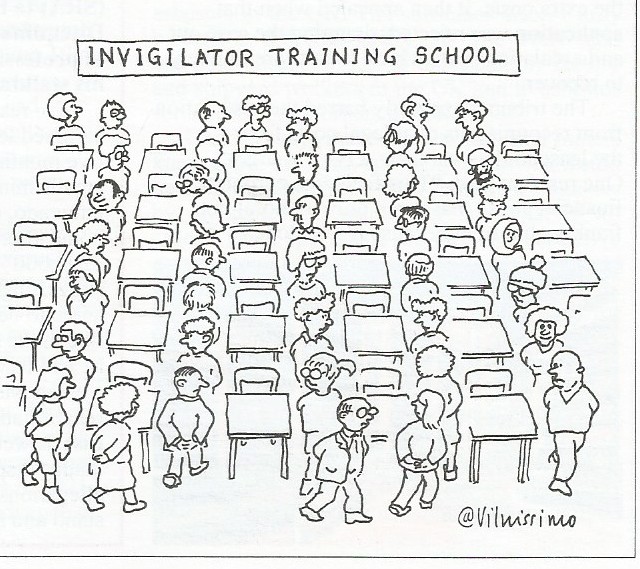
I saw the above cartoon in the latest Private Eye and, with Repeat Examinations rapdily approaching I thought I’d share it here without permission.
Years ago, academic staff had to invigilate their own examinations. I had to do this in my first teaching job at Queen Mary and, later, at Nottingham, but more recently the job has generally been done by support staff rather than academics. I moved from Nottingham to Cardiff in 2007 and don’t think I ever had to invigilate examinations there, so I haven’t done it for almost twenty years. Nowadays we are just expected to be “on call” to deal with any queries that arise in the Exam Hall by phone.
The cartoon reminded me of one of the funniest April Fool jokes I can recall. I think it was when I was at Queen Mary, but it’s so long ago I can’t remember who was responsible. Anyway, whichever colleague it was sent an email to all academic staff passing on what appeared to be a message from the University Management stating that all staff would be required to attend a compulsory day-long invigilator training workshop, including a “role play” session (the mind boggles). This message managed to trigger a significant number of staff members who made use of the “ReplyAll” on their email to vent their outrage at such a waste of time. It was a good April Fool, because the idea of it was quite plausible. Most April Fools are far too obvious.
Anyway, I’m not sorry that I no longer have to perform the task of exam invigilation, as it was always one of my least favourite jobs, and not only because I don’t enjoy seeing people under stress. Initially I thought supervising an examination might allow me time to do something useful, but there always seemed to be some interruption, such as students wanting an extra answer book, or asking about some issue with the examination paper, or wanting to leave to go to the toilet, etc.
The most dramatic interruption I can remember was when a student who suffered from epilepsy had a seizure in the examination hall. Fortunately we invigilators had been briefed as to what to do in such an eventuality, namely to move the furniture so the student didn’t hurt themselves but otherwise not to intervene until they went to sleep – which usually happens after a minute or two. This was done about 15 minutes before the exam started, not in a day-long training session. We were told that such an episode was unlikely as the student was taking medicine to prevent them occurring. It was quite when it actually happened, but happily the student recovered quickly and was perfectly OK afterwards. Apparently he had been so busy preparing for the examination that day he had forgotten to take his medication in the morning.
Having given up on the idea of doing some other work during an examination, I used to take a few crosswords to do. These are good for passing the time because you can solve a few clues then pause to look around the hall. Other things I used to do included walking around counting the number of right-handed and left-handed students, for example, though I never did any detailed statistical analysis of the results.
The primary purpose of invigilation is to prevent cheating or other misbehaviour, and I only ever saw a few examples of that – most of them involving calculators with, e.g., graph-plotting facilities which are not allowed.
Anyway, I’m glad I no longer have to invigilate examinations, and that makes me all the more grateful for the people who do. Here in Maynooth there are three examinations per day during the Examination Period, with a brief period between to put out the next set of papers, which means a long day for those who do this job. Hats off to the staff of the Exams Office at Maynooth who carry out this thankless task three times a year!


Leave a Reply