R.I.P. Jason Arday (1985-2026)

I read the terrible news about the death of Jason Arday on Friday evening. The first thing I want to do is express heartfelt condolences to his family – especially his wife and two children – and his friends and former colleagues and my hope that the media who hounded Prof. Arday to his death will at least give them some space to mourn his loss.
The word “tragedy” is often misused, applied to any event that is sad which this certainly is. The case of Jason Arday is a true tragedy in the sense arising from Greek drama: the central protagonists are always flawed characters who makes bad decisions, but are propelled relentlessly towards their fate by forces entirely beyond their control. Once the right-wing media lynch mob got hold of this story they were never going to back off. This is just some of the coverage from one newspaper, The Daily Telegraph.
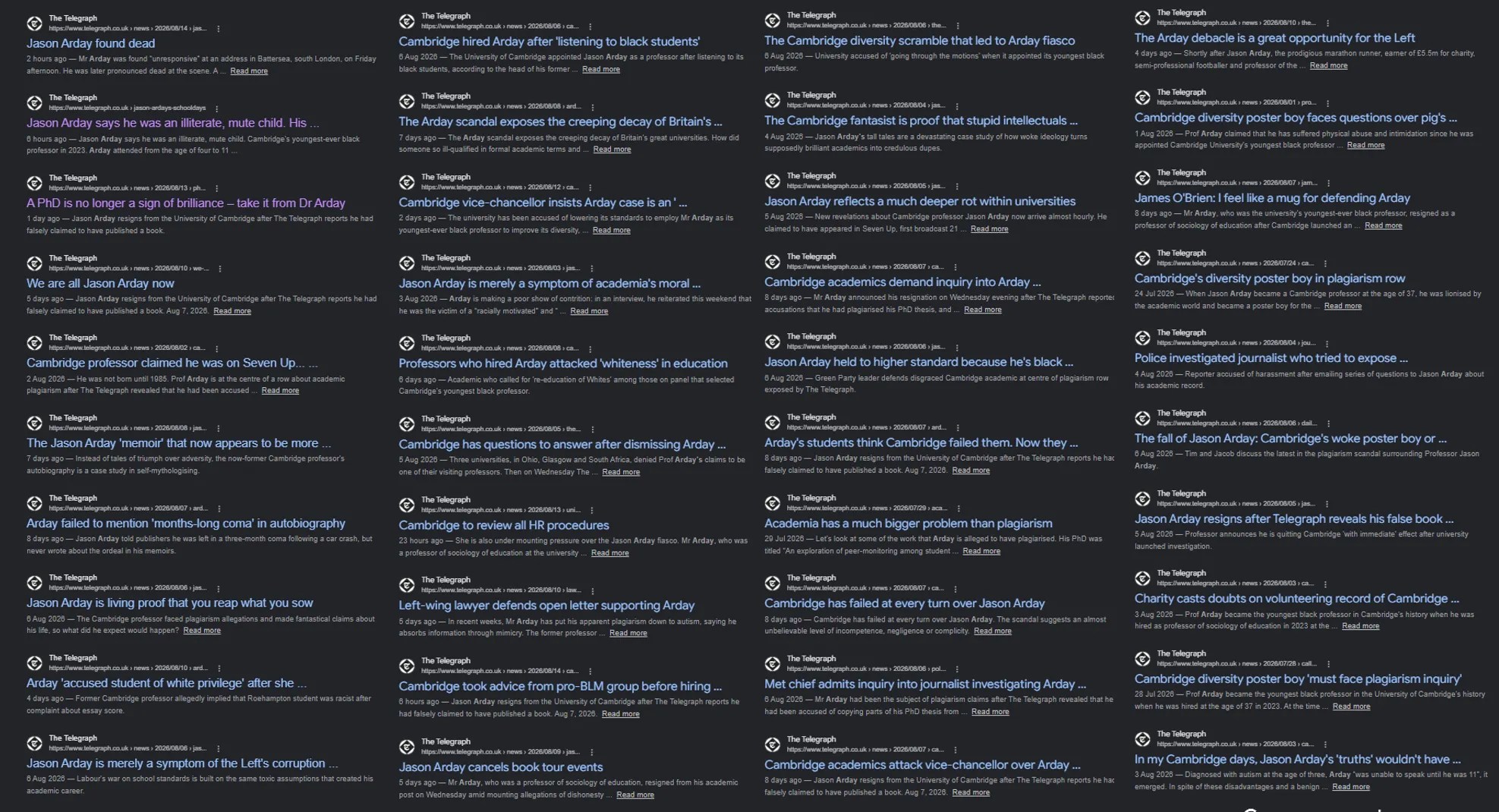
Yes, Arday did bad things, but the media attention was utterly disproportionate. Nobody could be expected to withstand such treatment. How did the people churning out these articles think this would end?
I find this whole saga bleaker than anything Sophocles wrote, because nobody comes out of it with any credit at all. Not Arday himself, nor Cambridge University, nor the press, nor Nathan Cofnas, the white supremacist blogger who brought everything out into the open. The latter may have exposed academic misconduct, but his motivation was rooted in his racist views and undoubtedly malicious.
Of course academic misconduct is wrong, but it does not warrant a death sentence. And where was the media furore when a (white) History professor at Cambridge, William O’Reilly, was found to have plagiarised his own students essays? Professor O’Reilly, incidentally, remains in post. That’s just one example. I’m sure there are dozens more that we know nothing about, because they couldn’t be used to further racist ends. If standards are not applied equally then they can be used to reinforce prejudice, as they have in this case. It’s called hypocrisy.
The usual Culture Warmongers are using this case to further their agenda against the principles of Equity, Diversity and Inclusion which are supposed to be adopted in universities and other institutions. For myself, this tragedy demonstrates that EDI* principles are not satisfied by mere tokenism, a facile form of window-dressing that does nothing to change the culture within the organisation.
(*For any Americans reading this I use the UK/European EDI in preference to the DEI used in the States which reminds me too much of OPUS DEI.)
In a slightly different context, this is why I have become cynical about the “widening participation” efforts by many higher-education institutions to recruit students from disadvantaged backgrounds. These may succeed in bringing more such students into courses – and hence greater income to the university – but they are rarely backed up by the support needed to enable them to succeed. Many institutions do not even track the outcomes of these students, not because they can’t but because The Management doesn’t care: once they’re in through the door that’s “job done”.
I came from what some people would call a disadvantaged background, although I don’t think of it that way. That I have had a career in academia is a result of an enormous amount of luck, starting way back in primary school. I would dearly like to see a system in which luck wasn’t so important, but what is being done now is not the way to achieve that. If we’re going to do EDI – and we should – let’s do it properly.
UPDATE: 20/8/2026. Nathan Cofnas has been suspended by Gent University pending a disciplinary process.


August 16, 2026 at 4:44 pm
I deeply regret Jason Arday’s suicide, and for me this affair is about academic standards; I regret any diversion of it into left v right or black v white. But I do regard Arday as the architect of his own misfortune. He was granted a PhD for a thesis that Nathan Cofnas’s substack article proved to contain extensive plagiarism. Arday responded that he “relied on using mimicry to make sense of information”. But he was knowingly publishing information under his own name using mimicry, which is a lot more than making sense of it. And although I don’t know whether he personally initiated the processes that caused a journalist asking awkward questions to be silenced by libel lawyers and then warned off by the police, and that led to accusations of racism against students who found his supervisions inadequate and asked for a change, I do not believe those things would have happened had Arday not cleared them. If you can’t take it – and some of us can’t – then for heaven’s sake don’t dish it out, because it might come back to bite you.
At the personal level this is tragedy. It would not have happened, however, had the board at Cambridge who hired him conducted due diligence, as I am sure they are now aware.
August 17, 2026 at 2:33 pm
It is a terrible case. Anton seems to be putting much of the blame on Arday but the University could have helped him a lot more. Once the allegations surfaced, Cambridge should have handled this quickly and internally. They then would have options available, including providing more training to him if that would help. Liverpool I think did it correctly, investigating quickly and they decided in favour of the PhD being awarded. Cambridge let the outside pressure get out of hand. They had reasons to hire Arday, and once hired Cambridge had a duty of care towards him. That was failed badly. The staff may be wondering, who will be next?
August 18, 2026 at 9:39 pm
Nathan Cofnas has given us some clues on who will be next, in a recent interview on youtube with one Rob Montz. The interview ends with Nathan Cofnas saying of himself “After the revolution, I’ll be the head of the department of eugenics and race science at Harvard maybe.”
August 18, 2026 at 11:40 pm
By all public accounts Cambridge, having hired Arday, backed him to the hilt right up to the moment of his resignation, at which point they had no further duty of care. Given that the allegations against him were made in the public domain, Cambridge had no control over the outside pressure on him. They made one mistake only, but a big one: hiring a man unfit to hold the position he did.
For which Liverpool John Moores has some culpability. Cambridge could reasonably expect that Arday’s doctoral thesis was up to the mark given that LJM had awarded it. Yet it was packed with plagiarism. Nobody has disputed the revelations of plagiarism which were posted in Cofnas’ substack article. Am I right in presuming that Arday’s thesis contained the usual declaration that it was all original work except where stated and referred to?
August 20, 2026 at 11:59 am
Surely LJM has disputed it by the fact they did an investigation and concluded Arday had no case to answer on the alleged plagiarism in the thesis?
August 20, 2026 at 12:12 pm
Read Cofnas’ article, which gives extensive examples, and decide that for yourself.
For all I know, plagiarism might be acceptable in sociology in a way it is not in history, classics or physics. But what would that say?
August 20, 2026 at 11:14 am
Being in a very different subject area in a different ivory tower, I personally have no insight into decisions at Liverpool John Moores or Cambridge, but there is a general point worth noting.The passages quoted by Cofnas would all be considered plagiarism by the usual rules. But without subject knowledge I at least cannot tell whether any one extract is (a) not claimed as original but not paraphrased enough [and nowadays could be trivially fixed by AI], or (b) claimed as original and thus taking credit for someone else’s work.The usual rules seem to give more weight to not-paraphrased-enough (which can be detected by software) than to taking someone else’s due (which may require domain knowledge). I assume we agree though, that the latter is more serious.Note that the separate case mentioned by Telescoper, of a professor taking credit for a (past?) student’s work.
August 20, 2026 at 1:30 pm
Not sure why I can’t reply directly….but anyway…
“Read Cofnas’ article, which gives extensive examples, and decide that for yourself.
For all I know, plagiarism might be acceptable in sociology in a way it is not in history, classics or physics. But what would that say?”
I was not making a judgement one way or the other (I have not read the thesis nor Cofnas article). I took issue with:
“Nobody has disputed the revelations of plagiarism”
which is not true given LJM has stated they checked and have a view that there is no plagiarism. So clearly some people say it is and some people say it is not. As you say this could indicate standards at LJM are low rather than no plagiarism.
August 20, 2026 at 5:25 pm
You are right that some have disputed the revelations of plagiarism; thank you for the correction. Rather than discuss whether Liverpool JM were right or wrong, I wish to shortcircuit that and ask: in the light of Cofnas’ documentation of examples, which you can easily check for yourself, do *you* think it was significant plagiarism?
August 20, 2026 at 2:57 pm
Update: Nathan Cofnas is now suspended by Gent University pending a disciplinary investigation.
https://www.ugent.be/en/news-events/statement-respect-human-dignity-opposition-discrimination.htm
August 26, 2026 at 5:46 pm
Strange to say, I once gave an exposition of mimicry as a principle in evolution, in a barebones Internet chat session; not using social media, I couldn’t see who I was addressing. Yes it could have been Jason;; and I’m recalling this to highlight the distinction between mimicry and plagiarism: it’s a technique of compliance rather than appropriation, but still less than original.
I was interested in the pattern information involved, which seems to set information in life science apart from the well-known Shannon information. (Over a finite alphabet that’s categorically NOT an entropy in the sense of Boltzmann). But now I find. a Mexican researcher in logic, OAM Perez, reviving Frank Ramsey’s way of representing negation by spatial inversion, which then bridges the gap to nature.
At issue here is Shannon’s redundancy, the shadow of predictable linguistic and social form around his information as news or events. Redundancy is horribly neglected in current information philosophy, which accordingly rings hollow and semantically vapid, creating a treacherous haze of ambiguity over social discourse, in which Jason’s tragedy unfolded.
Perez on the riddle of redundancy finds a trade-off between redundancy and arbitrariness in the use of terms; and on such terms we pass back into the game of rhetoric, where philosophy got under way in ancient times. There the voice of Nature from Nubia past Egypt registered in Jeremiah, and the Wisdom tradition through to Aristotle.
September 10, 2026 at 2:07 pm
It is worth looking at the 25min YouTube interview titled “The professor who warned Cambridge about Jason Arday” uploaded to the ‘CAF – Council for Academic Freedom’ channel. Emeritus professor of sociology David Harris was writing a book (not a negative one) about Critical Race Theory, heard of Jason Arday as a rising star, read some of his work, and emailed him courteously about repetition in his work. The response was a warning letter from libel lawyers Carter-Ruck referring to Arday as ‘our client’. When Harris replied to Arday, contrary to Arday’s request and still maintaining professional courtesy, Harris was referred to police for harassment. All of this was private correspondence long before Cofnas became involved and the consequent media pile-on.
The exoneration by Liverpool John Moores University of Arday when plagiarism in his PhD thesis was claimed is surely worth investigating. His research supervisor there was Phil Vickerman, who is interviewed on LJM’s website in a 2022 article titled “Meet Phil Vickerman – Pro-Vice Chancellor for Student Experience”.