Weekly Update from the Open Journal of Astrophysics 11/07/2026
Back home to Maynooth, just in time for another Saturday update of activity at the Open Journal of Astrophysics. Since the last update we have published a further nine papers, bringing the number in Volume 9 (2026) to 145 and the total so far published by OJAp up to 593.
I will continue to include the posts made on our Mastodon account (on Fediscience); these announcements also show the DOI for each paper.
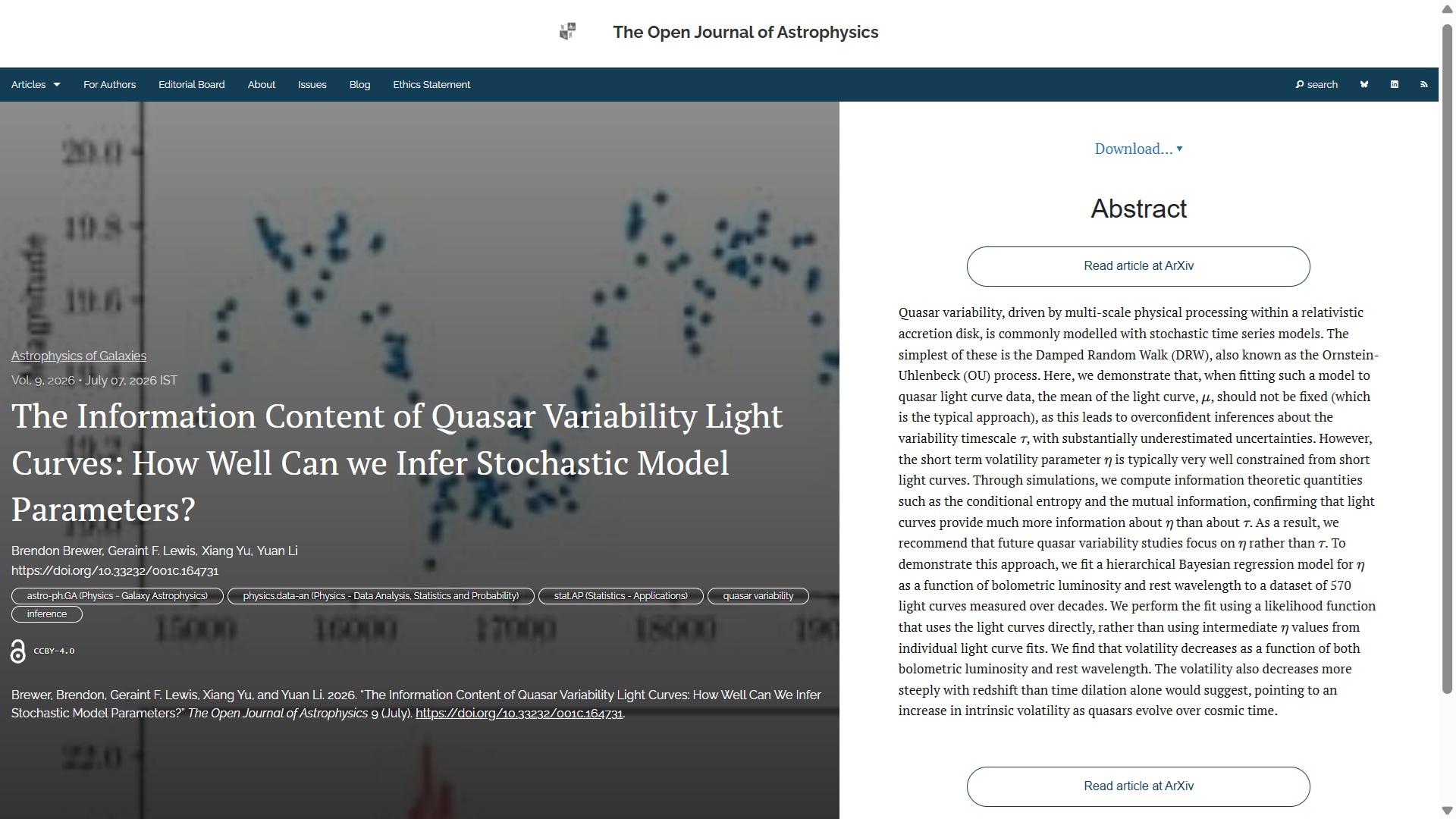
The first paper to report this week, published on Tuesday 7th July, is “The Information Content of Quasar Variability Light Curves: How Well Can we Infer Stochastic Model Parameters?” by Brendon Brewer (U. Auckland, NZ), Geraint F. Lewis (U. Sydney, AU), Xiang Yu & Yuan Li (Auckland). Published in the folder Astrophysics of Galaxies, this study suggests that quasar variability studies should focus on the short term volatility parameter, as it’s more informative than the variability timescale. Volatility decreases with redshift suggesting intrinsic effects.
The overlay for this paper is here
You can find the officially accepted version on arXiv here and the announcement on Fediverse here:

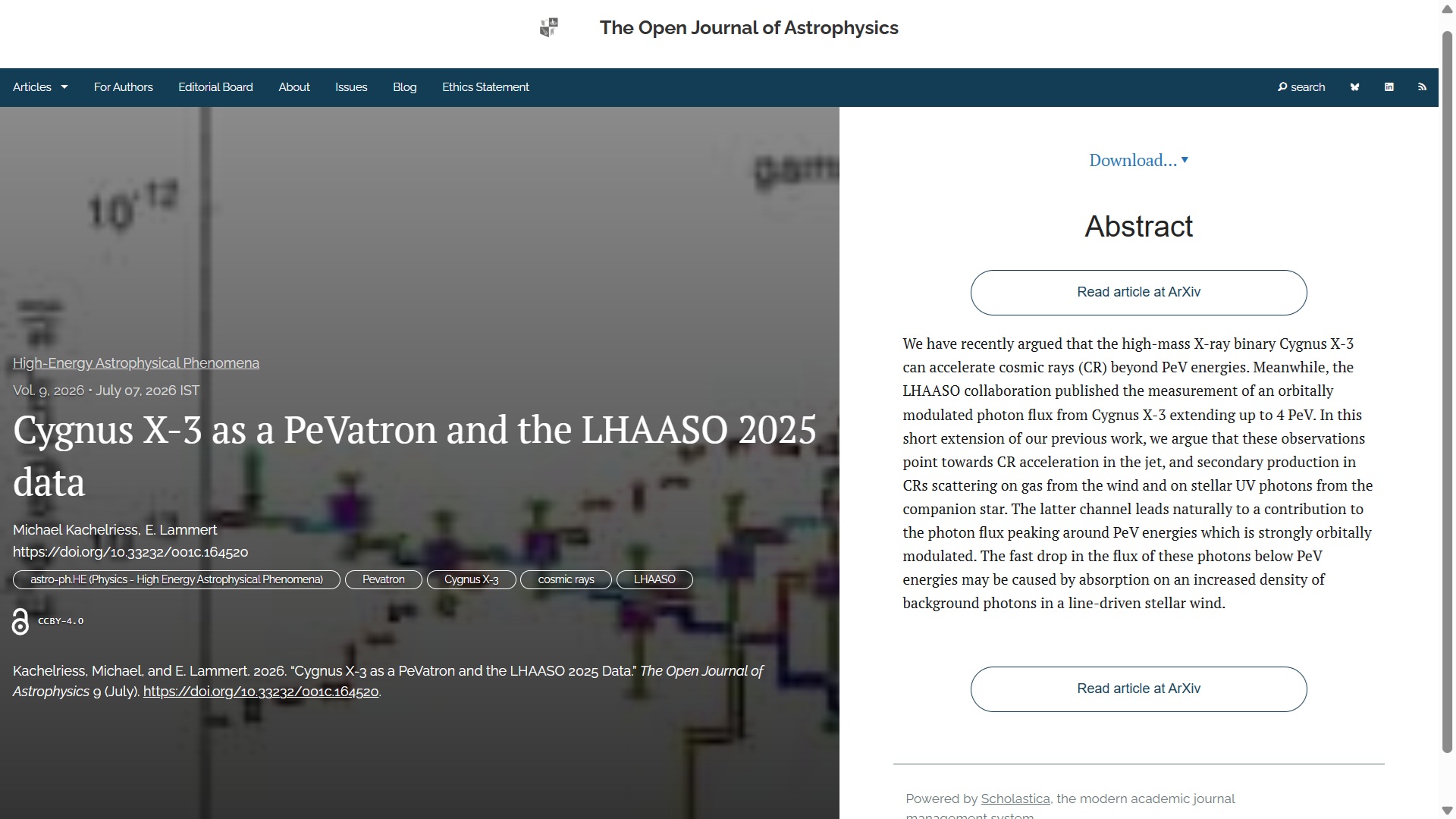
The second paper for this week, also published on Tuesday 7th July, but in the folder High-Energy Astrophysical Phenomena, is “Cygnus X-3 as a PeVatron and the LHAASO 2025 data” by Michael Kachelriess & E. Lammert (NTNU, Trondheim, Norway). This paper suggests that the high-mass X-ray binary Cygnus X-3 can accelerate cosmic rays beyond PeV energies, contributing to a photon flux peaking around PeV energies.
The overlay looks like this:
The official version of the paper can be found on arXiv here and the Fediverse announcement here:
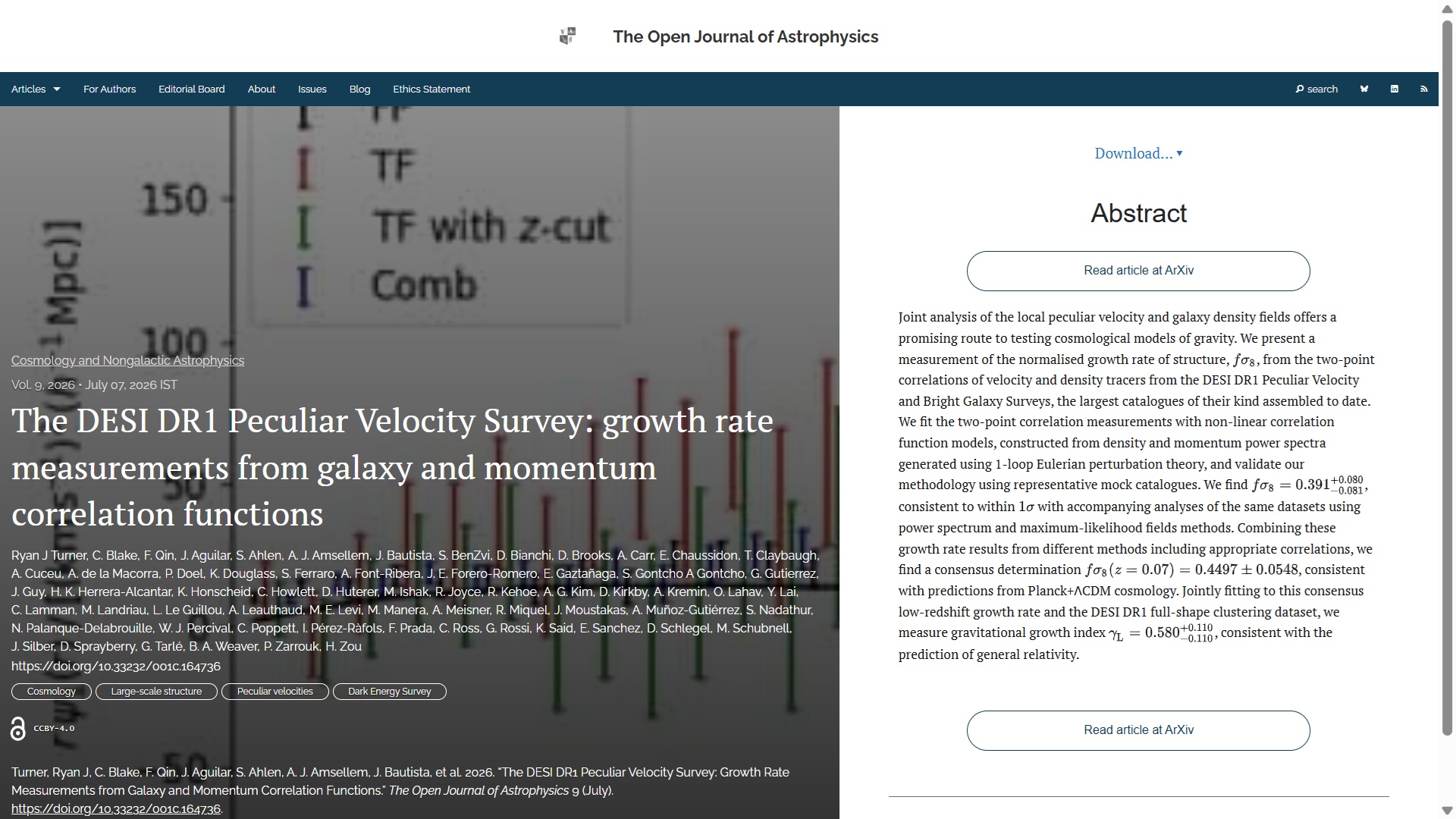
The third paper of the week, also published on Tuesday 7th July, but in the folder Cosmology and Nongalactic Astrophysics is “The DESI DR1 Peculiar Velocity Survey: growth rate measurements from galaxy and momentum correlation functions” by Ryan J Turner (Swinburne Institute of Technology, Australia) and 63 others from around the world. This paper analyzes local peculiar velocity and galaxy density fields to test cosmological models of gravity, finding results consistent with predictions from Planck+ΛCDM cosmology and general relativity.
The overlay for this one is here:
The final, accepted version can be found on arXiv here and the Mastodon announcement is here:
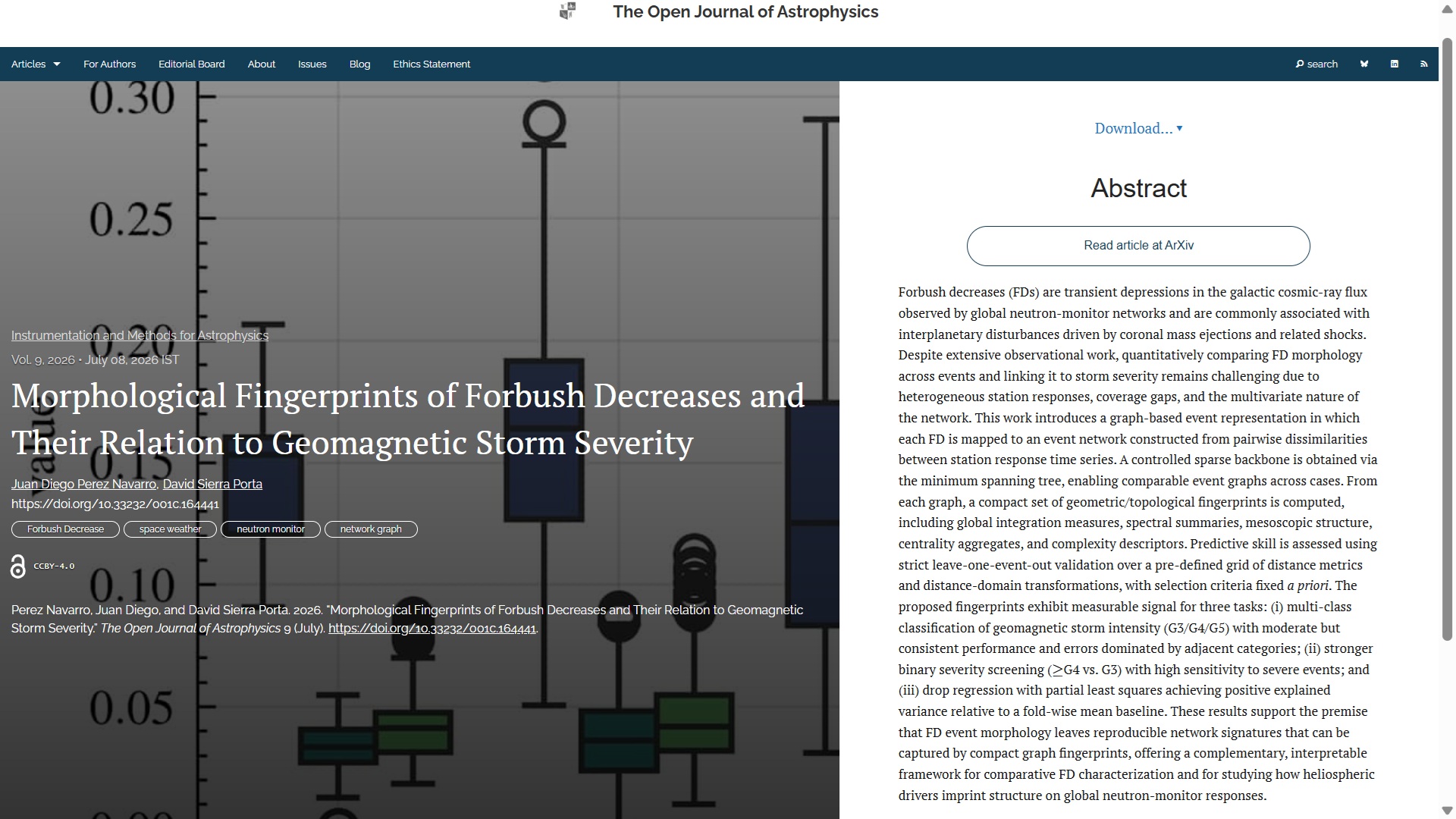
The fourth paper of the week, published on Wednesday 8th July in the folder Instrumentation and Methods for Astrophysics , is “Morphological Fingerprints of Forbush Decreases and Their Relation to Geomagnetic Storm Severity” by Juan Diego Perez Navarro and David Sierra Porta (Universidad Tecnológica de Bolívar, Colombia). This article introduces a graph-based method to analyze Forbush decreases (FDs), transient depressions in cosmic-ray flux, and uses network signatures to predict geomagnetic storm intensity.
The overlay for this one is here:
You can read the final version of this one on arXiv here and the Mastodon announcement is here:
The fifth paper of the week, also published on Wednesday 8th July but in the folder Astrophysics of Galaxies, is “On the connection between galaxy orientation and halo absorption properties” by Rohan Venkat, Soo May Wee, and Hsiao-Wen Chen (U. Chicago, USA). This article investigates the azimuthal dependence of metal-line absorption in the circumgalactic medium of 87 isolated galaxies. The results show no significant correlation between absorption strength and azimuthal angle.
The overlay for this one is here:
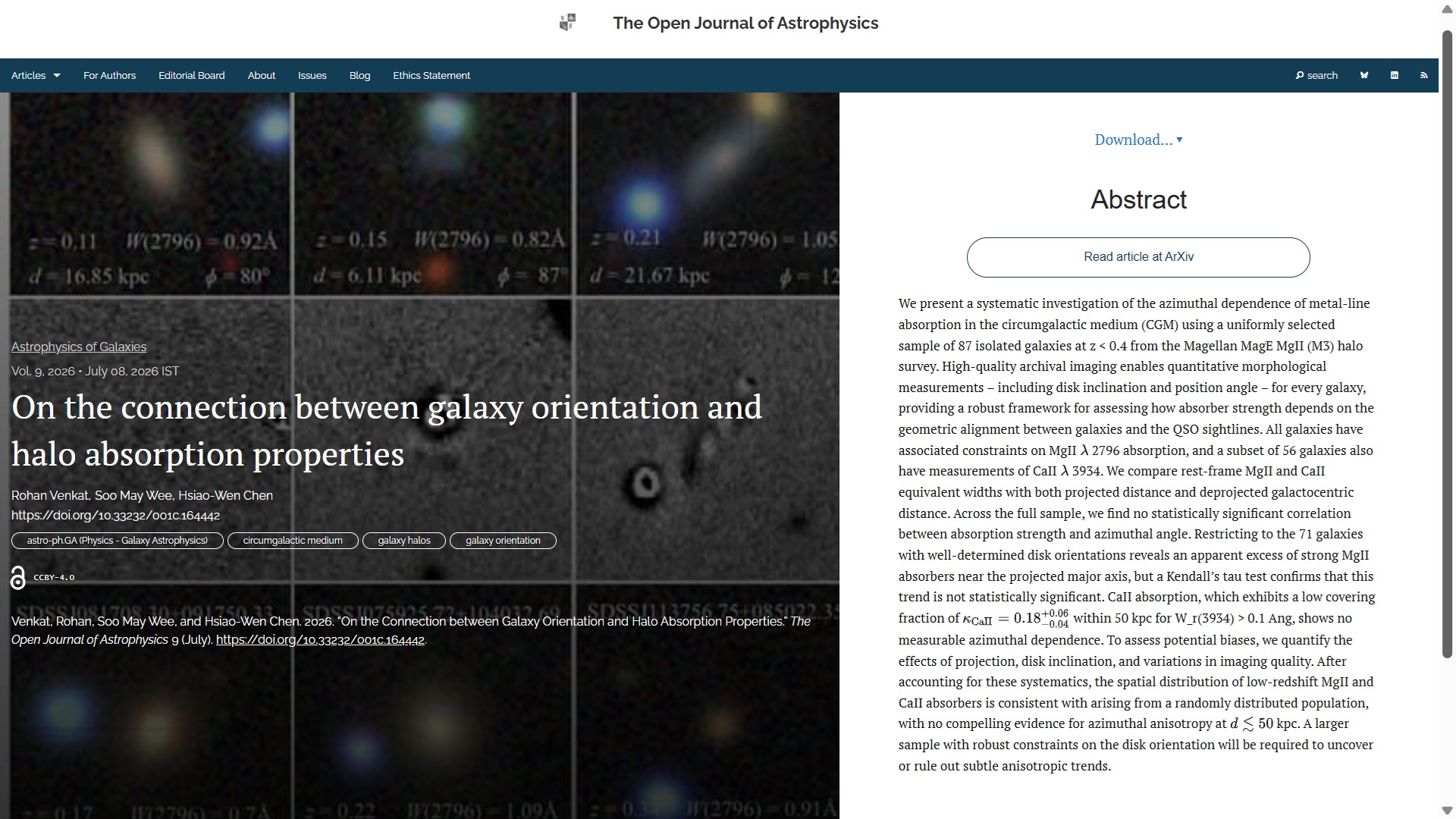
You can read the final version of this one on arXiv here and the Mastodon announcement is here:
The sixth paper of this week is “Searching for Periodicity in FRB 20240114A” by Jonathan I Katz (Washington U., USA). This was published on Thursday 9th July in the folder High-Energy Astrophysical Phenomena. The study described in this paper observed FRB 20240114A, an active Fast Radio Burst, but found no significant periodicity in its bursts, contradicting magnetar models predictions.
The overlay for this one is here:
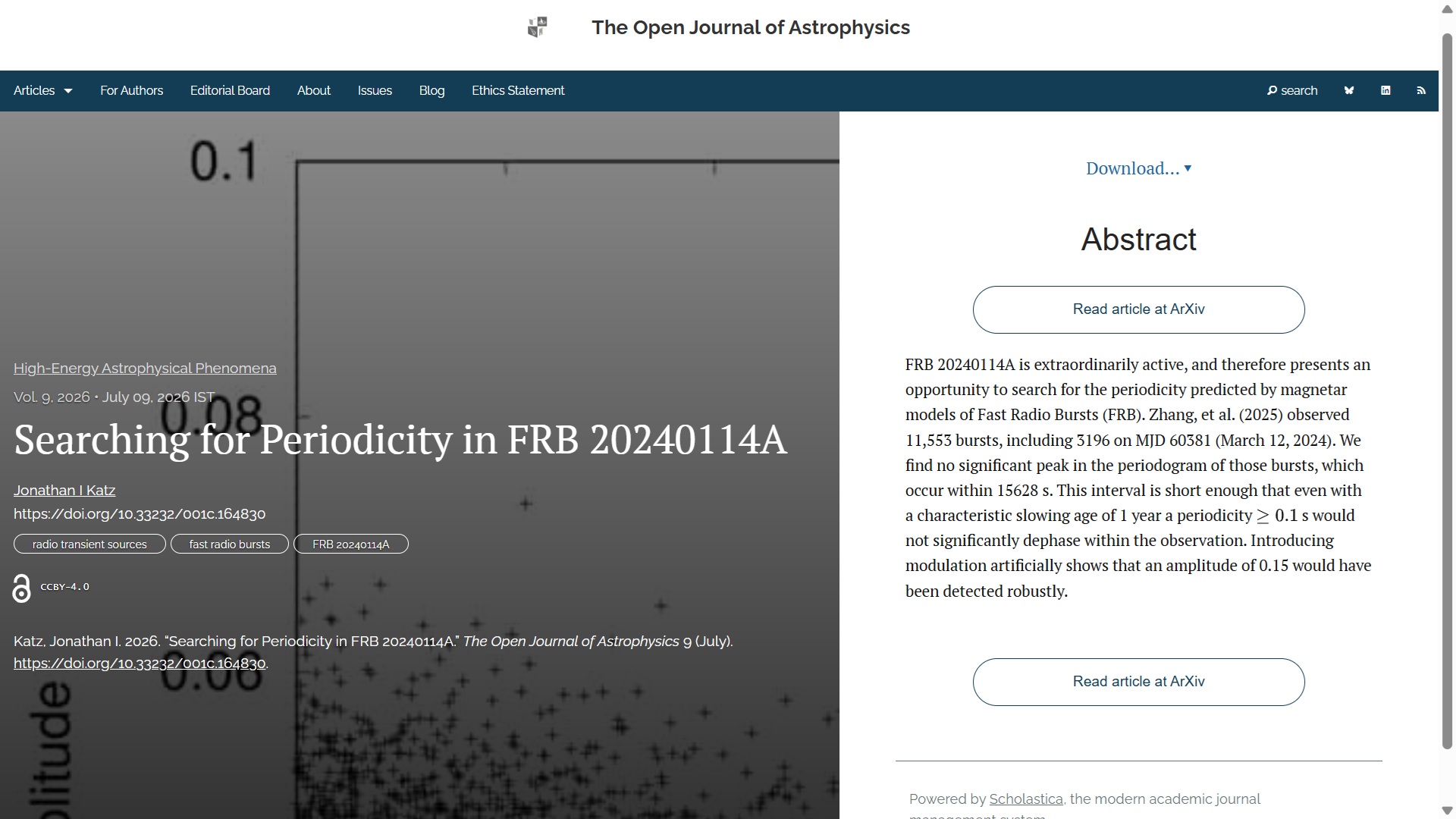
You can find the final accepted version on arXiv here and the Mastodon announcement is here:
The seventh article for this week is “Multiphase gas in Circumgalactic cloud complexes: Insights from kiloparsec-scale Magnetohydrodynamic Turbulence Simulations” by Rajsekhar Mohapatra (Princeton U., USA), Alankar Dutta (MPA Garching, Germany) and Prateek Sharma (Indian Institute of Science, Bangalore). This -paper was also published on Thursday 9th July, in the folder Astrophysics of Galaxies. This paper uses high-resolution simulations to investigate the mass distribution of the circumgalactic medium (CGM), a diffuse gas surrounding a galaxy’s halo with small-scale clumps of cold gas forming in quiescent regions.
The overlay for this one is here:
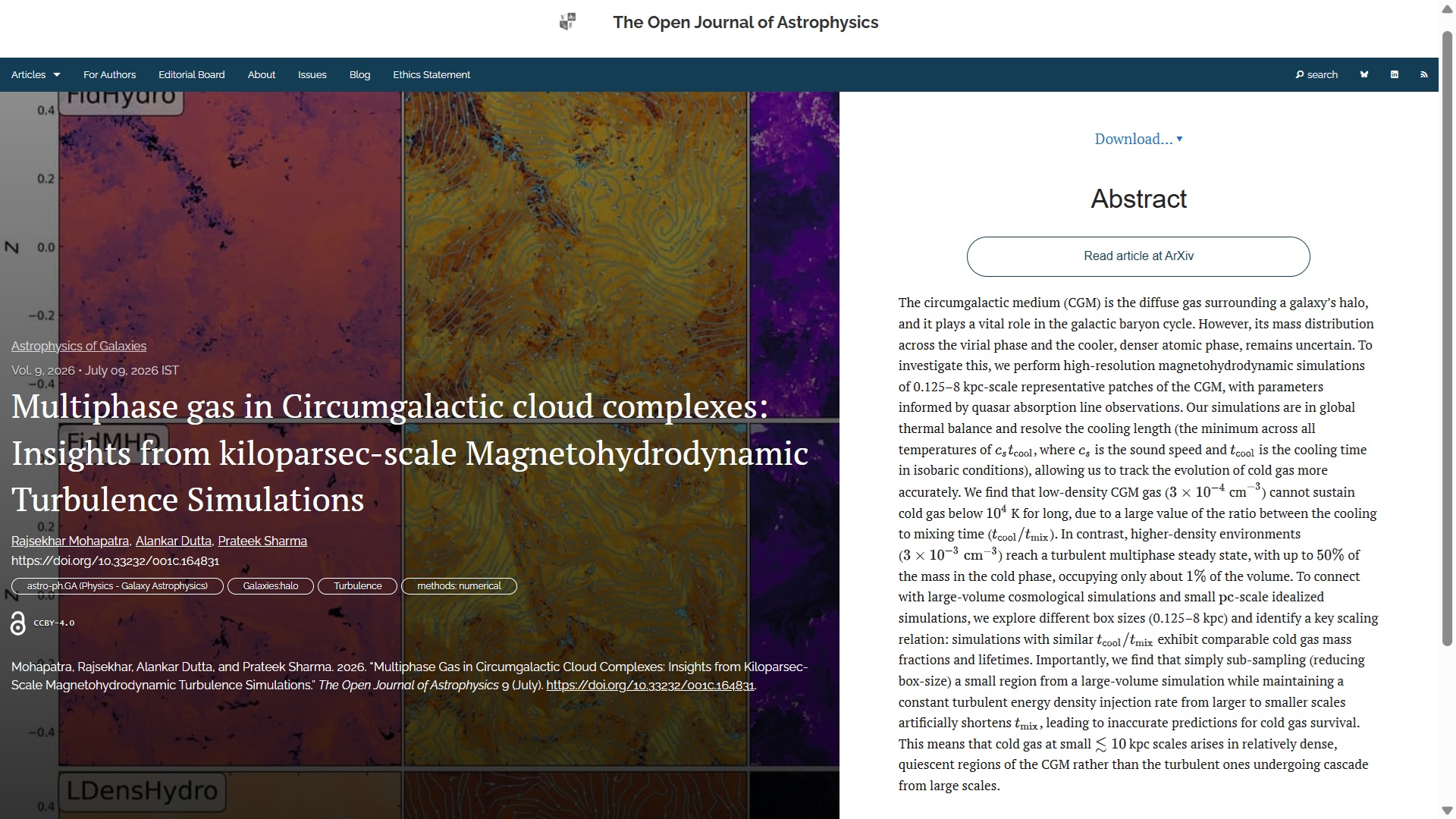
You can find the final accepted version of this one on arXiv here and the Mastodon announcement is here:
The (penultimate) eighth article for this week is “Line-of-sight shear in SLACS strong lenses I: shear and mass model parametrisations” by Natalie B. Hogg (U. Cambridge, UK), Daniel Johnson (U. Montpellier, France), Anowar J. Shajib (U. Chicago, USA) and Julien Larena (Montpellier). This was also published on Thursday 9th July, but in the folder Cosmology and Nongalactic Astrophysics. This article studies models of 23 strong gravitational lenses to measure line-of-sight shear for the first time, providing potential new constraints on cosmological parameters.
The overlay for this one is here:

You can find the final accepted version on arXiv here and the Mastodon announcement is here:
The ninth and last article for this week is “Current and future constraints on the expansion history of the GREA model” by Irene Graziotti (INAF-Osservatorio Astronomico di Capodimonte, Italy), Chiara De Leo (Sapienza University of Rome, Italy) and Matteo Martinelli (INAF-Osservatorio Astronomico di Roma, Italy). This study explores the General Relativistic Entropic Acceleration (GREA) framework, comparing it to the standard description of the universe. Current data favors the standard model, but GREA remains competitive.
The overlay for this one is here:
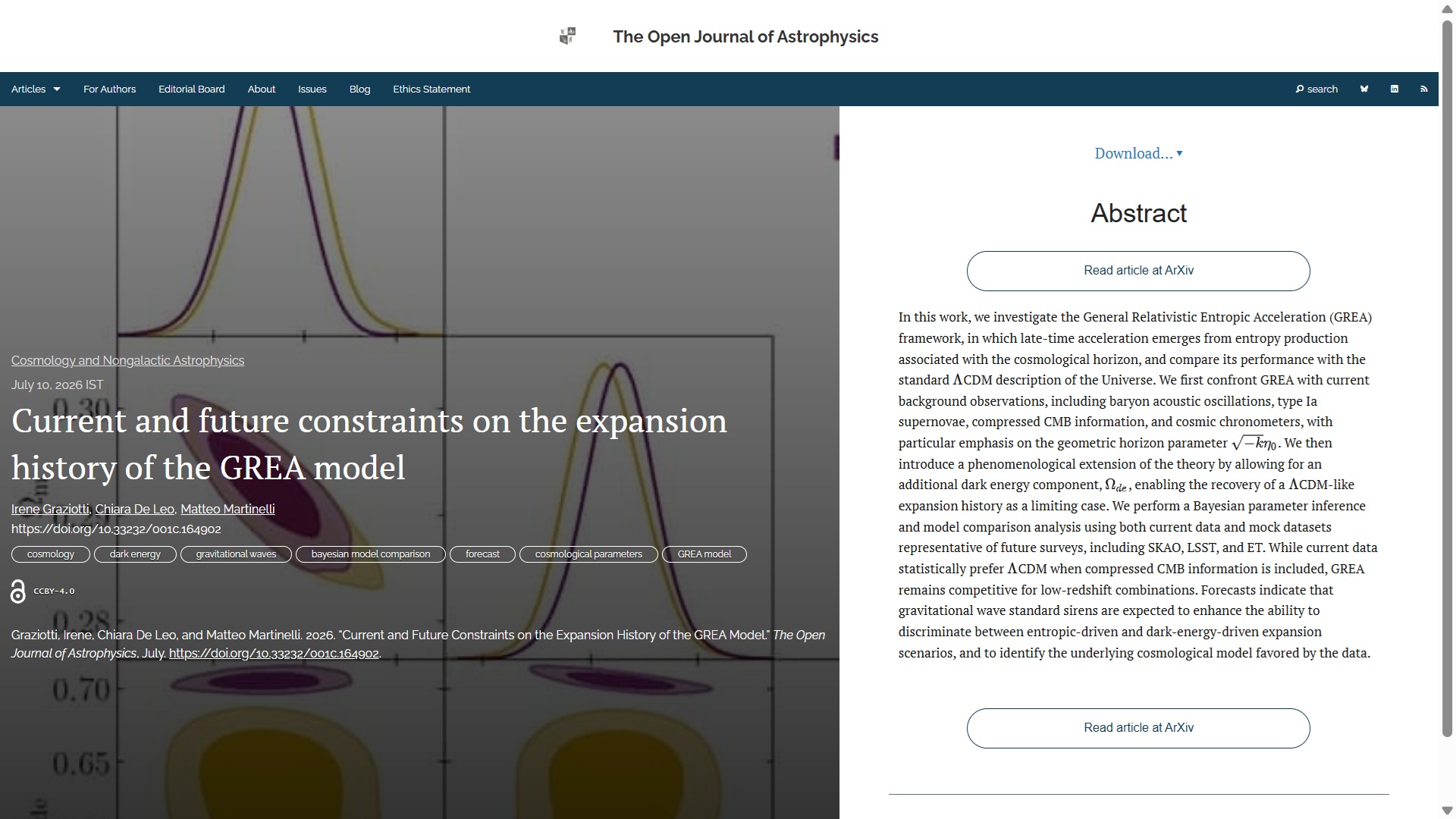
You can find the officially-accepted version on arXiv here and the Mastodon announcement here:
As you can see, it has been a bumper week, especially when you consider that there was no arXiv mailing om Monday July 6th owing to the July 4th holiday in the USA. I should have known this would happen while I was travelling!
 In the Dark
Leave a comment