Archive for cosmological parameters

Weekly Update from the Open Journal of Astrophysics 11/07/2026

Posted in OJAp Papers, Open Access, The Universe and Stuff with tags , , , , , , , , , , , , , , , , , , , , , , , , , , , , , , , , , , , , , on July 11, 2026 by telescoper

Back home to Maynooth, just in time for another Saturday update of activity at the Open Journal of Astrophysics. Since the last update we have published a further nine papers, bringing the number in Volume 9 (2026) to 145 and the total so far published by OJAp up to 593.

I will continue to include the posts made on our Mastodon account (on Fediscience); these announcements also show the DOI for each paper.

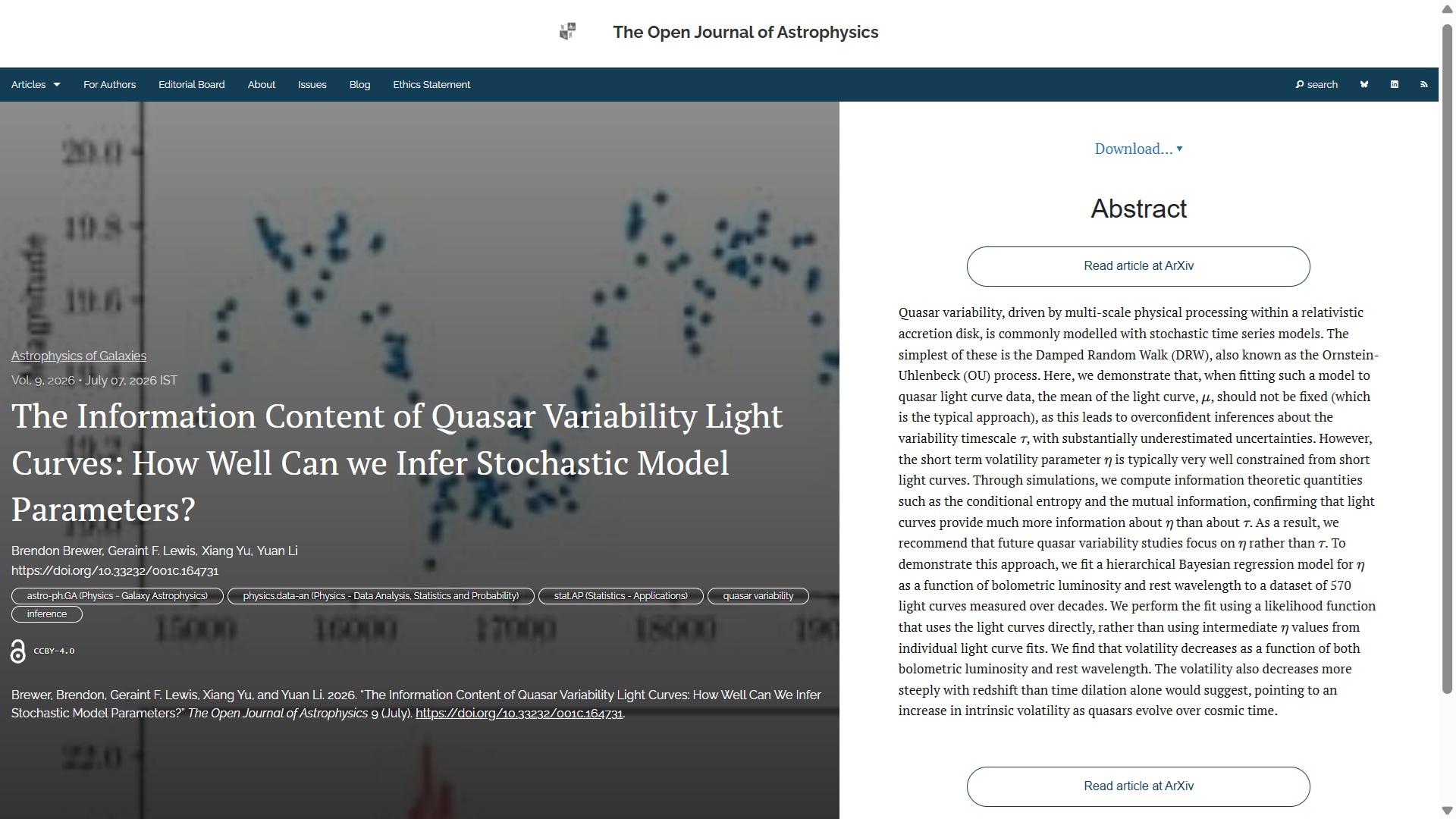
The first paper to report this week, published on Tuesday 7th July, is “The Information Content of Quasar Variability Light Curves: How Well Can we Infer Stochastic Model Parameters?” by Brendon Brewer (U. Auckland, NZ), Geraint F. Lewis (U. Sydney, AU), Xiang Yu & Yuan Li (Auckland). Published in the folder Astrophysics of Galaxies, this study suggests that quasar variability studies should focus on the short term volatility parameter, as it’s more informative than the variability timescale. Volatility decreases with redshift suggesting intrinsic effects.

The overlay for this paper is here

You can find the officially accepted version on arXiv here and the announcement on Fediverse here:

Open Journal of Astrophysics

New Publication at the Open Journal of Astrophysics: "The Information Content of Quasar Variability Light Curves: How Well Can we Infer Stochastic Model Parameters?" by Brendon Brewer (U. Auckland, NZ), Geraint F. Lewis (U. Sydney, AU), Xiang Yu & Yuan Li (Auckland)

doi.org/10.33232/001c.164731

July 7, 2026, 5:48 am 0 boosts 2 favorites

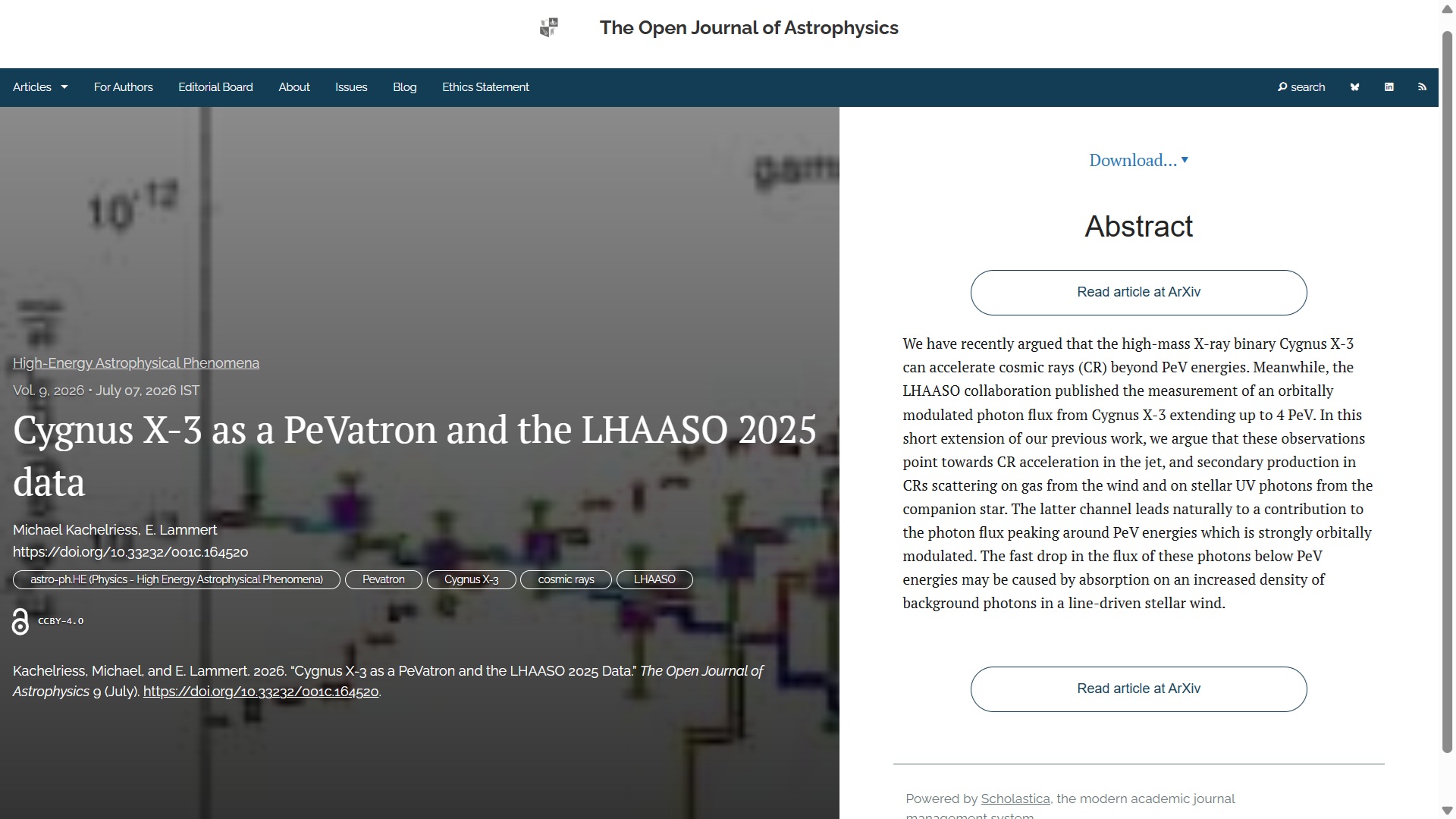
The second paper for this week, also published on Tuesday 7th July, but in the folder High-Energy Astrophysical Phenomena, is “Cygnus X-3 as a PeVatron and the LHAASO 2025 data” by Michael Kachelriess & E. Lammert (NTNU, Trondheim, Norway). This paper suggests that the high-mass X-ray binary Cygnus X-3 can accelerate cosmic rays beyond PeV energies, contributing to a photon flux peaking around PeV energies.

The overlay looks like this:

The official version of the paper can be found on arXiv here and the Fediverse announcement here:

Open Journal of Astrophysics

New Publication at the Open Journal of Astrophysics: "Cygnus X-3 as a PeVatron and the LHAASO 2025 data" by Michael Kachelriess & E. Lammert (NTNU, Trondheim, Norway)

doi.org/10.33232/001c.164520

July 7, 2026, 6:52 am 0 boosts 0 favorites

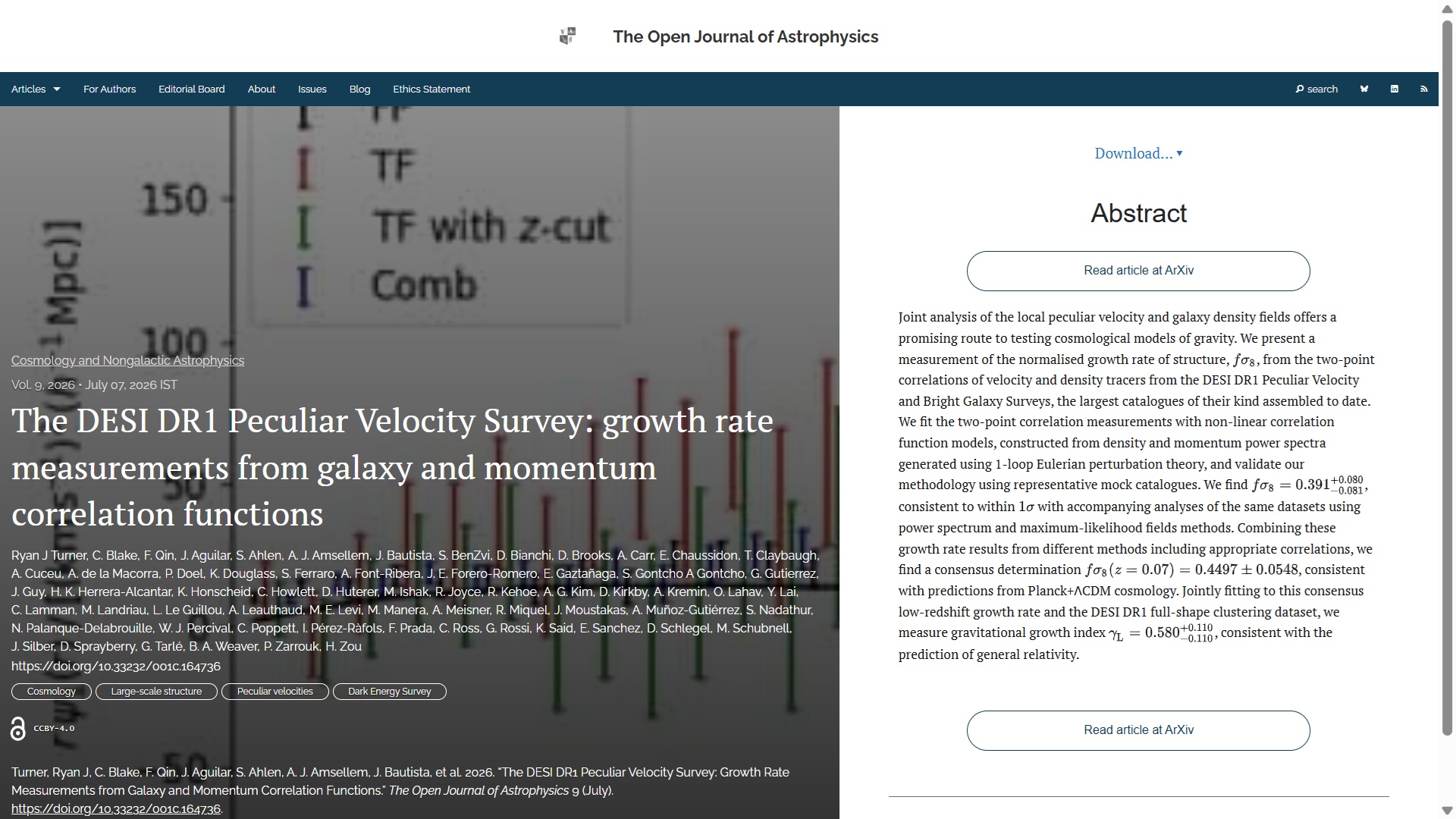
The third paper of the week, also published on Tuesday 7th July, but in the folder Cosmology and Nongalactic Astrophysics is “The DESI DR1 Peculiar Velocity Survey: growth rate measurements from galaxy and momentum correlation functions” by Ryan J Turner (Swinburne Institute of Technology, Australia) and 63 others from around the world. This paper analyzes local peculiar velocity and galaxy density fields to test cosmological models of gravity, finding results consistent with predictions from Planck+ΛCDM cosmology and general relativity.

The overlay for this one is here:

The final, accepted version can be found on arXiv here and the Mastodon announcement is here:

Open Journal of Astrophysics

New Publication at the Open Journal of Astrophysics: "The DESI DR1 Peculiar Velocity Survey: growth rate measurements from galaxy and momentum correlation functions" by Ryan J Turner (Swinburne Institute of Technology, Australia) and 63 others from around the world.

doi.org/10.33232/001c.164736

July 7, 2026, 7:51 am 0 boosts 0 favorites

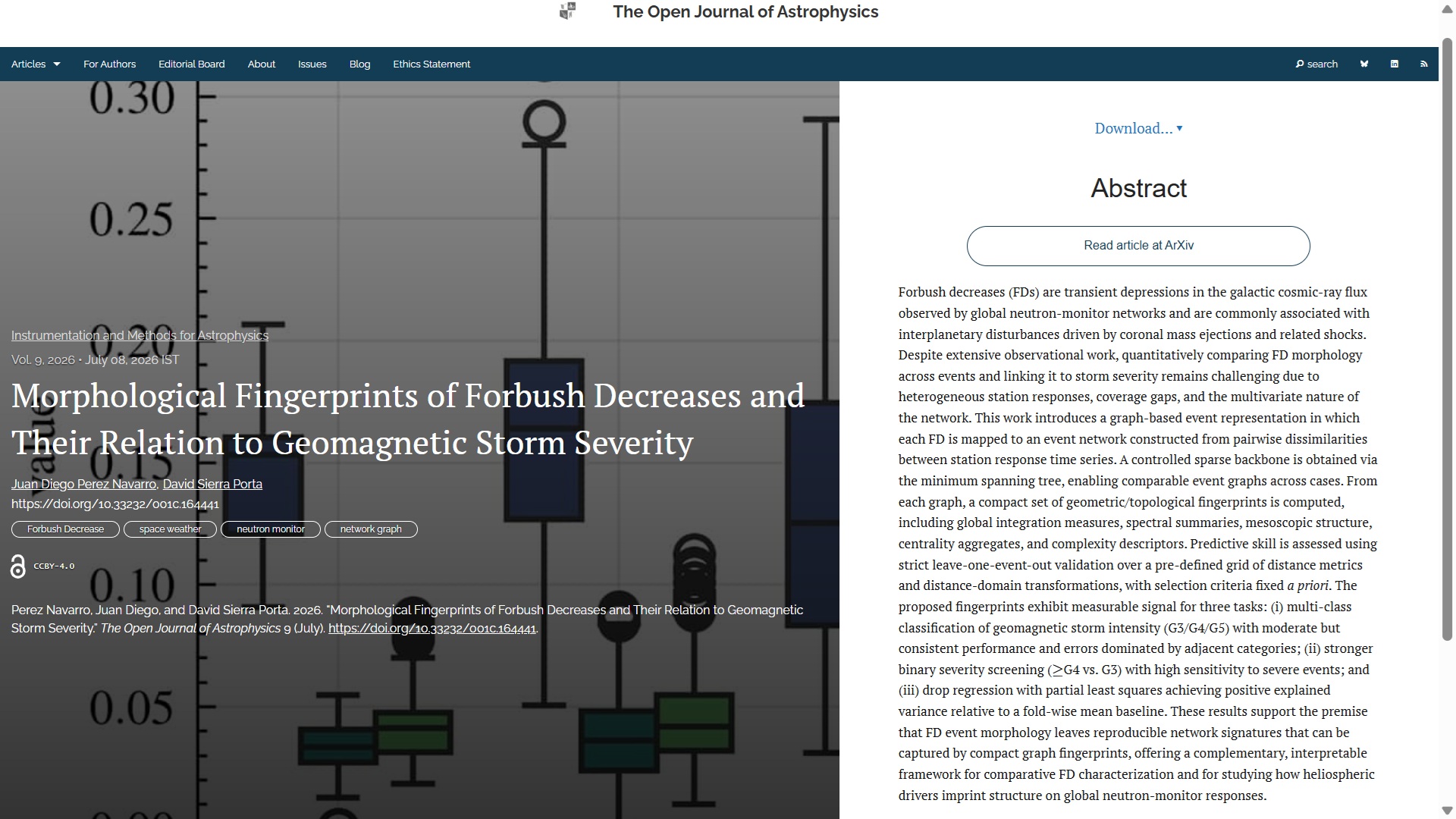
The fourth paper of the week, published on Wednesday 8th July in the folder Instrumentation and Methods for Astrophysics , is “Morphological Fingerprints of Forbush Decreases and Their Relation to Geomagnetic Storm Severity” by Juan Diego Perez Navarro and David Sierra Porta (Universidad Tecnológica de Bolívar, Colombia). This article introduces a graph-based method to analyze Forbush decreases (FDs), transient depressions in cosmic-ray flux, and uses network signatures to predict geomagnetic storm intensity.

The overlay for this one is here:

You can read the final version of this one on arXiv here and the Mastodon announcement is here:

Open Journal of Astrophysics

New Publication at the Open Journal of Astrophysics: "On the effective spin-mass ratio relation of binary black hole mergers that evolved in isolation" by Sambaran Banerjee (Helmholtz-Instituts für Strahlen und Kernphysik, Germany) and Aleksandra Olejak (MPA Garching, Germany)

doi.org/10.33232/001c.164325

June 30, 2026, 7:16 am 1 boosts 1 favorites

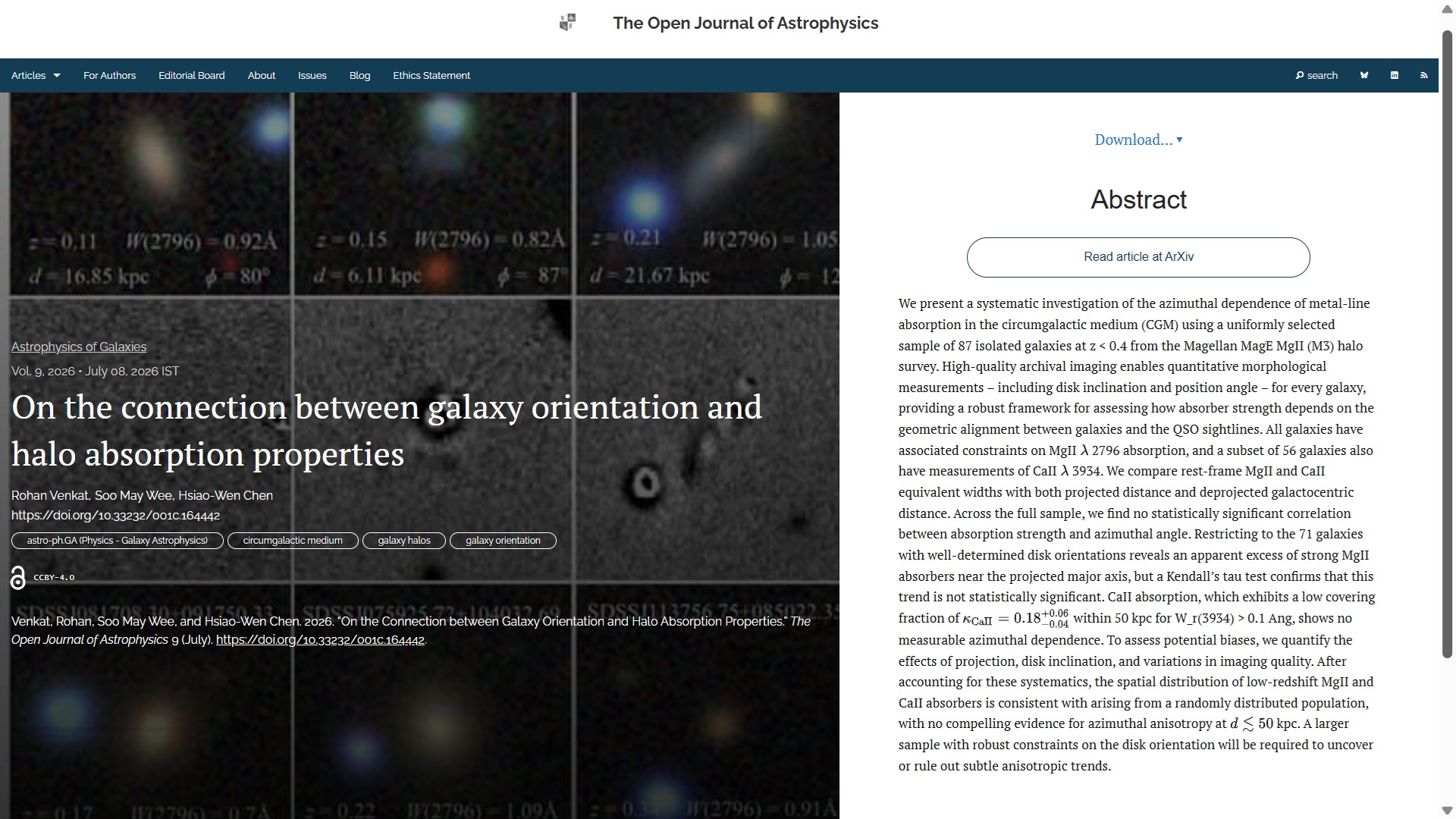
The fifth paper of the week, also published on Wednesday 8th July but in the folder Astrophysics of Galaxies, is “On the connection between galaxy orientation and halo absorption properties” by Rohan Venkat, Soo May Wee, and Hsiao-Wen Chen (U. Chicago, USA). This article investigates the azimuthal dependence of metal-line absorption in the circumgalactic medium of 87 isolated galaxies. The results show no significant correlation between absorption strength and azimuthal angle.

The overlay for this one is here:

You can read the final version of this one on arXiv here and the Mastodon announcement is here:

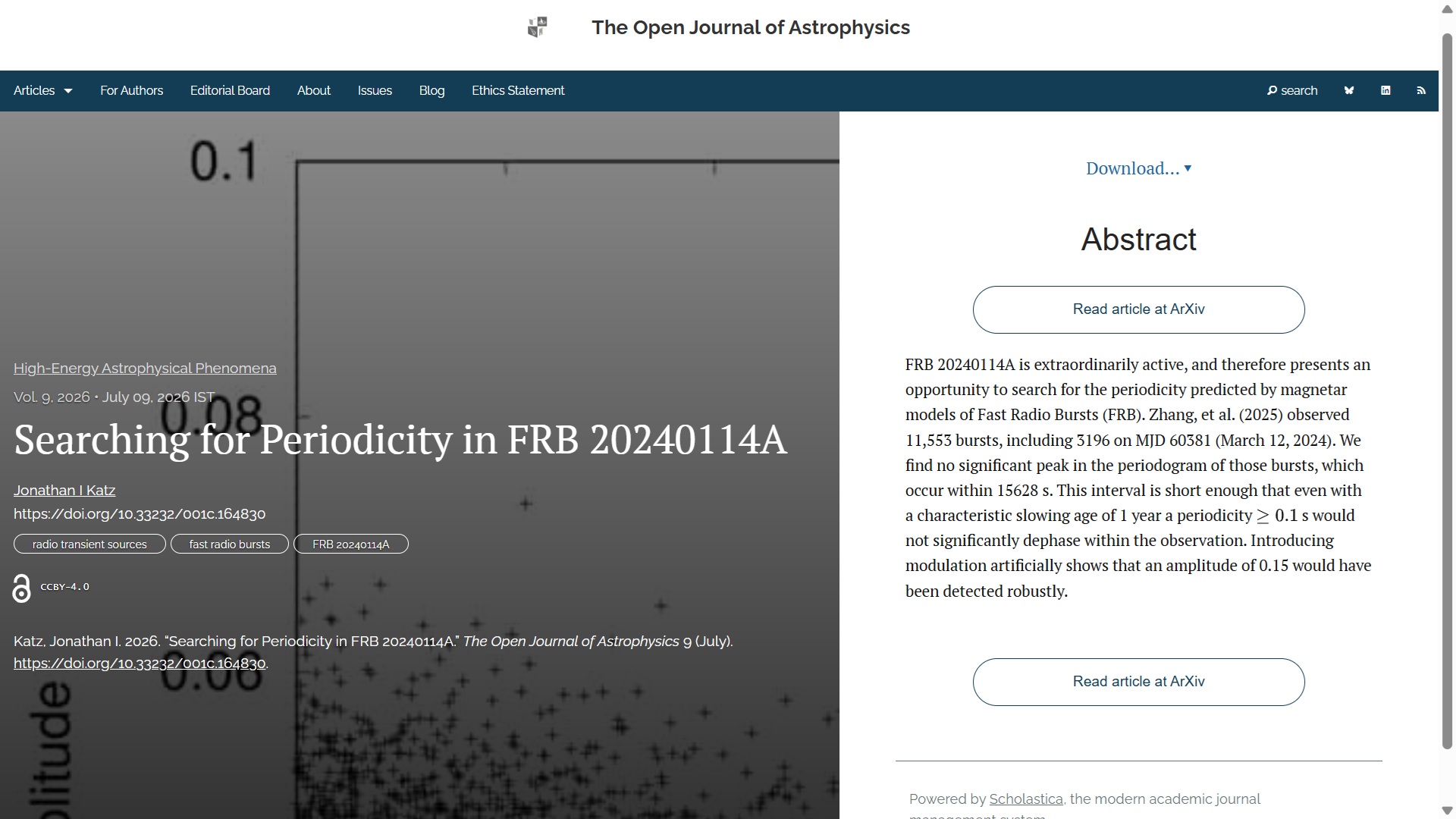
The sixth paper of this week is “Searching for Periodicity in FRB 20240114A” by Jonathan I Katz (Washington U., USA). This was published on Thursday 9th July in the folder High-Energy Astrophysical Phenomena. The study described in this paper observed FRB 20240114A, an active Fast Radio Burst, but found no significant periodicity in its bursts, contradicting magnetar models predictions.

The overlay for this one is here:

You can find the final accepted version on arXiv here and the Mastodon announcement is here:

Open Journal of Astrophysics

New Publication at the Open Journal of Astrophysics: "Searching for Periodicity in FRB 20240114A" by Jonathan I Katz (Washington U., USA)

doi.org/10.33232/001c.164830

July 9, 2026, 5:27 am 1 boosts 0 favorites

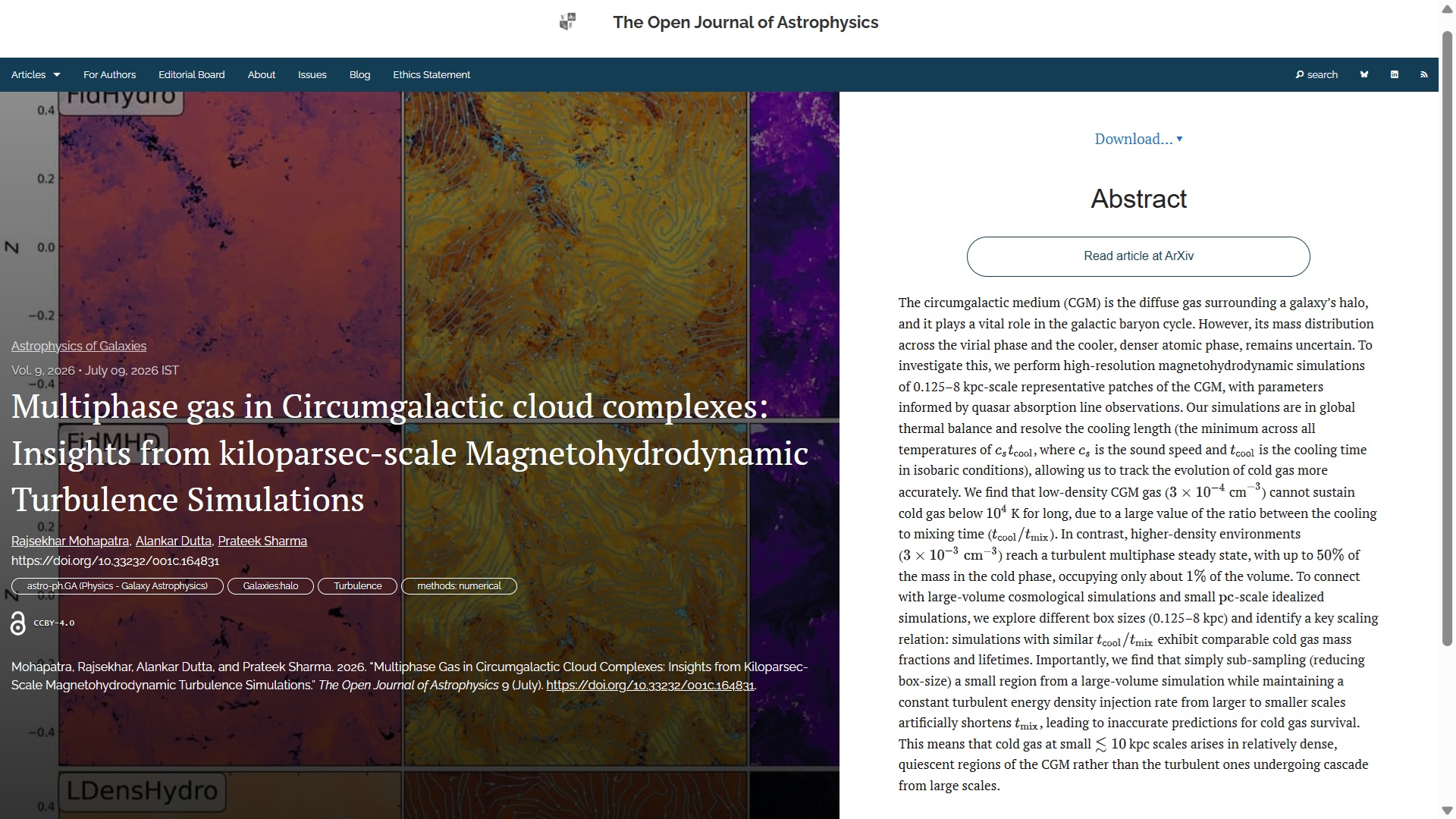
The seventh article for this week is “Multiphase gas in Circumgalactic cloud complexes: Insights from kiloparsec-scale Magnetohydrodynamic Turbulence Simulations” by Rajsekhar Mohapatra (Princeton U., USA), Alankar Dutta (MPA Garching, Germany) and Prateek Sharma (Indian Institute of Science, Bangalore). This -paper was also published on Thursday 9th July, in the folder Astrophysics of Galaxies. This paper uses high-resolution simulations to investigate the mass distribution of the circumgalactic medium (CGM), a diffuse gas surrounding a galaxy’s halo with small-scale clumps of cold gas forming in quiescent regions.

The overlay for this one is here:

You can find the final accepted version of this one on arXiv here and the Mastodon announcement is here:

Open Journal of Astrophysics

New Publication at the Open Journal of Astrophysics: "Multiphase gas in Circumgalactic cloud complexes: Insights from kiloparsec-scale Magnetohydrodynamic Turbulence Simulations" by Rajsekhar Mohapatra (Princeton U., USA), Alankar Dutta (MPA Garching, Germany) and Prateek Sharma (Indian Institute of Science, Bangalore)

doi.org/10.33232/001c.164831

July 9, 2026, 5:43 am 1 boosts 0 favorites

The (penultimate) eighth article for this week is “Line-of-sight shear in SLACS strong lenses I: shear and mass model parametrisations” by Natalie B. Hogg (U. Cambridge, UK), Daniel Johnson (U. Montpellier, France), Anowar J. Shajib (U. Chicago, USA) and Julien Larena (Montpellier). This was also published on Thursday 9th July, but in the folder Cosmology and Nongalactic Astrophysics. This article studies models of 23 strong gravitational lenses to measure line-of-sight shear for the first time, providing potential new constraints on cosmological parameters.

The overlay for this one is here:

You can find the final accepted version on arXiv here and the Mastodon announcement is here:

Open Journal of Astrophysics

New Publication at the Open Journal of Astrophysics: "Line-of-sight shear in SLACS strong lenses I: shear and mass model parametrisations" by Natalie B. Hogg (U. Cambridge, UK), Daniel Johnson (U. Montpellier, France), Anowar J. Shajib (U. Chicago, USA) and Julien Larena (Montpellier)

doi.org/10.33232/001c.164832

July 9, 2026, 6:33 am 1 boosts 1 favorites

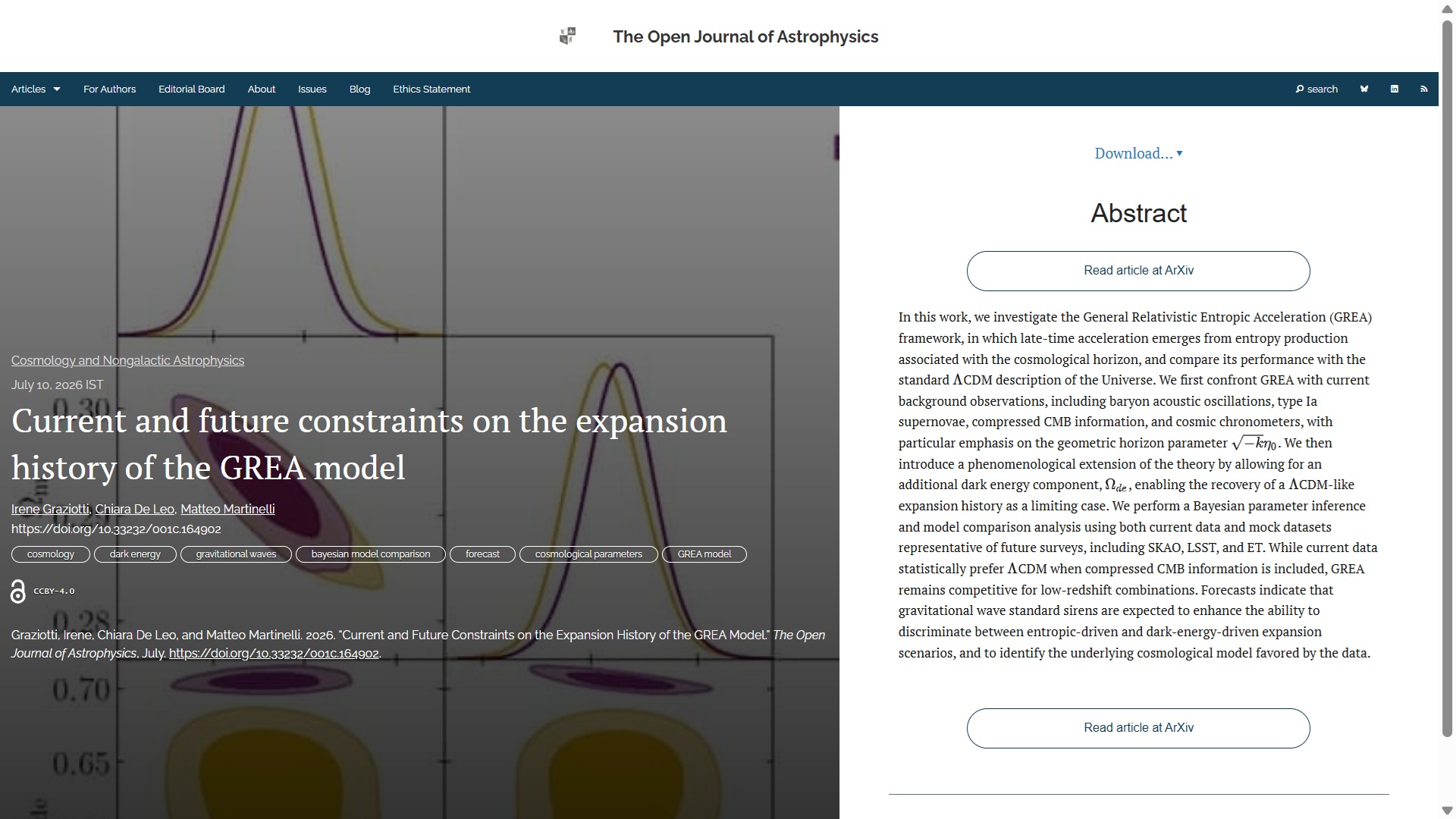
The ninth and last article for this week is “Current and future constraints on the expansion history of the GREA model” by Irene Graziotti (INAF-Osservatorio Astronomico di Capodimonte, Italy), Chiara De Leo (Sapienza University of Rome, Italy) and Matteo Martinelli (INAF-Osservatorio Astronomico di Roma, Italy). This study explores the General Relativistic Entropic Acceleration (GREA) framework, comparing it to the standard description of the universe. Current data favors the standard model, but GREA remains competitive.

The overlay for this one is here:

You can find the officially-accepted version on arXiv here and the Mastodon announcement here:

Open Journal of Astrophysics

New Publication at the Open Journal of Astrophysics: "Current and future constraints on the expansion history of the GREA model" by Irene Graziotti (INAF-Osservatorio Astronomico di Capodimonte, Italy), Chiara De Leo (Sapienza University of Rome, Italy) and Matteo Martinelli (INAF-Osservatorio Astronomico di Roma, Italy)

doi.org/10.33232/001c.164902

July 10, 2026, 5:41 am 1 boosts 0 favorites

As you can see, it has been a bumper week, especially when you consider that there was no arXiv mailing om Monday July 6th owing to the July 4th holiday in the USA. I should have known this would happen while I was travelling!

Not in Leiden…

Posted in Biographical, The Universe and Stuff with tags , , on March 24, 2025 by telescoper

It’s been a very busy day back to teaching after last week’s study break. This week there’s a big meeting in Leiden (Netherlands) which I would like to have attended as it combines the annual Euclid Consortium meeting with the 56th ESLAB Symposium. No doubt there’ll be a lot of discussion of the Euclid Q1 results announced last week. I can’t go, however, because of teaching commitments. The Euclid meetings are quite often scheduled in the summer, so I have a chance to attend, but not this time.

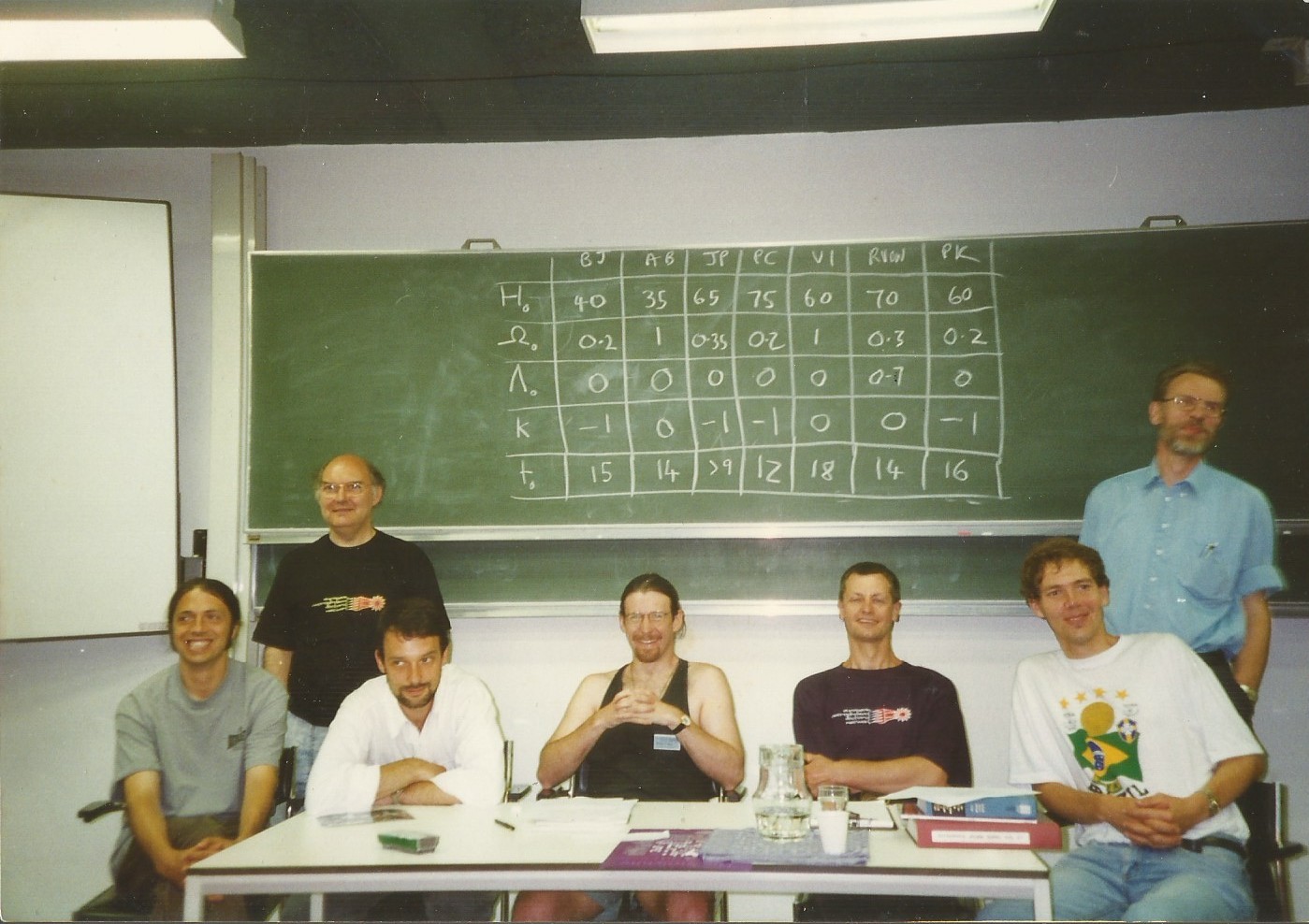
Anyway, I thought I would post a relevant memory from a previous trip to Leiden, about 30 years ago. which was taken at a conference in Leiden (Netherlands) in 1995. Was that really 30 years ago? Various shady characters masquerading as “experts” were asked by the audience of graduate students at a summer school to give their favoured values for the cosmological parameters (from top to bottom: the Hubble constant, density parameter, cosmological constant, curvature parameter and age of the Universe):

From left to right we have Alain Blanchard (AB), Bernard Jones (BJ, standing), John Peacock (JP), me (yes, with a beard and a pony tail – the shame of it), Vincent Icke (VI), Rien van de Weygaert (RW) and Peter Katgert (PK, standing). You can see on the blackboard that the only one to get anywhere close to correctly predicting the parameters of what would become the standard cosmological model was, in fact, Rien van de Weygaert…

The Cosmological Evidence – 25 Years Ago

Posted in Biographical, The Universe and Stuff with tags , , , on July 15, 2020 by telescoper

Today Facebook reminded me that the picture below is now 25 years old. I have posted it before and it has done the rounds at a number of cosmology conferences (usually to the accompaniment of lots of laughter), but I thought I’d circulate again as a bit of nostalgia and also to embarrass all concerned with this image. The picture was taken at a graduate school in cosmology in Leiden (in The Netherlands) in July 1995. In my memory that was a sweltering hot summer, which is my excuse for the informality of my attire.

Anyway, various shady characters masquerading as “experts” were asked by the audience of graduate students at a summer school to give their favoured values for the cosmological parameters. from from top to bottom these are:

  • the Hubble constant H0;
  • density parameter Ω0 (not split into dark matter and `ordinary’  matter as is now customary);
  • cosmological constant Λ0,
  • curvature parameter k
  • and age of the Universe t0.


From left to right we have Alain Blanchard (AB), Bernard Jones (BJ, standing), John Peacock (JP), me (yes, with a beard and a pony tail – the shame of it), Vincent Icke (VI), Rien van de Weygaert (RW) and Peter Katgert (PK, standing). You can see on the hi-tech digital display screen blackboard that the only one to get anywhere close to correctly predicting the parameters of what would become the standard cosmological model was, in fact, Rien van de Weygaert. Actually he was the only one of us to include a non-zero cosmological constant. My own favourite model at the time was a low-density model with negative spatial curvature.

Nobody is suggesting that panel discussions are the right way to settle scientific questions, of course, but it is interesting to see the diversity of opinions that were around in 1995.

P.S. Note that not all the combinations of parameters presented there are consistent with a Friedman model, but nobody said they had to be!


Evidence for a Spatially Flat Universe?

Posted in The Universe and Stuff with tags , , , , , , on February 19, 2020 by telescoper

Yesterday I saw a paper by George Efstathiou and Steve Gratton on the arXiv with the title The Evidence for a Spatially Flat Universe. The abstract reads:

We revisit the observational constraints on spatial curvature following recent claims that the Planck data favour a closed Universe. We use a new and statistically powerful Planck likelihood to show that the Planck temperature and polarization spectra are consistent with a spatially flat Universe, though because of a geometrical degeneracy cosmic microwave background spectra on their own do not lead to tight constraints on the curvature density parameter ΩK. When combined with other astrophysical data, particularly geometrical measurements of baryon acoustic oscillations, the Universe is constrained to be spatially flat to extremely high precision, with ΩK = 0.0004 ±0.0018 in agreement with the 2018 results of the Planck team. In the context of inflationary cosmology, the observations offer strong support for models of inflation with a large number of e-foldings and disfavour models of incomplete inflation.

You can download a PDF of the paper here. Here is the crucial figure:

This paper is in part a response to a paper I blogged about here and some other related work with the same general thrust. I thought I’d mention the paper here, however, because it contains some interesting comments about the appropriate choice of priors in the problem of inference in reference to cosmological parameters. I feel quite strongly that insufficient thought is given generally about how this should be done, often with nonsensical consequences. It’s quite frustrating to see researchers embracing the conceptual framework of Bayesian inference but then choosing an inappropriate prior. The prior is not an optional extra – it’s one of the key ingredients. This isn’t a problem limited to the inflationary scenarios discussed in the above paper, by the way, it arises in a much wider set of cosmological models. The real cosmological flatness problem is that too many cosmologists use  flat priors everywhere!


An Informational Approach to Cosmological Parameter Estimation

Posted in The Universe and Stuff with tags , , , , , , , on May 22, 2019 by telescoper

In order to avoid having to make a start on examination marking I was having a trawl through the arXiv this morning when I found an interesting paper by Stephens & Gleiser called An Informational Approach to Cosmological Parameter Estimation. The abstract is:

You can download a PDF of the full paper here.

I haven’t had time to go through the manuscript in detail but while it doesn’t seem to say very much of a specific nature about the Hubble constant tension issue, it does introduce an approach which is new to me. The Jensen-Shannon Divergence is a variation on the familiar Kullback-Leibler Divergence.

Anyway, I’d be interested in comments on this from experts!

Who’s worried about the Hubble Constant?

Posted in The Universe and Stuff with tags , , , , on January 11, 2018 by telescoper

One of the topics that is bubbling away on the back burner of cosmology is the possible tension between cosmological parameters, especially relating to the determination of the Hubble constant (H0) by Planck and by “traditional” methods based on the cosmological distance ladder; see here for an overview of the latter.

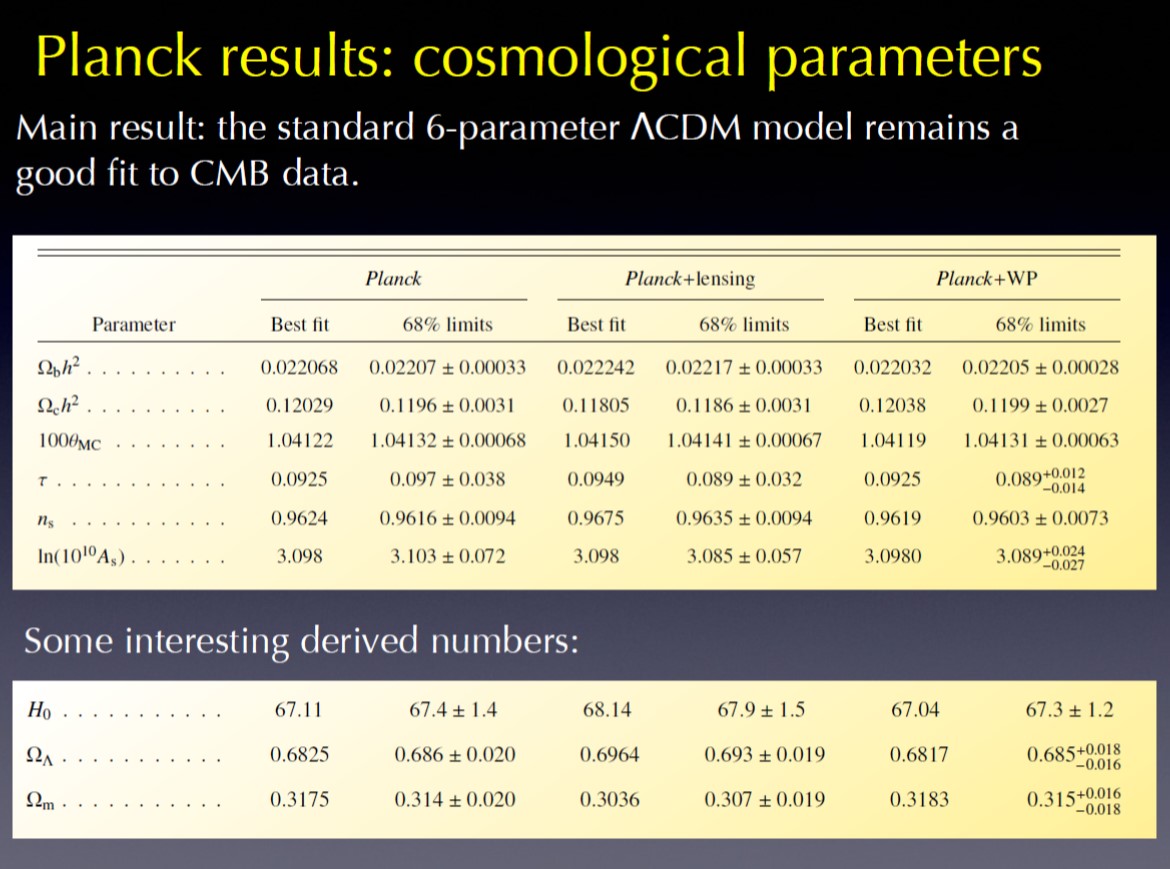
Before getting to the point I should explain that Planck does not determine H0 directly, as it is not one of the six numbers used to specify the minimal model used to fit the data. These parameters do include information about H0, however, so it is possible to extract a value from the data indirectly. In other words it is a derived parameter:

Planck_parameters

The above summary shows that values of the Hubble constant obtained in this way lie around the 67 to 68  km/s/Mpc mark, with small changes if other measures are included. According to the very latest Planck paper on cosmological parameter estimates the headline determination is H0 = (67.8 +/- 0.9) km/s/Mpc.

About 18 months I blogged about a “direct” determination of the Hubble constant by Riess et al.  using Hubble Space Telescope data quotes a headline value of (73.24+/-1.74) km/sec/Mpc, hinting at a discrepancy somewhere around the 3 sigma level depending on precisely which determination you use. A news item on the BBC hot off the press reports that a more recent analysis by the same group is stubbornly sitting around the same value of the Hubble constant, with a slight smaller error so that the discrepancy is now about 3.4σ. On the other hand, the history of this type of study provides grounds for caution because the systematic errors have often turned out to be much larger and more uncertain than the statistical errors…

Nevertheless, I think it’s fair to say that there isn’t a consensus as to how seriously to take this apparent “tension”. I certainly can’t see anything wrong with the Riess et al. result, and the lead author is a Nobel prize-winner, but I’m also impressed by the stunning success of the minimal LCDM model at accounting for such a huge data set with a small set of free parameters.

If one does take this tension seriously it can be resolved by adding an extra parameter to the model or by allowing one of the fixed properties of the LCDM model to vary to fit the data. Bayesian model selection analysis however tends to reject such models on the grounds of Ockham’s Razor. In other words the price you pay for introducing an extra free parameter exceeds the benefit in improved goodness of fit. GAIA may shortly reveal whether or not there are problems with the local stellar distance scale, which may reveal the source of any discrepancy. For the time being, however, I think it’s interesting but nothing to get too excited about. I’m not saying that I hope this tension will just go away. I think it will be very interesting if it turns out to be real. I just think the evidence at the moment isn’t convincing me that there’s something beyond the standard cosmological model. I may well turn out to be wrong.

Anyway, since polls seem to be quite popular these days, so let me resurrect this old one and see if opinions have changed!


Should we worry about the Hubble Constant?

Posted in The Universe and Stuff with tags , , , , on July 27, 2016 by telescoper

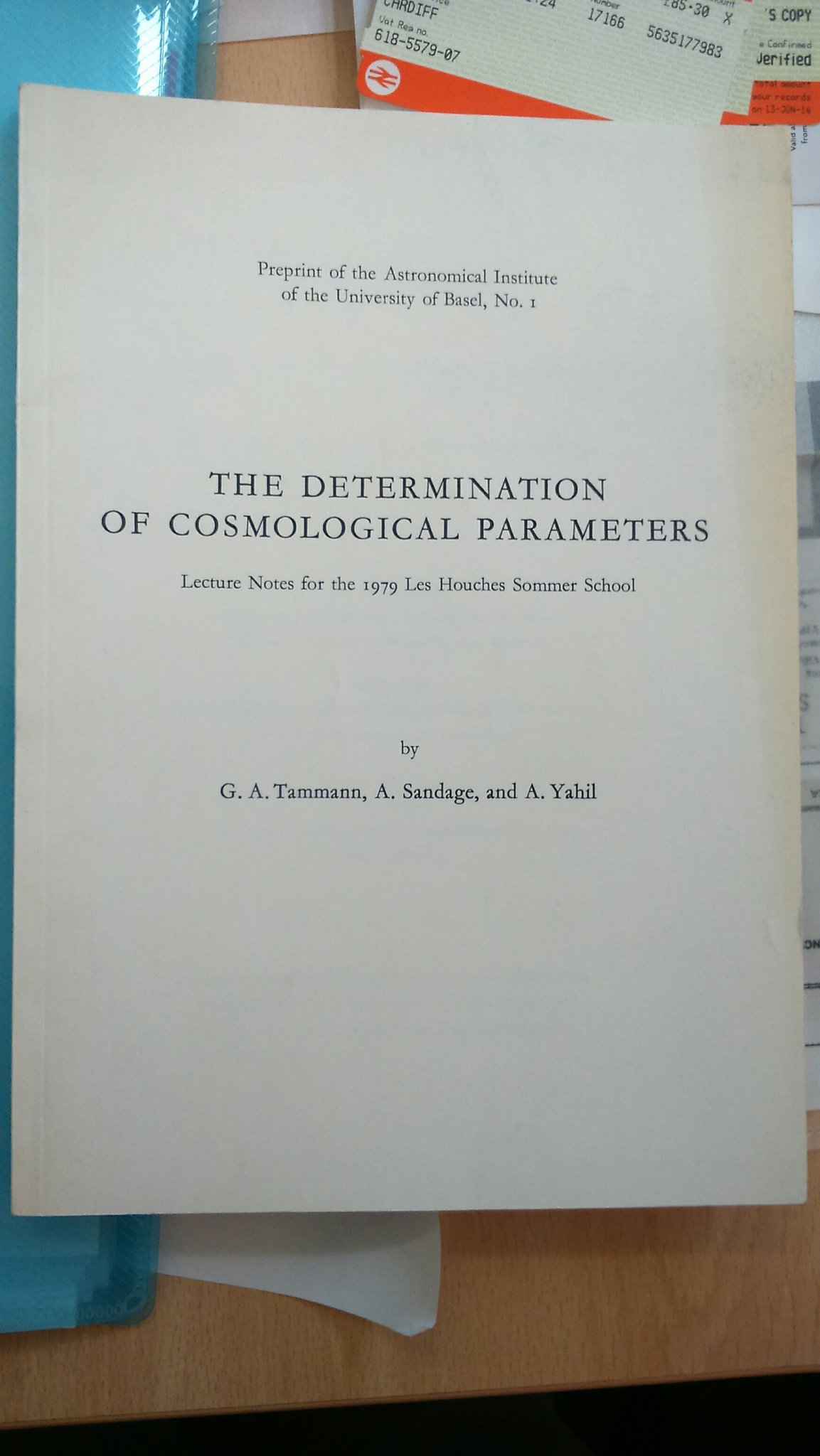
One of the topics that came up in the discussion sessions at the meeting I was at over the weekend was the possible tension between cosmological parameters, especially relating to the determination of the Hubble constant (H0) by Planck and by “traditional” methods based on the cosmological distance ladder; see here for an overview of the latter. Coincidentally, I found this old preprint while tidying up my office yesterday:

Cosmo_params

Things have changed quite a bit since 1979! Before getting to the point I should explain that Planck does not determine H0 directly, as it is not one of the six numbers used to specify the minimal model used to fit the data. These parameters do include information about H0, however, so it is possible to extract a value from the data indirectly. In other words it is a derived parameter:

Planck_parameters

The above summary shows that values of the Hubble constant obtained in this way lie around the 67 to 68  km/s/Mpc mark, with small changes if other measures are included. According to the very latest Planck paper on cosmological parameter estimates the headline determination is H0 = (67.8 +/- 0.9) km/s/Mpc.

Note however that a recent “direct” determination of the Hubble constant by Riess et al.  using Hubble Space Telescope data quotes a headline value of (73.24+/-1.74) km/sec/Mpc. Had these two values been obtained in 1979 we wouldn’t have worried because the errors would have been much larger, but nowadays the measurements are much more precise and there does seem to be a hint of a discrepancy somewhere around the 3 sigma level depending on precisely which determination you use. On the other hand the history of Hubble constant determinations is one of results being quoted with very small “internal” errors that turned out to be much smaller than systematic uncertainties.

I think it’s fair to say that there isn’t a consensus as to how seriously to take this apparent “tension”. I certainly can’t see anything wrong with the Riess et al. result, and the lead author is a Nobel prize-winner, but I’m also impressed by the stunning success of the minimal LCDM model at accounting for such a huge data set with a small set of free parameters. If one does take this tension seriously it can be resolved by adding an extra parameter to the model or by allowing one of the fixed properties of the LCDM model to vary to fit the data. Bayesian model selection analysis however tends to reject such models on the grounds of Ockham’s Razor. In other words the price you pay for introducing an extra free parameter exceeds the benefit in improved goodness of fit. GAIA may shortly reveal whether or not there are problems with the local stellar distance scale, which may reveal the source of any discrepancy. For the time being, however, I think it’s interesting but nothing to get too excited about. I’m not saying that I hope this tension will just go away. I think it will be very interesting if it turns out to be real. I just think the evidence at the moment isn’t convincing me that there’s something beyond the standard cosmological model. I may well turn out to be wrong.

It’s quite interesting to think  how much we scientists tend to carry on despite the signs that things might be wrong. Take, for example, Newton’s Gravitational Constant, G. Measurements of this parameter are extremely difficult to do, but different experiments do seem to be in disagreement with each other. If Newtonian gravity turned out to be wrong that would indeed be extremely exciting, but I think it’s a wiser bet that there are uncontrolled experimental systematics. On the other hand there is a danger that we might ignore evidence that there’s something fundamentally wrong with our theory. It’s sometimes a difficult judgment how seriously to take experimental results.

Anyway, I don’t know what cosmologists think in general about this so there’s an excuse for a poll:


Cosmology – Confusion on a Higher Level?

Posted in Biographical, The Universe and Stuff with tags , , , , , on January 19, 2015 by telescoper

I’ve already posted the picture below, which was taken at a conference in Leiden (Netherlands) in 1995. Various shady characters masquerading as “experts” were asked by the audience of graduate students at a summer school to give their favoured values for the cosmological parameters (from top to bottom: the Hubble constant, density parameter, cosmological constant, curvature parameter and age of the Universe).

From left to right we have Alain Blanchard (AB), Bernard Jones (BJ, standing), John Peacock (JP), me (yes, with a beard and a pony tail – the shame of it), Vincent Icke (VI), Rien van de Weygaert (RW) and Peter Katgert (PK, standing). You can see on the blackboard that the only one to get anywhere close to correctly predicting the parameters of what would become the standard cosmological model was, in fact, Rien van de Weygaert.

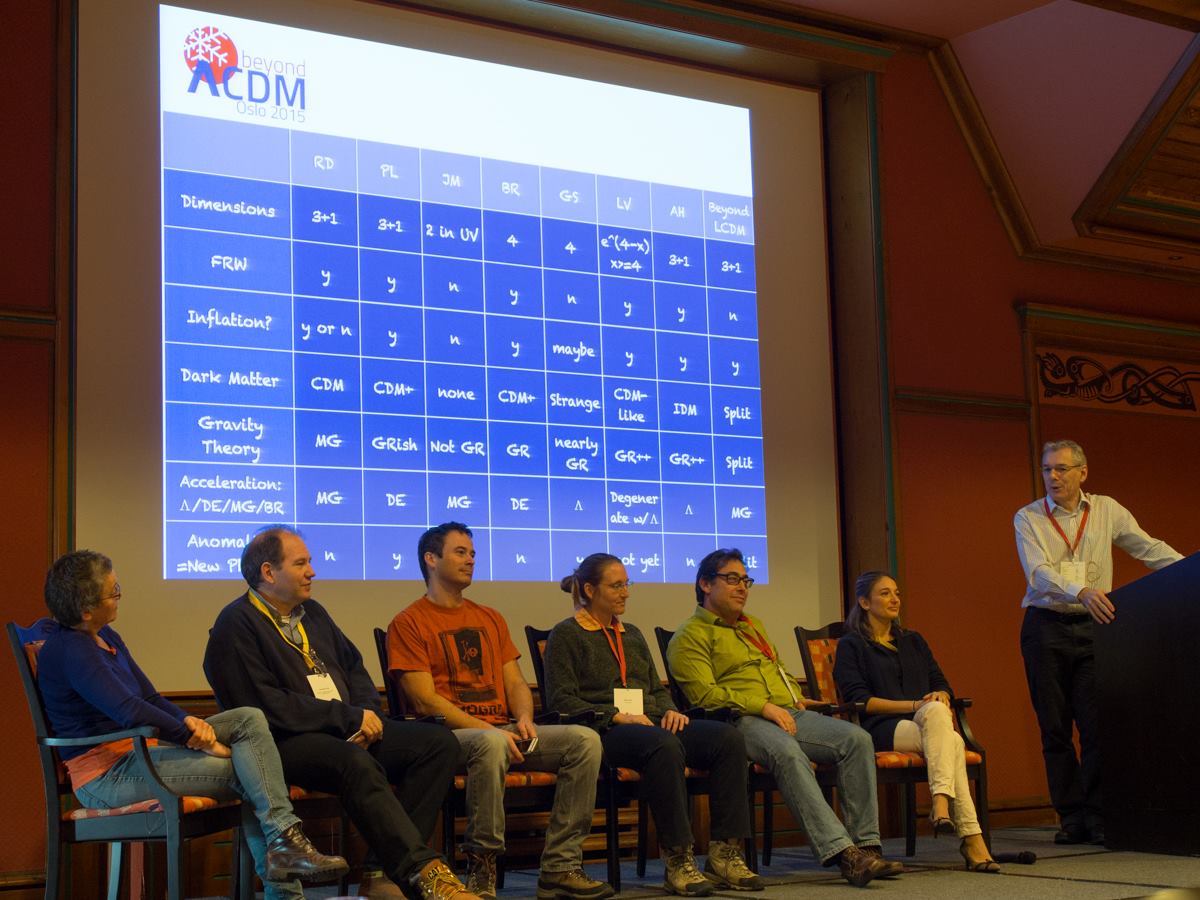
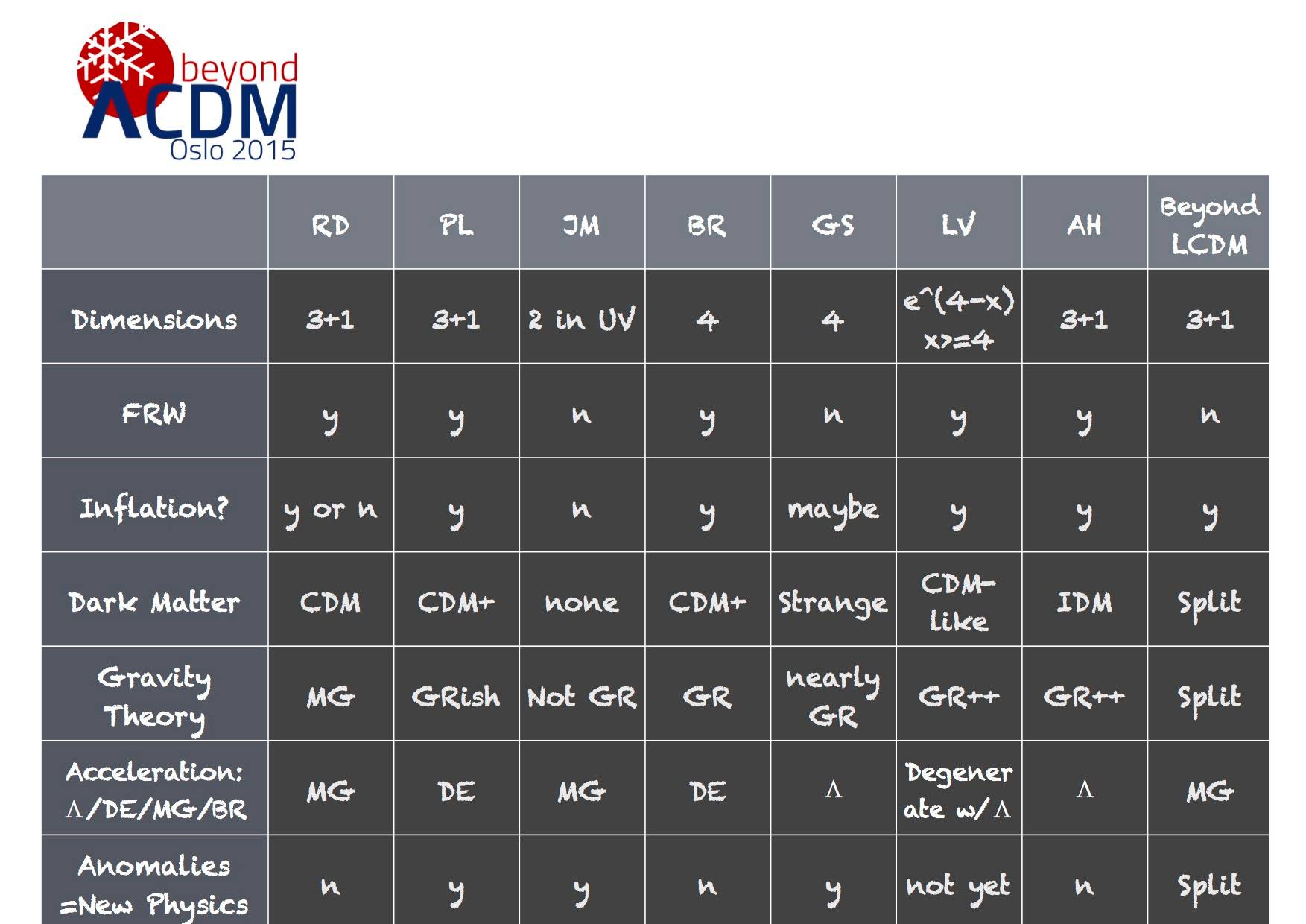
Well, my excuse for posting this again is the fact that a similar discussion was held at a meeting in Oslo (Norway) at which a panel of experts and Alan Heavens did a similar thing. I wasn’t there myself but grabbed the evidence from facebook:

experts

I’ll leave it as an exercise for the reader to identify the contributors. The 2015 version of the results is considerably more high-tech than the 1995 one, but in case you can’t read what is on the screen here are the responses:

panel_vote

The emphasis here is on possible departures from the standard model, whereas in 1995 the standard model hadn’t yet been established. I’m not sure exactly what questions were asked but I think my answers would have been: 3+1;  maybe; maybe; don’t know but (probably) not CDM; something indistinguishable from GR given current experiments; Lambda; and maybe. I’ve clearly become a skeptic in my old age.

Anyway, this “progress” reminded me of a quote I used to have on my office door when I was a graduate student in the Astronomy Centre at the University of Sussex many years ago:

We have not succeeded in answering all our problems. The answers we have found only serve to raise a whole set of new questions. In some ways we feel we are as confused as ever, but we believe we are confused on a higher level and about more important things.

The attribution of that quote is far from certain, but I was told that it was posted outside the mathematics reading room, Tromsø University. Which is in Norway. Apt, or what?

The Evidence

Posted in Biographical, The Universe and Stuff with tags , , , on September 25, 2009 by telescoper

Further to my recent post about the evidence for a low-density Universe, I thought I’d embarrass all concerned with this image, taken in Leiden in 1995.

Various shady characters masquerading as “experts” were asked by the audience of graduate students at a summer school to give their favoured values for the cosmological parameters (from top to bottom: the Hubble constant, density parameter, cosmological constant, curvature parameter and age of the Universe).

From left to right we have Alain Blanchard (AB), Bernard Jones (BJ, standing), John Peacock (JP), me (yes, with a beard and a pony tail – the shame of it), Vincent Icke (VI), Rien van de Weygaert (RW) and Peter Katgert (PK, standing). You can see on the blackboard that the only one to get anywhere close to correctly predicting the parameters of what would become the standard cosmological model was, in fact, Rien van de Weygaert.